Yun Gil Lee (2025). Developing Optimal Affordance Detection Technology Using Genetic Algorithm based on Posture Primitives on Atypical Surfaces. In: Human Interaction and Emerging Technologies (IHIET-FS 2025): Future Systems and Artificial Intelligence Applications. AHFE Open Access, vol. 196, pp. 230–237. https://doi.org/10.54941/ahfe1005971
This study presents an optimization method for human behavior simulation in atypical architectural spaces using genetic algorithms based on posture primitives. Traditional simulation tools often fail to capture diverse movement possibilities in non-standard environments, limiting their application in architectural design. To address this, we introduce a novel affordance detection technology that extracts potential human actions directly from architectural geometry rather than relying on predefined scenarios. Our approach employs genetic algorithms to refine optimal action placements on complex surfaces iteratively. A set of posture primitives is modeled based on anthropometric data, and their spatial suitability is evaluated through computational iterations. By integrating Rhino, Grasshopper, and ActoViz, our system enables designers to visualize and analyze possible human interactions within atypical architectural forms. The physics engine incorporated in the system introduces behavioral noise, allowing for a wider range of movement possibilities.The key contribution of this study is the automatic generation of spatial affordances for human behavior simulation. Unlike conventional methods, our approach does not require predefined action sets but instead derives possible movements dynamically based on spatial conditions. By systematically analyzing posture primitives and their adaptability to different surfaces, this research provides a data-driven foundation for predicting human behavior in complex architectural environments.Furthermore, the proposed method enhances the architectural design process by offering real-time feedback on spatial affordances, allowing architects to optimize layouts based on anticipated user interactions. The ability to generate realistic behavior simulations supports a more intuitive and human-centered design approach, making this research highly applicable to various architectural and urban planning contexts.By integrating computational affordance detection into architectural design, this study contributes to the advancement of human behavior simulation, enabling architects and designers to predict and refine spatial experiences with greater accuracy and efficiency.
Developing Optimal Affordance Detection Technology Using Genetic Algorithm 231
INTRODUCTION
With the increasing demand for new architectural spaces and advancements in computer technology, atypical architectural spaces have emerged. These forms of atypical architecture have now expanded into common architectural typologies in major cities worldwide. Human behavior within buildings serves as a critical criterion for assessing architectural quality. However, due to the organic and morphologically unique characteristics of atypical architectural spaces, architects face challenges in predicting or evaluating user behavior within these unfamiliar spaces. Recognizing the need for human behavior simulations in such environments, several studies have been conducted. However, these studies often remain limited to positioning human-shaped agents without sufficiently considering the diverse possibilities of atypical architectural spaces.
Current human behavior simulations have several key limitations. First, existing simulation tools, developed without sufficient investigation and analysis of human behavior in atypical architectural spaces, fail to accurately reproduce the locations, ranges, and directions in which human behaviors manifest in such environments. Second, human behavior simulations that rely on predefined scenarios and actions (such as evacuation simulation) provide little creative inspiration for architects. Third, there has been no significant research comparing and analyzing the accuracy and usefulness of these simulation technologies against real-world scenarios.
This study aims to develop technologies that enable more precise and practical human behavior simulations within the design process of atypical architectural spaces. The primary focus of the research is to enhance the autonomous behavior of human-shaped agents by automatically extracting affordances—potential action opportunities—from the physical information of atypical architectural spaces. The proposed geometry affordance detection technology serves as a foundation for enhancing agent intelligence by tracking information related to user interactions with physical elements both inside and outside architectural spaces.
This research employs genetic algorithms to determine appropriate locations and types of behaviors within atypical architectural surfaces. A genetic algorithm is an optimization technique inspired by natural selection and evolution, operating by iteratively refining solutions based on fitness evaluation. By leveraging genetic algorithms, this study identifies optimal positions, orientations, and action types for human behavior reproduction. To achieve this, various initial behaviors are modeled for atypical architectural spaces, and representative behaviors are extracted. A behavioral structure model is then developed to reconstruct agent actions, and relative coordinates of extracted behaviors are determined. These coordinates undergo iterative computation using genetic algorithms to optimize their placement within atypical architectural surfaces. The proposed technology is implemented using Rhino and Grasshopper, which are widely used in non-standard architectural design, while Unity3D is utilized as the simulation environment. As an initial stage of research, this study primarily focuses on applying and progressively optimizing various behaviors.
232 Lee
Figure 1: Examples of atypical architectural space (DDP, Galaxy SOHO, National Museum of Qatar).
Figure available in the original PDF paper.
ATYPICAL ARCHITECTURAL DESIGN AND HUMAN BEHAVIOR SIMULATION The representation of human form and actions serves as a crucial tool that enables architects to consider the relationship between occupants and space, thereby influencing alternative design decisions (Imrie, 2003; Scott, 1914). The reproduction of human behavior in the architectural design process has a positive effect in terms of creative problem-solving. Therefore, it is assumed that human behavior representation will also positively contribute to improving the qualitative level of design proposals in atypical architectural design processes. Moreover, dynamic simulation of human behavior, rather than a simple reproduction of forms, is expected to have a wider range of influences and effects on the design process. Gibson (1977) explained the social characteristics embedded in physical space through the concept of “affordance,” which suggests that specific objects or physical spaces contain information that prompts certain user actions. This can be summarized as “action possibilities,” which help explain the social phenomena embedded in architectural spaces. Hillier and Hanson (1984) argued that users need to perceive certain spatial characteristics in order to navigate spaces naturally, and these characteristics play a crucial role in generating social phenomena related to spatial movement. Consequently, the morphological information of physical space can trigger human behavior and social phenomena, and it is assumed that the morphological uniqueness of atypical architectural spaces may generate social phenomena distinct from those found in typical architectural spaces. The perception of a building’s physical information has the potential to induce responsive behavior. Given the morphological uniqueness of atypical architectural spaces, it is more appropriate to interpret their perception through the lens of direct perception, which involves responsive behavior based on the visually continuous information of an object. Therefore, the segmentation and organization of physical information within atypical spaces can lead to diverse responsive behaviors. It is assumed that the structured and segmented information will refine human behavior simulations, allowing architects to anticipate and account for unexpected behavioral manifestations.
OPTIMAL AFFORDANCE DETECTION TECHNOLOGY USING GENETIC ALGORITHMS BASED ON POSTURE PRIMITIVES FOR HUMAN BEHAVIOR SIMULATION This study aims to derive optimal human behavior in atypical architectural forms by utilizing genetic algorithms based on posture primitives. A genetic
Developing Optimal Affordance Detection Technology Using Genetic Algorithm 233
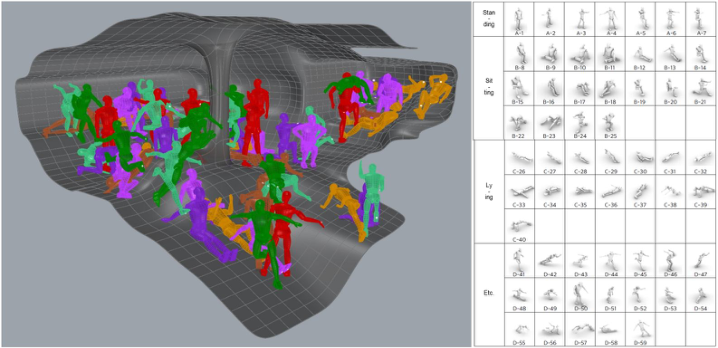
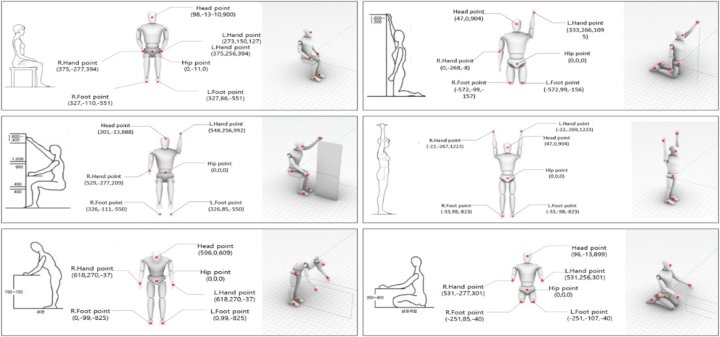
algorithm can be described as a method that generates increasingly suitable results through iterative calculations. In this research, a predefined set of behavioral patterns was iteratively applied to a specific point within the architectural space to determine the most appropriate action at that location. To achieve this, the study first identified various posture primitives that are likely to occur in atypical architectural spaces. Figure 2 presents the modeled posture primitives that can be anticipated in such environments. The modeling process was based on anthropometric data, using the standard body dimensions of an adult male. These posture primitives were designed to correspond appropriately to the physical characteristics of atypical architectural spaces. In Figure 3, for each modeled posture primitive, six coordinate points—left hand, right hand, left foot, right foot, head, and body center—were extracted. Each coordinate was calculated as a relative position with respect to the body center.
Figure 2: Modeled posture primitives expected to be reproducible in atypical architectural spaces.Figure 3: Extraction of relative coordinates for each point of posture primitives.
234 Lee
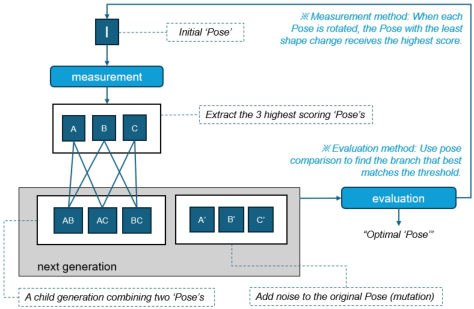
A technique was developed to explore optimal movements on atypical architectural surfaces using genetic algorithm methods. A physics engine was utilized to generate behavioral noise, ensuring a diverse range of possible actions. By employing genetic algorithms, iterative calculations were performed to derive relatively appropriate dominant behaviors. Figure 4 illustrates the genetic algorithm used in this study. Based on each cell of the atypical architectural surface, the previously identified posture primitives were placed, with the body center as the reference point. The posture primitives were incrementally rotated counterclockwise by 10 degrees during placement. After each placement operation, the coordinates of the hands, feet, head, and body center were extracted. The distances between these coordinates and the corresponding points on the atypical architectural surface were calculated to assess the appropriateness of each posture primitive. The movement with the minimal distance difference from the target points was designated as the optimal action and visualized accordingly. Figure 5 is a diagram of the genetic algorithm used in this study. Three high- scoring motions are extracted from the initial pose, and a more appropriate pose is derived by combining and modifying them. This process proceeds recursively.
Figure 4: A conceptual diagram showing how the genetic algorithm in Figure 3 is applied.Figure 5: Conceptual diagram of the genetic algorithm used in this study.
Developing Optimal Affordance Detection Technology Using Genetic Algorithm 235
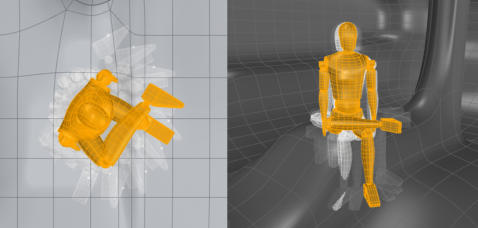
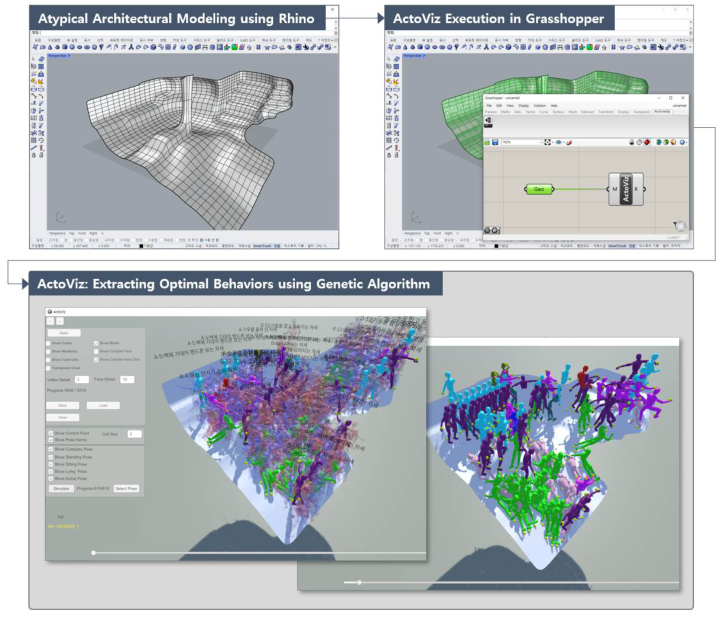
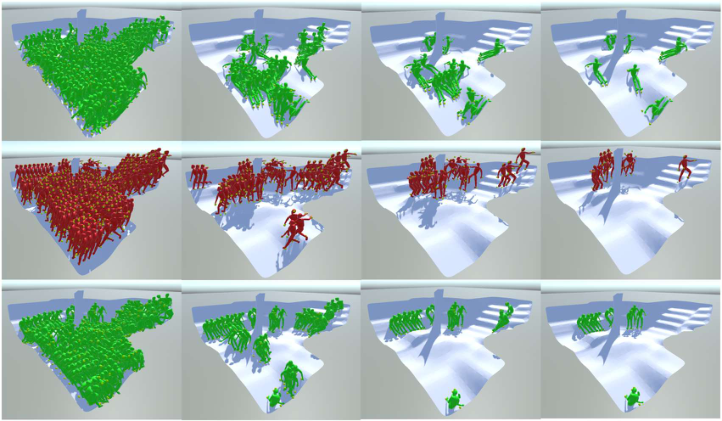
A platform, ActoViz, was developed to execute the proposed genetic algorithm. ActoViz was built using Rhino and Grasshopper, which are tools for designing atypical architectural forms. This platform enables designers to analyze and verify possible human behaviors occurring on modeled atypical architectural surfaces during the design process. Figure 6 illustrates the modeling and simulation process using Rhino, Grasshopper, and ActoViz. Figure 7 visualizes the actions that can be arranged based on the allowable distance for each movement. That is, as movements are placed further to the right, they can be considered more suitable. The locations where characters are positioned indicate the most appropriate spots for reproducing the corresponding actions. This process also identifies the set of feasible behaviors that can manifest at specific locations. By repeatedly applying this method, the affordance of various posture primitives can be extracted. This affordance information serves as fundamental data for autonomous agent behaviors, enabling more natural movement reproduction within atypical architectural spaces.
Figure 6: The execution process of ActoViz and the appearance of the optimal behavior generated through the genetic algorithm.
236 Lee
Figure 7: Differences in deriving optimal actions according to tolerance settings (the further to the right, the closer the tolerance).
CONCLUSION
This study developed an optimization technique for detecting human behavior affordances in atypical architectural spaces using genetic algorithms based on posture primitives. By integrating Rhino, Grasshopper, and ActoViz, the proposed method enables architects to predict and analyze human interactions with complex architectural surfaces more effectively. The key advantage of this research is its ability to extract action possibilities (affordances) directly from architectural geometry rather than relying on predefined behavioral scenarios. However, the study is limited by its focus on static posture primitives, the assumption of a standard adult male body, and the need for further real-world validation. Future research should incorporate dynamic movement patterns, broader user demographics, and empirical validation to enhance the accuracy and applicability of the model. Addressing these aspects will improve human behavior simulations in architectural design, leading to more intuitive and responsive built environments.
ACKNOWLEDGEMENT
This work was supported by the National Research Foundation of Korea (NRF) grant funded by the Korean government (MSIT) (RS-2023- 00207964).
REFERENCES
Gibson, J. J., The theory of affordances, In: Shaw, R. and Bransford, J. (Eds.), Perceiving, Acting, and Knowing: Toward an Ecological Psychology, Lawrence Erlbaum Associates, Hillsdale, NJ, 1977.
Developing Optimal Affordance Detection Technology Using Genetic Algorithm 237
Heft, H., Ecological psychology in context: James Gibson, Roger Barker, and the legacy of William James’s radical empiricism, Psychology Press, pp. 109–142, (2005). Available from: https://www.routledge.com/Ecological- Psychology-in-Context-James-Gibson-Roger-Barker-and-the-Legacy/Heft/p/ book/9780805856927. Hiller, B. and Hanson, J., Social Logic of Space, Cambridge University Press, Cambridge, 1984. http://www.ddp.or.kr, Nov 04 (2024) https://www.zaha-hadid.com/architecture/galaxy-soho, Nov 04 (2024) https://nmoq.org.qa/en, Nov 04 (2024) Imrie, R., Architects’ conceptions of the human body, Environment and Planning D:
Society and Space 21, pp. 47–65, 2003. Scott, G., The architecture of humanism: a study in the history of taste, Architectural Press, 1914.
LISTED IN THE AHFE DIGITAL BOOKSTORE CATALOGUE
Explore the complete digital volume
Human Interaction and Emerging Technologies (IHIET-FS 2025): Future Systems and Artificial Intelligence Applications
Read this individual research paper free through the original publisher, or explore the full digital proceedings book.
ISBN 978-1-964867-72-4
Explore this ISBN in the AHFE Bookstore ↗Listed in the July 2026 bookstore catalogue; search by ISBN to confirm current availability · Digital book purchase optional