Yotam Sahar, Michael Wagner, Shraga Shoval (2024). A Novel Adaptive Physio-Behavioral Method for Optimizing Performance: Using Grip Force for Augmenting Driver Training. In: Advances in Human Factors of Transportation. AHFE Open Access, vol. 148, pp. 452–459. https://doi.org/10.54941/ahfe1005236
The quest to remove the human factor from the equation of system performance led to the ironies of automation. Adaptive automation is an alternative approach, which aims to harmoniously integrate the person and the system, to fully utilize the maximum potential of each of the parties. Adaptive systems to the user's state offer significant advantages, such as reducing workload and improving performance. In the application of adaptive automation capabilities in driving, the existing methods suffer from practical limitations and shortcomings, which make it difficult to realize these capabilities. Among these shortcomings are large delays between the relevant event and the appearance of the physiological signs of stress in various measures, as well as the intrusiveness of the measurement means and their disturbance to the driver. Grip force is a physiological-behavioral measure of stress, which has relatively small delays and which can be easily integrated into operational means in a way that does not disturb the user. Here, we describe a series of studies highlighting an innovative method for capitalizing on stress, optimizing the driver's performance according to the psychological stress, which is measured unobtrusively according to the grip force. While stress is one of the aspects that has significant implications for the driver's performance and safety, an optimal level of stress is conducive for performance.We established an adaptive method for measuring and deciphering the psychological stress of the operator according to the grip force, in a variety of environments, tasks and means of operation. These included five studies, with a total of 157 participants, using driving, tele-driving, driving in a simulator, and computer games. Operation means used in these studies are steering wheels and joysticks. Diverse stress manipulations targeted social and performance aspects during the experiments, while strictly adhering to the rules of ethics to avoid any harm to the participants. Being a novel index of stress, grip force was validated according to skin conduction, heart rate and heart rate variability, as well as self reported stress.A detailed inspection was conducted of the time window, required for the recognition of stress according to grip force data. A 2 to 5 second time window was found proper. Various transfer functions were found useful for the translation of grip force to the stress level. Finally, a method for calculating the current stress level is described, overcoming interpersonal variability with fast automatic calibration. Applying the principles of the method in a real-time training environment showed an improvement in the training efficiency measures compared to traditional non-adaptive training methods. In simulated environments, those who trained with this grip force-based stress-adaptive method achieved a higher level of expertise in performing the task, in a shorter training time than those who trained with other methods. Leveraging stress to augment driver performance, both during training and during real-time driving, holds the potential to improve road safety and save human lives. Applications of this method in other fields, such as aviation and remote medicine are discussed including recommendations for appropriate intervention methods.
A Novel Adaptive Physio-Behavioral Method for Optimizing Performance 453
INTRODUCTION
“To err is human…” (Pope, 1749) One primary objective of engineering is to create flawless, error-free systems. Automation entails employing technologies that minimize human intervention in processes, aiming for two key objectives: lightening the work- load on individuals and diminishing the likelihood of errors stemming from human limitations. However, as highlighted in the well-known paper “Ironies of Automation”, the relentless pursuit of maximum automation, given tech- nology’s incapacity to entirely tackle real-world challenges without human involvement within the circle of control, leads to heightened complexity in the tasks managed by human operators. Paradoxically, this increased automation results in operators becoming less skilled, precisely due to the automation’s limitations in enabling them to acquire the necessary skills for effective intervention when required (Bainbridge, 1983).
An alternative engineering approach aimed at enhancing system perfor- mance is adaptive automation. This approach advocates for an integration of the human factor into the system rather than attempting to eliminate it. It suggests that optimal performance is achieved through a harmonious synergy between the human element and the system, where each side compensates for the limitations of the other. An adaptive system has the capability to adjust itself based on the user’s condition. For instance, when the system detects signs of psychological stress in the user, it might alter its working mode, allocate tasks to another user, or execute tasks automatically. Such an adap- tive system aims to enhance the overall performance of the system-operator unit. It allows the operator to leverage their superior abilities in situations where they outperform the automatic capabilities of the system. However, in situations where the operator cannot utilize their strengths, the automatic processes maintain a satisfactory level of performance. To achieve this, the system must first be capable of receiving information about the user’s state in real time, including their performance, physical condition, cognitive state, or emotional state (Scerbo, 2007).
One of the primary approaches in adapting systems to cognitive and emotional states involves utilizing physiological indices that mirror the cog- nitive workload and the level of psychological stress (Calefato, Montanari & Tesauri, 2008). Physiological indicators encompass various measures such as heart rate (HR), heart rate variability (HRV), skin conductance, and elec- troencephalogram (EEG). Nevertheless, these indices can potentially disrupt the user experience, primarily due to the requirement of assembling sensors and conducting intricate calibration procedures. Consequently, these indices may not be well-suited for commercial applications. Additionally, some indi- cators reflect the user’s cognitive and emotional state at a previous time point, introducing a delay in measurement. This delay, which can extend to many minutes in certain measures, poses a challenge for adaptive automation appli- cations that necessitate real-time measurement of the user’s cognitive and emotional state.
Grip force serves as a physiological-behavioral indicator influenced, among other factors, by overall muscle tension, which, in turn, is affected
by the activity of the sympathetic nervous system. Employing grip force as a measure of a cognitive-emotional state, such as stress, offers the advan- tage of minimal interference for the user. In tasks where grasping an object is integral, measuring force can be achieved without requiring sensors to be attached to the human body. This is possible by embedding the measure- ment means directly onto the object being grasped. Additionally, due to its correlation with overall muscle tension, grip force shows relatively rapid responsiveness, making it potentially suitable for applications in adaptive automation.
In the last two decades, several studies have explored the possibil- ity of measuring stress and workload through grip force (Wahlström et al., 2002; Visser et al., 2004; Liao et al., 2006). However, most of these studies have only offered surface-level evidence, leaving many aspects of grip force parameters, particularly the measurement delay, largely unexplored. In the field of adaptive automation, grip force measure- ment has not been used for the adaptation of real-time systems or of training.
In an endeavor to facilitate the effective utilization of the grip force index for adaptive automation purposes, a series of studies (Wagner et al., 2015; Botzer et al., 2021; Sahar et al., 2021; Sahar et al., 2022; Sahar et al., 2023) was conducted, addressing the following inquiries: Q1: Does grip force a valid measure of psychological stress? Q2: What are the parameters of grip force concerning the measurement of psychological stress? This encompasses investigating (a) the transfer function and (b) the characteristics associated with the appearance delay of the index (specifically, the offset and width of the time window). Q3: Is it possible, and if so, how can the grip force component attributed to stress be distinguished from other factors influencing the index? This includes exploring effects stemming from relative motion or task performance. Q4: How does adaptive training, based on grip force measurements to assess stress, offer advantages or benefits?
The initial three research questions aim to define the grip force index and enhance our understanding of its attributes concerning stress measurement. The fourth question builds upon the insights garnered from the preceding inquiries, progressing towards harnessing these capabilities to influence cir- cumstances within a given context and foster advancements in the training process for psychomotor tasks.
METHOD
To accomplish the research objectives, the study incorporated laboratory experiments intended to examine specific aspects of grip force in stress measurement during psychomotor tasks, aligning with Q1 and Q2 to val- idate these attributes. Moreover, field experiments were undertaken to explore the impact of mobile settings and complex tasks, aligning with Q3.
A Novel Adaptive Physio-Behavioral Method for Optimizing Performance 455
Finally, the research encompassed an experiment involving a stress-adaptive training system utilizing grip force as a stress metric. This experiment aimed to compare the effectiveness and duration of psychomotor task train- ing between stress-adaptive training and conventional methods, aligning with Q4.
Participants The body of research consists of five studies encompassing a total of 189 participants, from which comprehensive information was obtained from 138 individuals due to several reasons, primarily technical constraints. Among these participants, 96 were men and 42 were women, ranging in age from 18 to 47 years.
Apparatus The experiments involved participants using specific operational tools to carry out the tasks, namely, steering wheels and joysticks. These tools were equipped with sensors to measure grip force. The grip force measurement tools utilized across these studies were all based on force-sensitive resistor (FSR) sensing technology. This sensor, compact and cost-effective, comprises two layers separated by a spacer. One layer consists of a flexible semiconduc- tor material, while the other is an open electric circuit. The sensor functions as an adaptable resistor—meaning, as pressure increases on the sensor, the resistance within the circuit decreases.
To validate the grip force index, devices capable of measuring valid physiological stress indicators, including the Mindware Mobile Impedance Cardiograph, g®.GSRsensor2, and Empatica E4, were utilized. These instru- ments collected HR, HRV, and skin conductance data, complemented by self-report measures such as the NASA TLX.
During the experiments, various manipulations were employed to induce stress among the participants. These manipulations encompassed sce- narios like the risk of incurring a fine for reward, scenarios involv- ing intense interpersonal interactions, and challenging, unforeseen driv- ing events, such as unexpected pedestrian crossings. It’s important to note that these manipulations were carefully designed in compli- ance with rigorous ethical guidelines and received approval from ethics committees.
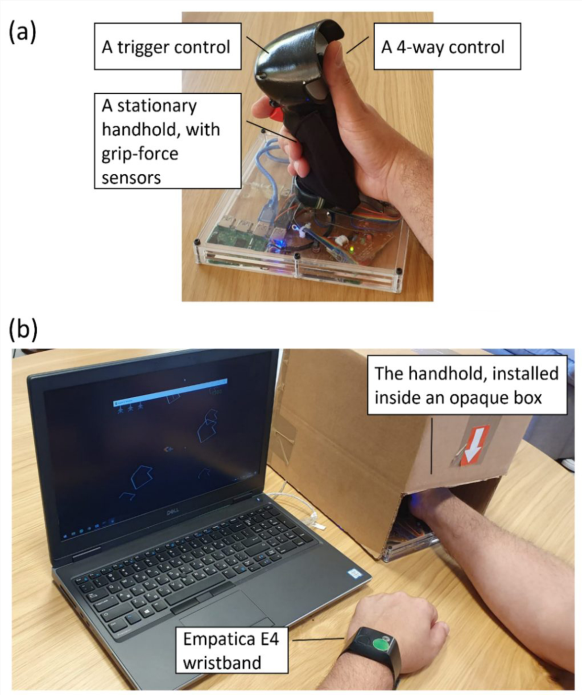
An adaptive training system for a complex task was developed, com- prising the Asteroids computer game. The game is operated using con- trols on a stationary handhold equipped with embedded grip force sensors. Dedicated software computes real-time stress levels based on standardized grip force measurements. The task’s difficulty level is then dynamically adjusted in response to the real-time stress calculation. Above a spec- ified threshold, the difficulty decreases, whereas below a certain lower threshold, the difficulty increases to adapt the challenge level accordingly (see Figure 1).
Figure 1: An adaptive psychomotor training apparatus, according to stress measured by grip force. Grip force recorded from the handhold utilized for task operation (a) compared with HR obtained from the Empatica wristband (b) (adapted from Sahar et al., 2022).
RESULTS
To validate grip force as a stress measurement tool (according to Q1), it was compared against established stress indices. Pearson’s correlation anal- ysis revealed a significant correlation between grip force and HR, r(8)=0.72, p<0.05 (Sahar et al., 2022), as well as between grip force and skin conduc- tivity, r(463)=0.635, p<0.001 (Wagner et al., 2015). Moreover, the grip force pattern observed across different experimental conditions aligned with the stress patterns reported in NASA-TLX self-reports (Wagner et al., 2015). Sim- ilarly, it corresponded to patterns in other physiological indices, including HR and HRV (Sahar et al., 2021), as well as in skin conductance (Wagner et al., 2015; Sahar et al., 2023). Several grip force parameters utilized in stress measurement were discov- ered for the first time, including factors like transfer functions and time window characteristics, as addressed in Q2. The transformation functions
A Novel Adaptive Physio-Behavioral Method for Optimizing Performance 457
encompass a range of techniques, such as converting raw grip force into a standardized score (Wagner et al., 2015), applying logarithmic transforma- tions (Sahar et al., 2021), and employing various combinations of dispersion and central measures (such as mean, median, maximum, and standard devi- ation) across multiple grip force sensors integrated into the controls (Sahar et al., 2023). The identified characteristics of the grip force measurement window involve a grip force data window width that spans from 1 to 5 seconds. Additionally, the measurement window offset varies from 0 to 4.2 seconds, depending on the specific transform function selected for analysis (Sahar et al., 2023).
Regarding Q3, which focuses on neutralizing non-stress-related effects on grip force measurement, the research discovered that grip force manifests stress indicators differently across various surfaces. This discovery forms the basis for situation-specific grip force measurement, allowing the extraction of grip force data devoid of extraneous influences. For instance, the study con- centrated on grip force in the specific area where fingers rest on the steering wheel during vehicle braking, ensuring exclusion of potential influences stem- ming from the driver’s deceleration and leaning movements during braking (Sahar et al., 2023).
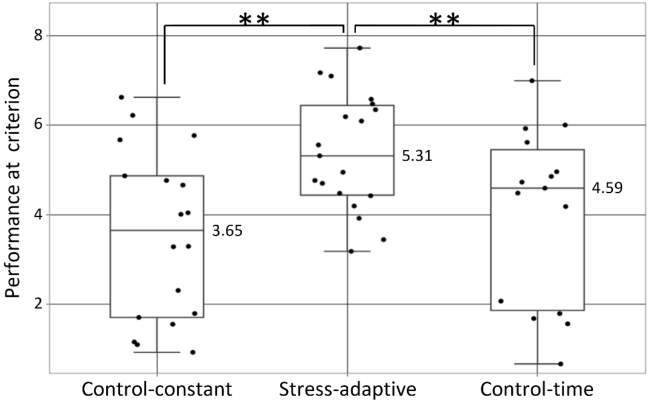
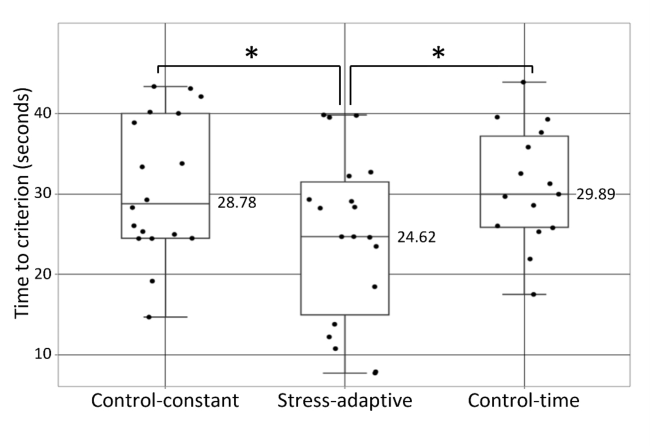
Based on these findings, engaging in stress-adaptive training within a virtual environment, which involved continuous calibration of task diffi- culty according to the individual’s stress level to maintain an optimal state, demonstrated greater effectiveness compared to non-stress-adaptive train- ing, as revealed in response to Q4. In detail, the stress-adaptive training method using grip force yielded a higher level of expertise acquired than that achieved through other methods (see Figures 2 and 3) within a shorter training duration (Sahar et al., 2022).
Figure 2: Performance as a function of training protocol, stress-adaptive vs. control conditions. Two asterisks represent significance level of p ≤0.01 (adapted from Sahar et al., 2022).Figure 3: The duration needed to achieve the criterion marking the completion of the learning phase (i.e., “Tine to criterion”), relative to the training protocol used, stress- adaptive vs. control conditions. One asterisk represents significance level of p ≤0.05 (adapted from Sahar et al., 2022).
CONCLUSION
Adaptive training demonstrates the potential to enhance performance, as evidenced by its advantages over alternative approaches in terms of skill acquisition and training duration. Contrary to the belief that stress solely hampers human performance, it was discovered to serve as a tool that can enhance the operator’s capabilities. By continuously monitoring stress levels, the system can dynamically adjust according to the current condition of the operator. This adaptive approach enables human operators to maximize their abilities optimally while providing system compensation if there is a potential imminent decline in the human operator’s performance, as indicated by their current cognitive or emotional state. Thus, the system can proactively prevent this anticipated decline by precisely intervening to the required extent.
The ability to measure cognitive and emotional states, such as stress, plays a crucial role in enhancing the performance of the operator-system unit. To integrate this functionality across different domains, especially in driving- related systems, the grip force index has been developed. This index, designed to be user-transparent, effectively distinguishes between different stress levels in real-time, as evidenced by the findings.
Utilizing stress adaptive capabilities has the potential to enhance driv- ing safety, optimize the learning and training procedures for new drivers, and elevate the overall driving experience. With the intermediate stage in the advancement towards autonomous driving anticipated to span several decades (Litman, 2023), it becomes imperative to adequately address the human factor in driving. Doing so is vital for enhancing safety measures and ultimately preserving human lives on the roadways.
A Novel Adaptive Physio-Behavioral Method for Optimizing Performance 459
REFERENCES
Bainbridge, L. (1983). Ironies of automation. In Analysis, design and evaluation of man–machine systems (pp. 129–135). Pergamon. Botzer, A., Sahar, Y., Wagner, M., & Elbaum, T. (2021). Analyzing individuals’
grip force over short intervals in a joystick-controlled task with and without a stress manipulation. Behaviour & Information Technology, 40(5), 476–482. doi: 10.1080/0144929X.2021.1912184. Calefato, C., Montanari, R., & Tesauri, F. (2008). The adaptive automation design. Human Computer Interaction: New Developments, 141–154. Liao, W., Zhang, W., Zhu, Z., Ji, Q., & Gray, W. D. (2006). Toward a decision-
theoretic framework for affect recognition and user assistance. International Journal of Human-Computer Studies, 64(9), 847–873. Litman, T. (2023). Autonomous vehicle implementation predictions. Victoria, Canada: Victoria Transport Policy Institute. Pope, A. (1749). An essay on criticism. With notes by Mr. Warburton. H. Linton. Sahar, Y., Elbaum, T., Musicant, O., Wagner, M., Altarac, L., & Shoval, S.
(2023). Mapping Grip Force Characteristics in the Measurement of Stress in Driv- ing. International Journal of Environmental Research and Public Health, 20(5) , 4005. doi: 10.3390/ijerph20054005. Sahar, Y., Elbaum, T., Wagner, M., Musicant, O., Hirsh, T., & Shoval, S. (2021).
Grip Force on Steering Wheel as a Measure of Stress. Frontiers in Psychology, 12, 617889. doi: 10.3389/fpsyg.2021.617889. Sahar, Y., Wagner, M., Barel, A., & Shoval, S. (2022). Stress-Adaptive Training: An Adaptive Psychomotor Training According to Stress Measured by Grip Force. Sensors 22(21):8368. doi: 10.3390/s22218368. Scerbo, M. (2007). Adaptive automation. Neuroergonomics: The brain at work, 239252. Visser, B., De Looze, M. P., De Graaff, M. P., & Van Dieën, J. H. (2004). Effects of
precision demands and mental pressure on muscle activation and hand forces in computer mouse tasks. Ergonomics, 47(2), 202–217. Wagner, M., Sahar, Y., Elbaum, T., Botzer, A., & Berliner, E. (2015). Grip force as a measure of stress in aviation. The International Journal of Aviation Psychol- ogy, 25(3–4), 157–170. https://doi.org/10.1080/10508414.2015.1162632. Wahlström, J., Hagberg, M., Johnson, P., Svensson, J., & Rempel, D. (2002). Influ-
ence of time pressure and verbal provocation on physiological and psychological reactions during work with a computer mouse. European journal of applied physiology, 87, 257–263.
LISTED IN THE AHFE DIGITAL BOOKSTORE CATALOGUE
Explore the complete digital volume
Advances in Human Factors of Transportation
Read this individual research paper free through the original publisher, or explore the full digital proceedings book.
ISBN 978-1-964867-24-3
Explore this ISBN in the AHFE Bookstore ↗Listed in the July 2026 bookstore catalogue; search by ISBN to confirm current availability · Digital book purchase optional