Hugo Breard, Béatrice Cahour, Jean-marie Burkhardt, Arnaud Koustanai (2024). Driving with anxiety/fear/apprehension: understanding the cognitive and emotional experience of drivers to design assistance systems. In: Advances in Human Factors of Transportation. AHFE Open Access, vol. 148, pp. 331–343. https://doi.org/10.54941/ahfe1005224
More than half of all drivers experience at least “occasionally” uncomfortable driving situations where emotions such as Anxiety/Fear/Apprehension (AFA) occur (52.2%), and even 17% of people declare being particularly hampered, or even handicapped in their daily lives, by their fear of driving. With Renault Group, an ergonomic approach has been implemented with the aim of designing driving assistance systems to improve the comfort and safety for this type of drivers. We report on the results of two successive studies carried out as the first steps of this project, to (study 1) identify the anxiety-provoking situations and the profile of people who are subject to this type of feelings, and (study 2) to obtain an in-depth understanding of the history and lived experience of these drivers in problematic situations. Study 1’s results show that women experience higher levels of AFA than men in all tested driving situations and particularly on winding roads, when driving unfamiliar vehicles or when driving at night. Young drivers (aged 18-35) report AFA more frequently than older drivers. However, situations involving specifically vision-related issues are perceived as more anxiety-provoking by those aged 66 and over, as well as driving with an agitated or talkative passenger. Explanatory hypotheses, both cultural and cognitive, are proposed for these different results. Study 2 aims to deepen the previous results through a qualitative approach. 26 anxious drivers (2/3 women) aged 22 to 75 were interviewed individually (1) about their driving history and (2) the driving situations they were most apprehensive about. Then, they were asked (3) to describe in detail one anxiety-provoking driving situation, using the Explicitation Interview method, to question the dynamics of the cognitive activities, actions, thoughts, perceptions, and emotions at that moment, (4) to elicit the coping strategies they might use to manage anxiety-provoking situations, and (5) to imagine potential assistance systems. The results highlight that lack of confidence, low driving frequency, having an accident, having stressful supervisors while you’re learning to drive, can lead to AFA. Women and young people mentioned more coping strategies than the others. Moreover, men feeling AFA while driving described their emotions and difficulties less directly than women. The fact that men are clearly less concerned by AFA while driving remains an issue to be investigated.
This work is part of a project aiming to develop assistance systems for peo- ple prone to emotional discomfort while driving. Emotional discomfort is defined as “a feeling that builds on the affective states experienced [and that] results in unpleasant sensations and emotions such as embarrassment, anxiety, fear and irritation” (Cahour, 2010). We focus on anxiety, fear, and apprehension (AFA). In the literature we find these emotions as very close ones (e.g. Plutchik, 1980) and we are interested in a semantic field more than in specific emotions that the participants may verbalise interchangeably (some will talk of being a bit anxious, some of being afraid, etc.). These emo- tions have been identified as factors likely to limiting or even incapacitating drivers. Indeed, people experiencing AFA while driving can be affected in their autonomy (Taylor et al., 2011), as it can lead them to give up driving, or to be at risk when they drive with attentional impairments due to AFA (Matthews & Desmond, 1995) or even to adopt hostile and aggressive driv- ing behaviour (Clapp et al., 2014). Therefore, providing a support to drivers to deal more serenely and appropriately with the driving situations associ- ated to AFA is an interesting avenue, as well as to promote their ability to manage them. This requires identifying AFA-related driving situations and understand the cognitive and emotional process and the possible strategies applied, more or less efficiently, by drivers experiencing such emotional dis- comfort. Therefore, this paper reports on the results of two successive studies carried out as the first steps of this project, to (study 1) identify the anxiety- provoking situations and the profile of people who are subject to frequent fear of driving, and (study 2) to obtain an in-depth understanding of the history and lived experience of these drivers in problematic situations.
SURVEY OF DRIVERS’ AFA AND ASSOCIATED DRIVING SITUATIONS: A QUANTITATIVE STUDY Objectives and Research Questions
This study aims (1) to characterize the profile of people experiencing emo- tional discomfort, especially AFA while driving, and (2) to identify the driving situations in which these emotions occurred. To answer these research issues, a questionnaire was developed (Bréard et al., 2023).
Method: Population, Material, and Statistical Analysis A convenience sample of 2234 licensed drivers were recruited but the current analysis consider a subset of 2216 people (%women 39.5%; %men=59.7%) who identified as male or female. Men declare higher daily driving frequen- cies than women in the personal sphere (%women=44.6%; %men=56.5%; chi2=48.86 (df = 4); p<0.01) and professional sphere (%women=12.2%; %men=16.5%; chi2=35.06 (df = 4); p<0.01). The questionnaire included 23 items (e.g. 7 items covering socio-demographic variables) and an inventory of 28 driving situations grouped into 3 main categories: (1) “Types of road”(e.g. When I’m driving on the freeway), (2) “Interactions with other road users” (e.g. When I’m with a passenger who criticizes my driving) and (3) “Other
Driving With Anxiety/Fear/Apprehension 333
contexts” (e.g. When I’m driving abroad). For each situation, the respondent was asked to indicate the intensity of their usual feeling of AFA on a scale ranging from 1 (no feeling) to 5 (very strong feeling). These situations were selected based on a literature review (e.g. Cahour, 2008; Blégent et al., 2015) and preliminary interviews. We used IBM SPSS 25 software for descriptive analyses and tests. As data are mostly categorical, we ran descriptive analysis on variables and contingency tables1.
Results
52.2% of drivers experience at least “occasionally” uncomfortable driving situations where AFA occur, and even 17% of people declare being partic- ularly hampered, or even handicapped in their daily lives, by their fear of driving. AFA is reported more frequently by women than by men (chi2=34.43 (df = 16); p<0.01). There are positive attractions between “women” and the “often” (RD=+0.85) and “always” (RD=+0.78) responses for the fre- quency of AFA occurrence whereas men exhibited attraction for the responses “never” (RD=+0.38) and “rarely” (RD=+0.24). AFA varies across age classes (chi2=247.02 (df = 4); p<0.01). The following positive attractions are observed: 18–25 age group with the “often” (RD=+0.41) and “always” (RD=+0.72) responses, the 26–35 age group with “always (RD=+0.64) and the 66 and over age group with “never” (RD=+0.61). There is a repul- sion between the 51–65 age group and the “always” responses (RD=−0.54). Younger drivers therefore report AFA more frequently than older drivers.
Seven driving situations are perceived as particularly anxiety-provoking by the whole population: driving in bad weather conditions (M=3.40; SD = 1.04), when careless pedestrians are close to the vehicle (M=3.26; SD = 1.03), when something obstructs visibility (M=3.18; SD = 1.10), when a vehicle tailgates (M=3.15; SD = 1.16), when driving near bicy- cles or scooters (M=3.10; SD = 1.10), when driving abroad (M=3.10; SD = 1.19) and when dazzled by headlights (M=3.03; SD = 1.12). Women reported systematically higher average intensity of AFA than men in all the proposed driving situations (all t-tests were significant at 0.01 and the situation “When driving in traffic jams” at 0.05). The highest differences were found for driving on a winding road (MF=3.20; SDF=1.13; Mmen=2.30; SDmen=1.04), driving an unfamiliar car (Mwomen=2.85; SDwomen=1.12; Mmen=2.17; SDmen=0.98) and driving at night (Mwomen=2.98; SDwomen=1.25; Mmen=2.14; SDmen=1.05). There are also age-related differences on intensity of AFA associated to each driving sit- uations. The feeling of AFA increases constantly with age in four situations: driving with an agitated and/or talkative passenger, being dazzled by head- lights, driving at night, and driving when something is obstructing visibility.
1For each contingency table, we calculated Cramer’s V2, an estimator of the magnitude of the association between two categorical variables. Cramer’s V2 lies between 0 and 1. We considered the association as strong when V2 was greater than 0.16 and as weak when V2 was less than 0.04. We therefore analyzed the association when V2 was greater than 0.04. The frequencies were compared using the Chi2 test. In the case of significant statistical difference and V2 greater than 0.04, we calculated the association between each modality of the contingency table. Relative deviations (RDs) measure the associations and are determined based on a comparison between observed and expected frequencies (i.e., those that would have been obtained if there was no association between the two variables)
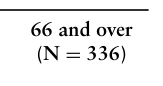
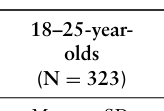
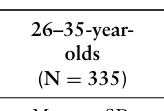
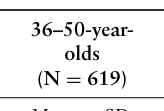
Drivers aged of 66 and more exhibit the lower feeling of AFA when driving in a dense urban area, in a narrow two-way lane and arriving at a complex intersection. Finally, the situations “driving near bicycles or scooters” and “when a vehicle tailgates me” show an increase in the feeling AFA, reaching a peak between the ages of 51 and 65, before falling back to the same level as for young people. Table 1 presents those results.
Table 1. Description of driving situations generating AFA according to age (N = 2216).
Table available in the original PDF paper.
Equation reproduced from the original PDF.Equation reproduced from the original PDF.Equation reproduced from the original PDF.Equation reproduced from the original PDF.Equation reproduced from the original PDF.
2.73 1.19 2.70 1.15 2.66 1.12 2.65 1.12 2.31 1.10
Mean SD Mean SD Mean SD Mean SD Mean SD Driving in dense urban area
2.62 1.10 2.64 1.15 2.60 1.11 2.64 1.07 2.36 1.12
Driving on narrow two-way lane
2.73 1.10 2.67 1.08 2.58 1.03 2.66 1 2.39 1.08
Arriving at a complex intersection
2.06 1 2.27 1.03 2.43 1.03 2.50 1.06 2.68 1.20
Driving with an agitated / talkative passenger
2.89 1.14 2.90 1.10 2.95 1.07 3.18 1.11 3.18 1.20
Being dazzled by headlights
2.96 1.10 3 1.06 3.10 1.10 3.31 1.07 2.93 1.17
Driving at night 2.10 1.06 2.28 1.14 2.39 1.14 2.61 1.22 2.95 1.35 Visibility obstructed 2.99 1.07 3.07 1.05 3.16 1.09 3.35 1.05 3.23 1.22 Driving near bicycles or scooters Being tailgated 3 1.19 2.99 1.17 3.25 1.07 3.32 1.14 2.97 1.25
The prevalence of AFA in relation to gender (e.g. Taylor et al., 2011) and age is coherent with the literature (Blégent et al., 2015). The higher preva- lence of AFA among women could be interpreted as originated by several factors like social and cultural norms (e.g. relationship with the car since the childhood, less expression of fear by men) and/or lower experience and fre- quency of driving in our sample. Therefore, the results of the questionnaire might minimise men’s number because of these characteristics. Also, the fact that older drivers report being less prone to AFA could be due to the fact that some can “employ the strengths of aging […] to avoid or de-escalate a negative event”(Charles, 2010) and may have therefore acquired more confi- dence and experience over time (Fort et al., 2023). The 18–25 years-olds are more affected by driving situations associated to a high attentional demand whereas people aged 66 and over are more vulnerable to driving situations affecting visibility. In addition, the older group seems to be more sensitive to disturbances inside the passenger compartment than others, who are more vulnerable to disturbances outside the passenger compartment.
AN IN-DEPTH EXPLORATION OF COGNITIVE AND EMOTIONAL PROCESSES IN DRIVING WITH AFA: A QUALITATIVE STUDY Objectives and Research Questions
This qualitative study aims (1) to provide a deeper understanding of the cognitive and emotional processes involved during uncomfortable driving
Driving With Anxiety/Fear/Apprehension 335
situations, (2) to identify the antecedents of people prone to AFA while driving and (3) the coping strategies they may or may not use.
Method: Population, Material and Analysis Methods 26 participants (17 women, 8 men and 1 non-binary person) aged from 22 to 75 were interviewed. Interviews lasted an average of 1 hour 36 minutes. To be recruited, participants had to hold a driving licence and have a high frequency of AFA (score of 4 “Often” or 5 “Always”) in the questionnaire mentioned above. The interview guide comprises 5 sections. (1) The first section traces the participants’ driving history. (2) The second section collects an overview of driving situations with AFA in which they feel emotional discomfort. (3) The third section uses the explicitation interview method (Vermersch, 2007) to delve more deeply into the lived experience of one emotional discomfort situation with AFA in terms of actions, thoughts, emotions, and sensory per- ceptions. (4) The fourth section sets out the different coping strategies used by drivers to deal with emotional discomfort. (5) The last section aims to understand the assistance systems that seem useful to the drivers and consis- tent in helping them. This last section will not be covered in this article. A qualitative analysis of the content of the interviews with progressive abstrac- tion of the verbatims was carried out for each interview and we extracted categories for the “Overview of uncomfortable situations” (section 2) and “Coping strategies” (section 4). For the “Explicitation” part (section 3), a schematized chronicle of lived experience has been created.
Results of the Qualitative Study We present first in details the case of a young woman, synthetizing her descriptions for parts 1 to 4 of the interview. Then we present some global results concerning the recurrent elements of the driving histories, the cate- gories of uncomfortable situations, and the coping strategies developed by the 26 participants.
Illustrating the Method to Analyse the Collected Lived Experience Through a Case (W5) To demonstrate the analysis method applied to each individual case, we present the case study of Joanne. It shows the cognitive and emotional dynam- ics of a person driving with AFA, the different historical and situated factors of her emotional discomfort, and her coping reactions. This case was selected because it highlighted a large number of driving situations that generate AFA and coping strategies. This interview lasted 76min.
Driving History of Joanne Joanne is a 30-year-old female executive with 7 years of education. She started supervised driving at age 16 in the suburb of a large French city, without any particular motivation, but already with a certain apprehension: “I’ve always been a bit apprehensive about driving, so [...] I’d better start early. [...] I’ve always had the impression that the driver was more under stress than the other passengers. I think I associate this role with something that is a bit undergone and not very pleasant”. On the other hand, she loves the car as a
passenger: “It’s like a moment of relaxation because it lulls me to sleep, and I fall asleep very quickly in the car”. At this stage, her parents were the ones who gave her accompanied driving lessons. However, she soon stopped driv- ing with her mother because she was adding to her stress. Her opportunities to drive were limited because she could rarely drive alone with her father. When she was 17, she moved to Paris. Although she passed her theoreti- cal driving test on the first attempt, she had to take her practical driving test twice. Her impressions of her training were still very negative: “I always have the impression of having bad instructors, [...] people who are not very benev- olent, almost a little harmful”. Even after obtaining her driving licence at the age of 18, she didn’t really feel capable: “I didn’t drive that much, so I didn’t drive enough to really reach a level where I felt comfortable”. From then on, she drove alone, ideally on familiar roads or around her parents’ house: “I was beginning to master it quite well. [...] when I have [...] someone in the car who’s stressed, it really increases the stress enormously”. However, over time, her driving frequency decreased: “I didn’t have a car (once in Paris) and I had far fewer opportunities to drive”. Aged 22, she moved to Chicago and stopped driving: “You had to retake the theoretical exam over there to get an equivalent licence and so it was a series of obstacles that [...] gave me an excuse not to force myself to drive”. Today, she hasn’t driven again but on very rare occasions and would like to drive again someday.
Overview of Uncomfortable Driving Situations for Joanne
Table 2. Overview of uncomfortable driving situations for Joanne (cf. Overview of Driving Uncomfortable Situations to see all the categories).
Table available in the original PDF paper.
Social Pressure
Vehicle handling
Driver state Driving environments
Interactions with others
Attentional difficul- ties
Dealing with the unexpected and the unknown
Major cities
Loss of control
Time pressure
Presence of Other Drivers
Stressed passen- gers
Multitude of infor- mation
Driver state during long journeys Parking Unknown routes
Insertion on Motor- ways
Roads without markings
Unclear passenger instruc- tions
Driving abroad
Driving near trucks
Being Honked At
Unknown vehicle
Roundabouts without road markings Being Tailgated
An abun- dance of cars, pedestri- ans, and bicycles in the city
While she used to limit herself to short journeys, today that limit has been further reduced: “There was a time when I would have avoided more than an hour of driving. Today, I think it’s even more than half an hour”. These short- comings also have an impact on her perceived control of the vehicle: “I’m afraid of losing control. There’s something about the fact that it’s a move- ment that you don’t completely control. There’s a slippery side to it, a side
Driving With Anxiety/Fear/Apprehension 337
where you’re forced to lose control a little [...] skiing and cycling do it to me too”. Parking also seems to be a particularly stressful manoeuvre: “Parking has always really stressed me out. [...] It’s a complicated manoeuvre, where I have difficulty measuring distances properly, understanding exactly what tra- jectory the vehicle is going to take depending on how my steering wheel is”. Joanne feels particularly uncomfortable in situations involving many road users and non-users, especially in big cities: “If I’m in the city and there are lots of cars, pedestrians and bikes [...] it’s going to stress me out a lot”. For Joanne, this type of situation therefore requires a major deployment of her attention span, “as soon as there’s a lot of information, it’s going to stress me out a lot”. The presence of other drivers is also a source of social pres- sure for Joanne, even though “there’s no sign of impatience from the people around” her. Other factors reinforce this social pressure, including insertion on motorways and certain negative interactions with other drivers, such as being honked at or followed. Joanne also experiences AFA “when people are stressed in the car”, but also when passengers take on the role of co-driver but don’t give clear directions. The anticipation of unknown and unexpected elements generates AFA for Joanne, as she indicated with unfamiliar routes, which are roads “that I don’t know and where I know there’s going to be a lot of information, a lot of unknowns”, but also vehicles that she is not used to drive, and driving abroad: “For example, in the United States, it’s supposed to be simpler but they have automatic cars. As soon as it’s a bit out of my comfort zone... I’m already not very comfortable, I find it hard to add even more diffi- culties by having a vehicle I don’t know and signs I don’t know”. Among the situations of emotional discomfort identified by Joanne in her questionnaire, she refined four of them during the interview, perceiving them as generating less AFA than what she mentioned in the questionnaire. For instance, driving near trucks and time pressure, compared to the other situations mentioned, are situations with lower levels of AFA than the ones mentioned in the ques- tionnaire. When it comes to roads and roundabouts without markings, the AFA experienced is more closely related to the problem of unfamiliar routes and passenger directions that may be unclear: “The road markings... but that goes a bit with the I don’t know where to go... if I have clear directions, then it’s fine”.
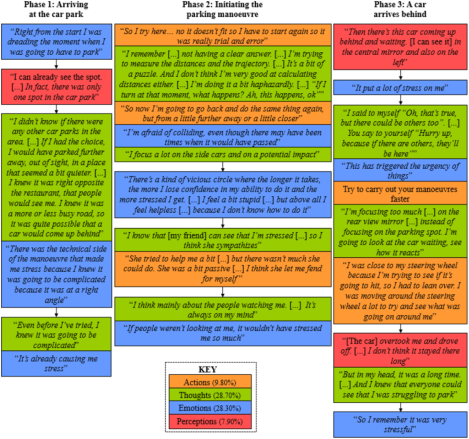
Explicitation of One Specific Driving Situation Explicitation techniques were used to gather in detail an experience Joanne had lived as a source of emotional discomfort. All the interviews have been transcribed. Verbatims have been selected and categorized relating to thoughts, sensory perceptions, emotions, or actions (Cahour et al., 2016). They are then listed in chronological order to establish a chronicle of activity describing the temporal development of the lived experience (see Figure 1). To contextualise Joanne’s explicitation, 4 types of information were also extracted, namely her description of the passenger, the description of the
exterior environment, the purpose of the journey, and the circumstances of the event2:
1. Purpose of the journey: “We were going to a friend’s birthday party, and it turned out to be in a restaurant” 2. Description of the passenger (internal environment): “I was with a friend who was a co-pilot and I was driving my parents’ car, so a car I know well”; “I know she (my friend) can see I’m stressed [...] She was trying to help me a bit [...]”My friend was new to driving too, so she wasn’t really able to help me or guide me. She wasn’t particularly making me more stressed, but she just couldn’t help me “ 3. Description of the external environment: “There was a sort of terrace overlooking the car park [...] so people in the restaurant could see what was going on in the car park”; “They were perpendicular spots. [...] They were really at 90
almost to park in”; “The spaces were quite narrow” 4. Circumstances of the event: “It happened to be at my parents’, in the local area, so a region I know well”; “I had been in the United States for a while, so I was already starting to lose my grip a bit, driving less and less and therefore feeling less comfortable”; “It was night [...] The weather was fine, there were no problems at all with bad weather or that wasn’t a factor at all”; “I didn’t feel stressed during the journey, well not too much”; The journey took between 15 and 20 minutes
Figure 1: Chronicle of the experience of a specific driving situation lived by Joanne.
This chronicle of lived experience synthesizes the temporal flow of cog- nitive, emotional, and social processes, and the entanglement of action, 2It is important to question these elements at the beginning of the interview to re-situate the actions and help a vivid recovery of the situation.
Driving With Anxiety/Fear/Apprehension 339
emotions, perceptions, and thoughts. The impact of action on emotion, and vice versa, can be seen in the “vicious circle” described by Joanne: the less control she has over parking, the more stress she feels, and the more stress she feels, the less control she has. Her difficulty in parking caused her to gradually lose confidence in herself (“The longer it took me, the more I lost confidence in my ability to do it and the more stressed I got [...] I feel a bit stupid [...] but above all I feel helpless [...] because I don’t know how to do it”). This confi- dence was not very high from the outset: “Right from the start I was dreading the moment when I was going to have to park” and the feeling of apprehen- sion in anticipation is clearly expressed. Her difficulty in adjusting her driving stems from (1) her difficulty in perceiving the distances between vehicles, (2) her attentional focus on certain elements: not hitting one of the cars (“I think I’m afraid of hitting it even though there may have been times when it would have gone by “) and then (3) her focus on the car waiting behind (“It added a lot of stress [...] So now I’m focusing too much on the rear view mirror [...] instead of on the parking spot. I’m going to look at the car waiting, see how it reacts [...] instead of focusing on what I was doing”). Here we see the interaction between perceptions (visual focus), actions (manoeuvring) and emotions (fear and stress), and we can assume that fear and stress are at the root of the focus and of the difficulty of manoeuvring. She also mentions a social factor of her AFA: she is sensitive to the image she reflects to others: “I think mainly about the people watching me [...] It’s always on my mind”. We understand that other people’s gazes contribute to her stress (a term she uses for the most part, although she also mentions apprehension, irritation, and fear): “I think mainly about the people watching me [...] It’s always on my mind”. So here we have a link between thinking about the judgement of people in the restaurant (not her friend, whom she thinks is compassionate) and the feeling of emotional discomfort, which itself can disrupt action. More than half of what Joanne talks about in her explanation concerns thoughts (28.7% of the total content) and emotions (28.3%). The fewer occurrences of actions (9.8%) and sensory perceptions (7.9%) can probably be explained by the trial-and-error aspect of her action, which is fragmented and hesitant, and which she may have difficulty remembering in detail.
Joanne’s coping strategies We asked about recurrent coping strategies in the fourth part of the interview. Joanne’s coping strategies are grouped into 3 categories (Table 3), she does not mention strategy relating to technology (cf. Coping Strategies to see the 4 categories of coping).
Table 3. Joanne’s coping strategies.
Table available in the original PDF paper.
Emotion-focused coping
Avoid driving with stressed people (SE1) Problem-focused coping
Driving with female friends who feel the same way (SA1)
Warn passengers that she is stressed and may require assistance (SA2)
Find an alternative by letting someone else drive in her stead (SA3)
Her coping strategies focus particularly on avoidance, whether it’s avoid- ance of a certain type of passenger, namely those who are stressed (SE1), total avoidance of driving (SP1) or partial avoidance of a driving situation gener- ating emotional discomfort (SP2). She can potentially look for someone to drive for her (SA3). In that sense, involving others to cope with emotional discomfort is the second type of strategy used by Joanne. Moreover, if she takes on the role of driver, she prefers to drive with friends who are in the same situation as her (SA1) or choose to warn passengers about her stress and her need for assistance (SA2).
Global Results Driving History An initial analysis highlighted several elements in the driving history that may explain the causes of AFA. First, the participants considered that they had a low level of driving experience compared to other drivers. Beyond an objec- tive judgement of their actual driving ability, this appears to be due to a lack of confidence: “I didn’t have any confidence in myself at all. And for me, the practical driving test was a big deal. [...] It seemed insurmountable”– Woman 4. This lack of self-confidence is partly due to the experience of driving train- ing. Indeed, some participants said they had had negative experiences during their learning: “A very sexist instructor who shouted at me and when I pan- icked, he shouted at me, so of course I panicked even more” – W9. Lack of confidence in driving skills also appears to have an impact on driving fre- quency and it becomes a spiral. Participants tended to reduce their driving frequency over time. In fact, those who did not feel confident, even after obtaining their driving licence, seemed not to drive frequently or even alone: “For a year after I got my licence, I didn’t want to drive alone. I drove with friends or when I had to be alone, I often asked my parents to come with me” – W12. Furthermore, people who stopped driving completely at an early age and for several years dread resuming driving, particularly because of this lack of confidence: “I really started driving again many years later when my children were born. [...] There’s always that little bit of anxiety and I always prefer to leave the car to my husband for long distances and now I have the impression that it’s coming back again. [...] I think it’s because I don’t drive enough, but it’s that fear. As soon as I get in the car, it’s a nightmare” – W13. The reasons why the stopped driving may also differ from just the lack of confidence: some of them stop driving when they move to big cities and their confidence is decreased with the scarcity of driving occasions. Other partici- pants also mentioned having had an accident as a source of AFA or as a cause to stop driving.
Overview of Driving Uncomfortable Situations In our interviews we identified 8 categories of driving situations generating emotional discomfort for the participants:
1. Social pressure: situations in which the driver feels forced to carry out certain actions, sometimes in a hurry, and feels the risk of displeasing others or damaging the image they have of him or her.
Driving With Anxiety/Fear/Apprehension 341
2. Interactions with others: situations involving communication with pas- sengers or other road users (e.g. being criticised by a passenger, passing a vehicle in a narrow street, driving near bicycles or motorbikes). 3. Attentional difficulties: situations that disrupt the driver’s attentional con- trol through distractions, an overload of information or difficulties in selecting relevant information. 4. Lack of visibility: situations involving visual obstructions due to obstacles, or environments where visual capacities are impaired (e.g. at night, fog, dazzled by headlights). 5. Vehicle handling: situations involving the driver’s skills where they have the feeling of not mastering the vehicle (e.g. parallel parking, driving fast on the motorway). 6. Dealing with the unexpected and the unknown: situations in which the driver is unable or no longer able to anticipate the next steps of the jour- ney, when they are in a foreign country or when they are driving a new car. 7. Driver state: situations involving the driver’s fatigue or vigilance. 8. Driving environments: specific configurations in which driving takes place (e.g. mountain roads, city), when an underlying cause is not mentioned (e.g. attentional complexity, interactions) Note that in a previous classification (Cahour, 2008), the categories “Social image and social relations”, “Need of multiple attention”, and “Impossibility of anticipating” were considered as sources of discomfort rather than situa- tions per se. The fact that they are common to several situations supports their use as categories of situations. Our other categories are similar or con- sistent with this. Our classification highlights problematic situations relating to vision (“Lack of visibility”) and differentiate between long-terms difficul- ties like those due to the driving skills and difficulties due to a temporary driver state (e.g. fatigue).
Coping strategies A total of 58 coping strategies were identified by all participants. These strategies were of 4 types: (1) emotion-focused (N = 16; 18.11% of all strategies identified), (2) problem-focused (N = 23; 41.73%), (3) other- persons-focused (N = 12; 25.20%) and (4) technology-focused (N = 7; 14.96%). On average, women mentioned slightly more strategies than men (Mwomen=5; SDwomen=1.84; Mmen= 4.37; SDmen=1.85). Younger partic- ipants mentioned more strategies than older participants (M18–25=6.25; SD18–25=2.99; M26–35=5; SD26–35=1.64; M36–50=4.4; SD36–50=0.89; M51–65=4.62; SD51–65=2.07; M66+=4.25; SD66+=0.96). Many emotion- focused strategies were mentioned, but few could be generalised. 17.65% of women used strategies that enabled them to refocus on themselves, such as talking aloud to themselves, or focusing on managing their breathing. In contrast, men use more “external” means such as playing music or the radio (%men=37.5; %women=5.88%). The 66 and over age group did not men- tion any emotion-focused strategy, in line with the emotional detachment (Charles, 2010). The most used problem-focused strategies for all participants
was partial avoidance of driving (%women=58.82%; %men=50%). This strategy was more used by women, unlike total avoidance (%women=11.76%; %men=25%). Furthermore, partial avoidance concerned less the 36–51-year- olds, maybe because of constraints with children. When it comes to coping strategies centred on others, participants tend to seek to drive with a passen- ger who can act as co-pilot (%women=35.29%; %men=25%), particularly in the 51–65 age group (62.5%). Participants are also looking for some form of emotional support. For example, they prefer to drive with some- one who relaxes them (%women=17.65%; %men=25%) or someone they trust, who is not judgmental (%women=23.53%; no men). These last two strategies are more likely to be adopted by 18–25-year-olds. Finally, con- cerning technology-centred strategies, the use of navigation systems remains particularly popular (%women=41.18%; %men=50%), especially among 18–25-year-olds (75%) and 36–50-year-olds (60%) and still 50% of our 51–65-year-olds. This strategy was the only one used by participants under 51. Older participants only marginally mentioned the use of certain advanced driver-assistance systems (e.g. cruise control and speed limiter, traffic sign recognition system, front collision warning).
DISCUSSION AND CONCLUSION The questionnaire showed that 52.2% of drivers experience driving situa- tions generating AFA and that 17% of people are particularly hampered or handicapped in their daily lives by those feelings. AFA is more prevalent among women as already showed in the literature (e.g. Taylor et al., 2011) and can be explained by cultural factors. AFA is widespread among young people, whereas older people seem to have acquired more confidence and experience over time and are therefore less prone to AFA (Charles, 2010; Fort et al., 2023). We were also able to distinguish the situations generating AFA for each population group. Based on the interviews, the driving history highlights several factors that may have led to AFA (e.g. a priori lack of con- fidence, less occasions to drive). 8 categories of driving situations generating AFA have been identified. Some categories are not often discussed in the lit- erature such as social pressure. Regarding regulation strategies, we found 4 types of coping strategies: emotion-focused, problem-focused, other people- focused and technology-focused. Those were more mentioned by women and young people, while older people did not mention emotion-focused coping strategies, in connection with their emotional detachment. Men feeling AFA while driving mentioned their emotions and difficulties less directly than women, being vaguer in their descriptions. They were also less willing to take part in the interviews. The fact that men are less concerned by AFA while driving remains an issue to be investigated. The case study of a young woman reports pre-existing AFA before the start of driving, accompanied by a stressful learning experience and a circumstantial interruption of driv- ing. The chronicle of lived experience shows the method of analysis and the cognitive-emotional processes with the reciprocal effects of actions, thoughts, emotions, and perceptions. Coping strategies centred on emotions, problems
Driving With Anxiety/Fear/Apprehension 343
and others are used before and during the driving experience. A similar anal- ysis is currently being carried out on the other 25 interviews. In the next step, in order to co-design assistance systems to manage these disabling situations, a participatory design approach will include the analysis of the last section of the interviews and following co-design workshops with drivers feeling emo- tional discomfort. The focus will be on the daily driving situations generating AFA the most frequently.
REFERENCES
Blégent, M., Gassie, L., & Thurmaud, F. (2015). Le stress au volant. Opinion Way. Bréard, H., Burkhardt, J. M., Cahour, B., & Koustanai, A. (2023). Les situations de conduite générant de l’anxiété, de la peur et/ou de l’appréhension selon le genre et l’âge. EPIQUE Conference, ARPEGE Science publishing, July 2023, Paris, France. Cahour, B. (2008). Discomfort, affects and coping strategies in driving activ-
ity. European Conference on Cognitive Ergonomics, January 2008, Madeira, Portugal. Cahour, B. (2010). Emotions, affects et confort comme nouveaux déterminants de l’activité et de l’usage. In Valléry, Leport, MC. G., & Zouinar, M. (Eds). Ergonomie des produits et des services médiatisés : nouveaux territoires, nouveaux enjeux, PUF. Cahour, B., Salembier, P., & Zouinar, M. (2016). Analyzing lived experience of
activity. Le Travail Humain, PUF, 79(3), 259–284. Charles, S. T. (2010). Strength And Vulnerability Integration (SAVI): a model of emotional well-being across adulthood. Psycho Bull, 136(6), 1068–1091. Clapp, J. D., Baker, A. S., Litwack, S. D., Slaon, D. M., & Beck, J. G. (2014). Properties
of the Driving Behavior Survey among individuals with motor vehicle accident- related posttraumatic stress disorder. Journal of Anxiety Disorders, 28(1), 1–7. Fort, A., Evennou, M., Jallais, C., Charbotel, B., & Hidalgo-Muñoz, A. (2023).
A prevalence study of driving anxiety in France. Journal of Transport & Health. Matthews G., Desmond, PA. (1995). Stress as a factor in the design of in-car driving enhancement systems, Le travail Humain, 58(2), 109–129. Plutchik, R. (1980). Emotion, a psychoevolutionary synthesis. Harper & Row,
New York. Taylor, J. E., Alpass, F., Stephens, C., & Towers, A. (2011). Driving anxiety and fear in young older adults in New Zealand. Age and Ageing, 40(1), 62–66. Vermersch, P. (2007). The explicitation interview. (English version of L’entretien
d’explicitation, ESF, Paris, 1994).
LISTED IN THE AHFE DIGITAL BOOKSTORE CATALOGUE
Explore the complete digital volume
Advances in Human Factors of Transportation
Read this individual research paper free through the original publisher, or explore the full digital proceedings book.
ISBN 978-1-964867-24-3
Explore this ISBN in the AHFE Bookstore ↗Listed in the July 2026 bookstore catalogue; search by ISBN to confirm current availability · Digital book purchase optional