Mohamed Naceur Ben Aziza, Adel Badri (2026). Collaborative Robotics and Worker Safety: An Ergonomic Perspective on Benefits and Risks. In: Safety Management and Human Factors. AHFE Open Access, vol. 227, pp. 120–126. https://doi.org/10.54941/ahfe1007923
Collaborative robotics represents one of the main pillars of the latest industrial revolutions. With the goal of innovation and primarily to address the need for improved efficiency and productivity, cooperation between human workers and robots has emerged as a simple, effective, and relatively low-cost solution that does not require significant adaptation—whether in the work environment or in workers’ level of expertise. Indeed, collaborative robots are financially accessible and quite user-friendly, easy to install and program, which facilitates their integration into the workplace.From a health and safety perspective, particularly in ergonomics, collaborative robots offer many advantages in preventing musculoskeletal disorders (MSDs). A robot is useful for performing difficult tasks such as handling heavy loads, repetitive tasks, or tasks requiring high precision. The robot helps prevent human workers from being exposed to high physical strain and significant injury risk or from being forced into awkward postures that increase the risk of MSDs.On the other hand, sharing the same work environment between robots and humans also presents risks. The balance of power between humans and robots is not equivalent, and an unexpected movement, poor coordination, or programming or design issues can have a significant impact on a person’s safety—either instantly or over the long term due to repeated exposure to the same conditions. Therefore, integrating collaborative robots into workplaces must be done cautiously, considering ergonomic aspects during the design, installation, and programming phases to maximize benefits and minimize risks. This requires focusing on the human worker who will collaborate with the robot, considering their capabilities and limitations.
The industrial world, like many other economic sectors, is compelled to adapt to reality in its search for new markets, new customers, and to respond to existing needs or create new ones. Adaptation cannot take place without adopting new tools capable of making production greater, less costly, or of better quality. Over the years, this desire has mainly taken the form of integrating new technologies or inventions that have marked history. Indeed, beginning with the invention of the steam engine—which marked the end of traditional industry and the official start of the first industrial revolution
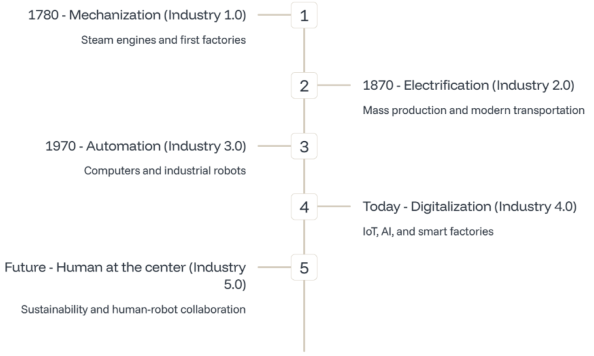
Collaborative Robotics and Worker Safety: An Ergonomic Perspective 121 (Industry 1.0)—then moving to the electrification of production lines thanks to the invention of electricity (Industry 2.0), followed by automation (Industry 3.0), and finally reaching robotization and the integration of new technologies highlighting data, artificial intelligence, and others (Industry 4.0, 5.0, etc.). Through these industrial revolutions, significant progress at the industrial level has clearly been achieved. However, the issue of occupational health and safety has not always been a top priority. In fact, new risks have emerged every time a major change has affected the industrial environment. These risks are generally linked to exposure to new hazards previously unknown, such as handling machines or being exposed to dangerous machine components, exposure to electricity, increasingly advanced equipment, and so on. This has also been the case during the most recent industrial revolutions, particularly Industry 4.0 and beyond. Indeed, risks related to artificial intelligence, big data, connectivity, and others have emerged. These emerging risks make it necessary to maintain a controlled situation and pursue a mission of continuous improvement.
Given that industry is in constant evolution, vigilance must never be relaxed, and efforts in occupational health and safety must continue in order to face the evolution of hazardous situations and the risks that result from them. In this context, ergonomic risks—which represent the primary cause of musculoskeletal disorders—have also evolved and changed. New technologies have made it possible to reduce the duration of exposure or even eliminate the need for exposure altogether. This is, for example, the case of companies that have decided to robotize certain repetitive tasks requiring physical strength from workers or tasks that require workers to maintain constrained postures for a more or less extended period.
This solution, although quite practical, cannot be perfect, and several elements and conditions must come together in order to avoid creating other unintended and unforeseen risks prior to integration. Collaborative robots, which represent a specific type of robot, present additional challenges, given that they can interact with and share the workplace with human workers.
Figure 1: Industrial evolutions from Industry 1.0 to Industry 5.0.
METHODOLOGY
This search adopts the reviewing approach in the aim to identify the Ergonomic benefits of the integration on cobots in industry 5.0 contexts and to discuss the possible ergonomic challenges in plants adopting cobots and to propose some recommendations to minimize or eliminate these risks. A systematic search for scientific articles, chapters and conference publications was done using the most widely keywords used to refer to cobot and Ergonomics aspects. Keywords were mostly searched in titles of articles published. Cross- disciplinary database Scopus was the principal source of articles searched.
Table 1: Result of research in digital databases.
Table available in the original PDF paper.
RESULTS
Collaborative robotics (Human-Robot Collaboration, HRC) is part of the industry 4.0/5.0 paradigm, aiming at human-centered production that combines productivity and operators’ well-being. Several studies show that the integration of cobots helps reduce both physical and cognitive workload while improving the efficiency of industrial systems.
Ergonomics aims to adapt a workstation or a task to the individual. One of the greatest advantages of cobots in terms of ergonomics is undoubtedly the automation of complex, repetitive tasks or tasks that require significant physical or mental effort. The automation of visual inspection tasks by robots, for example, helps reduce workers’ exposure to hazardous environments or to repetitive and physically demanding tasks. This contributes to a reduction in musculoskeletal disorders (MSDs), such as back pain and upper limb disorders, which are common among human workers performing inspection tasks (Tasneem and Pieters, 2026).
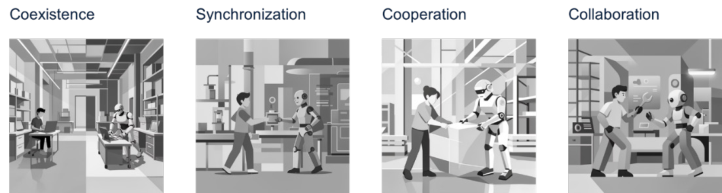
Human-robot collaboration is rapidly expanding in the industrial manufacturing sector. Indeed, it enables the combination of productivity and quality through the joint involvement of human workers and cobots. This collaboration takes place in different forms (Figure 2).
Figure 2: Different types of collaboration human-cobot.
A CONTRIBUTIONS OF COLLABORATIVE ROBOTICS TO ERGONOMICS The integration of collaborative robots into industrial environments offers both productivity gains and an effective tool for addressing various ergonomic and safety challenges.
Several studies have highlighted the contribution of collaborative robots in handling strenuous or repetitive tasks. This clearly plays an important role in reducing musculoskeletal disorders (MSDs). Indeed, in a case study, Martin et al., (2025) reported a 58% reduction in ergonomic risk when tasks were transferred to a robot in engine assembly. Furthermore, in assembly applications, collaborative robotics enables a significant improvement in working postures (Navas-Reascos, et al., 2026). Cobots also reduce physical fatigue and travel distance, thereby improving working conditions in logistics systems (Pasparakis, et al., 2023). This confirms that the targeted automation of non-ergonomic tasks is a major driver for improving occupational health.
Real-time ergonomic monitoring and assessment Recent advances incorporate intelligent systems capable of continuously monitoring ergonomics. This is the case of the smart framework based on computer vision, which enables real-time assessment via OWAS (Ovako Working Posture Analysis System), with detection of risky postures and triggering of robotic interventions (Iodice et al., 2025). Thus, classical approaches using methods such as OpenPose, YOLO, or REBA allow for non-invasive evaluation without wearable sensors, improving practicality in industrial environments (Iodice et al., 2025). Moreover, digital twins and physiological sensors (EMG, heart rate) enable a detailed analysis of muscular fatigue and physiological state (Li et al., 2025). These systems promote proactive injury prevention and dynamic task adaptation.
Optimization of task allocation and adaptive assistance The integration of ergonomics into decision-making models improves both performance and well-being. Indeed, collaborative robotics contributes to the intelligent management of workload, which is essential for the sustainability of production systems. This has been demonstrated in numerous research works and case studies. Dynamic task allocation models, for example, make it possible to reduce human worker fatigue by transferring demanding tasks to robots (Faccio et al., 2024). Furthermore, proactive assistance based on reinforcement learning significantly reduces perceived physical effort (Cai et al., 2025). Regarding work planning, scheduling models that integrate ergonomic fatigue (HRCAW-ES) optimize task sequencing while protecting and preserving operators’ health (Lim et al., 2025).
Improvement of cognitive ergonomics Beyond physical ergonomics, several contributions highlight the benefits of using collaborative robots on mental workload. These findings show that HRC contributes to a balance between performance and mental comfort, a key element of Industry 5.0. Indeed, cobots allow operators to free themselves from non-value-added tasks and to focus more on higher-value activities. This significantly reduces
124 Ben Aziza and Badri their overall cognitive load (Lobato et al., 2025). This is also the case for immersive or teleoperation systems (e.g., CaFe TeleVision), which reduce cognitive load and improve user acceptance, with an increase in success rate of up to 28.89% (Chen et al., 2025). Adaptive interfaces (e.g., LLMs, voice interaction) facilitate human–robot interaction (although they still present challenges and require improvements) by reducing ambiguity and cognitive stress (Tasneem and Pieters, 2026).
ERGONOMIC CHALLENGES OF COLLABORATIVE ROBOTICS Although the integration of collaborative robots in the workplace in general, and in industry more specifically, brings many advantages, several major challenges remain. These challenges mainly concern the ergonomic integration of cobots as well as technical and technological issues.
Complexity of ergonomic assessment in real environments Among the main challenges is the difficulty of accurately measuring ergonomics. Indeed, classical methods (such as RULA, REBA, OWAS) have limitations in terms of granularity and mathematical modeling, making their integration into automated systems complex (Amani and Akhavian, 2024). On the other hand, existing approaches are often either subjective or non-continuous, which represents a significant limitation for real-time use (Cai et al., 2025). In addition, the simultaneous consideration of both physical and cognitive factors remains only marginally addressed in most models (Chutima et al., 2025).
Consideration of human variability The human worker, who constitutes one of the two pillars of collaboration, can itself introduce an additional level of complexity to the impacts of cobot integration and may unintentionally generate new risks or hazardous situations due to the variability of human behavior, which represents a major challenge. Indeed, operators exhibit unpredictable behaviors that may lead to errors or dangerous situations (A theoretical foundation for erroneous behavior…, 2026). In addition, fatigue, skills, and individual preferences make universal optimization difficult (A framework for human–robot collaboration enhanced by preference learning…, 2026). Therefore, models must incorporate this variability to ensure safety and comfort.
Trade-off between productivity and ergonomics One of the primary advantages of collaborative robotics is undoubtedly the significant contribution to productivity. However, designing HRC systems requires a careful balance between industrial performance and worker health. Several studies highlight this unavoidable trade-off. For example, multi-objective optimization has demonstrated the compromise between cycle time and ergonomics (RULA) (Cavone et al., 2025). A high work pace increases short-term productivity but raises the risks of musculoskeletal disorders (MSDs) and mental workload (Lemonnier
Collaborative Robotics and Worker Safety: An Ergonomic Perspective 125 et al., 2025). Conversely, an excessive focus on well-being may reduce overall performance (Faccio et al., 2024).
Technological and integration challenges The industrial deployment of collaborative robots, while respecting ergonomic aspects, still faces several technical and technological challenges. Indeed, these systems require advanced technologies (vision, AI, sensors), which are often costly and complex to integrate (Berti et al., 2024). In addition, simulation and design tools, which are important for ensuring real-time safety, lack flexibility and require numerous iterations (Berti et al., 2024). Furthermore, requirements related to data privacy and security (particularly with LLMs and connected systems) are becoming increasingly significant challenges (Tasneem and Pieters, 2026).
Cognitive and psychosocial factors In terms of cognitive ergonomics, human aspects remain critical. Indeed, cognitive stress, trust, and acceptance of cobots directly influence performance (Chutima et al., 2025). Other ethical concerns also pose challenges related to worker monitoring and must be taken into account (Iodice et al., 2025). Furthermore, it is evident that the roles assigned to operators (leader vs. follower) significantly impact mental workload (Lobato et al., 2025).
CONCLUSION
In conclusion, the literature highlights the contribution of collaborative robotics to improving ergonomic working conditions. This is particularly evident through the reduction of physical loads and the risks of musculoskeletal disorders (MSDs), the provision of real-time ergonomic monitoring, the dynamic optimization of tasks, and the enhancement of cognitive ergonomics.
On the other hand, persistent challenges cannot be overlooked, including the complexity of ergonomic assessment, human variability, productivity– ergonomics trade-offs, technological constraints, as well as cognitive and ethical issues.
These elements underline the importance of adopting integrated, adaptive, and human-centered approaches to fully harness the potential of collaborative robotics.
The benefits of human–cobot collaboration can lose all their value if poorly implemented integration generates new ergonomic risks and ultimately becomes more of a problem than a solution.
ACKNOWLEDGMENT
The authors would like to thank the Université du Québec à Trois-Rivières (UQTR), Mitacs Canada and Natural Sciences and Engineering Research Council of Canada (NSERC) for their financial support.
REFERENCES
Amani, M. and R. Akhavian (2024). “Intelligent ergonomic optimization in bimanual worker-robot interaction: A Reinforcement Learning approach.” Automation in Construction 168: 105741. Attahir, M., et al. (2025). “Cognitive ergonomics assessment and categorization in
human-robot collaborative workplaces: a systematic literature review.” Journal of Industrial and Production Engineering: 1–40. Bouillet, K., et al. (2025). “Effects of pace on productivity and physical and mental workloads in a human–cobot collaboration.” International Journal of Occupational Safety and Ergonomics 31(1): 328–336. Calzavara, M., et al. (2024). “Achieving productivity and operator well-being: a
dynamic task allocation strategy for collaborative assembly systems in Industry 5.0.” The International Journal of Advanced Manufacturing Technology 134: 3201–3216. Iodice, F., et al. (2025). “Intelligent Framework for Human-Robot Collaboration: Dynamic Ergonomics and Adaptive Decision-Making.” Journal of Intelligent & Robotic Systems 112(1): 5. Keshvarparast, A., et al. (2024). “Ergonomic design of Human-Robot collaborative
workstation in the Era of Industry 5.0.” Computers & Industrial Engineering 198: 110729. Liu, X., et al. (2025). “A digital twin-driven method for improving human comfort in human–robot collaboration.” The International Journal of Advanced Manufacturing Technology 137(1): 339–359. Martin, A., et al. (2025). “Collaborative Robot in Engine Assembly: A Socioeconomic
Approach to Technological Advancement in Manufacturing.” IET Collaborative Intelligent Manufacturing 7. Navas-Reascos, G. E., et al. (2026). “Simulation tests of wire harness assembly tasks supported by collaborative robots for different types of wire harnesses.” International Journal of Computer Integrated Manufacturing: 1–27. Park, K.-T., et al. (2025). “Production scheduling for human–robot collaborative
assembly workstations under constraints of ergonomic fatigue and simultaneous cooperation.” Journal of Manufacturing Systems 83: 337–356. Pasparakis, A., et al. (2023). “Assessing the impact of human–robot collaborative order picking systems on warehouse workers.” International Journal of Production Research 61(22): 7776–7790. Proia, S., et al. (2025). “Safety Compliant, Ergonomic and Time-Optimal Trajectory
Planning for Collaborative Robotics.” IEEE Transactions on Automation Science and Engineering 22: 594–605. Segura, P., et al. (2025). “Work Roles in Human–Robot Collaborative Systems: Effects on Cognitive Ergonomics for the Manufacturing Industry.” Applied Sciences 15: 744. Tang, Z., et al. (2025). CaFe-TeleVision: A Coarse-to-Fine Teleoperation System
with Immersive Situated Visualization for Enhanced Ergonomics. Tasneem, O. and R. Pieters (2026). “Human–robot collaborative visual inspection with Large Language Models.” Robotics and Computer-Integrated Manufacturing 98: 103154. You, Y., et al. (2025). “An offline reinforcement learning-based framework for
proactive robot assistance in assembly task.” Computers & Industrial Engineering 208: 111313. You, Y., et al. (2025). “A human digital twin approach for fatigue-aware task planning in human-robot collaborative assembly.” Computers & Industrial Engineering 200: 110774.
LISTED IN THE AHFE DIGITAL BOOKSTORE CATALOGUE
Explore the complete digital volume
Safety Management and Human Factors
Read this individual research paper free through the original publisher, or explore the full digital proceedings book.
ISBN 979-8-950676-03-1
Explore this ISBN in the AHFE Bookstore ↗Listed in the July 2026 bookstore catalogue; search by ISBN to confirm current availability · Digital book purchase optional