Karine Ung, Damien Burlet-Vienney, Firdaous Sekkay, Aida Haghighi, Chantal Gauvin, Anouk Aubert-Simard, Caroline Jolly, Francois Gauthier (2026). Implementation and adoption of AI-based camera systems for pedestrian detection on construction sites: field insights on barriers and enablers. In: Safety Management and Human Factors. AHFE Open Access, vol. 227, pp. 132–141. https://doi.org/10.54941/ahfe1007925
Collisions between mobile industrial equipment and pedestrian workers remain a major source of serious injuries and fatalities on construction sites, accounting for 8% of reported fatal accidents in Quebec, Canada. In response, proximity detection systems, including artificial intelligence (AI)-based camera systems providing automated pedestrian detection, have been introduced to support collision avoidance. Adoption of AI-based camera systems is increasing due to their logistical simplicity compared with RFID-based solutions, but their use on construction sites remains limited and exploratory. Consequently, field-based evidence on how these systems interact with real construction activities and provide added value remains limited. This study examines barriers and enablers to the implementation and adoption of AI-based camera systems for pedestrian detection on construction sites.The study is based on a multi-case qualitative field investigation conducted across six construction sites involving four companies and twelve types of mobile equipment. Data collection included on-site field observations supported by video recordings and semi-structured interviews with mobile equipment operators, pedestrian workers, managers, and technology vendors. An inductive thematic analysis identified interrelated barriers and enablers shaping implementation and adoption, including detection reliability, installation and configuration practices, interface design, worksite organization, and worker involvement. These findings provide field-based insights into real-world use and show that adoption depends on alignment across technical, operational, organizational, and user-related factors.
Mobile Equipment-Pedestrian Collisions on Construction Sites Collisions between mobile equipment (ME) and pedestrian workers (PW) constitute a persistent safety problem in construction and other sectors involving close interaction between mobile equipment and workers, and are associated with severe outcomes, including fatal and serious injuries.
In the United States, ME-PW remain a significant source of fatalities on construction and roadwork sites. Between 1990 and 2007, visibility-related incidents involving ME resulted in an average of 33 deaths per year in the construction sector, accounting for approximately 4% of construction fatalities (Hinze & Teizer, 2011). Struck-by accidents continue to occur on roadwork sites, with approximately 19 worker deaths recorded annually between 2011 and 2020 involving vehicles or equipment, and analyses show that nearly half of fatal struck-by accidents between 1992 and 2020 involved collisions with internal ME rather than external vehicle intrusions (Al-Bayati et al., 2023; Harris et al., 2022).
In Canada, collisions between ME and PW accounted for an average of 25 fatalities per year between 2020 and 2022 across all sectors, including road construction sites involving third-party vehicles. These incidents represented approximately 2.5% of all occupational fatalities, with construction, transportation, and warehousing identified as the most affected sectors (Association of Workers’ Compensation Boards of Canada (AWCBC), 2024).
In Quebec, ME was involved in 41% of all serious and fatal occupational accidents investigated between 2013 and 2023. During this period, 34 fatal ME-PW collisions were documented, representing 8% of all fatal occupational accidents, with the construction sector accounting for 56% of the cases (Burlet-Vienney et al., 2026).
Together, these data show that ME-PW collisions remain a recurring safety concern. Investigated cases indicate that such events occur not only when PW are located in physical blind spots, but also when they are not detected by operators during task execution, even while within the nominal field of view (Hinze & Teizer, 2011; Noll et al., 2017). This highlights the need for continued examination of prevention approaches addressing the detection of PW in dynamic construction environments.
Proximity Detection Systems in Construction and the Emergence of Artificial Intelligence (AI)-Based Cameras Proximity detection systems are used to reduce the risk of collisions between ME and PW by detecting the presence of persons or obstacles within predefined zones and by providing warnings or automated control responses (Marsot et al., 2009; McCann, 2006; Ruff et al., 2011). These systems rely on several technological principles, including marker-based solutions (e.g., radiofrequency identification or magnetic markers worn by workers), markerless wave-reflection sensors (e.g., ultrasonic, radar, or laser- based sensing), and vision-based systems using cameras (Alarifi et al., 2016; International Organization for Standardization, 2017; Lee et al., 2017; Li et al., 2019). Depending on system architecture, detection and alert processing
may be performed locally on the ME (embedded systems) or centrally through real-time localization infrastructures (Han, 2019; Kanan et al., 2018).
AI-based camera systems constitute a subset of markerless proximity detection technologies and use image processing to identify PW within the field of view and provide alerts or visual feedback to operators (Son et al., 2019). Compared with tag-based or centralized systems, AI-based cameras generally require less additional infrastructure and do not rely on workers carrying markers, which facilitates their deployment in dynamic construction environments.
In recent years, AI-based camera systems have received increased attention in the construction sector, reflecting the availability of commercial products that can be installed directly on ME. This study therefore focuses on AI-based camera systems used for pedestrian detection on construction sites. Despite this interest, their use in practice remains limited and exploratory in the province of Quebec (Canada), with deployments confined to pilot implementations or isolated machines (Saidi, 2021). Uncertainty persists regarding system performance under real working conditions and their contribution to everyday safety management.
Gap in Field-Based Evidence and Study Objective Existing research on proximity detection and AI-based camera systems has primarily focused on technical feasibility (Lee & Lee, 2023; Zhang, 2021) and detection performance under controlled or experimental conditions (Antwi-Afari et al., 2019; Nnaji et al., 2020; Son et al., 2019). By comparison, fewer studies have examined how these systems are implemented, used, and perceived in everyday construction activities, and to the conditions under which they provide added value in real working environments.
To address this gap, this study examines barriers and enablers to the implementation and adoption of AI-based camera systems for pedestrian detection on construction sites. The analysis draws on qualitative field evidence to document how these systems are deployed, configured, and used in practice, and how their use is shaped by operational, organizational, and contextual factors.
METHODOLOGY
This study adopted a multi-case qualitative field investigation (Yin, 1994) to examine the implementation and adoption of AI-based camera systems for pedestrian detection on construction sites. A qualitative approach was selected to capture contextual variability and sociotechnical interactions shaping system use in real working conditions.
Ethical approval for the study was obtained from the Polytechnique Montréal research ethics committee (CER2324-52-D).
Data were collected across six active construction sites involving three different companies. Feedback from a fourth company with a non-active site is also included. The study included the observation of twelve mobile equipment units (three types: telehandler, loader, excavator) equipped with
Implementation and Adoption of AI-Based Camera Systems for Pedestrian Detection 135 AI-based camera systems for pedestrian detection. These cases are considered mainly as pilot studies by companies. Sites varied in terms of project type, work organization, and equipment use, allowing examination of system implementation across different operational contexts (Table 1).
Table 1: Overview of study sites, participants, ME, and camera configurations observed.
Table available in the original PDF paper.
Type of Site Participants Type of ME Camera Configuration
4 telehandlers 1 camera (rear)
Company 1 Industrial (1 site)
Equipment manager; ME operator Feedback only
Company 2 Civil (non- active)
Occupational health and safety officer; project manager
Company 3 Civil (1 site)
2 telehandlers 2 cameras (rear and right-side)
Project manager; 3 ME operator; PW; intern
1 wheel loader 1 camera (rear)
Company 4 Energy (4 sites)
5 project committee members; 2 surveyors; 4 ME operators, PW
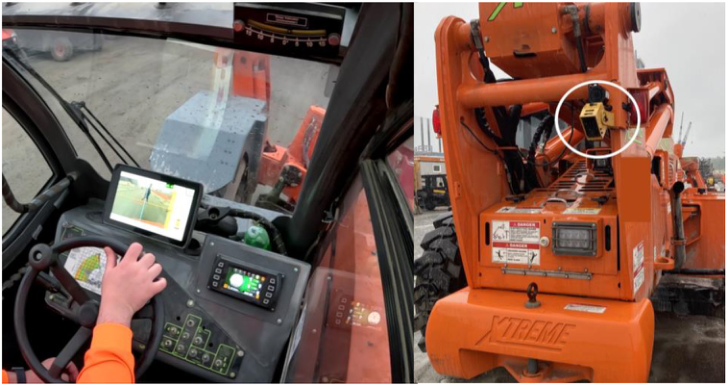
5 excavators 2, 3 or 4 cameras (rear and right-side + left-side + front) On-site field observations were conducted and supported by pictures (Figure 1) and video recordings of working situations involving ME and PW. The observations documented operator–system interactions, the presence and movement of PW, system alerts, and operator responses during task execution. Video recordings were reviewed to identify and document key events and interactions involving ME operators, PW, and the AI-based camera system, and the resulting observation notes were included in the qualitative analysis.
Figure 1: In-cabin screen (left) and rear-mounted camera (right) of an AI-based camera system installed on a telehandler.
Semi-structured interviews (Vermersch, 2019) were conducted on the construction sites with ME operators, PW, suppliers, safety managers, equipment managers, and project managers. The interviews were audio- recorded and transcribed verbatim to document multiple operational perspectives on the use of AI-based camera systems in everyday work situations.
All data were analyzed using an inductive thematic analysis supported by NVivo® software. Coding focused on barriers and enablers shaping the implementation and adoption of AI-based camera systems and was conducted iteratively, with cross-case synthesis used to examine patterns across sites. Themes were treated as interrelated, reflecting the combined influence of technical, operational, organizational, and human factors on system use.
RESULTS
The results are organized around factors influencing the implementation and adoption of AI-based camera systems for PW detection on construction sites. These barriers and enablers are presented in Table 2. The following subsections describe the main areas in which they were reported.
Detection Reliability, Alerts and Trust Barriers and enablers related to detection reliability, alerts, and trust concerned system response and operator reliance. Enablers included reports of good detection, good performance under different conditions, and positive perceptions of alert functioning and the alarm system. The system was also described as contributing to the avoidance of collisions and equipment damage.
Barriers included false positives, false negatives, excessive detections and alarms, and sensitivity to conditions. Operators also reported issues related to the system remaining active at all times, as well as alerts activating when the machine was not moving. Regarding the cases with servo control, abrupt hydraulic blocking was noted, particularly at higher speed.
Additional barriers concerned the operator’s reliance on the system. In some situations, reliance on direct vision was reported, indicating limited reliance on alerts or camera-based detection and a preference for visual checks outside the cabin. In contrast, situations leading to excessive confidence were also reported, in which operators relied strongly on the system during equipment operation.
Installation and Configuration Practices Barriers and enablers related to installation and configuration practices concerned both system setup and deployment conditions. Enablers included reports of ease of integration and limited logistical constraints, indicating that system installation was perceived as manageable in some contexts.
Several configuration and installation barriers were also identified. These included constraints related to ME configuration (e.g., achieving the required mounting height for the camera; mirrors partially obstructing a monitored zone). Barriers were also reported in relation to detection zones, as zones that were too large generated excessive alerts.
Implementation and Adoption of AI-Based Camera Systems for Pedestrian Detection 137 The diversity of ME was reported as a factor affecting configuration, with differences across machines requiring specific setup considerations. Barriers were also reported in relation to limited service support during installation and deployment.
Additional configuration-related issues concerned the regular positioning of PW and signalers during operations.
Cabin Interface Configuration and Alert Modalities Barriers and enablers related to cabin interface configuration and alert modalities concerned how system feedback was presented to operators. Enablers included the ease of use of the interface and a degree of flexibility, such as the ability to adjust alert settings (e.g., volume).
Barriers were reported in relation to auditory and visual alerts, particularly when alerts were too frequent. Additional barriers concerned the screen and display, including issues affecting the visibility or readability of information.
Worksite Variability and Configuration Transferability Barriers related to worksite variability and configuration transferability concerned differences in equipment, site conditions, and operating situations. The diversity of ME was identified as a factor affecting how systems were configured and used across sites. Variations in visibility and blind spots were also reported, influencing detection conditions during ME operation.
Additional barriers were related to detection zones, which were described as not always aligning with all work situations.
Training Practices, Operator and Worker Involvement Barriers related to training practices and operator and PW involvement were reported and concerned system use and understanding.
A lack of training and limits in knowledge were reported, along with user error and poor habits (e.g., starting to drive the ME before the camera system was activated). Concerns were also reported regarding the potential for system use to be associated with excessive confidence.
Table 2: Identified barriers and enablers to system implementation and adoption.
Table available in the original PDF paper.
Barriers Codes Enablers Codes Ease of integration; Limited logistical constraints; Alert functioning; Alarm system; Interface; Screen; Technical system performance; Good detection; Good performance under different conditions; Avoids collisions and damage.
Alerts; Auditory alerts; Visual alerts; Installation and configuration; Camera configuration; Screen configuration; Diversity of ME; Lack of service support; Positioning of PW and signalers; Technical system performance; Abrupt hydraulic blocking; Screen, display; Sensitivity to conditions; System functional at all times (not only in reverse); Excessive detections and alarms; Visibility and blind spots; Detection zones; Usage; Reliance on direct vision; User errors and poor habits; Knowledge limitations; Lack of training; Leads to excessive confidence.
Note. Codes shown in bold correspond to parent (higher-level) codes in the coding structure; non-bold items represent associated sub-codes.
DISCUSSION
AI-Based Camera Systems as Non–Plug-and-Play Solutions The findings show that the implementation and adoption of AI-based camera systems depend on alignment among technical characteristics, operational demands, organizational arrangements, and user understanding. System performance and use varied across contexts, indicating that these technologies cannot be treated as plug-and-play solutions. Rather, their contribution depends on how they are configured, introduced, and used within specific work situations. This aligns with previous work indicating that operational principles for defining detection zones, alerting strategies, and system actions in real-world contexts remain insufficiently specified (Golovina et al., 2019).
Reframing False Alarms Beyond a Technical Perspective False alarms emerged as an important issue, but not solely as a technical performance limitation. The findings indicate that alerts were interpreted in relation to ongoing activities and operational context, and their perceived usefulness depended on what was happening at the time of detection (e.g. no risk if the ME is not moving; full alarm not required). This highlights the role of false alarms in shaping trust calibration, with both disengagement and excessive reliance reported depending on how alerts were experienced in practice. This is consistent with earlier assessments by INRS (2015), which noted the diversity and complexity of collision-risk situations and emphasized that proximity detection systems function primarily as information and warning tools rather than protective devices.
Implications for Technology Developers For technology developers, the results emphasize the importance of configuration processes, alert functioning, and integration with work practices. Detection zones, alert modalities, and system responses need to be adjustable to support use across different equipment and operating situations. Attention to how systems behave during non-standard or unexpected conditions is also critical for supporting sustained use (e.g. indicate that detection is disabled). In this context, the findings highlight the limited applicability of formal standards for collision warning and avoidance systems, such as ISO 21815-3, under variable site and operational conditions.
Implications for Occupational Health and Safety Professionals For occupational health and safety professionals, the findings identify conditions under which AI-based camera systems can support risk management in daily work. System effectiveness was linked to organizational practices, including how technologies were introduced, how workers were involved, and how training and feedback were provided. The results also highlight the limits of technology-only approaches, indicating that AI-based camera systems support collision risk management only when embedded within broader organizational, training, and operational practices.
Implementation and Adoption of AI-Based Camera Systems for Pedestrian Detection 139 Limitations and Future Research
The qualitative scope of this study provides detailed insights into barriers and enablers of implementation and adoption; however, replication would be difficult due to the situated, context-dependent nature of the data. In addition, the qualitative analysis presented should be regarded as preliminary and does not encompass all stages of an exhaustive qualitative analysis. In particular, the inter-coder agreement process was conducted as a methodological step to support an in-depth analysis planned for future research.
The findings are grounded in the specific regional, operational, regulatory, and organizational contexts in which the data were collected. Future research should examine the implementation and adoption of AI-based camera systems across a wider range of construction environments to assess the transferability of the findings.
Finally, the study captures initial adoption dynamics, configuration challenges, and early trust calibration at a given point in time. This limits insight into how system use, perceptions, and practices evolve over longer periods, indicating a need for longitudinal studies.
CONCLUSION
This study provides field-based evidence on the implementation and adoption of AI-based camera systems for pedestrian detection on construction sites, drawing on qualitative observations and stakeholder perspectives. By examining barriers and enablers in real working conditions, the findings contribute to a better understanding of how these systems are used in practice.
The results show that AI-based camera systems can support construction safety under specific technical, operational, and organizational conditions. Their contribution depends on how they are configured, integrated into work practices, and understood by users, indicating that their effectiveness cannot be assumed independently of context.
ACKNOWLEDGMENT
The authors acknowledge the financial support of the Institut de recherche Robert-Sauvé en Santé et en Sécurité du Travail (IRSST) under Grant No. 2023-0008. The authors also express their appreciation to the participating companies and study participants for their collaboration.
REFERENCES
Al-Bayati, A. J., Ali, M., & Nnaji, C. (2023). Managing Work Zone Safety during Road Maintenance and Construction Activities: Challenges and Opportunities. Practice Periodical on Structural Design and Construction, 28(1), 04022068. https://doi.org/10.1061/PPSCFX.SCENG-1212 Alarifi, A., Al-Salman, A., Alsaleh, M., Alnafessah, A., Al-Hadhrami, S., Al-Ammar,
M., & Al-Khalifa, H. (2016). Ultra Wideband Indoor Positioning Technologies: Analysis and Recent Advances. Sensors, 16(5), 707. https://doi.org/10.3390/ s16050707
Antwi-Afari, M. F., Li, H., Wong, J. K.-W., Oladinrin, O. T., Ge, J. X., Seo, J., & Wong, A. Y. L. (2019). Sensing and warning-based technology applications to improve occupational health and safety in the construction industry: A literature review. Engineering, Construction and Architectural Management, 26(8), 1534–1552. https://doi.org/10.1108/ECAM-05-2018-0188 Association of Workers’ Compensation Boards of Canada (AWCBC). (2024).
National Work Injury, Disease and Fatality Statistics. AWCBC. Burlet-Vienney, D., Gauthier, F., Gauvin, C., Jolly, C., Haghighi, A., Sekkay, F., Saidi, A., Jocelyn, S., & Chinniah, Y. (2026). Serious and fatal collisions between mobile equipment and pedestrian workers in Quebec: A critical analysis of contributing factors and the role of proximity detection devices in risk reduction. Safety Science, 194, 107038. https://doi.org/10.1016/j.ssci.2025.107038 Golovina, O., Perschewski, M., Teizer, J., & König, M. (2019). Algorithm for
quantitative analysis of close call events and personalized feedback in construction safety. Automation in Construction, 99, 206–222. https://doi.org/10.1016/j. autcon.2018.11.014 Han, W. (2019). A connected work zone hazard detection system for highway construction work zones. Virginia Polytechnic Institute and State University. Master’s thesis. Harris, W., Trueblood, A. B., Brooks, R. D., & Brown, S. (2022). Fatal and nonfatal
transportation injuries in the construction industry, 2011-2020 (cdc: 121119). Hinze, J. W., & Teizer, J. (2011). Visibility-related fatalities related to construction equipment. Safety Science, 49(5), 709–718. https://doi.org/10.1016/j. ssci.2011.01.007 Institut national de la recherche scientifique [INRS]. (2015). Prévenir les
collisions engins-piétons. Rapport n° ED6083. http://www.inrs.fr/media. html?refINRS=ED%206083 International Organization for Standardization. (2017). Earth-moving machinery— Operator’s field of view—Test method and performance criteria. Standard ISO 5006. Kanan, R., Elhassan, O., & Bensalem, R. (2018). An IoT-based autonomous system
for workers’ safety in construction sites with real-time alarming, monitoring, and positioning strategies. Automation in Construction, 88, 73–86. https://doi. org/10.1016/j.autcon.2017.12.033 Lee, C., Suh, J., Baek, J., & Choi, Y. (2017). Review of Collision Avoidance Systems for Mine Safety Management: Development Status and Applications. Tunnel and Underground Space, 27(5), 282–294. https://doi.org/10.7474/TUS.2017.27.5.282 Lee, J., & Lee, S. (2023). Construction Site Safety Management: A Computer Vision
and Deep Learning Approach. Sensors, 23(2), 944. https://doi.org/10.3390/ s23020944 Li, J., Carr, J., Zhou, C., Jobes, C. C., Swanson, L. R., & Bellanca, J. (2019). The Influence of a Continuous Mining Machine and Roof/Rib Mesh on Magnetic Proximity Detection Systems. Mining, Metallurgy & Exploration, 36(4), 751–756. https://doi.org/10.1007/s42461-019-0060-z Marsot, J., Charpentier, C., & Tissot, C. (2009). Collisions engins-piétons. Analyse
des récits d’accidents de la base EPICEA (free translation: Vehicle-pedestrian collisions: Analysis of accident narratives from the EPICEA database) (ND 2318). Hygiène et Sécurité Du Travail 217, 23–32. https://hal.science/hal-05003646v1 McCann, M. (2006). Heavy equipment and truck-related deaths on excavation work sites. Journal of Safety Research, 37(5), 511–517. https://doi.org/10.1016/j. jsr.2006.08.005
Implementation and Adoption of AI-Based Camera Systems for Pedestrian Detection 141 Nnaji, C., Gambatese, J., Lee, H. W., & Zhang, F. (2020). Improving construction
work zone safety using technology: A systematic review of applicable technologies. Journal of Traffic and Transportation Engineering (English Edition), 7(1), 61–75. https://doi.org/10.1016/j.jtte.2019.11.001 Noll, J., DeGennaro, C., Carr, J., DuCarme, J., & Homce, G. (2017). Causal Factors of Collision Accidents Involving Underground Coal Mobile Equipment. Volume 14: Emerging Technologies; Materials: Genetics to Structures; Safety Engineering and Risk Analysis, V014T14A007. https://doi.org/10.1115/IMECE2017-70714 Ruff, T., Coleman, P., & Martini, L. (2011). Machine-related injuries in the US
mining industry and priorities for safety research. International Journal of Injury Control and Safety Promotion, 18(1), 11–20. https://doi.org/10.1080/17457300 .2010.487154 Saidi, A. (2021). État de l’art portant sur les technologies de détection de personnes applicables aux chantiers de construction (free translation: State of the art on person detection technologies applicable to construction sites). (Report no. QR-1120). Institut de Recherche Robert-Sauvé En Santé et En Sécurité Du Travail (IRSST). https://pharesst.irsst.qc.ca/expertises-revues/9/ Son, H., Seong, H., Choi, H., & Kim, C. (2019). Real-Time Vision-Based Warning
System for Prevention of Collisions between Workers and Heavy Equipment. Journal of Computing in Civil Engineering, 33(5), 04019029. https://doi. org/10.1061/(ASCE)CP.1943-5487.0000845 Vermersch, P. (2019). L’entretien d’explicitation [free translation: The explicitation interview] (6th ed.). ESF Sciences humaines Yin, R. K. (1994). Case study research: Design and methods (3rd ed.). Sage Zhang, Y. (2021). Safety Management of Civil Engineering Construction Based
on Artificial Intelligence and Machine Vision Technology. Advances in Civil Engineering, 2021(1), 3769634. https://doi.org/10.1155/2021/3769634
LISTED IN THE AHFE DIGITAL BOOKSTORE CATALOGUE
Explore the complete digital volume
Safety Management and Human Factors
Read this individual research paper free through the original publisher, or explore the full digital proceedings book.
ISBN 979-8-950676-03-1
Explore this ISBN in the AHFE Bookstore ↗Listed in the July 2026 bookstore catalogue; search by ISBN to confirm current availability · Digital book purchase optional