Geneviève Gagnon, Firdaous Sekkay, Daniel Imbeau, Mario Bourgault (2023). An overview of various tasks and trades in the construction industry offering potential for exoskeletons. In: Human Factors and Wearable Technologies. AHFE Open Access, vol. 85, pp. 55–65. https://doi.org/10.54941/ahfe1003627
This paper reviewed a Canadian construction firm's health, safety, and environment database. A total of 13 Canadian offices were represented in the database, spanning January 2019 through June 2022. All 4395 entries were categorized based on damage type, injury nature, accident type, and causal agent. A thorough analysis of each event description was conducted to determine whether wearable technologies if they had been available and used, could likely have prevented the accident. This paper identifies the various tasks and trades in the construction industry which offer the potential for using wearable technologies, more specifically exoskeletons. It discusses the types of accidents that could possibly be prevented by using innovative exoskeletons. Based on the findings, this study also lists criteria that exoskeletons should meet to be beneficial to construction workers' health.
Wearable technologies, more precisely exoskeletons, are progressively gai- ning more attention in industries where physical work is omnipresent. These technologies assist employees who perform repetitive or physically deman- ding tasks. The use of exoskeletons aims at enhancing physical capacity in various manual handling tasks. The term exoskeleton refers to a kinematic chain in close contact with the human body that provides support, rigidity, protection, or augmentation of strength and/or sensitivity (Karvouniari et al., 2018). These technologies are expected to reduce the physical workload and fatigue workers experience, thus decreasing the risks of musculoskeletal inju- ries and improving their health (de Looze et al., 2018). Exoskeletons also aim at increasing worker productivity by enabling them to work faster and more efficiently.
The subject of exoskeletons appears to be of particular interest among scholars in the context of the construction industry where manual labor is widespread (Linner et al., 2018; Kim et al., 2019; Zhu et al., 2021). Many trades require workers to perform physically demanding tasks over most of
the workday, increasing the risk for musculoskeletal injuries. Tasks often include manual handling, awkward postures, repetitive movements, expo- sure to vibration, and high-force application when using different types of power tools.
Every year, work-related accidents are numerous in the construction indu- stry. In Canada, worker compensation boards report 28 452 accidents with loss time in 2018, 28 111 in 2019, and 23 718 in 2020 (AWCBC, 2021). More specifically, among the compensated work-related musculoskeletal disorders (WRMSD) in the province of Québec, the construction industry accounted for 5.9 % in 2017, 6.2% in 2018, 7.2% in 2019, and 8% in 2020 (CNESST, 2021). Compensated WRMSD in the construction industry increases every year. Working conditions in this industry make exoskeletons an appealing proposition to improve worker safety. Nonetheless, such technologies are yet uncommon in the construction sector (Linner et al., 2018). As the constru- ction industry encompasses several trades and many tasks, it is difficult to identify which ones could benefit from such technologies.
This research can be used by safety professionals in the construction industry as a starting point to identify areas where the implementation of exoskeletons could be beneficial. It can also help manufacturers of exoske- letons to develop innovative products that better help and protect workers. On a larger scale, this paper intends to motivate the industry and improve the working conditions of laborers.
METHODOLOGY
Database Data on construction accidents at a large Canadian construction firm were used for this study. More specifically, an analysis of the company’s Health, Safety, and Environment (HSE) database helped identify the tasks that were being performed when an accident occurred, which caused a musculoskeletal injury. As part of the dataset provided by the firm, the following information was provided: the date and location of the accident, the trade, and title of the worker injured, the event type, the primary cause, the nature and the body area of the injury, and the number of lost days. It is important to note that there was also a fairly detailed description of each accident that provided insights into the context and nature of the accident. A total of 13 Cana- dian offices across two provinces were represented in this database, spanning January 2019 through June 2022. The database included 4395 entries about human and environmental incidents, accidents, and near misses. Among these entries, 822 were removed from the dataset because they lacked information regarding the type of event and injury. Other injuries were removed, as they were deemed irrelevant to the objective of the study (e.g., cuts, pinches, and motor vehicle accidents). A total of 3573 entries were thus analyzed.
Data Classification As a starting point, three researchers analyzed 499 selected entries. Inju- ries to the musculoskeletal system, including internal damage, strain, pain,
An Overview of Various Tasks and Trades in the Construction Industry 57
and faintness, were selected using a filter based on injury type. Researchers also reviewed accidents that had previously been classified as musculo- skeletal by the construction firm. In this study, the term musculoskeletal refers to accidents involving one or a combination of the following: force exertion, awkward postures, repetitive motions, or manual handling of heavy or over-dimensioned objects. From the descriptions found in the data- base, these accidents typically result in sprains, pain, internal damage, or faintness.
The researchers classified accidents in the database using the accident classification scheme provided by the CNESST (Commission des normes de l’équité de la santé et de la sécurité du travail), the province of Québec’s worker compensation board (CNESST, 2023). Table 1 shows the CNESST’s accident classification scheme.
Table 1. CNESST accident classification scheme.
Table available in the original PDF paper.
Accident Type Accident Type Specified Fall to a lower level Fall to a lower level, unspecified. Falling down stairs or steps. Fall from the edge of a roof. Fall from a stationary vehicle. Fall from a ladder, a stepladder. Fall from a platform, scaffolding, etc. Fall through an opening in a floor. Fall from the top of the beams of a building or other steel structure. Fall through a floor surface.
Fall at the same level Fall at the same level, unspecified. Fall onto a floor, walkway or other surface. Fall on or against objects.
Stuck or crushed by equipment or objects
Stuck or crushed by equipment or objects. Stuck by moving equipment or machinery. Crushed or stuck by rolling, sliding or moving objects.
Contact with extreme temperatures Contact with extreme temperatures.
Contact with electric current Contact with electric current, unspecified.
Overexertion Overexertion while lifting an object. Overexertion while holding, carrying, turning or brandishing objects. Overexertion when pulling or pushing objects. Overexertion while throwing objects. Overexertion, unspecified.
Exposure to caustic, harmful or allergenic substances Contact with extreme temperatures
Contact with skin or other exposed tissue. Exposure to caustic, noxious or allergenic substances, unspecified.
Fall to a lower level Falling down stairs or steps.
Continued
Table 1. Continued Accident Type Accident Type Specified
Table available in the original PDF paper.
Struck by an object Struck by a falling object. Struck by an object, unspecified. Struck by a door or portable barrier. Struck by a swinging or sliding object, unspecified. Struck by an object that slips from the hands. Struck by a flying object, unspecified. Struck by an ejected substance or object. Struck by a flying object or a loose particle (material breaking loose from a tool, machine or other equipment).
Friction or abrasion by friction or pressure
Friction or abrasion by handled objects on a surface. Friction or abrasion by friction or pressure, unspecified. Rubbing or abrasion by a foreign body in the eye. Friction or abrasion while kneeling.
Hit an object Hitting a stationary object. Hitting an unspecified object. Hitting a moving object. Repetitive motion Repetitive motion, unspecified. Repetitively placing, grabbing, or moving objects, except tools. Repetitive use of tools. Body reaction Body reaction, unspecified. Bending, climbing, crawling, stretching, turning. Slipping, tripping, losing balance -- not falling, unspecified. Slip on an object -- without falling. Tripping over an object -- without falling. Step into a hole -- without falling. Body reaction to exertion.
To better reflect the database content, categories were added. As many accidents were found to occur when workers were working with their hands above their shoulders or in kneeling positions, the awkward posture category was added to the scheme. A category for excessive strain when using vibrating or rotary portable power tools was also added because of the high number of accidents in the database where the tool jammed unexpectedly causing different types of upper limb strains.
All entries were categorized according to damage type (bodily injury, mate- rial breakage, near miss, environmental, unknown), injury nature (musculo- skeletal or other), accident type, and causal agent. Additionally, a content analysis of each entry was performed, and it was determined whether wea- rable (or assistive) technologies, if available and used at the time of the accident, could likely have prevented it. As a result, 198 entries were deemed relevant or relevant under certain conditions. This categorization revealed injuries associated with activities for which no exoskeleton device currently seems available on the market, but could be considering the state of current technologies. We categorized these entries as relevant under conditions. We
An Overview of Various Tasks and Trades in the Construction Industry 59
determined specific conditions that must be met by innovative exoskeletons to assist a manufacturer in developing wearable equipment that could help avoid the overexertions associated with these accidents.
Data Analysis JMP 17 Pro Statistical Discovery (from SAS) software package and Excel were used to generate results. To describe the frequencies of categories, descri- ptive analyses were performed. The analysis was limited to the 198 entries that were considered relevant or relevant under conditions.
RESULTS AND DISCUSSION
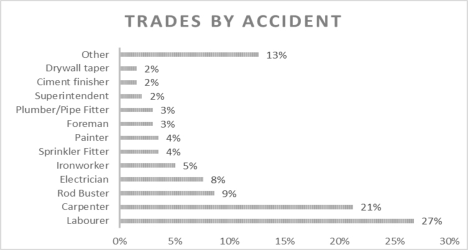
Trades Anwer et al., (2021) suggest that musculoskeletal injuries are influenced by trade and task-specific risk factors. Findings from one trade may not necessa- rily apply to others (e. g., painters versus rebar workers) (Anwer et al., 2021). To determine which trades are most likely to suffer from WRMSD and hence benefit from exoskeletons, this study examined accidents by trade. Labo- rers were involved in 53 accidents, or 27% of the total number, as shown in Figure 1. With 42 accidents, carpenters made up 21% of all accidents. The number of accidents among rod busters (rebar workers), electricians, and ironworkers was 17 (9%), 15 (8%), and 10 (5%), respectively. All 22 other trades had accident rates below 4% among the 198 entries analyzed.
Figure 1: Trades by accident.
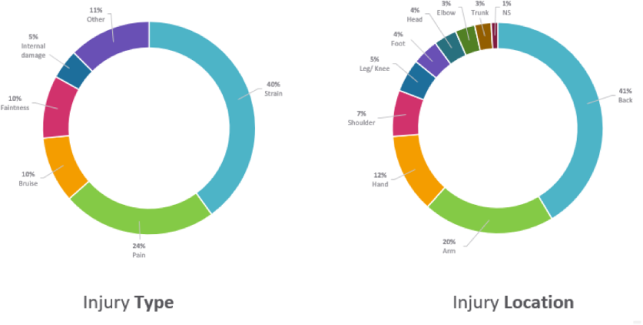
ACCIDENT TYPE AND INJURY LOCATION According to Figure 2, 41 % of all accidents analyzed resulted in back inju- ries. Among the accidents analyzed, injuries to the arm, hand, shoulder, leg/knee, and elbow accounted for 20%, 12%, 7%, and 5%, respectively. A study by Pan et al., (2022) showed that the back is the body part most susce- ptible to injuries in construction. In terms of injury type, strains account for most cases (40%), followed by pain (24%), faintness (10%), bruises (10%), internal damage (5%), and others (13%).
Figure 2: Injury location and type.
Table 2 illustrates the relationship between the injury type and body loca- tion. Accordingly, when an accident involving the back or the arms occurs, workers will probably suffer from strain and pain.
Types of Construction Accidents According to the Occupational Safety and Health Administration, root causes are underlying factors responsible for the occurrence of an accident (OSHA, 2015). The direct cause occurred immediately before the accident and dire- ctly caused it (Argonne National Laboratory, 2017). As root causes are not always immediately evident, and direct causes sometimes differ, both were determined. An example within the database would be a worker that felt a sharp pain in his back after forcing a ventilation duct into place. He was per- forming his task in the ceiling. An excessive strain would be the direct cause, while an awkward posture would be the root cause since he was working with his hands above shoulder level. Another example is a worker who fell as he was going up a staircase while carrying several 2x4s on his shoulder. The root cause would be an excessive strain and the direct cause would be a fall. Finally, a worker and his colleague were transporting a pipe weigh- ing approximately 105 lbs. One of the workers fell and dropped the pipe, causing his co-workers’ shoulder to be injured. As a direct cause, the inju- red worker was struck by an object, while as a root cause, the colleague fell and dropped the pipe. Of the 198 accidents, 39 had a different root and direct cause.
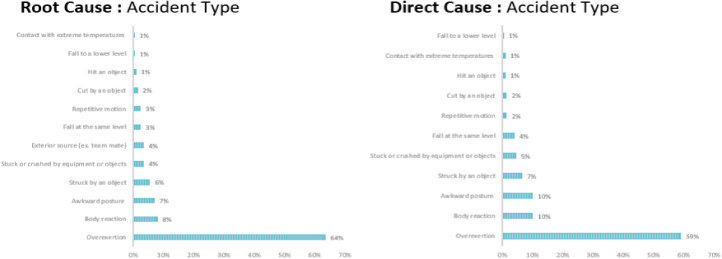
According to Figure 3, nearly 80% of the accidents analyzed had a root cause associated with overexertion, body reactions, and awkward posture. Among the 198 accidents analyzed, there were 126 cases of overexertion (64%), 16 cases of body reactions (8%), and 14 cases of awkward postures (7%). Similar results were found for the direct cause of the accidents. Ove- rexertion (59%), body reactions (10%), and awkward postures (10%) were also responsible for about 80% of the accidents. To prevent future accidents,
An Overview of Various Tasks and Trades in the Construction Industry 61
Table 2. Relationship between injury type and body location.
Table available in the original PDF paper.
Injury Type Injury Location # of acc. Total # of acc.
Strain Back 44 80 Arm 15 Shoulder 9 Hand 7 Elbow 2 Leg 2 Trunk 1 Pain Back 18 48 Arm 10 Shoulder 4 Head/Neck 2 Leg/Knee 5 Hand 3 Trunk 3 Foot 2 Elbow 1
Faintness Back 14 20 Head/Neck 2 Arm 1 Elbow 1 Leg/Knee 1 Trunk 1 Bruise Back 5 20 Arm 5 Foot 5 Hand 2 Head/Neck 1 Elbow 1 Trunk 1
Internal Damage Arm 6 9 Hand 1 Leg/Knee 1 Foot 1 Other (Irritation, crushing, cut) Hand 10 21 Head/Neck 3 Arm 2 Not specified 2 Leg/Knee 1 Elbow 1 Back 1 Shoulder 1
organizations should focus on the root cause rather than the direct cause (Argonne National Laboratory, 2017).
Overexertion was primarily associated with holding, carrying, turning, or brandishing objects, lifting, pulling, or pushing objects, and using rota- ting power-vibrating hand tools. Body reactions manifested when bending,
Figure 3: Accident types.
climbing, crawling, stretching, and turning. Twisting was included here as well. Finally, awkward postures were associated with kneeling, squatting, and working with the hands above shoulder level. Table 3 provides more details. Direct causes also yielded similar results.
Regarding injuries associated with exertions for which no exoskeletons are currently available, exoskeletons should meet the following conditions:
Allow handling loads with widely varying characteristics (e.g., weight, dimensions);
Provide a good grip on the load being handled;
Provide good equipment to better support the use of power hand tools;
Help pull on loads;
Help with squatting and kneeling-related tasks to maintain stability and comfort;
Possible usage in a narrow and difficult environment;
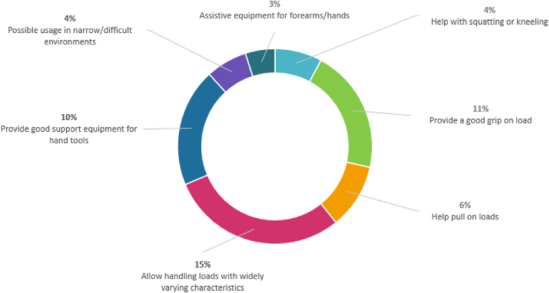
Assistive equipment for the forearms and hands; Only 22 of the 198 accidents analyzed resulted in lost days, totaling 189 days. Manual handling was the most common cause of these accidents. Workers in the construction industry handle a variety of materials, such as formwork panels, benches, insulating canvas, lumber, reinforcing steel rods, steel beams, cable rolls, concrete buckets, and bricks. Figure 4 shows that exoskeletons that allow handling loads with widely varying characteristics could possibly have prevented 15% of the analyzed accidents. The database showed workers hurting their backs while lifting large fans from concrete blocks, carrying reinforcing steel bars to a lower lever, lifting 300 lbs of acoustic panels, and much more. Exoskeletons that would provide a better grip on objects could have prevented 11 % of accidents. There were several accidents where workers were injured while handling large plywood sheets, canvas, and metal heddles because they slipped from their hands. In 17 of the 198 accidents, workers handled materials as a team since the loads were too heavy for a single individual. Several examples of heavy materials inclu- ded a 200-pound pipe, a 1000-pound material lift, a 200-pound heating unit, metal walkway parts, and electrical panels. Several accidents occurred when a teammate dropped his side of the load. Manual handling accidents could
An Overview of Various Tasks and Trades in the Construction Industry 63
Table 3. Root cause accident types specified.
Table available in the original PDF paper.
Accident Type Accident Type Specified # of acc.
Total # of acc.
42 126
Overexertion Overexertion while holding, carrying, turning or brandishing objects.
16
Overexertion while lifting an object. 41 Overexertion when pulling or pushing objects. 22 Excessive strain when using a rotating or vibrating hand tool.
Overexertion. 5
1
Body reaction Bending, climbing, crawling, stretching, turning. 10 16 Tripping over an object -- without falling. 3 Body reaction to exertion. 2 Slipping, tripping, losing balance -- not falling, unspecified.
Awkward posture Kneeling or squatting. 7 14 Work above the shoulders. 6 Work far from the center of gravity. 1 Struck by an object Struck by an object that slips from the hands. 7 11 Struck by a falling object. 2 Struck by an object used or handled. 2
Stuck or crushed by equipment or objects. 6 7 Stuck or crushed by equipment or objects Stuck by moving equipment or machinery, 1
Repetitive motion Repetitive use of tools. 4 5 Repetitive motion. 1 Fall at the same level Fall onto a floor, walkway or other surface. 4 5 Fall on or against objects. 1
Cut by an object Cut by an object with sharp edges. 3 3 Hit an object Hitting a stationary object. 2 2
Contact with extreme temperatures; 1 1 Contact with extreme temperatures
Falling down stairs or steps. 1 1 Fall to a lower level
possibly be reduced by exoskeletons that could provide a good grip on objects and that would allow workers to handle loads with varying characteristics.
An exoskeleton capable of supporting rotating hand tools could poten- tially have prevented 10% of analyzed accidents. Many accidents occurred due to drilling bits getting stuck suddenly and straining workers’ hands and arms by the tool’s counter-reaction. 6% of accidents could have been preven- ted by exoskeletons that could help workers pull on loads. Workers injured their backs, torsos, and hands while pulling on power cables, geosynthe- tic materials, and concrete out of a 15-foot well. Exoskeletons that could
Figure 4: Exoskeleton desirable characteristics.
help with squatting and kneeling could have prevented 4% of accidents. A worker experienced back pain after installing framing on scaffolding in a kneeling position. Other workers experienced back and shoulder pain while sanding concrete floors and beams on their knees. Bulky exoskeletons would be unsuitable for tasks in restricted places, like the plenum space in ceilings, which accounted for 4% of the accidents. Finally, assistive equipment for the forearms and hands to better hold a tool could have prevented 3% of analy- zed accidents. A worker injured his wrist while exerting force on a tool to loosen an object, while another injured his forearm during intensive scraping.
CONCLUSION
By analyzing accident databases, employers gain insight into accident cau- ses and injuries, allowing them to determine which tasks and trades could potentially benefit from existing or new exoskeletons. It also informs manu- facturers on the requirements that their exoskeletons should meet to better help and protect workers. According to the data analysis, exoskeletons could greatly benefit laborers and carpenters. Manually handling objects of vari- ous sizes and weights, or rotating hand tools jamming unexpectedly, were the most common causes of accidents in the database analyzed. These were associated with overexertion that most often resulted in back and arm strain, among other injuries. Many accidents analyzed in this database could not be prevented with the exoskeletons currently available. Future exoskeletons should therefore be capable of helping with handling loads with varying cha- racteristics, providing a good grip on objects, assisting in pulling loads, and providing good hand tool support equipment.
The second phase of this study will focus on using exoskeletons in constru- ction sites to collect data and assess their effectiveness with trades and tasks established in this first phase.
ACKNOWLEDGMENT
The authors wish to thank our industrial partner for authorizing us to use their data, making this study possible. We also wish to thank Mitacs and our industrial partner for contributing to the funding of this research.
An Overview of Various Tasks and Trades in the Construction Industry 65
REFERENCES
Anwer, S., Li, H., Antwi-Afari, M. F., Wong, A. Y. L., 2021. Associations between physical or psychosocial risk factors and work-related musculoskele- tal disorders in construction workers based on literature in the last 20 years: A systematic review. International Journal of Industrial Ergonomics 83, 103113. https://doi.org/10.1016/j.ergon.2021.103113 Argonne National Laboratory., 2017. HSX MODULE: ROOT CAUSE ANALY-
SIS. https://www.chds.us/coursefiles/hsx/modules/root_cause_analysis/story_cont ent/external_files/HSx%20Module_Root%20Cause%20Analysis.pdf AWCBC-The Association of Workers’ Compensation Boards of Canada, 2021. National Work Injury, Disease and Fatality Statistics. https://awcbc.org/wp-content/ uploads/2022/07/National_Work_Injury_Disease_and_Fatality_Statistics-2018- 2020.pdf CNESST-Commission des normes de l’équité de la santé et de la sécurité du travail.,
2021. Statistiques sur les lésions attribuables aux troubles musculosquelettiques musculosquelettiques. https://www.cnesst.gouv.qc.ca/sites/default/files/document s/statistiques-lesions-tms.pdf CNESST-Commission des normes de l’équité de la santé et de la sécurité du travail.,
2023. Work accident. https://www.cnesst.gouv.qc.ca/en/working-conditions/leav e/accidents-and-illnesses de Looze, M. P., Bosch, T., Krause, F., Stadler, K. S., O’Sullivan, L. W., 2016. Exoskeletons for industrial application and their potential effects on physical workload. Ergonomics 59, 67 1681. https://doi.org/10.1080/00140139.2015.1081988 Karvouniari, A., Michalos, G., Dimitropoulos, N., Makris, S., 2018. An approach for
exoskeleton integration in manufacturing lines using Virtual Reality techniques. Procedia CIRP 78, 103–108. https://doi.org/10.1016/j.procir.2018.08.315 Kim, S., Moore, A., Srinivasan, D., Akanmu, A., Barr, A., Harris-Adamson, C., Rempel, D. M., Nussbaum, M. A., 2019. Potential of Exoskeleton Technologies to Enhance Safety, Health, and Performance in Construction: Industry Perspectives and Future Research Directions. IISE Transactions on Occupational Ergono- mics and Human Factors 7, 185–191. https://doi.org/10.1080/24725838.2018. 1561557 Linner, T., Pan, M., Pan, Wen, Taghavi, M., Pan, Wei, Bock, T., 2018. Identification
of Usage Scenarios for Robotic Exoskeletons in the Context of the Hong Kong Construction Industry. Presented at the 34th International Symposium on Auto- mation and Robotics in Construction, Taipei, Taiwan. https://doi.org/10.22260/ ISARC2018/0006 OSHA-Occupational Safety and Health Administration., 2015. Incident [Accident]Investigations: A Guide for Employers. https://www.osha.gov/sites/default /files/IncInvGuide4Empl_Dec2015.pdf Pan, X., Zhong, B., Wang, Y., Shen, L., 2022. Identification of accident-
injury type and bodypart factors from construction accident reports: A graph- based deep learning framework. Advanced Engineering Informatics 54, 101752. https://doi.org/10.1016/j.aei.2022.101752 Zhu, Z., Dutta, A., Dai, F., 2021. Exoskeletons for manual material handling – A review and implication for construction applications. Automation in Construction 122, 103493. https://doi.org/10.1016/j.autcon.2020.103493
LISTED IN THE AHFE DIGITAL BOOKSTORE CATALOGUE
Explore the complete digital volume
Human Factors and Wearable Technologies
Read this individual research paper free through the original publisher, or explore the full digital proceedings book.
ISBN 978-1-958651-61-2
Explore this ISBN in the AHFE Bookstore ↗Listed in the July 2026 bookstore catalogue; search by ISBN to confirm current availability · Digital book purchase optional