Qingyuan Kan, Tiejun Ma (2026). User Perception and Sentiment Analysis of Knee exoskeletons for Hiking Based on Social Media Comments: A Preliminary Study. In: Human Factors in Robots, Drones and Unmanned Systems. AHFE Open Access, vol. 218, pp. 66–76. https://doi.org/10.54941/ahfe1007679
With the rapid development of wearable robotic technologies, knee exoskeletons especially for hiking have emerged as assistive devices intended to reduce physical fatigue during outdoor activities. As these systems gradually enter early-stage consumer markets, understanding users’ real-world perceptions is important for human-centered design and evaluation. This study investigates public perceptions of knee exoskeletons through analysis of user-generated comments from social media. Approximately 9,000 comments related to knee exoskeletons were collected from the Chinese social media platform Rednote over a six-month period. After data cleaning and preprocessing, 7,280 valid comments were retained. Chinese word segmentation and Term Frequency–Inverse Document Frequency weighting were applied to extract textual features, and K-means clustering was used to identify major thematic categories in user discussions. In addition, lexicon-based sentiment analysis using the National Taiwan University Sentiment Dictionary was conducted to examine emotional tendencies. The results indicate that user discussions mainly focus on product attributes and usage scenarios. Neutral expressions (4755) dominate the comments, while negative sentiment (1304) slightly outweighs positive sentiment (1221) among emotionally polarized comments, reflecting a cautious and pragmatic public attitude. Although users recognize the potential benefits of physical assistance, concerns regarding comfort, weight, usability, and practical value remain prominent. Overall, this study demonstrates the feasibility of social media comment analysis as a complementary approach for evaluating human factors in emerging wearable robotic systems.
With the development of wearable robotic technologies, exoskeleton systems have gradually expanded from industrial and medical applications to consumer-oriented scenarios such as outdoor activities. Knee exoskeletons are designed to assist lower-limb movement, reduce physical fatigue, and enhance endurance during prolonged walking. These exoskeletons have been applied in tourist areas of famous mountains in
User Perception and Sentiment Analysis of Knee Exoskeletons 67 China to assist hikers, who need to pay out of their own pockets to rent them. As these devices begin to appear in public settings and early-stage markets, understanding how they are perceived and discussed by users andpotential users has become increasingly relevant for human-centered design and improvement.
Most existing studies on lower-limb exoskeletons have focused on biomechanical performance, energetic efficiency, and evaluations conducted under controlled experimental conditions (Dollar and Herr, 2008; Young and Ferris, 2017). More recent reviews have further emphasized sensing, interactive control, and human–robot interaction as key technical aspects in exoskeleton development (Zhang et al., 2024). While these studies provide essential insights into system design and functional performance, they typically rely on predefined tasks and limited participant samples. Consequently, users’ spontaneous perceptions, expectations, and concerns in informal or everyday contexts are less frequently examined.
In parallel with experimental research, social media platforms have become important spaces where users share observations, impressions, and limited experiences with emerging technologies. User-generated comments reflect how products are interpreted, evaluated, and contextualized in natural discussion environments. Analyzing such data therefore offers a complementary perspective on public perception that differs from laboratory- based evaluation or structured surveys.
Against this background, the present study investigates public perceptions of knee exoskeletons for hiking through large-scale analysis of user- generated comments collected from a Chinese social media platform. By applying text feature extraction, term-level clustering, and lexicon-based sentiment analysis, this study aims to identify key experiential themes reflected in user discussions, examine the multidimensional structure of user evaluations, and describe overall emotional tendencies expressed in public discourse.
METHODS
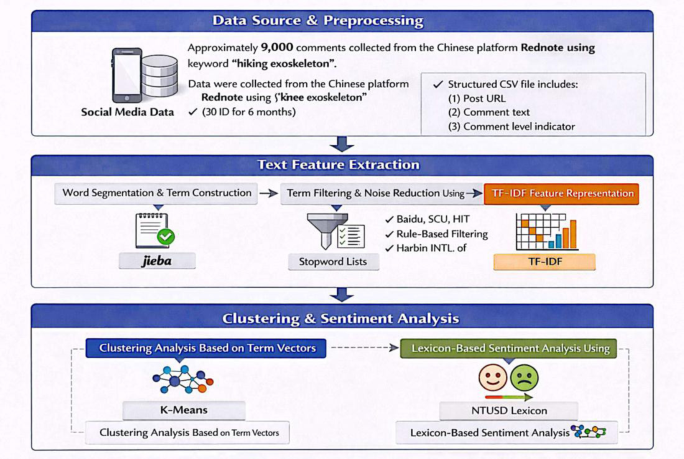
This study adopts a structured, multi-stage text analysis framework to investigate user perceptions of hiking exoskeletons based on large-scale social media comments. The overall methodology integrates data preprocessing, text feature extraction, and combined clustering and sentiment analysis, forming a coherent analytical pipeline for exploring both thematic patterns and emotional tendencies in user-generated content. An overview of the methodological framework is illustrated in Figure 1.
Figure 1: Analytical workflow for social media comment analysis of knee exoskeletons.
DATA SOURCE AND PREPROCESSING To systematically examine public attitudes toward knee exoskeletons, this study analyzed user-generated comments as spontaneous, experience-based evidence from social media. Data were collected from the Chinese platform Rednote (https://www.xiaohongshu.com) using the search keyword “knee exoskeleton”. Comments posted under relevant entries within the most recent six-month period were retrieved, yielding an initial dataset of approximately 9,000 comments. All comments were stored in a structured CSV file. Each record contained (1) the URL of the associated post, (2) the comment text, and (3) a comment- level indicator. The comment-level field distinguishes primary (first-level) comments from nested replies, enabling analysis across different layers of user interaction.
Prior to analysis, the raw dataset was cleaned and filtered. Duplicate comments with identical content were removed. Noisy entries that contained only emojis, user mentions (e.g., “@username”), or lacked meaningful textual content were excluded. To further reduce the influence of low-information texts, comments shorter than three Chinese characters were filtered out. After preprocessing, 7,280 valid comments remained for subsequent analyses, including word frequency statistics, clustering, and sentiment analysis.
TEXT FEATURE EXTRACTION Word Segmentation and Term Construction
User-generated comments on social media platforms are often informal, fragmented, and linguistically irregular, which makes raw text unsuitable for direct quantitative analysis. In Chinese text processing, the absence of explicit word boundaries further necessitates word segmentation as a fundamental preprocessing step for subsequent text mining and semantic analysis.
In this study, the jieba Chinese word segmentation tool was employed to segment all valid comments into lexical units. Jieba is an open-source Chinese text segmentation toolkit that has been widely used in natural language processing tasks, including social media analysis and sentiment analysis, due to its robustness and practical effectiveness in handling large- scale user-generated content (Jieba Chinese Text Segmentation, 2024).
To construct textual features, an n-gram modeling strategy was adopted to control feature granularity. Given that this study focuses on users’ general perceptions and discussion themes rather than complex syntactic structures, word-level features were considered sufficient. Accordingly, the n-gram parameter was set to n = 1, resulting in a unigram-based term set. Higher- order n-grams were excluded to maintain interpretability and to limit feature dimensionality, following common practices in text mining and information retrieval research (Manning et al., 2008).
Through the above segmentation and term construction process, the original comment texts were transformed into a structured set of lexical features, providing a unified and computable input for subsequent term filtering, feature representation, and clustering and sentiment analysis.
Term Filtering and Noise Reduction After word segmentation and term construction, the resulting term set still contains a number of terms with limited semantic meaning or low information content. To improve the semantic validity and interpretability of textual features, a multi-level, rule-based term filtering and noise reduction strategy was applied to the segmented results.
Specifically, common functional words, pronouns, and grammatical terms were removed using a combination of three widely used Chinese stopword dictionaries, including the Baidu stopword list, the Sichuan University stopword list, and the Harbin Institute of Technology stopword list, in order to reduce the influence of high-frequency terms with limited discriminative power (Baidu, 2023; SCU NLP Group, 2019; HIT NLP Group, 2020). Single-character terms were further excluded, as they generally lack stable and explicit semantic meaning in Chinese text.
In addition, structural noise introduced by platform-specific mechanisms in social media comments was eliminated by removing fixed formatted fields (e.g., “Reply username:”), as well as punctuation marks and emoji symbols that do not convey linguistic semantic information. Based on the characteristics of the Chinese language and the objectives of this study, residual low-information terms such as quantifiers and subject-related terms were further filtered.
70 Kan and Ma Overall, this rule-based filtering strategy effectively reduces noise in social media text and yields a refined term set that better reflects users’ experiential and attitudinal expressions, thereby improving the reliability of subsequent text mining analyses (Aggarwal, 2018).
TF–IDF Feature Representation To convert the filtered terms after noise reduction into quantitative features suitable for analysis, the TF–IDF (Term Frequency–Inverse Document Frequency) weighting scheme was adopted. TF–IDF is a widely used text representation method that assigns higher weights to terms that are frequent within a document but relatively rare across the entire corpus, thereby enhancing their discriminative power (Salton and Buckley, 1988; Manning et al., 2008).
In this study, TF–IDF was applied to the refined term set obtained after rule- based filtering. By down-weighting ubiquitous terms and emphasizing more informative ones, TF–IDF provides a compact and interpretable representation of term importance within user comments, and has been extensively used in information retrieval and text analysis tasks (Singhal et al., 1996).
Generally speaking, the TF–IDF representation effectively captures the relative importance of terms in user comments while maintaining interpretability, making it well suited for subsequent exploratory analyses in this study.
CLUSTERING AND SENTIMENT ANALYSIS Clustering Analysis Based on Term Vectors
After TF–IDF feature representation, clustering analysis was conducted to explore latent semantic structures in user discussions. In this study, clustering was performed at the term level rather than the comment level. Each term was represented by its TF–IDF distribution across all comments, allowing the analysis to capture differences in how terms are used across discussion contexts. In parallel, raw word frequency statistics were computed to provide a complementary overview of commonly mentioned concepts (Salton and Buckley, 1988; Manning et al., 2008).
Because the original term vectors are high-dimensional—where each dimension corresponds to an individual comment—direct clustering in the original space may lead to instability and cluster degeneration. To improve robustness, Truncated Singular Value Decomposition (Truncated SVD) was applied to project the high-dimensional term–comment matrix into a lower- dimensional latent semantic space, preserving dominant co-occurrence patterns while reducing noise and sparsity (Deerwester et al., 1990). The reduced term vectors were then L2-normalized to ensure that clustering was driven by similarities in usage patterns rather than absolute frequency differences (Singhal et al., 1996).
Following these preprocessing steps, K-means clustering was applied to the normalized term vectors, with the number of clusters set to 4. This choice prioritizes semantic interpretability and stability over mathematical optimality, making it suitable for exploratory analysis of user experience–related content
User Perception and Sentiment Analysis of Knee Exoskeletons 71 (MacQueen, 1967). To characterize each cluster, terms were ranked by their average TF–IDF values within the cluster, and top-ranked terms were selected as representative keywords for semantic interpretation and visualization.
This clustering strategy enables the identification of distinct groups of terms that share similar usage patterns across user comments, providing an interpretable representation of recurring themes in user discussions.
Lexicon-Based Sentiment Analysis To examine the overall emotional tendencies expressed in user comments, a lexicon-based sentiment analysis approach was adopted. In this study, sentiment polarity was identified using the National Taiwan University Sentiment Dictionary (NTUSD), which provides curated lists of positive and negative sentiment terms and has been widely used in Chinese sentiment analysis research (Ku & Chen, 2007).
After term filtering and feature extraction, each comment was analyzed by matching its constituent terms against the NTUSD sentiment lexicon. For each comment, the numbers of positive and negative sentiment terms were counted to characterize its emotional orientation. Compared with supervised learning approaches, the lexicon-based method offers greater transparency and interpretability, making it well suited for exploratory analysis of large- scale, unlabeled social media data.
To reduce the influence of comment length and uneven term distributions, sentiment scores were normalized by the total number of terms in each comment. In addition to separate positive and negative counts, a net sentiment score was computed as the difference between positive and negative sentiment term frequencies, providing a concise indicator of overall emotional tendency.
This sentiment analysis strategy enables a straightforward assessment of users’ general attitudes expressed in the comments, complementing the clustering analysis by adding an affective perspective to the interpretation of thematic patterns.
RESULTS AND DISCUSSION
High-Frequency and TF–IDF Term Analysis
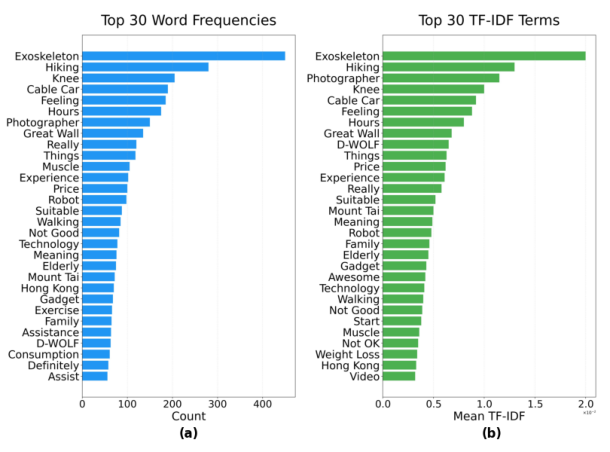
Figure 2 presents the top 30 terms ranked by word frequency and TF–IDF values, providing an overview of the most salient concepts in user discussions related to knee exoskeletons. The word frequency results show that terms such as exoskeleton, hiking, knee, calorie, and mount occur most frequently across the comment corpus. These high-frequency terms indicate that user discussions are predominantly centred on physical assistance, body-related experience, and hiking scenarios. Overall, the frequency-based distribution suggests that users primarily focus on practical usage and perceived physical effects rather than technical specifications.
In contrast, the TF–IDF ranking highlights terms that are more context- specific and discriminative across different comments. Terms such as photographer, Great Wall, Mount Tai, price, and experience appear
72 Kan and Ma prominently, reflecting discussions grounded in concrete usage contexts, personal experiences, and cost-related considerations. Compared with raw frequency results, TF–IDF terms capture less common but more distinctive aspects of user discourse, indicating diversity in how users describe and evaluate knee exoskeletons.
Clustering Analysis of High-Frequency Terms Based on the term-level clustering results, high-frequency terms were grouped into four clusters, each representing a distinct semantic pattern in user discussions. Table 1 lists the top 30 representative terms for each cluster, ranked by their average TF–IDF values.
Table 1 presents the representative terms for each cluster, ranked by their average TF–IDF values. Cluster 0 is dominated by general conversational and platform-related terms, including reply expressions, interaction-related words, and social references, reflecting common communication patterns on social media platforms.
Clusters 1 to 3 contain terms that are more closely related to knee exoskeletons. Cluster 1 includes terms associated with specific usage scenarios and practical considerations, such as hiking locations, physical conditions, and cost-related factors. Cluster 2 is characterized by terms describing user perceptions and experiential responses, including perceived effectiveness, walking experience, and related equipment. Cluster 3 comprises terms related to product-specific perception and contextual references, including technical attributes, usage conditions, and social or regional references.
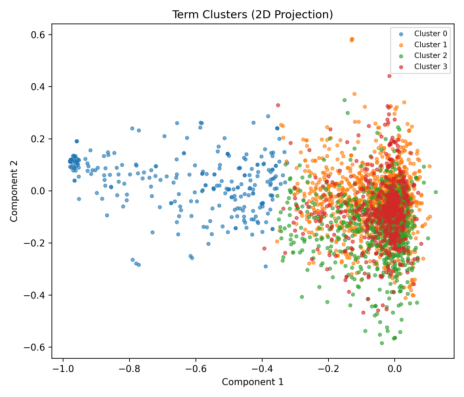
Figure 2: Top 30 terms ranked by word frequency and TF-IDF values.Figure 3: Two-dimensional visualization of TF–IDF-based term clusters using Truncated SVD.Table 1: Representative terms for each cluster ranked by average TF–IDF values.
Table available in the original PDF paper.
Cluster Number Top20 Words 0 Reply/Private message/Thanks/Thank you/Support/Like/Encouragement/ Agree/Indeed/Really/Maybe/Someone/Everyone/Video/Comment/ Share/Recommend/Understand/Feel/Watch/Introduction/Explain/Chat/ Communication/Interaction/Friends/Family/Online/Platform/Discussion
3 Exoskeleton/realistic/Hong Kong/video/great/encouragement/ time/load/like/out of power/mobile phone/mechanical/protection/ China/rehabilitation/scenic area/altitude/authoritative/ recommendation/increasingly
Figure 3 shows the two-dimensional visualization of TF–IDF-based term clusters. A distinct separation can be observed for Cluster 0, which is clearly isolated from the remaining clusters along the first component. This cluster contains a relatively sparse distribution of terms and does not exhibit strong semantic coherence, suggesting that it primarily consists of low-informational or weakly related terms rather than a meaningful discussion theme.
Clusters 1–3, on the other hand, are distributed in closer proximity within the two-dimensional space, forming denser regions with partially overlapping boundaries. Although these clusters are spatially adjacent, their overall distributions differ in terms of density and central tendency, indicating that
74 Kan and Ma they represent related but distinguishable patterns of term usage. This result suggests that user discussions are organized around multiple experiential dimensions that share common vocabulary while maintaining distinct focal emphases.
Overall, the clustering results reveal that user discussions of knee exoskeletons are structured around multiple experiential dimensions, while also containing a distinct layer of platform-related conversational content. This structure highlights the multidimensional nature of user perceptions and provides a basis for further interpretation in subsequent analysis.
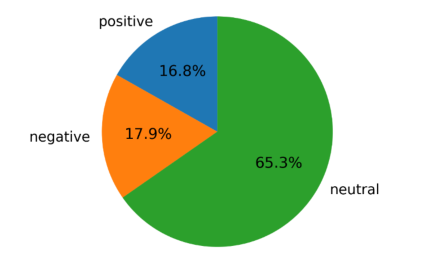
Sentiment Analysis Results The sentiment analysis results of user comments are summarized based on the lexicon-based classification using the National Taiwan University Sentiment Dictionary. After preprocessing, a total of 7,280 valid comments were included in the analysis and categorized into positive, negative, and neutral sentiment classes.
As shown in the results, neutral comments constitute the majority of the dataset, accounting for 4,755 comments (65.3%). These comments mainly consist of descriptive statements, inquiries, or neutral observations regarding knee exoskeletons. Among the remaining comments with explicit emotional polarity, 1,304 comments (17.9%) were classified as negative, while 1,221 comments (16.8%) were classified as positive.
Figure 4: Sentiment distribution of knee exoskeleton user comments.
Taken together with the clustering results presented above, these findings provide further insight into the underlying factors shaping user perceptions of knee exoskeletons.
The clustering results suggest that current user perceptions of knee exoskeletons are largely shaped by mediated exposure and limited situational experience rather than sustained personal use. A substantial portion of high- frequency terms is associated with videos, demonstrations, and specific tourist destinations, indicating that many users form their impressions through online visual content or short-term trial experiences in scenic areas.
User discussions therefore tend to emphasize visible features, technological novelty, and immediate assistance effects, while topics related to long-term
User Perception and Sentiment Analysis of Knee Exoskeletons 75 comfort, reliability, and continuous usability appear less prominent. This pattern suggests that public understanding of knee exoskeletons may still be at an early stage of adoption, where perceptions are influenced more by media representation and contextual exposure than by extensive hands-on experience.
When considered alongside the sentiment analysis results, the slightly higher proportion of negative sentiment among emotionally polarized comments may reflect cautious attitudes arising from practical concerns, such as price, weight, and endurance, particularly when anticipated benefits do not fully align with real-world application scenarios.
CONCLUSION
This study examined public perceptions of knee exoskeletons through large-scale analysis of user-generated social media comments. The results show that user evaluations are mainly experience-oriented, emphasizing assistance effectiveness, comfort, and usage contexts, and are inherently multidimensional. Sentiment analysis indicates that neutral expressions dominate discussions, while negative opinions slightly outweigh positive ones, reflecting generally cautious attitudes toward this emerging consumer- oriented assistive technology. Overall, social media–based analysis offers valuable insights into real-world usability concerns and supports user- centered evaluation and iterative design of knee exoskeletons.
ACKNOWLEDGMENT
The authors declared no potential conflicts of interest with respect to the research, authorship, and/or publication of this article.
REFERENCES
Deerwester, S., Dumais, S.T., Furnas, G.W., Landauer, T.K. and Harshman, R.
(1990). Indexing by latent semantic analysis. Journal of the American Society for Information Science, Volume 41, No. 6, pp. 391–407. Dollar, A. M. and Herr, H. (2008). Lower extremity exoskeletons and active orthoses: Challenges and state-of-the-art. IEEE Transactions on Robotics, Volume 24, No. 1, pp. 144–158. Fox, C. (1989). A stop list for general text. ACM SIGIR Forum, Volume 24, No. 1–2,
pp. 19–35. Jiang, J., Xu, X. and Sun, M. (2008). Research on Chinese stop word list and word segmentation. Journal of Chinese Information Processing, Volume 22, No. 6, pp. 34–40. Jieba Chinese Text Segmentation. (2024). Open-source Chinese text segmentation toolkit. Available at: https://github.com/fxsjy/jieba Jurafsky, D. and Martin, J.H. (2009). Speech and language processing. Pearson
Education. Ku, L.W. and Chen, H.H. (2007). Mining opinions from the Web: Beyond relevance retrieval. Journal of the American Society for Information Science and Technology, Volume 58, No. 12, pp. 1838–1850.
observations. Proceedings of the Fifth Berkeley Symposium on Mathematical Statistics and Probability, Volume 1, No. 1, pp. 281–297. Manning, C.D., Raghavan, P. and Schütze, H. (2008). Introduction to Information Retrieval. Cambridge University Press. National Taiwan University Sentiment Dictionary (NTUSD). (2024). Sentiment
lexicon for Chinese text analysis. Available at: https://github.com/ntunlplab/ NTUSD Salton, G. and Buckley, C. (1988). Term-weighting approaches in automatic text retrieval. Information Processing & Management, Volume 24, No. 5, Shannon, C.E. (1948). A mathematical theory of communication. Bell System
Technical Journal, Volume 27, No. 3, pp. 379–423. Singhal, A., Buckley, C. and Mitra, M. (1996). Pivoted document length normalization.
Proceedings of the 19th Annual International ACM SIGIR Conference on Research and Development in Information Retrieval, pp. 21–29. Wang, X., Li, Z. and Wang, H. (2010). Research on Chinese text classification technology based on stop words dictionary. Journal of Software, Volume 21, No. 5, pp. 1148–1156. Xue, N. and Shen, L. (2003). Chinese word segmentation as LMR tagging.
Proceedings of the Second SIGHAN Workshop on Chinese Language Processing. Yao, H. and Deng, W. (2012). Research on Chinese stop words dictionary and its application. Journal of Computer Applications, Volume 32, No. 7, pp. 1937–1940. Young, A. J. and Ferris, D. P. (2017). State of the art and future directions for
lower limb robotic exoskeletons. IEEE Transactions on Neural Systems and Rehabilitation Engineering, Volume 25, No. 2, pp. 171–182. Zhang, Y., Jin, R. and Zhou, Z.H. (2010). Understanding bag-of-words model: A statistical framework. International Journal of Machine Learning and Cybernetics, Volume 1, No. 1, pp. 43–52. Zhang, Y.-P., Cao, G.-Z., Li, L.-L. and Diao, D.-F. (2024). Interactive control of
lower limb exoskeleton robots: A review. IEEE Sensors Journal, Volume 24, No. 5, pp. 5759–5784.
LISTED IN THE AHFE DIGITAL BOOKSTORE CATALOGUE
Explore the complete digital volume
Human Factors in Robots, Drones and Unmanned Systems
Read this individual research paper free through the original publisher, or explore the full digital proceedings book.
ISBN 978-1-964867-94-6
Explore this ISBN in the AHFE Bookstore ↗Listed in the July 2026 bookstore catalogue; search by ISBN to confirm current availability · Digital book purchase optional