Myeonghoon Ko, Tiejun Ma, Shuping Xiong (2022). Effects of carbon fiber insole on lower-extremity muscle activation and wearing comfort during treadmill running. In: Physical Ergonomics and Human Factors. AHFE Open Access, vol. 63, pp. 21–27. https://doi.org/10.54941/ahfe1002592
Background and Objective: Although the role of shoes on sports performance and injury has been extensively examined, only a few studies investigated the effects from insoles. Recent studies on carbon fiber insoles (CFI) on athletic performance reported that CFI could improve sports performance by reducing energy loss and increasing energy return. However, there are scarce reports on the effects of CFI on muscle fatigue and wearing comfort. While stiffer CFI insoles are superior in energy loss reduction and energy return, they could increase more muscle activation to absorb the shock or provide more propulsive force to push CFI, leading to increased muscle fatigue and discomfort. Therefore, this study aims to evaluate the effect of CFI on lower-extremity muscle activation and wearing comfort during treadmill running. Methods: Three types of insoles were compared, namely CFI, CFI with cushioning (CFIC), and a benchmark commercial insole (COM). Fifteen healthy young men participated in the experiment. Each participant wore the same sports shoe, three different insoles in a random order, and ran on a treadmill at a speed of 10 km/h for 5 minutes. Surface electromyography signals of four lower-extremity muscles (Rectus femoris, Tibialis anterior, Biceps femoris, and Gastrocnemius medialis) were recorded in real-time for measuring muscle activation. After completing a trial run with each experimental insole, the participants provided their subjective ratings on perceived insole stiffness, energy support, overall comfort, and fatigue. Analysis of variance (ANOVA) and post-hoc grouping analysis were conducted to statistically evaluate the effects from three different insoles. Paired t-test was performed to compare CFI and CFIC and explore any cushioning effect. Results: In terms of lower-extremity muscle activation, even though CFIC and COM showed no significant difference for all four lower-extremity muscles, CFI induced a marginally significant increase of 1.5% on Gastrocnemius medialis (p = 0.063) and a significant reduction of 0.7% on rectus femoris (p=0.011) than COM. For the subjective ratings, both CFI and CFIC were significantly stiffer than COM (p < 0.001), but there were no significant differences in overall comfort, energy support, and fatigue. Compared with CFI, CFIC significantly reduced Gastrocnemius medialis muscle usage by 2.1% (p = 0.012) and was marginally less stiff (p = 0.102).Conclusions: This preliminary study showed that the carbon fiber insole CFI induced higher calf muscle usage and was perceived to be stiffer during treadmill running, which could contribute to provide the propulsive force for better sports performance. Carbon fiber insole with cushioning (CFIC) can help to relieve muscular fatigue. Further research should be conducted to examine the carbon insole effects on sports performance and long-term muscle activation and perceived feelings.
Increasing energy return and reducing of energy loss are two main strategies for improving athletic performance (Martyn R. Shorten, 2011; Nigg et al., 2000). In terms of energy considerations, there has been extensive research on the effects of shoes on sports performance. A previous study suggested cer- tain requirements for energy return (Martyn R. Shorten, 1993). For example, energy must be returned at the correct location and at the exact time with the right frequency. In addition, the area where the effective energy return should be made differs from the maximum energy storage area. Also, studies have shown that the cushioning materials are not ideal for energy return (Nigg and Segesser, 1992). As a result, many researchers have investigated ways to enhance sports performance by inserting the carbon plate in the midsole of shoe to increase stiffness. It has been reported that stiffer footwear redu- ces energy loss and increases energy generation (Willwacher et al., 2013; Roy and Stefanyshyn, 2006). According to the prior studies on the effects of shoes
on athletic performance, stiffer shoes improve the performance of running economy, 40-meter sprint, and running jump (Roy and Stefanyshyn, 2006; NIGG and Stefanyshyn, 2000; Stefanyshyn and Fusco, 2004). Others disco- vered that wearing stiff shoes can improve cutting drill performance (Enders et al., 2015; Tinoco et al., 2010).
Footwear could also play a role in the injury (Witana et al., 2009). Resea- rchers have been concerned with athletic injuries, especially those involving the metatarsophalangeal (MTP) joint. The forefoot bending stiffness has been examined as a treatment for the MTP joint because it can limit or reduce the forefoot extension that causes injuries in the MTP joint and turf toe (Clan- ton and Ford, 1994; Hockenbury R. T., 1999; McCormick J. J. and Anderson R. B., 2009). Previous studies have demonstrated that MTP joint angle was lower in stiffer shoes (Roy and Stefanyshyn, 2006; Wannop et al., 2015; Ngu- yen et al., 2015). As a result, increased stiffness might be utilized to prevent foot-related injuries.
Extensive research has explored the role of carbon plates embedded in shoes on sports performance and injury, however, only a few studies have investigated the effects of insoles with carbon fiber plates. A recent study regarding the effect of carbon fiber insoles (CFI) on athletic performance found that CFI can help athletes perform better by minimizing energy loss and improving energy return (Robert W. Gregory et al., 2017). It also offers the advantages of being relatively inexpensive and versatile, such as can be inserted into a variety of shoes and easily replaced.
Although it is important to investigate the muscular activation while wea- ring the CFI, as a stiffer CFI may increase muscle activity to absorb the impact or provide greater propulsive force to push it, resulting in muscle fatigue and wearing discomfort, there are scarce reports on the effects of CFI on muscle fatigue and wearing comfort. Therefore, this study aimed to evaluate the effect of CFI on lower-extremity muscle activation and wearing comfort during treadmill running.
METHODS
Participants Fifteen young Korean males with shoe sizes between 260 and 270mm (age: 24.9 ± 2.9 years; height: 173.5 ± 4.6 cm; weight: 68.4 ± 10.5 kg) partici- pated in the experiment. All participants were not suffering from any sort of back or lower limb pain. Written informed consent was obtained from par- ticipants, and the experimental protocol was approved by the Institutional Review Board.
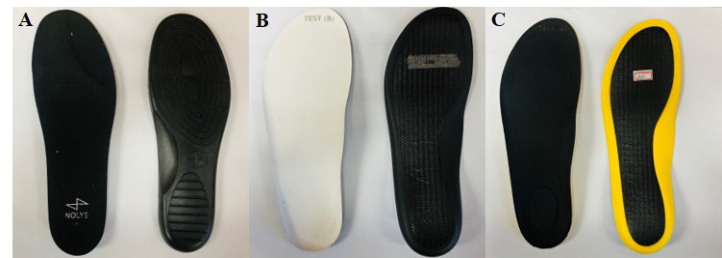
Experimental Design and Procedure A within-subject experimental design was used to investigate the effects of CFI. Three different types of insoles (Fig. 1) were tested: benchmark comme- rcial insole (COM), CFI, and CFI with cushioning (CFIC). The COM was composed of polyurethane foam with an approximate thickness of 0.7 cm in front and 1 cm in the heel. Both CFI and CFIC were made of EVA, included
Effects of Carbon Fiber Insole on Lower-Extremity Muscle Activation 23
Figure 1: Three different types of experimental insoles (A: COM, B: CFI, C: CFIC).
a carbon plate with a thickness of 0.1 cm, and had an approximate thickness of 0.4 cm in front and 0.4 cm for CFI, 0.65 cm for CFIC in the heel. Additi- onally, cushioning pads were interposed in the front and heel parts for CFIC to identify the cushioning effect. To better generalize the findings, the expe- riment was conducted with participants’ own sports shoes. Each participant wore identical sports shoes with three different types of insoles in random order and ran on a treadmill (Model S21T, STEX fitness Europe).
Four surface electromyography (EMG, Bagnoli, Delsys) sensors were used to measure the activation of lower-extremity muscles with a sampling frequ- ency of 1000 Hz. In addition, experimental participants wore a heart rate monitor chest strap (Model H10, Polar), which collected data at a rate of 1 Hz and 60 samples per minute.
Before starting the experiment, all participants performed a stretching and dynamic warm-up for at least 10 minutes. After warming up, participants’ skin was prepared by removing excessive hair and cleaning with alcohol. Next, the EMG sensors were attached to the skin using adhesive tapes and firmly fixed with the straps to minimize potential noise from any detach- ment or tremble. Four EMG sensors were attached to Rectus Femoris (RF), Tibialis Anterior (TA), Biceps Femoris (BF), and Gastrocnemius Medialis (GM) muscles (Konrad, 2006). Maximum voluntary contraction (MVC) of each muscle was measured twice after warm-up. The heart rate sensor was wrapped around the chest, and the strap was tightened to a comfortable fit.
Participants were instructed to walk at 3 km/h for at least 30 seconds to familiarize themselves with the task of running on the treadmill. Afterward, they jogged at 6 km/h for at least 30 seconds and ran at a speed of 10 km/h for 5 minutes. Participants then ran or walked at their preferred running speeds for at least 1 minute to cool down. After completing a trial run with each insole, participants gave their subjective ratings on perceived insole stiffness, energy support, overall comfort, and fatigue through a 9-point rating scale. Participants were given at least 10 minutes to rest between trials to avoid the fatigue effect.
Data Processing and Analysis EMG data during the whole task were rectified, normalized, and smoo- thed using the root mean square (RMS) filter to perform a linear envelope.
The data of heart rate was averaged over one minute. After processing all data, statistical analysis was performed. Repeated measures Analysis of vari- ance (ANOVA) and Fisher’s LSD post-hoc grouping analysis were conducted to statistically evaluate the effects from three different insoles. In addition, paired t-test was performed to compare CFI and CFIC and explore any cush- ioning effect. Excel (Microsoft, USA) and EMGworks (Delsys, USA) were used to process all data, and SPSS 20 (V20.0, IBM, USA) was employed to conduct all statistical tests, with a significance level of 0.05.
RESULTS AND DISCUSSION
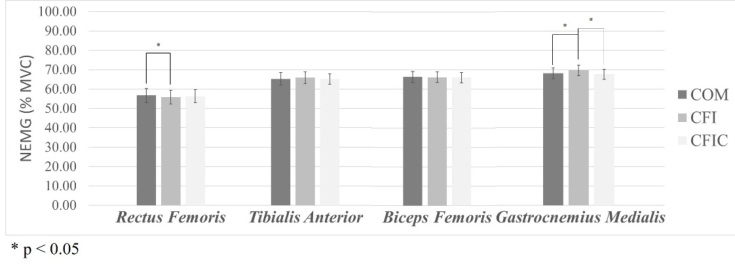
Muscle Activation Fig. 2 shows the muscle activation by different insole types. ANOVA tests revealed significant differences between three different insoles on activation of RF (p = 0.037) and GM (p = 0.034) muscles. However, there were no significant differences on TA (p = 0.759), GM muscles (p = 0.386), and heart rate (p = 0.698).
When participants wore CFI insoles, their RF muscle activation was signi- ficantly lower (-0.7%, p = 0.011) than COM insoles. This could be due to the structure of the CFI. The RF muscle is mainly activated to absorb the impact and stabilize the single-limb balance during the stance phase (Armand et al., 2015) when the contacted foot becomes totally flat. The CFI is more rigid with arch support, so it can reduce the effort to control and support the lower limb. In addition, the CFI can provide more energy support because the space under the insole acts as a spring, reducing the usage of RF muscle. On the other hand, compared to COM, CFI induced a marginally significant (p = 0.063) increase on GM by 1.5%. There are two potential reasons why they used more GM muscle when wearing the CFI. First, the increased stif- fness can affect the point of the force application. An earlier study reported that the CFI’s anterior point of force application during the last 25% of the propulsive stance phase was changed anteriorly (Wannop et al., 2017). Par- ticipants’ moment arm and moment of the ankle joint increased, leading to greater GM muscle activation. Second, the insole should bend during pro- pulsion. However, the CFI is harder to bend than the COM insole due to the higher stiffness. As a result, the participant had to put more effort into flexing the CFI, resulting in an increase in GM muscle activation.
Compared with CFI, CFIC significantly reduced GM muscle usage by 2.1% (p = 0.012), demonstrating the cushioning effect on relieving GM muscle fatigue. By adding a soft foam pad to the CFI, it can help to reli- eve muscular fatigue. A previous study showed that the softest insole induced the lowest fatigue index during 25 minutes of treadmill exercise (Ko Eun-Hye et al., 2004). A soft insole effectively absorbs the impact, so participants did not need to put more muscular effort. Therefore, the use of CFIC may have an impact on long-term sports performance due to less muscular fatigue.
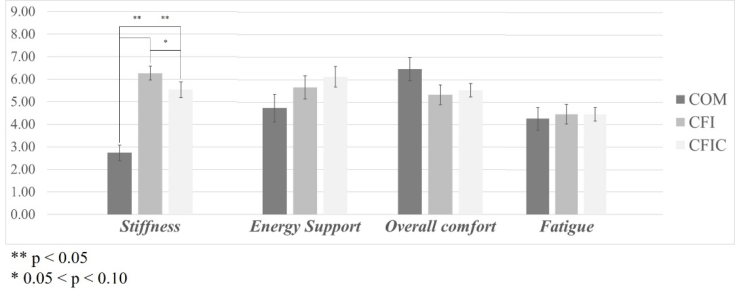
Subjective Evaluation As shown in Fig. 3, both CFI and CFIC were perceived significantly stiffer than COM (p < 0.001), and CFI was marginally stiffer compared to CFIC
Effects of Carbon Fiber Insole on Lower-Extremity Muscle Activation 25
Figure 2: The muscle activation (mean and standard error) of Rectus Femoris, Tibia- lis Anterior, Biceps Femoris, and Gastrocnemius Medialis muscles by three different insoles. *indicates significant group difference.Figure 3: Subjective ratings (mean and standard error) by three different insoles. *indicates significant group difference.
(p = 0.102). This result should be reasonable since both CFI and CFIC use stiff carbon fiber plates. There were no significant differences in overall com- fort (p = 0.151), energy support (p = 0.171), and fatigue (p = 0.899) between the three different insoles. In this research, participants had difficulties figu- ring out the differences between the insoles except the stiffness while running on the treadmill. A prior study also showed that the differences in asses- sed comfort between different shoes decreased as the task intensity increased (Miller J. E. et al., 2000). In their study, the gap was more evident in light intensity activities such as standing and working tasks.
LIMITATION AND FUTURE WORK This preliminary study has some limitations. First, the fast-run task in this study may be somewhat short (5 minutes/trial) compared to some previous studies. As a result, the RMS values of the normalized EMG (<70%) in this study were lower than the previous study (Crozara et al., 2015). Second, the effect of CFI and cushioning on athletic performance was not examined in
this research. Therefore, more research is needed on the effects of CFI on sports performance and long-term muscle activation.
CONCLUSION
The effects of carbon fiber insole (CFI) on lower-extremity muscle activation and wearing comfort during treadmill running have been investigated in this research. Our study indicates that the CFI induced more calf muscle usage and was perceived stiffer during treadmill running, which may provide greater propulsion but also increase muscle fatigue. Wearing a CFI with cushioning (CFIC) appears to help relieve muscle fatigue. Further research should be conducted to examine the effects of CFI on sports performance and long-term muscle activation.
ACKNOWLEDGMENT
This work was funded by Yongjin Fine Chemical Co. (G01210302) and BK21 FOUR Program through the National Research Foundation of Korea (NRF- 5199990113928).
REFERENCES
Bonnefoy-Mazure, A., Armand, Stéphane. (2015). Normal gait. Clanton TO, Ford JJ. (1994). Turf toe injury. Clin Sports Med. 13(4), 731–41. Enders, H., Vienneau, J., Tomaras, E. K., Koerger, H., Nigg, S., Nigg, B. (2016).
Soccer shoe bending stiffness significantly alters game-specific physiology in a 25- minute continuous field-based protocol. Footwear Science, Vol 8(2), 83–90. Gregory, Robert, Axtell, Robert, Robertson, Marc, Lunn, William. (2018). The Effects of a Carbon Fiber Shoe Insole on Athletic Performance in Collegiate Athletes. Journal of Sports Science. 6. HOCKENBURY, R. TODD. (1999). Forefoot problems in athletes. Medicine &
Science in Sports & Exercise. Vol 31, Issue 7, 448–458. Ko, Eun-Hye, Choi, Houng-Sik, Kim, Tack-Hoon, Roh, Jung-Suk, Lee, Kang-Sung.
(2004). Effect of the Fatigue to Insole Types During Treadmill Exercise. Physical Therapy Korea. 11. Konard, P. (2005). The ABC of EMG: A Practical Introduction to Kinesiological Electromyography. Noraxon Inc. USA, version 1.0. Luciano F. Crozara and Dain P. LaRoche. (2015). Utility of electromyographic fatigue
threshold during treadmill running. Muscle & Nerve. Vol 52. 1030–1039. Martyn R. Shorten. (1993). The energetics of running and running shoes. Journal of Biomechanics. Vol 26, 41–51. McCormick JJ, Anderson RB. (2009). The great toe: failed turf toe, chronic turf toe,
and complicated sesamoid injuries: Foot Ankle Clin. Vol 14(2), 135–50. Miller JE, Nigg BM, Liu W, Stefanyshyn DJ, Nurse MA. (2000). Influence of foot, leg and shoe characteristics on subjective comfort. Foot Ankle Int. Vol 21 (9), 759–767. Nguyen, Anh-Dung, Taylor, Jeffrey B., Baellow, Andrea L., Arpante, Allison K., Wri-
ght, Kaitlyn E. (2015). Effects of plate stiffness on in-cleat load and motion during unanticipated cutting. Footwear Science. Vol 7. 52–53. Nigg, B. M., Segesser, B. (1992). Biomechanical and orthopedic concepts in sports shoe construction. Medicine & Science in Sports & Exercise. Vol 24, 595–602.
Effects of Carbon Fiber Insole on Lower-Extremity Muscle Activation 27
Nigg, B. M., Stefanyshyn, D., Denoth, J. (2000). Mechanical Considerations of Work and Energy. In Biomechanics and Biology of Movement, edited by Nigg, B. M., MacIntosh, B. R., and Mester, J. Champaign, IL: Human Kinetics, 5–18. Roy, J., Stefanyshyn, D. (2006). Shoe midsole longitudinal bending stiffness and run-
ning economy, joint energy, and EMG. Medicine & Science in Sports & Exercise, Vol 38(3), 562–569. Shorten, Martyn. (2011). Biomechanics of sports shoes, by Benno M. Nigg. Footwear Science. 3, 1–2. Stefanyshyn, D. J., & Fusco, C. (2004). Athletics: Increased shoe bending stiffness
increases sprint performance. Sports Biomechanics. Vol 3(1), 55–66. Stefanyshyn, D. J., & Nigg, B. M. (2000). Influence of midsole bending stiffness on joint energy and jump height performance. Medicine & Science in Sports & Exercise, Vol 32, 471–476. Tinoco, N., Bourgit, D., Morin, Jean-Benoît. (2010). Influence of midsole metatar-
sophalangeal stiffness on jumping and cutting movement abilities. Proceedings of The Institution of Mechanical Engineers, Part P: Journal of Sports Engineering and Technology. 224. 209–217. Wannop John William, Killick Anthony, Madden Ryan, Stefanyshyn Darren J.
(2017). The influence of gearing footwear on running biomechanics. Footwear Science. Vol 9, 111–119. Wannop, J.W., Schrier, N., Worobets, J.T., Stefanyshyn, D.J. (2015). Influence of forefoot bending stiffness on American football performance. Footwear Science, Vol 7(S1), 141–142. Willwacher, Steffen, König, Manuel, Potthast, Wolfgang, Brüggemann, Gert-Peter.
(2013). Does Specific Footwear Facilitate Energy Storage and Return at the Meta- tarsophalangeal Joint in Running?. Journal of applied biomechanics. Vol 29, 583–92. Witana CP, Goonetilleke RS, Xiong S and Au EYL. (2009). Effects of surface characteristics on the plantar shape of feet and subjects’ perceived sensations. Applied Ergonomics, 40(2), 267–279.
LISTED IN THE AHFE DIGITAL BOOKSTORE CATALOGUE
Explore the complete digital volume
Physical Ergonomics and Human Factors
Read this individual research paper free through the original publisher, or explore the full digital proceedings book.
ISBN 978-1-958651-39-1
Explore this ISBN in the AHFE Bookstore ↗Listed in the July 2026 bookstore catalogue; search by ISBN to confirm current availability · Digital book purchase optional