William Makowski, Thomas Martin, W Andy Schaudt (2025). Integrative Bicycle Helmet Fit. In: Ergonomics In Design and Kansai Engineering. AHFE Open Access, vol. 170, pp. 23–33. https://doi.org/10.54941/ahfe1006164
Bicycle helmets can reduce head injury in the event of a crash. However, an improperly fitting helmet may move out of its intended position, exposing parts of the rider’s head and increase the risk of head injury. In published research, bicycle helmet fit is defined infrequently and inconsistently. In addition, a research study may explore one or two components of fit, yet describe their study holistically as bicycle helmet fit. In response, a literature review was conducted on bicycle helmet fit and includes other relevant aspects of fit from other industries and applications. This paper operationally defines and describes bicycle helmet fit, integrating the concepts of (1) perception of fit, (2) static fit, and (3) dynamic fit. Finally, an integrated approach to helmet fit should benefit future research, as well as the design and development of future safety countermeasures for cyclists.
Evidence shows that the use of bicycle helmets can significantly reduce the risk of head injury during a crash (Lee et al., 2009; Romanow et al., 2014). However, the use of improperly fitting helmets and its relationship to a greater risk of injury has been continually identified over the last few decades (Bromell & Geddis, 2016; Hagel et al., 2010; Lee et al., 2009; Rezendes, 2006; Thai et al., 2014). The persistent problem indicates that prior research and development processes have not fixed the helmet fit problem. In response, a literature review was performed to categorize and define three general concepts of fit, present an overview of the methods used in research, and describe limitations. This literature review calls attention to areas for future research and product development.
Simply putting a bicycle helmet on one’s head and buckling the straps does not ensure it will be in the proper position and prevent head injury during a crash (Lee et al., 2009). Proper fit can increase the likelihood that the impact- mitigating liner will be between the rider’s head and the road or other striking object during an impact, reducing or preventing a potential head injury (Lee et al., 2009; Romanow et al., 2014). For many cyclists, helmets are available that fit and can prevent injury during a crash (Rivara et al., 1999; Thai et al., 2014). However, a rider’s ability to find a helmet that fits well is affected by many variables, such as the number of head shapes and sizes
available at a particular store, the number of stores one goes to, or what one is willing to order online. When searching for a helmet, the rider assesses helmet fit based on a limited selection, training, and feedback, and typically fitting the helmet while sitting or standing.
Methods for assessing bicycle helmet fit have been promoted by organizations such as the National Highway Traffic Safety Association (NHTSA), Safe Kids, and the Bicycle Helmet Safety Institute (Bicycle Safety: Bike Safety Tips for Kids and Adults, n.d.; Bike Safety Tips, n.d.; How to Fit a Bicycle Helmet, n.d.; Rezendes, 2006). The process for assessing helmet fit is often referred to as the “Eyes, Ears, and Mouth Check” (Bike Safety Tips, n.d.; How to Fit a Bicycle Helmet, n.d.). However, limitations of these assessments may result in helmeted riders riding with ill-fitting helmets, which can increase the likelihood that the helmet may move out of place when riding (Hagel et al., 2010; Rezendes, 2006).
In research, bicycle helmet fit is defined infrequently and inconsistently (Lee et al., 2009), even in papers directly addressing the topic. Lee et al. defined bicycle helmet fit as: A properly fitted helmet is considered to sit straight and horizontal on the head, and not too far forward to cover the eyebrow or too far back on the head so that the forehead is exposed. The helmet cannot be too loose without the buckle or helmet straps fastened. The helmet straps must be fastened with approximately one-finger width space between the chin and the straps. Furthermore, the helmet should be stationary when movement is attempted. A helmet is considered to be in an improper wearing position when it is tilted (side-ways, forward or backward), not securely strapped under the chin, has more than two-finger breadths space between the chin and the helmet, and moves front-to-front, side-to-side or rotationally when movement is attempted (Lee et al., 2009, 125).
Then, the definition’s language was slightly updated (Hagel et al., 2010). A challenge with the definition is it does not include the user’s perception of fit, even though they do describe it later in their study (Lee et al., 2009). In addition, prior fit evaluations do little to address dynamic helmet position, as they say “the helmet should be stationary when movement is attempted” (Lee et al., 2009, 125). Helmet stability is described in greater depth, but stability is not included in the fit definition or criteria (Lee et al., 2009).
Other papers addressing bicycle helmet fit may define one or two aspects of fit, but do not provide an operational definition (Bromell & Geddis, 2016; Depreitere, 2004; Ellena et al., 2016; Morlock et al., 2016; Rezendes, 2006; Rivara et al., 1999; Romanow et al., 2014; Thai et al., 2014). For example, Hagel et al., 2010 focuses on correct and incorrect helmet use while cyclists are riding, but do not include aspects of helmet movement during a crash in their definition.
Another challenge with Lee and Hagel’s definitions is, the definitions are reflective of product development strategies of a time, where helmet sizes and head shapes have been limited, and helmet availability has been dependent on what a store offered. In addition, they rely on a visual assessment for
Integrative Bicycle Helmet Fit 25
correct helmet use and imprecise body length measurements such as “two- finger breadths”(Lee et al., 2009, 125). In contrast, today, many more design, development, manufacturing, and distribution technologies are available to create tailored user-centered product experiences. Some of those technologies include 3D scanning apps, 3D rendering programs, latticing software to create digital foams, additive manufacturing, and automation (Nofar et al., 2022). A definition that integrates all aspects of bicycle helmet fit and is independent of traditional manufacturing technologies will serve as a foundational element for future product development and research (Lee et al., 2009). Drawing on the prior literature, three aspects of integrative bicycle helmet fit are defined as follows:
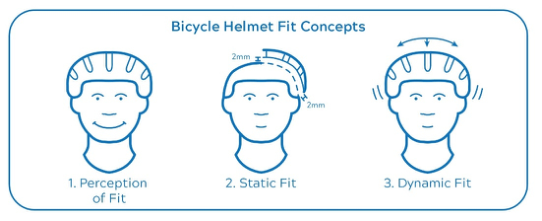
1. Perception of fit is the rider’s expressed or unexpressed comfort of the helmet, while at rest, as well as over long periods of time while riding. Perception of fit can be evaluated by questionnaires or measuring pressure sensitivities. A rider’s perception of comfort is subjective and should be compared to objective measures of fit, such as static fit. 2. Static fit is the actual distance between the rider’s head and the helmet, that allows the helmet to be loose enough so that it is comfortable, yet tight enough so that the helmet does not move out of its intended position during a crash. In addition, the helmet should adequately cover the rider’s head. An assessment of static fit can include the eyes, ears, and mouth check. A more objective evaluation can include physical or digital measurements of the rider’s head compared to other parts of the helmet. 3. Dynamic fit is the helmet’s stability when movement occurs, with the end goal of the helmet being in its intended position during a crash. Dynamic fit can be evaluated by measuring helmet displacement while the rider is at rest and the helmet is being pulled, pushed or tilted, while the rider is riding, or during a crash.
A simplified version of the three different fit concepts is shown below in Figure 1.
Figure 1: The figure shows the three integrated concepts of bicycle helmet fit.
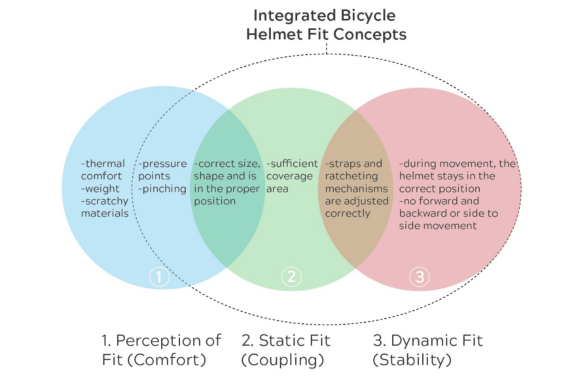
Although the fit concepts are distinctly different, similarities and overlap between the three do exist. For this paper the definition starts with perception of fit because the rider’s perceived comfort may affect the amount they bike, or they may quit riding altogether. The three concepts and the overlap between each is shown below in Figure 2.
Figure 2: The figure shows the three integrated concepts of bicycle helmet fit (shown in the dotted oval): 1. Perception of fit (shown in the blue circle). 2. Static fit (shown in the green circle). 3. Dynamic fit (shown in the red circle).
Perception of Fit The rider or parent’s perception of fit can be the first set of criteria for evaluating and quantifying bicycle helmet fit. The 1986 ASTM standard, Anthropometric Fit Testing and Evaluation, describes that a piece of personal protective equipment (PPE) may be considered to fit via some physical measurement (static fit) (McConville, 1986). However, if that item “repeatedly causes a pressure point that threatens to become intolerable after long-term wear, the item is unacceptable until that problem can be resolved” (McConville, 1986). The relationship between comfort and fit has been extensively investigated to identify design preferences, for both PPE and consumer products (Fu & Luximon, 2022).
If a rider does not consider the helmet to be comfortable, measurements that quantify helmet fit may need to be reevaluated. If there is the perception of the helmet not fitting, the person may reduce or stop participating in the activity, they might not wear the helmet, they may adjust it improperly, or they may be thinking about the helmet as opposed to focusing on the activity at hand. A primary reason children stop wearing bicycle helmets is because they are “uncomfortable and never fit properly” (Rezendes, 2006, 37). In addition, comfort can change over long periods of use, as the helmet may feel heavier, shift, or become hot and sweaty. Changes in perception of fit over time and in adverse conditions can shift a participant’s focus from the activity at hand to thinking about the helmet, which may put the rider at risk.
Questionnaires, numerical systems, and star rating systems have been used to measure riders’ perceptions of fit (Ellena et al., 2016; McConville, 1986). Riders can have varying pressure sensitivities, so future research may include measuring pressure points and general pressure with methods such as the Pressure Discomfort Threshold and the Pressure Pain Threshold (Fu & Luximon, 2022; Morlock et al., 2016; Shah & Luximon, 2021). As pressure
Integrative Bicycle Helmet Fit 27
is measured, peak pressure, impact force, and peak vertical force can be mapped (Yung-Hui & Wei-Hsien, 2005).
Although evaluating a rider’s perception of helmet fit is important, those results must be compared to an expert’s evaluation. Otherwise, the rider may perceive that the helmet is the correct size and shape, in the correct position, and secured properly, however due to either lack of experience or training, the helmet may not actually fit correctly and could move out of the proper position in the event of a crash. Riders can have the perception that their helmet fits, however when the rider’s helmet fit is evaluated by an expert, the helmet does not fit as well as originally perceived by the rider (Bromell & Geddis, 2016; Lee et al., 2009).
In 2014, Thai et al. examined the relationship between perception and evaluation by soliciting users’ perceptions, conducting fit assessments, collecting head measurements, and stability testing. In the same year, Ellena et al. (2014) developed the Helmet Fit Index (HFI), a digital method for evaluating how human head shapes and bicycle helmets couple. Then in 2016, they compared their HFI to riders’ perceptions of fit (Ellena et al., 2016).
Optimizing the ergonomic design of a helmet can improve one’s experience of comfort and fit, which may increase bicycle helmet use, as well as the likelihood that the helmet is in the correct position during a crash (Fu & Luximon, 2022; Lee et al., 2009). Research that examines a rider’s perception of fit, compared to an expert’s evaluation should consider connecting those findings to dynamic fit situations as well, as addressed by Thai et al. (2014). Finally, as the science of helmet comfort and fit progresses, standards and testing may want to evaluate riders’ perceptions of fit, as helmets are tested on metal head forms which cannot give feedback (Ellena et al., 2016).
STATIC FIT As mentioned previously, discrepancies between a rider’s perception and an expert’s evaluation of fit can exist (Bromell & Geddis, 2016; Lee et al., 2009). Head-helmet coupling can be quantified by physical and digital measurements. Physical measurements can include measuring the cephalic index and helmet interior (Rivara et al., 1999; Thai et al., 2014). Digital measurements can include scanning one’s head, the helmet’s interior, and pairing them digitally (Ellena et al., 2014; Morlock et al., 2016). Whether the measurements were taken physically or digitally, the helmet is fitted and measured while the helmet is at rest, or not moving, referring to static fit.
Physical Measurements In 1999, Rivara et al. measured children’s helmet fit, by measuring their heads, making casts of their heads, and taking additional measurements. The goal was that the measurements would reflect the way the child actually wore the helmet. In 2003, Parkinson and Hike also evaluated bicycle helmet fit for children and developed four categories of criteria, with fourteen subcomponents. The categories that directly related to static fit were: room, straps, and stability (Parkinson & Hike, 2003). In 2014, Thai et al. studied the relationship between helmet coupling and helmet
stability, by determining the rider’s cephalic index (head length and width), as well as visually assessed helmet positioning. Then they tested each helmet’s stability, which will be discussed further in the section, Stability Testing (Thai et al., 2014).
Static fit has been evaluated with physical measurements of the head and helmet over the past few decades. Some studies included internal measurements of the helmet, while others did not. In addition, some measured fit as the rider normally wears their helmet, while others measured fit after the researcher had put the helmet on the rider and adjusted it. Another consideration was the variation between studies for including or not including comfort pads, ratcheting mechanisms, or chin straps when measuring static fit. The various approaches to collecting measurements should be considered for digital measurements as well.
Digital Measurements In 1998, Bradtmiller took 1025 scans of children’s heads as a basis for a new set of head forms and sizes. More recently, in 2014 Ellena et al. collected scan data for the head and helmet, comparing the two through the creation of their Helmet Fit Index (HFI).
The investigation compared the rider’s head shape to the interior of the helmet, quantifying helmet fit with an overall fit score and leveraged digital tools such as 3D scanning, software, and computational techniques (Ellena et al., 2014). The criterion Standoff Distance (SOD), Gap Uniformity (GU), and the Head Protection Proportion (HPP) were used to evaluate the relationship between the head scan and the helmet scan (Ellena et al., 2014). In 2016, building on their research, Ellena et al. performed additional scans, calculated the HFI for each, and then compared the results to the rider’s perception of fit (Ellena et al., 2016). They found that the HFI compared well to the rider’s perception of helmet fit, which has helped to bridge the gap between subjective assessments from riders and more objective evaluations (Ellena et al., 2016). Also in 2016, Morlock et al. collected 3D head scans as a basis for creating up to date sizing charts. An initial helmet fit analysis was performed digitally by pairing a 3D scanned head with a 3D scanned helmet. Challenges with hair volume and compression were experienced during the measurement and scanning process (Morlock et al., 2016). Additional considerations for evaluations and digital measurements of helmet fit may include: determining the minimum viable scan needed for an accurate scan, especially as scanning methods improve; optimizing how the digital head and helmet scans are paired; navigating how comfort padding and the ratcheting mechanism affect helmet fit; evaluating the influence of hair in relation to fit; comparing digital helmet fit to physical helmet fit, as the physical fitting experience may differ from the digital fitting experience.
Finally, for static fit, even if the fit meets a study’s fit criterion there is no guarantee that the helmet will be stable while riding or during a crash. Thai et al, as well as Parkinson and Hike, begin to bridge the gap between static fit and dynamic fit by measuring helmet stability.
Integrative Bicycle Helmet Fit 29
DYNAMIC FIT The primary goal of properly fitting a bicycle helmet is that “the helmet should be stationary when movement is attempted” referring to dynamic fit (Lee et al., 2009, 125). The helmet should be stationary as a rider or researcher pushes, pulls, or tilts the helmet when the rider is not moving (Lee et al., 2009; Parkinson & Hike, 2003). The helmet should be stationary when movement occurs as a biker is riding (Bromell & Geddis, 2016; Hagel et al., 2010). Finally, the helmet should be stationary when movement occurs as a rider crashes or may receive multiple blows to the helmet (Rivara et al., 1999; Romanow et al., 2014; Thai et al., 2014).
Stability Testing Helmet stability can be critical for ensuring the helmet stays in its intended position (Thai et al., 2014). Without proper stability, the helmet may be displaced, moving forward or backward (translating) or rotate while riding (Thai et al., 2014). Without proper stability, during a crash the helmet may even come off, exposing parts of the head to direct impact (Thai et al., 2014). Stability testing could be as minimal as a rider tilting or gently shaking their head and visually assessing displacement.
In 1995, Rowe et al. examined correct and incorrect bicycle helmet use, where they assessed helmet stability by trying to push the helmet forward (over the eyes) or backward (exposing the forehead). Then, in 2003, Parkinson and Hike evaluated bicycle helmet fit, where they developed four categories of criteria, two of which, strap and stability directly related to dynamic fit. In 2008, Lee et al. conducted a systematic literature review of correct helmet use where they identified 2285 citations, determined 61 as relevant, and reviewed 11 of the studies. Of the eleven studies, only the Rowe et al. and Parkinson and Hike studies included criterion for helmet stability in their correct helmet use definitions. In 2014, Thai et al. tested rearward, forward, and lateral stability, using a strap and force gauge fastened to the helmet. Head dimension and shape were not found to influence stability, but rather the ratcheting mechanism was associated with helmet stability. When head dimension and head shape, elements of static fit, appear not to influence helmet stability, it is difficult to determine what role static fit plays in stability testing (Thai et al., 2014).
Riding Stability Stability testing while the rider is at rest does not guarantee the helmet will be stable while riding. In 2010, Hagel et al. made unobtrusive field observations of passing cyclists for correct, incorrect, and non-helmet use (Hagel et al., 2010). They were not explicitly measuring bicycle helmet stability, rather they were making observations of correct and incorrect helmet use. However, if the helmet was not in the correct position as the rider passed the observer, an assumption can be that the rider’s helmet was not stable at the time the observer viewed the rider. In addition, if the helmet was not in the correct position as the rider passed the observer, another assumption can be that the helmet’s initial position was not stable at the time the rider began riding.
Studies that only examine static fit may assume the helmet will stay in the correct position while riding. Studies that only examine dynamic fit while a cyclist is riding may assume the helmet will stay in the correct position while crashing. Bicycle helmet fit evaluations would benefit by integrating elements of all stability concepts.
Impact Stability When a rider is crashing, as well as receiving multiple blows to the helmet, the helmet should be stable (Rivara et al., 1999; Romanow et al., 2014; Thai et al., 2014). A helmet that does not fit properly may move out of the correct position during a crash, exposing portions of the rider’s head to direct impact (Rivara et al., 1999). Evaluating and measuring helmet fit and stability during an impact is less reviewed in both laboratory and real-world settings, as conducting such tests could put a participant at risk of injury (Thai et al., 2014; Yu & Dennison, 2019). In 2008, Mills and Gilchrist performed oblique impacts with a simulated road surface, fitting a metal headform with a compliant scalp and wig. They found the helmet would move out of position in oblique impacts and that ratcheting mechanisms fixed to the liner were more secure than those attached with Velcro (Mills & Gilchrist, 2008). As mentioned in the Physical Measurements section, Thai et al. found that head dimension and shape had little to no effect on helmet stability, but rather the ratcheting mechanism did (Thai et al., 2014). So, future research could explore how the ratcheting mechanism does or does not affect helmet stability during impact testing.
In 2019, Yu and Dennison studied how helmet fit criterion may affect engineering characteristics, such as peak linear acceleration, that relate to head injury. Their primary finding was that, during impact testing poor helmet fit did not systematically alter acceleration values when compared to normal fit (Yu & Dennison, 2019). However, other research has found helmet fit does alter acceleration values (Maw et al., 2012). For speed skaters, “smaller and rounder helmets produce lower peak linear decelerations,” although “the effect of helmet size is greater than that of helmet shape” (Maw et al., 2012, 822). Future research could explore additional engineering metrics that better relate to helmet fit and injury, such as pressure (Jadischke, 2012). Yu and Denison (2019) also found that a helmet’s impact stability varies based on the type of impact, where torso-first impacts resulted in greater helmet displacement when compared to head-first impacts. Helmet displacement can leave parts of the head exposed and increase the risk of head injury (Yu & Dennison, 2019). The point is, bicycle helmets can be displaced during a crash, so impact stability should be studied further.
Additional Considerations Other industries and fields, including footwear, headphones, and masks, have reviewed fit as well (Fu & Luximon, 2022). Ellena et al. (2016) based their Helmet Fit Index on the work of Meunier, which examined ballistic helmet fit.
Integrative Bicycle Helmet Fit 31
Similarly, future research should examine studies and standards from other industries such as garment fit, PPE, military, and apply relevant techniques.
Ellena et al. (2016) found a broad range of helmet fit scores, with a variety of outliers especially among female and Asian populations. The broad range of scores highlighted the need for a greater range of sizes and shapes for helmets and headforms. The ISO headforms used for safety standards, were developed in the 1950s, based on the British workforce and are not representative of the diverse range of cyclists’ head sizes and shapes (Ellena et al., 2016; Thai et al., 2014).
Measuring children’s head size and shape can also be a challenge, as size and shape can change with growth (Huelke, 1998). In addition, hair thickness, curly hair, and bald spots can affect measurements and scan data (Ellena et al., 2014; Morlock et al., 2016; Thai et al., 2014). However, scan caps can reduce some challenges when collecting accurate scans (Ellena et al., 2016).
CONCLUSION
Finally, for a bicycle helmet to fulfill its intended function, it should be comfortable, the correct size and shape, in the correct position, and stable in the event of a crash. Optimizing the ergonomic design and improving comfort can lead to a greater adoption and longer use of bicycle helmets. A study of bicycle helmet fit should integrate elements of perception of fit, static fit, and dynamic fit. Studying any one of these fit concepts in a singular context does not guarantee the helmet will be worn due to comfort issues or in the correct position during a crash. Reviewing other fit research strategies will help direct future studies and benefit the design and development of future safety countermeasures. As new technologies emerge, such as airbag helmets, definitions should be updated accordingly.
ACKNOWLEDGMENT
Thanks to Virginia Tech’s Institute for Creativity, Arts, and Technology (ICAT), as well as Link, License, and Launch (LLL), for supporting this literature review. Neither ICAT or LLL were involved in the preparation of the review. Also, thank you to Dr. Rowson at Virginia Tech’s Helmet Lab and Dr. Reed at the University of Michigan Transportation Research Institute’s Biosciences Group for feedback.
REFERENCES
Bicycle Safety: Bike Safety Tips for Kids and Adults., n.d.. National Highway Traffic Safety Association. Retrieved October 22, 2023, from nhtsa.gov/road-safety/ bicycle-safety. Bike Safety Tips., n.d. Safe Kids Worldwide. Retrieved October 22, 2023, from
safekids.org/tip/bike-safety-tips. Bradtmiller, B., 1998. Improving Children’s Bike Helmets. Practicing anthropology, 20(2), pp. 34–37. Bromell, R. J. and Geddis, D. C., 2017. Child cyclists: A study of factors affecting
their safety. Journal of paediatrics and child health, 53(2), pp. 145–148.
Depreitere, B., 2004. A rational approach to pedal cyclist head protection (No. 309).
Leuven University Press. Ellena, T., Subic, A., Mustafa, H. and Pang, T. Y., 2016. The helmet fit index–an intelligent tool for fit assessment and design customisation. Applied ergonomics, 55, pp. 194–207. Ellena, T., Subic, A., Pang, T. Y. and Mustafa, H., 2014, October. The helmet fit
index-A method for the computational analysis of fit between human head shapes and bicycle helmets. In International Congress on Sport Sciences Research and Technology Support (Vol. 2, pp. 145–153). SciTePress. Fu, F. and Luximon, Y., 2022. Comfort and fit perception based on 3D anthropometry for ear-related product design. Applied Ergonomics, 100, p. 103640. Hagel, B. E., Lee, R. S., Karkhaneh, M., Voaklander, D. and Rowe, B. H., 2010.
Factors associated with incorrect bicycle helmet use. Injury Prevention, 16(3), pp. 178–184. How to Fit a Bicycle Helmet., n.d. Bicycle Helmet Safety Institute. Retrieved October 22, 2023, from helmets.org/fit.htm. Huelke, D. F., 1998. An overview of anatomical considerations of infants and
children in the adult world of automobile safety design. In Annual Proceedings/ Association for the Advancement of Automotive Medicine (Vol. 42, p. 93). Jadischke, R., 2012. Football helmet fitment and its effects on helmet performance.
Wayne State University. Lee, R. S., Hagel, B. E., Karkhaneh, M. and Rowe, B. H., 2009. A systematic review of correct bicycle helmet use: How varying definitions and study quality influence the results. Injury prevention, 15(2), pp. 125–131. Maw, S., Lun, V. and Clarke, A., 2012. The influence of helmet size and shape on
peak linear decelerations when impacting crash pads. Procedia engineering, 34, pp. 819–824. McConville, J. T., 1986. Anthropometric fit testing and evaluation. In Performance of Protective Clothing. ASTM International. Mills, N. J. and Gilchrist, A., 2008. Oblique impact testing of bicycle helmets.
International Journal of Impact Engineering, 35(9), pp. 1075–1086. Morlock, S., Schenk, A., Klepser, A. and Schmidt, A., 2016. Using 3D scanning for improved helmet design. In Proceedings of the 7th International Conference on 3D Body Scanning Technologies (pp. 190–200). Nofar, M., Utz, J., Geis, N., Altstädt, V. and Ruckdäschel, H., 2022. Foam 3D
printing of thermoplastics: A symbiosis of additive manufacturing and foaming technology. Advanced Science, 9(11), p. 2105701. Parkinson, G. W. and Hike, K. E., 2003. Bicycle helmet assessment during well visits reveals severe shortcomings in condition and fit. Pediatrics, 112(2), pp. 320–323. Rezendes, J. L., 2006. Bicycle helmets: overcoming barriers to use and increasing
effectiveness. Journal of pediatric nursing, 21(1), pp. 35–44. Rivara, F. P., Astley, S. J., Clarren, S. K., Thompson, D. C. and Thompson, R. S.,
1999. Fit of bicycle safety helmets and risk of head injuries in children. Injury Prevention, 5(3), pp. 194–197. Romanow, N. R., Hagel, B. E., Williamson, J. and Rowe, B. H., 2014. Cyclist head and facial injury risk in relation to helmet fit: A case-control study. Health Promotion and Chronic Disease Prevention in Canada, 34(1). Rowe, B. H., Thorsteinson, K. and Bota, G. W., 1995. Bicycle helmet use and
compliance: A northeastern Ontario roadside survey. Canadian journal of public health= Revue canadienne de sante publique, 86(1), pp. 57–61.
Integrative Bicycle Helmet Fit 33
Shah, P. and Luximon, Y., 2021. Assessment of pressure sensitivity in the head region for Chinese adults. Applied ergonomics, 97, p. 103548. Thai, K. T., McIntosh, A. S. and Pang, T. Y., 2015. Bicycle helmet size, adjustment,
and stability. Traffic injury prevention, 16(3), pp. 268–275. Yu, H. Y. and Dennison, C. R., 2019. A laboratory study on effects of cycling helmet fit on biomechanical measures associated with head and neck injury and dynamic helmet retention. Journal of biomechanical engineering, 141(1), p. 011007. Yung-Hui, L. and Wei-Hsien, H., 2005. Effects of shoe inserts and heel height
on foot pressure, impact force, and perceived comfort during walking. Applied ergonomics, 36(3), pp. 355–362.
LISTED IN THE AHFE DIGITAL BOOKSTORE CATALOGUE
Explore the complete digital volume
Ergonomics In Design and Kansai Engineering
Read this individual research paper free through the original publisher, or explore the full digital proceedings book.
ISBN 978-1-964867-46-5
Explore this ISBN in the AHFE Bookstore ↗Listed in the July 2026 bookstore catalogue; search by ISBN to confirm current availability · Digital book purchase optional