Gerbera Vledder, Rebeca Sabater Compomanes, Utkarsh Singh, Halil Kılıç, Maxim Smulders, Yu Song, Peter Vink (2024). Experiences of upright sleeping in a vehicle: the preferred back rest angle. In: Advances in Human Factors of Transportation. AHFE Open Access, vol. 148, pp. 664–669. https://doi.org/10.54941/ahfe1005258
In many vehicles passengers are sleeping. Groenesteijn et al.(2014) reported that on medium to long distance train trips, the second most time was spend on ‘staring or sleeping’. Bouwens et al. (2017) report that the majority of passengers sleep during a flight, while this activity has the lowest comfort score. The likelihood of resting and sleeping during a commute automated vehicle trip is also high (Wilson et al., 2022). Usually this sleeping is a nap, as Faraut et al. (2017) defined a nap as any sleep period with a duration of less than 50% of the average major sleep period of an individual. Discomfort while taking this nap might be caused by the upright sitting position. Studies by Nicholson and Stone (1987), Aeschback et al. (1994), Hayashi and Abe (2008) and Roach et al. (2018) show that the larger the recline angle of the seat ('flatter'), the better the sleep efficiency. A flat bed is preferred. However, a flat bed is often not possible due to space and economic reasons. In this study we tried to discover what back rest angle is acceptable for an upright sleep. The study was carried out using six customized chairs of which the backrest could be positioned in five different angles (110º, 120º, 130º, 140º, 150º) and an additional 180º bed was added as a reference (a horizontal stretcher). Sleeping was facilitated by for instance, a good temperature, darkness, blankets and cushions. 16 participants were asked to try to sleep six times for a duration of 90 minutes to facilitate at least one sleep cycle, each person starting in a different backrest angle and having a different order. Questions on sleep comfort and comfort in general (on a scale 0-10, 0 being no comfort and 10 extreme comfort) were asked after the sleep. The results show that overall comfort was low (below 6) for 110 and 120 degrees and it was significantly better at 130 degrees or more. The same trend was shown for the sleeping comfort. In conclusion, a conclusive statement based on sleep quality is hard to give, but in terms of comfort a backrest angle of 120 degrees or less is unacceptable for a nap. Suggesting that for a short napping situation a minimum of a 130 degree recline should be available. To improve sleep comfort in 110 and 120 degree recline; neck support, lower back and lower leg support are the main attention points.
In many vehicles passengers are sleeping. Groenesteijn et al. (2014) reported that on medium to long distance train trips, the second most time was spent on ‘staring or sleeping’. Bouwens et al. (2017) report that the majority of passengers sleep during a flight, while this activity has the lowest comfort score. The likelihood of resting and sleeping during a commute automated vehicle trip is also high (Wilson et al., 2022). Usually this sleeping is a nap, as Faraut et al. (2017) defined a nap as any sleep period with a duration of less than 50% of the average major sleep period of an individual. Discomfort while taking this nap might be caused by the upright sitting position. Stud- ies by Nicholson & Stone (1987), Aeschbach et al. (1994), Hayashi & Abe (2008), and Roach et al. (2018) show that the larger the recline angle of the seat (‘flatter’), the better the sleep efficiency. A flat bed is preferred. How- ever, a flat bed is often not possible due to space and economic reasons during mobility. In the previously mentioned studies, sleep efficiency in a range of backrest recline angles was studied. Cabellero-Bruno et al. (2022) tested the comfort experience in 150 and 177 degrees, but for design purposes it is use- ful to make a comparison of a complete range with smaller increments to
Experiences of Upright Sleeping in a Vehicle: The Preferred Back Rest Angle 665
give design professionals the tools for choosing the best seat setup for their client’s needs. Therefore in this paper, six backrest recline angle conditions with increments of 10
, were studied. Additionally, in many studies on the recline angle of the backrest, the focus lies on sleep efficiency. For academic purposes the influence of the recline angle on sleep comfort and the comfort perception of the nap is underexposed. The research question addressed in this study is: Based on overall comfort and sleep quality, what is the preferred backrest angle for short naps, comparing 6 backrest angle sleep conditions with a increment of 10
starting at 110
.
METHOD
To discover what back rest angle is acceptable for an upright sleep, six cus- tomized chairs were used of which the backrest could be positioned in five different angles (110
, 120
, 130
, 140
, 150
)(Fig. 1) and an additional 180
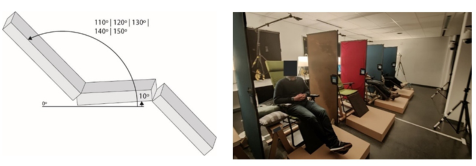
bed was added as a reference (a horizontal stretcher). Sleeping was facilitated with a good temperature, dimmed warm lights, blankets (Caddick et al., 2018) and a cushion. The research setup is shown in Fig. 1. Sixteen participants (8 male, 8 female, mean age: 24 ± 3.7) were asked to try and sleep six times for a duration of 90 minutes to facilitate at least one sleep cycle (Carskadon and Dement, 2005), the angle sequence was randomized using the Microsoft Excel randomization function to prevent order effects. Participants were selected prior to the study based on a reduced Morningness- Eveningness questionnaire (rMEQ)(score of 17 or lower, no specific type or evening types were included)(Danielsson, Sakarya and Jansson-Fröjmark, 2019), people were selected who are more likely to sleep during the day. Additionally, people with sleeping disorders, people who find it ‘extremely not easy’ to nap during the day, and who snore, were excluded. The nap start time was at 13:00 or 15:30. Prior to the test all test participants signed an informed consent and the test procedure was approved by the research ethi- cal committee of the Delft University of Technology (nr. 2679). Questions on sleep comfort were asked after the sleep, and questions on general comfort were asked before and after the sleep (on a scale of 0–10, 0 being no com- fort and 10 extreme comfort). Additionally, the participants were asked to give a local posture discomfort (LPD) score for each body part, as described by Anjani et al. (2021). A self-written Python code was used to calculate general descriptive statistics and to calculate significant differences with the Wilcoxon Signed rank test.
Figure 1: Seat configurations excluding 180◦(left) and a research setup impression (right). The leg rest moves parallel to the backrest and the lights were dimmed during the test as they are brighter for the purpose of this picture.
RESULTS AND DISCUSSION
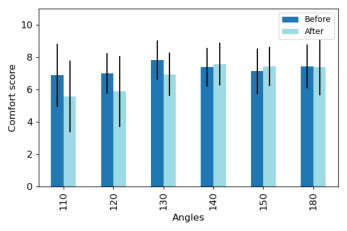
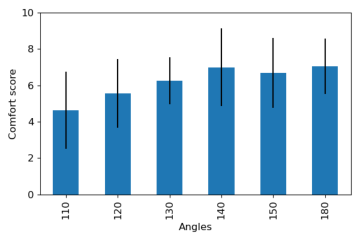
The results show that overall comfort was low (below 6) for 110 and 120 degrees (Fig. 2). Overall comfort was significantly better at 130
and larger angles compared to 110
and from 140
and higher compared to 120
(Table 1). A comparable trend was shown for sleeping comfort (Fig. 3, table 1). When looking at the before and after comparison, the after- sleep general comfort experience is better than before sleep from 140
and upwards, with the exception of 180
.
Figure 2: Mean overall comfort score before and after sleep.Figure 3: Mean sleep comfort score.Table 1. Wilcoxon signed-rank test p-values. Sign. values (<.05) are highlighted in green.
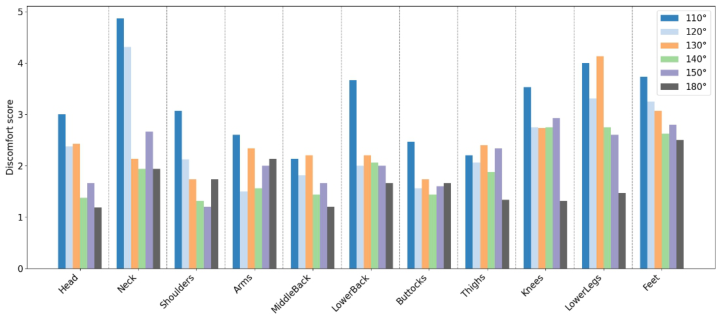
Figure 4: Local postural discomfort (1=no discomfort, 10=extreme discomfort).
As shown in Fig. 4, overall the LPD score is low (below 5), but if the angles are compared a pronounced higher discomfort score is given for the neck at 110/120 degrees and lower leg region and feet at 110/120/130 degrees, and for the lower back region in 110 degrees.
The results show a general improvement trend in the comfort scores as the backrest recline angle increases. This is in line with previous findings. But interestingly this increase flattens from 140
and higher, suggesting an opti- mum. Curious is the outcome for 180
as all literature suggests flat sleeping is preferred. A possible explanation might be that the comfort of the 180
condition is compared with the participant’s home situation. In this case, the used ‘stretcher’ will be perceived as relatively uncomfortable to their own bed.
As a limitation of this study, the comfort score is not compared to the sleep quality. Therefore, this study only gives a representation of the subjective experience of the participants. Which is also a valuable insight e.g. comfort is an important determinant for choosing to travel by night train (Kantelaar et al., 2022) or the willingness to fly with a certain airline (Vink et al., 2012).
This study used a ‘simple’ garden seat design, this might partially explain the lower back support discomfort. Therefore in future research using a dif- ferent seat design might have an influence on the outcomes. Additionally, the
sitting comfort in a seat is also influenced by the sitting posture (Smulders and Vink, 2021). This study did not take the sleeping posture into account. For further seat design improvements common upright sleeping postures should be clarified to define where seat support is necessary as sleeping requires different supports (Smulders et al., 2019).
The mean age of the participants was low, further research should consider this as napping habits and ease of movement might be different between age groups. We know napping frequency increases with age (Milner and Cote, 2009) and sleep movements decrease in older adults (Skarpsno et al., 2017). The first might influence the ease with which people fall asleep as they are more used to sleeping during the day, and secondly, as older people move less during sleep this can increase discomfort.
The participants in this test were selected based on their ease of falling asleep during the day to test their sleep comfort. When interpreting the results, this should be taken into account. The selected group might expe- rience the seat angle differently than others who have more trouble sleeping, as they spend more time awake in the seat.
This research gave inspiration for further testing of upright sleeping in a car seat, mapping sleeping postures in different backrest angles, measuring posture movements during sleep, and connecting sleep comfort to sleeping quality. Future research on sleep in dynamic situations is needed to further define attention points for sleeping environments in the context of traveling.
CONCLUSION
A conclusive statement based on sleep quality is hard to give, but in terms of comfort, a backrest angle of 120 degrees or less seems to be unacceptable for a nap. Also, more participants experience a good nap for 130 degrees and more. Suggesting that for a short napping situation, a minimum of a 130 degree recline or more is preferred. To improve sleep comfort in 110 and 120 degree recline; neck, lower back, and lower leg supports are the main attention points.
ACKNOWLEDGMENT
The authors would like to acknowledge the help of all participants who were willing to participate in this research.
REFERENCES
Aeschbach, D. et al. (1994) ‘Sleep in a sitting position: Effect of triazolam on sleep stages and EEG power spectra’, Psychopharmacology, 114(2), pp. 209–214. Available at: https://doi.org/10.1007/BF02244838. Anjani, S. et al. (2021) ‘PCQ: Preferred Comfort Questionnaires for product design’,
Work, 68(s1), pp. S19–S28. Available at: https://doi.org/10.3233/WOR-208002. Bouwens, J. M. A., Tsay, W. J. J. and Vink, P. (2017) ‘The high and low comfort peaks in passengers’ flight’, Work, 58(4), pp. 579–584. Available at: https://doi.org/10. 3233/WOR-172637.
Experiences of Upright Sleeping in a Vehicle: The Preferred Back Rest Angle 669
Caddick, Z. A. et al. (2018) ‘A review of the environmental parameters necessary for an optimal sleep environment’, Building and Environment, 132, pp. 11–20. Available at: https://doi.org/10.1016/J. BUILDENV.2018.01.020. Carskadon, M. A. and Dement, W. C. (2005) ‘Normal Human Sleep: An Overview’,
in Principles and Practice of Sleep Medicine. Elsevier, pp. 13–23. Available at: https://doi.org/10.1016/B0-72-160797-7/50009-4. Danielsson, K., Sakarya, A. and Jansson-Fröjmark, M. (2019) ‘The reduced Morningness–Eveningness Questionnaire: Psychometric properties and related factors in a young Swedish population’, https://doi- org.tudelft.idm.oclc.org/10.1080/07420528.2018.1564322, 36(4), pp. 530–540. Available at: https://doi.org/10.1080/07420528.2018.1564322. Faraut, B. et al. (2017) ‘Napping: A public health issue. From epidemiological to laboratory studies’, Sleep Medicine Reviews, 35, pp. 85–100. Available at: https://doi.org/10.1016/J. SMRV.2016.09.002. Groenesteijn, L. et al. (2014) ‘Activities, postures and comfort perception of
train passengers as input for train seat design’, Ergonomics. Taylor & Francis, pp. 1154–1165. Available at: https://doi.org/10.1080/00140139.2014.914577. Hayashi, M. and Abe, A. (2008) ‘Short daytime naps in a car seat to counteract daytime sleepiness: The effect of backrest angle’, Sleep and Biological Rhythms, 6(1), pp. 34–41. Available at: https://doi.org/10.1111/j.1479-8425.2008.00333.x. Heufke Kantelaar, M. et al. (2022) ‘Willingness to use night trains for long-distance
travel’, Travel Behaviour and Society, 29, pp. 339–349. Available at: https://doi. org/10.1016/j.tbs.2022.08.002. Milner, C. E. and Cote, K. A. (2009) ‘Benefits of napping in healthy adults: Impact of nap length, time of day, age, and experience with napping’, Journal of Sleep Research, 18(2), pp. 272–281. Available at: https://doi.org/10.1111/J.1365– 2869.2008.00718. X. Nicholson, A. N. and Stone, B. M. (1987) ‘Influence of back angle on the quality of
sleep in seats’, Ergonomics, 30(7), pp. 1033–1041. Available at: https://doi.org/ 10.1080/00140138708965993. Roach, G. D. et al. (2018) ‘Flat-out napping: The quantity and quality of sleep obtained in a seat during the daytime increase as the angle of recline of the seat increases’, Chronobiology international, 35(6), pp. 872–883. Available at: https://doi.org/10.1080/07420528.2018.1466801. Skarpsno, E. S. et al. (2017) ‘Sleep positions and nocturnal body movements based
on free-living accelerometer recordings: association with demographics, lifestyle, and insomnia symptoms’, Nature and Science of Sleep, 9, pp. 267–275. Available at: https://doi.org/10.2147/NSS. S145777. Smulders, M. et al. (2019) ‘Neck posture and muscle activity in a reclined business class aircraft seat watching IFE with and with- out head support’, Applied Ergonomics, 79, pp. 25–37. Available at: https://doi.org/10.1016/J. APERGO.2018.12.014. Smulders, M. and Vink, P. (2021) ‘Human behaviour should be recorded in (dis) comfort research’, Work, 68(s1), pp. S289–S294. Available at: https://doi.org/10. 3233/WOR-208027. Vink, P. et al. (2012) ‘Possibilities to improve the aircraft interior com- fort experience’, Applied ergonomics, 43(2), pp. 354–359. Available at: https://doi.org/10.1016/J. APERGO.2011.06.011. Wilson, C. et al. (2022) ‘Non-Driving Related tasks and jour- ney types for future autonomous vehicle owners’. Available at: https://doi.org/10.1016/j.trf.2022.01.004.
LISTED IN THE AHFE DIGITAL BOOKSTORE CATALOGUE
Explore the complete digital volume
Advances in Human Factors of Transportation
Read this individual research paper free through the original publisher, or explore the full digital proceedings book.
ISBN 978-1-964867-24-3
Explore this ISBN in the AHFE Bookstore ↗Listed in the July 2026 bookstore catalogue; search by ISBN to confirm current availability · Digital book purchase optional