Alexa-Sibylla Wagner ab, Ümit Kilincsoy ad, Maximilian Reitmeir, Peter Vink (2020). Adaptive Customization –Value Creation by Adaptive Lighting in the Car Interior. In: Advances in Social and Organizational Factors. AHFE Open Access, vol. 9. https://doi.org/10.54941/ahfe100309
In this paper adaptive customization by color changing LEDs is investigated. Two forms of customization are studied: one system reacts on the color of subjects’ clothes and one system was influenced by a color blending App. Both are built up in a real car. The emotional responses were recorded before and after the test with 70 subjects. Emotions as attraction, hope and joy were found as reactions and 58.6% preferred this approach of steering the interior lighting. Half of the sample preferred the color mixing and half the automatic color detection system showing that there are two clear interaction preferences. The expectations recorded prior to the test influenced the level of experience massively and also interfered with the subjects’ emotions.
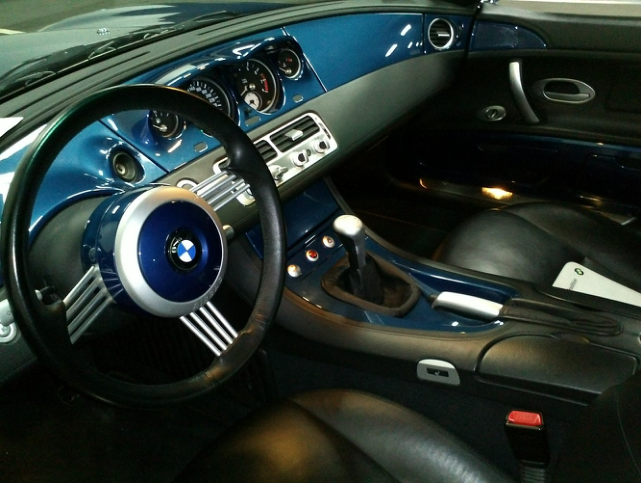
In the BMW museum it is shown that high class customization of luxurious cars in the 60s and 90s was offered for only one person e.g. the BMW 507 and the BMW Z8 (see Fig.1). The initial buyer could choose among a lot of interior features, colors and materials and therefore the car was customized to the buyer’s needs. However, this is only an advantage for the 1st owner of a car and can seldom be applied to the retail market or car sharing. In the past, customization was only available for make-to-order products. Nowadays, customization is realized by colors and materials aside of technical features in form of packaging or sub-brands in order to satisfy an increasing demand for individualization (Futschik, 2011). Another possibility for customization is to change the appearance of the interior continuously.
Figure 1. The interior of the Z8, which is made custom specific and the color repeats itself in different parts of the interior. In the last years the application of LEDs increased in our homes, decorations and in cars itself either as safety features like head and tail lamps (Lachmayer, 2011) as well as interior design elements (So & Chan, 2009) e.g. as programmable and application steered LED lightstrips (Donath, 2013) or photonic textiles (Klaß, 2005). For the second owner and car sharing users, which could be a change in the mobility behavior of customers especially in bigger cities, customizable lighting elements in the interior can be an interesting approach. Therefore, in this project RGB LEDs are used that can be adapted continuously during the lifetime of the car. To test whether this is possible and appreciated by customers this project is initiated. Several design stages (ideation, user innovation contest, benchmark on customization with smart phones, integration into the car) were applied for generating a prototype followed by a qualitative and quantitative study. The overall research question is: ‘can adaptable customizable functions create a value for customers?’ and more specific: ‘is color connected to the user being influenced on experienced emotions?’.
THE IDEATION STAGE The first design stage consisted of a student workshop identifying a relationship between excitement or positive experiences and customization (n=18 subjects). The purpose was to lead to the core question of customization to be a buying motivation in a time in which mobility solutions tend to change massively e.g. flexible ownership models of cars, individualization and decreasing significance of owning a car as status symbol (Winterhoff et al., 2009; Horx, 2010). The students of various backgrounds doing their internship at BMW were subdivided in teams of 3 to 4 in order to play different games in randomized order. The excitement of games in which the participants needed to be on their own were rated low whereas the individualizing of an easy brick game like Make ‘n Break by setting own rules proved to be as intense as group experiences like performing a stand-up play with puppets. It seems that customization of the game where users can make their own rules increased excitement. This was a motivation to continue and the question is what can be customized by users themselves within the car.
USER INNOVATION BY CROWD SOURCING As a next step crowd sourcing applied in the form of a web-based contest (cf. Terwiesch & Ulrich, 2009) was used to generate an user-oriented pool of ideas for customization of the automotive interior (Fueller et al., 2005; Fueller & Hieberth, 2004; Barl et al., 2003; Shawney et al, 2005, Ernst & Gulati, 2003; McAlexander et al., 2002; Fueller et al., 2008; Wiegandt, 2009). Via platforms, posters, advertising and social media (e.g. Facebook) participants were invited to submit functions or designs allowing an enhanced degree of customization compared to current cars. With the incentives of prizes (first prize was a visit to BMW, combining extrinsic with intrinsic motivation (Walter & Back, 2011)) the competition resulted in a broad variety of 740 ideas for customization of the automotive interior. The contest members were 1075 participants who evaluated the ideas by choosing “I like this idea” or “I would use this idea” (illustrated by thumbs up/down). Simultaneously, an evaluation group of experts within BMW selected ideas (Riedl et al., 2010). The best ideas out of both pre-selections were sent to a jury of external and BMW experts. They evaluated the ideas and selected the winners. The winning idea “color matching camera and lighting” was intended to sense the color of the clothing of the driver and adapt the interior color of lighted panels to the clothing color. This idea was taken as an inspiration for the mock-up and transferred to a design of adaptable lighting elements.
BENCHMARK ON CUSTOMIZATION WITH SMART PHONES To check if this idea has a change of acceptance, the need for customization was also investigated among other products like the iPhone. Qualitative interviews with seven iPhone users on applying different mobile covers or sleeves in bright colors, materials and equipped with different functions were studied. Two main characteristics of customization could be identified in how the product is affected in order to adapt it to a person: aesthetic customization and functional customization. Aesthetic customization is represented by material (silk bag, leather sleeve and silicone cover), texture (croc, form of a chocolate bar, a cassette player) and color (gold, green, brown etc.), functional customization by added functions like charging, protection cover and antenna amplification. The consumers were willing to pay for this aesthetic customization from 8-20 Euros and 16-80 Euros for the functional customization. This means customization related to color is already used among other products supporting the vision that the new idea of adaptive interior lighting has potential.
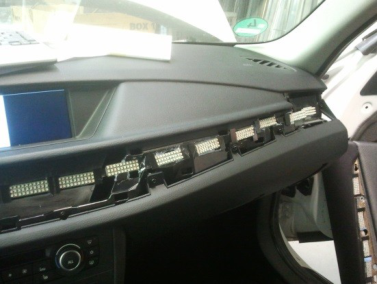
INTEGRATION IN THE CAR: BUILDING THE MOCK-UP The experience of the adaptive interior lighting was created by mounting a camera in the car in the inside mirror serving as the color sensor. The camera was programmed to detect the colors of the clothing in the area of the right shoulder. According to this data input the color of the LEDs were manipulated. Openings (dot shape) were made in the dashboard and door trims. Behind these openings RGB LEDS were mounted able to change color (see Fig.2a). Additionally, the LEDs could receive the signal from an APP via WLAN to change or blend colors by the usage of an iPad (see Fig. 2b).
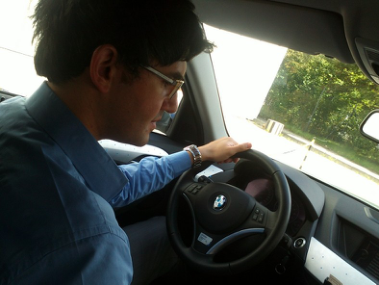
Figure 2a. Adaptive interior lighting mounted in the dashboard (left picture), red lighting of dashboard and door trims adapted to red shirt of driver detected by camera.
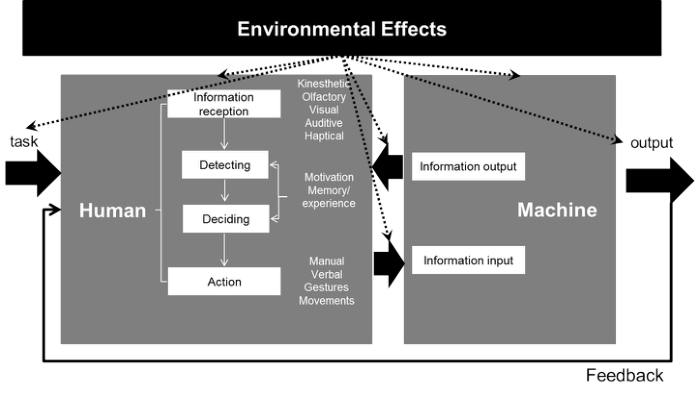
It is interesting to position this interaction of the driver with the adaptive interior lighting into a broader scientific perspective to add to the understanding of human preferences. This is done by using Human-Machine- Interaction models (cf. Schlick et al., 2010; Bubb, 2008). Lessons could be learned on the adaption of subsystems to the driver’s skills, psychological and physical restrictions of information processes e.g. through Cognitive Engineering (Rasmussen et al., 1994). As both models consist of valuable information, but neither one serves as the right approach for this study, a combination might be useful. Schlick’s model represents the inner information processing of humans in relation to the respective stimulus, whereas Bubb’s model describes the effect of environmental impact on human, machine and the information flow between. Both aspects were used and transferred into an adequate model for studying customization systems for the automotive interior (cf. Figure 3) analoguous to Bubb’s model in a closed loop with a special focus on the consumer trend “simplify” i.e. the customer’s expectation of an simple and intuitive access to a technological system (Winterhoff et al., 2009; Lemmer, 2011). The model in Fig.3 has a machine and a human side. In case of using the App, the system information is taken (information output on the App) and there is a reception in the human, then the human detects and decodes and an action follows.
Figure 2b. The color choice by APPsteering.
For the design of an adaptable interior lighting the resulting research questions regarding their character of customization are: Do users prefer an automatic adjustment or a conscious choice by an App? What effect can be identified of the subject’s expectations on their emotional arousal before and after the test?
METHOD
A study with 70 subjects was performed to answer the research questions whether the conscious color choice or the automatic color adaption were preferred and to identify differences between those two interaction processes between human and machine (cf. Figure 3). Regarding the inner processes happening within a human, the camera-based adaption is representing an interaction with no detection or decision. So the system automatically detects the color of the subject’s clothes and decides which color should be displayed by the LEDs. The App allows the subjects to decide on the interior lighting color.
Figure 3. Conceptual Model of Human-Machine-Interaction based on the model of Schlick et al. (2010) and the lecture notes of Prof. Bubb.
According to the Human-Machine model (cf. Fig. 3), the lighting adaptation can be subdivided in an information input part and an information output part. To identify the expectations of the subjects and the resulting interference the researcher questioned these aspects prior to the presentation.
First a pretest was conducted with 11 participants (5 females, 6 males) receiving a product presentation and who afterwards filled out a questionnaire with a special focus on the emotional added value of customization. The pretest showed it was difficult to catch the subjects’ emotions, also that a lab situation would be more convenient, as lighting conditions outside could vary massively. So the mock-up was positioned inside with constant lighting conditions. Before and after experiencing the interiors a guided interview was held with 70 participants. The mean age of the study population varied between 20 and 59 years with a majority of middle aged subjects, 27 females and 43 male most of them working at BMW (R&D 71.4%, Production 12.9%, Marketing 5.7%). In order to identify the emotional responses of subjects the emocards (Desmet et al., 2001) were used along with a bipolar 7-point Likert scale of 2 opposite emotions: aversion-attraction, fear-hope and boredom-joy. The subjects had to rate those 3 emotions before and after the test. All pre-tests indicated that a verbal description of the emotion is necessary in order to prevent misinterpretations. Other items like satisfaction were excluded as subjects lacked understanding of the reason why an interior feature should lead to dissatisfaction, this will be more important associated with comfort ratings or usability than emotional responses. Even in the pretest the subjects prove to have an above average level of consumer innovativeness as well as a high automobile involvement. However, they showed only an average level of a need for customization. This issue was also found in the 70 subjects involved in the complete test (>50% high scores in innovativeness, >70% high scores in automobile involvement, > 20% mediocre to moderate high scores in automotive customization). Established marketing scales were combined with an automotive customization scale which was developed by the researcher through prior experiments to this study. T-tests of the questionnaire items prove to be significant, serving as a profound tool for the study. The marketing scales along with a typical catalogue of buying criteria for a car were tested in a 5-point Likert scale with 1 as lowest score and 5 has highest. For instance, overall quality, reliability and quality of the interior were valued as most important by the sample, whereas variability of the interior, brand image, reputation of the manufacturer, customization and storage capacity were regarded as not important. The first interview part was questioned before the subjects experienced the feature. It was done to identify their expectations of the word “adaptive lighting”, the frequency of color switching of interior lighting (never 14.3%; once 10%; more than once 22.9%), the most favorite colors and most favorite clothes colors. As the majority of subjects mentioned that they would only change the lighting color of the interior seldom to never, a new approach to operate this color change is a plausible way to lead users to a new customizable and adaptive experience. A comparison of the new steering possibilities with current ones e.g. a switch to change a pre-defined set of colors has to be drawn and rated by the subjects as well as qualitative interview parts regarding the reason for their choice (automatic adaption by camera-input or blending colors with an iPad App). Other questions were focused on whether this steering option should go further in form of a brainstorming technique. This particular interview part was conducted sitting in the driver’s seat, as the researcher aimed for continuation and similarities in the setting combined with the anticipation of being an actual driver in the car. This scenery should lead to a deeper insight in the authentic user-product interaction.
Pre- and post-ratings of emotions were tested with t-tests for paired comparisons (p<.05). The positive scores of the preferences were also tested against the negative scores using Wilcoxon (p<.05) along with a cross-tab analysis to discover relationships with subjects preferring the camera based adaption of the lighting color and with subjects preferring the App on a CE device e.g. iPad. The impact of expectations was tested with cross-tabs and ANOVA. Additionally, the validity of the Likert scales was checked with correlations and ANOVA with the established emocards.
RESULTS
The pretest showed that the subjects preferred an adaption of the lighting’s color according to their mood. Even if the most favorite color in general and regarding clothes’ color is blue, the majority preferred the conscious color choice via interfaces like an App on a CE device to the camera-based one. This trend was investigated further in a guided study with 70 subjects. Again the color blue proved to be the most favorite color (33.3%) followed by green (14.4%), red (12.6%), black (8.1%) and no preference at all (9.9%); other colors like white, orange, yellow, magenta, purple, cyan and grey were chosen as well, but played only a minor role in the sample. However, the most favorite clothes colors are decisively different with blue (21.4%), black (18.8%), no preference (17.0%), red (13.4%) and white (7.1%) compared to the pretest sample. Here the downwards order of preference changed, as colors like grey and brown are preferred as clothes colors, opposite to their general favorability, followed by orange, green, cyan, magenta and purple.
The test with emocards (Desmet et al., 2001) alongside Likert scales showed significant correlations for the scales of aversion-attraction (before=-.514, after =-.440), fear-hope (before=-.565, after =-.438) and boredom-joy (before=-.453, after =-.497) both before and after the test. As the scales are inverse, the correlations are negative. Attraction and hope show significant correlations to almost all emotional responses except for the mood asked before the test by emocard, this might be a result of the forward orientation of the item. The level of joy before the test also correlates intensively with other emotions, after the test joy is not only correlating with the emocard, but also strongly with the level of attraction (.813) and hope (.807).
Table 1. The frequency distribution of the EMOCARDs before (a) and after (b) experiencing the feature.
Table 1 shows the results of the emocards before and after experiencing the adaptive lighting system, revealing a general feeling of average pleasantness. According to the Wilcoxon test the 2 samples of emotional responses before and after differ significantly from each other (p = .023 < .05). So the change in emotional feedback especially the rise of percentages of the “excited neutral” state and “excited pleasant” state, along with a decrease in negative responses from before the test to after, is significant.
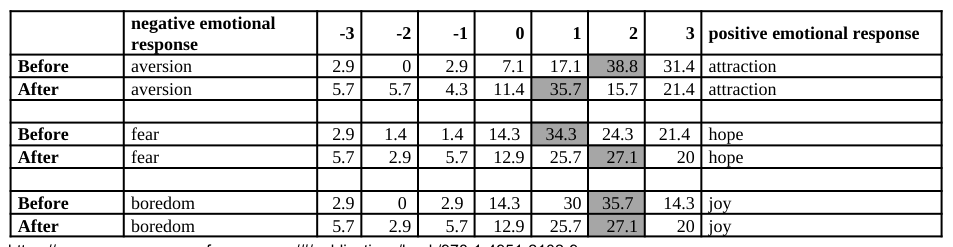
Table 2. The frequency distribution of the different emotions elicited before (a) and after (b) experiencing the feature.
The positive emotions of attraction, hope and joy have the highest scores. Whereas the level of attraction in the before-after analysis shows a small decrease, the level of hope indicates a small increase. Simultaneously, the rating of joy remained unchanged. The item attraction could be affected by the subjects’ expectations being higher than the actual experience itself. As the Wilcoxon test proved a rather strong significance of p = .001 with the emotion aversion and its counterpart attraction, this change in opinion seems to be an important observation. Consequently the effects of expectations and the resulting implications upon the subjects’ emotions should be investigated further.
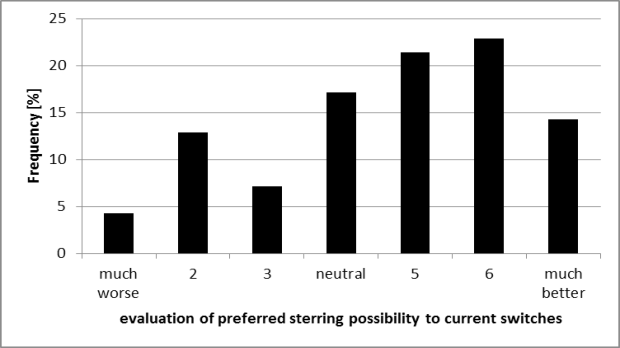
Regarding the preferred steering possibility offered by the lighting, the preference was equally divided, 50% preferred the camera and 50% preferred the color blending by an iPad App. Figure 4 shows the results regarding the question if the chosen operation by camera or App would be worse or better than the common one i.e. a switch for lighting color changes. Figure 4 shows the frequency distribution of the sample along a 7 point Likert-scale, indicating a preference for the new approaches of operations of the interior lighting. As main reasons for this evaluation the individual choice and independence through an App was mentioned by 35.1% representing the half of the sample preferring the App. The other half favoring the cam-based system indicated the adaptive reaction without the intervention of the driver (17%) or the direct changing with automatic adjustment (16%) as cause for the choice.
Figure 4. Comparing the new control of light with the current one. The question was is the new one worse or better on a 7-point Likert scale.
On the question whether the steering of the color should be changed further than App or CAM, the majority of subjects wished a combination of various steering possibilities of the lighting color within the automotive interior, e.g. integration of App in the car as hardware (18.6%), combination of cam and switch (13.3%), combination of cam and App ( 8.8%), combination of cam and iDrive (4.4%) , combination of cam/switch/music (0.9%) and combination of App and voice control (0.9%). But also new ideas like biometric recognition (15%), camera-based hues changing according to the driving mode (5.3%) and identification of the driver by the key (1.8%) were considered. Interestingly, the CE device applications also influence some subjects to come up with ideas like shooting a picture of today’s clothes and sending it to the car (2.7%). Thus, most subjects are inclined to have functionalities beyond the camera-based system or App.
Given the fact that the sample can be equally divided in subjects preferring the camera-based lighting color adaption and those preferring a conscious choice and color blending with an App interface, the differences between those two clusters would be interesting. Therefore, a cross-tab analysis lead to the results summed up by Table 3.
Table 3. Comparison of characteristics between subjects preferring a camera-based adaption of the lighting or a CE-device App.
Table available in the original PDF paper.
The camera favoring cluster discloses a strong relationship to the item questioning the level of influence of a human upon a machine or mechanism responsible for the color change (p = .000, Cramer’s V = .605). The increase in automation is appreciated by this particular cluster as various combinations of camera-based lighting and additional functionalities e.g. combination of camera, switch and music choice etc. (p = .000, Cramer’s V =.789). Consequently, also the reasons for favoring the camera as source for the color reflect the automation idea with no intervention of the driver or the inference to clothes representing the mood of its wearer. In contrast, the App cluster favors all App related combinations with additional steering possibilities (p = .000, Cramer’s V = .802) and constitutes the conscious choice and independence from other systems as major reasons (p = .000, Cramer’s V = .837).
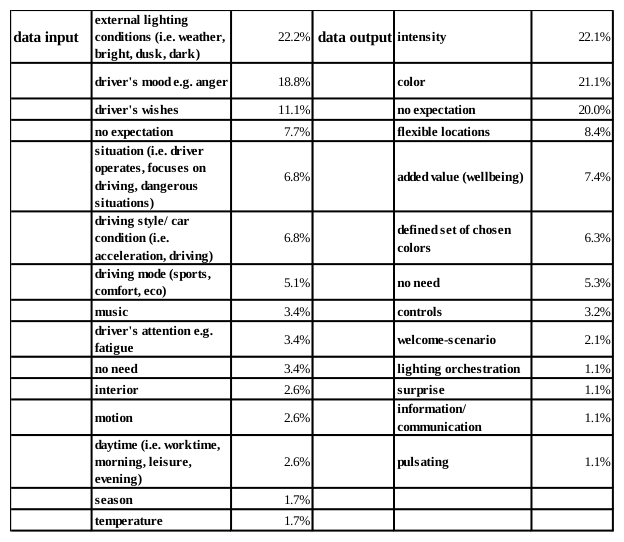
The influence of expectations on the emotional arousal of the subjects was analyzed by clustering the answers of subjects regarding expected information input forms for the color adaption and potential data output forms. In Figure 5 the data input can be subdivided in environmental causes, human causes and automotive causes with a major emphasis on the first two (cf. Table 4), whereas the most subjects expect a change in the lighting in form of color and intensity or have no expectations at all.
Figure 5. Clusters of expectations of adaptive lighting regarding various forms of information input and information output.
Figure available in the original PDF paper.
Table 4. Frequency distribution of expectations of data input and data output (downwards order).
A cross-tab analysis showed a rather strong significant relationship between the expectations and the item “joy” (p = .000, Cramer’s V= .606). Boredom representing the negative counterpart of enjoyment in this study was the emotion that the subjects felt regarding motion, situation, temperature and the driver’s attention as data input. On the other hand, subjects with no expectation at all or expecting an adaptation following the daytime, external lighting conditions, the interior, season, the driver’s wishes, music or the driving mode showed enjoyment of such an adaptive lighting concept. The emotional arousal of attraction and hope, questioned after the test, also proved to be significant in relation to various forms of data input (attraction: p = .002, Cramer’s V = .517, hope: p = .001, Cramer’s V = .527). The negative counterpart of attraction i.e. aversion tends to be felt by subjects expecting no need for such an adaptive lighting or the driving mode, external lighting conditions, seasonal changes or the daytime as optional data input sources. Subjects with a neutral emotional state have possible expectations as external lighting conditions or motion. Interestingly a change of the lighting according to the season evokes both aversion and attraction by the subjects. The driver’s wishes, daytime and season are also not distinctive in relation to the subjects’ emotions from fear to hope. Fear is implied by subjects expecting no need for having this system and having no expectation at all. Hopeful subjects tend to expect an adjustment according to the driver’s attention, situation, temperature, interior, music, driving style or season. If the lighting adapts according to the driving mode, the driver’s attention, the mood or the daytime, the same subjects valued the exterior design as an important car buying criterion (p = .003, Cramer’s V = .533). Also the purchase argument of having a comfortable car (p = .003, Cramer’s V = .531) is very important, especially when there are no prior expectations. Analogously, the data output indicating average strong significant relationships with the buying criteria roominess (p = .000, Cramer’s V = .595) and interior design (p = .004, Cramer’s V = .508) rated very important, again having no expectations is interfering with the subjects’ evaluation of ideas of potential ways the lighting should change.
DISCUSSION AND CONCLUSION Regarding the research question ‘Do users prefer an automatic adjustment or a conscious choice by an App? What effect can be identified of the subject’s expectations on their emotional arousal before and after the test?’ it is clear that half of the study population prefers the App and half prefers the automatic adjustment. If color is connected to the user experiencing emotional arousal, the study could verify a general feeling of average pleasantness as well as an increase in positive and decrease in negative emotional responses (emocards) compared with the pretest. The Likert scales offered a deeper insight in this general emotional feedback. Whereas the level of joy remained unchanged, there was a little increase in the level of hope and a little decrease in attraction after the feature presentation indicating that expectations could have a biasing effect on the emotional experience of the subjects.
This effect was investigated further by an analysis and clustering of the answers to the qualitative question concerning expectations of the word “adaptive lighting” prior to the feature presentation. According to the HMI model (cf. Fig. 3) the information input for the color adaption could be subdivided in environmental, human and automotive causes, whereas the information output is concentrated upon the function itself; in this case the general characteristics of RGB LEDs like changing color or intensity, but also flexible locations and even an added value like wellbeing were expected. The subjects expecting no need for any adaptive lighting, tended to show aversion and fear of the feature. Surprisingly, having no prior expectations of the systems proved to be a crucial reason for enjoyment as emotional response along with other expectations (adaption to daytime or external lighting conditions, adaption to the interior, season, the driver’s wishes or music). But convenient input forms as motion, temperature, attention or the situation known from other features or systems were regarded as boring. The appreciation of either a steering of the lighting color by an App or a camera of 58.6% compared to 24.4% preferring the common steering by a switch, proved a general trend to new ways of interaction. The main difference is the location of decision making which is internalized in the user by the conscious color choice by an App and externalized by the camera.
In this study 50% preferred the App and 50% preferred the camera-based solution. Even if both steering possibilities offer advantages as the conscious choice and control over the color (App) to the automation of color changing without the intervention of the driver (camera), functionalities beyond these were pursued. As a result, users are searching for new and surprising interactions with a machine especially in terms of emotional features like lighting.
The general pursue of added value, expected by 7.4% of the subjects, is proven by relationships between characteristic App and camera reasons, as well as a strong tendency for color changes happening once (28.6%) or more frequent (57.2%). For those subjects expecting an added value at the same time valued roominess and interior design as very important. Even in the iPhone study the aesthetic (material, texture, color) and functional customization (charging, protection and antenna amplification) provided additional value.
Although the mock-up of the color changing system reached a high level of integration, the brand attribution was hindering associations to other brands and therefore limited the openness of the brainstorming part of the survey. The homogeneity of the sample (mostly engineers, male, aged 20 to 59) would need to be compared to actual buyers with an extraordinary need for customization to draw conclusions, especially a focus group of customers regarding the car as an expression of themselves and as an extension of office and living room, so-called Sensation Seeker (Winterhoff, 2009). Other direct measurement techniques for emotional feedback would be important to consider as well in future research like, Facereader (Benţa, K.-I. et al., 2009; Melder et al., 2007; van Kuilenburg 2005), EEG (Oude Bos, 2006) and heart rate by ECG measures (Appelhans & Luecken, 2006) in order to get data which is not filtered through perception, cognitive processes and interpretation of emotional illustrations and scales. To conclude neither automobile involvement nor consumer innovativeness were low in this study, the need for customization however was only average, indicating that the marketing scales show no relations to customization per se.
REFERENCES
Appelhans, B. Luecken, L.J. (2006) “Heart rate variability as an index of regulated emotional responding.” Review of General Psychology, 10 (3): 229-240 Bartl, M. et al. (2003) “Community Based Innovation” in Herstatt, Cornelius & Sander, J. (publ.): Produktentwicklung mit
virtuellen Communities,Wiesbaden: 141-169 Benţa, K.-I. et al. (2009) „Evaluation of a System for Real-Time Valence Assessment of Spontaneous Facial Expressions”, in proceeding of: The International Romanian-French workshop "Distributed environments adaptability, semantics and security systems", At Cluj-Napoca, Romania, 1 Bubb, H. (2008)“Produktergonomie” Skriptum zur Vorlesung. München: Lehrstuhl für Ergonomie. Desmet, P.M.A. (2003), “Measuring emotion; development and application of an instrument to measure emotional responses to products”, in: M.A. Blythe, A.R. Monk, K. Overbeeke and P.C. Wright, eds., Funology: From Usability to Enjoyment, Dordrecht: Kluwer Academic Publishers. Desmet, P.M.A., Overbeeke, C.J. and Tax, S.J.E.T. (2001), “Designing products with added emotional value: development and application of an approach for research through design”, The Design Journal, 4 (1): 32-47. Donath, A. (2013) “Hue-Leuchtschlangen von Philips“, the golem.de website: http://www.golem.de/news/smartphonesteuerung-hue-leuchtschlangen-von-philips-1308-100822.html Ernst, H. Gulati, R. (2003) “Virtual Customer Integration– Bringing the Customer back into the Organisation, Evaston”,
Working Paper 2003, USA. Fueller, J. et al. (2005) “How to Integrate Members of Virtual Communities into New Product Development” in: Electronic Commerce Research Journal, 6(1): 57-73 Fueller, J. et al. (2008) “Brand Community Members as a Source of innovation”, Journal of Innovation Management, 25: 608- 619 Fueller, J. Hienerth, C. (2004) “Online Consumer Groups as Co-Innovators –Virtual Integration of Community Members into
New Product Development”, Working Paper European Business Forum. Futschik, H.D. (2011) „Design“, in Handbuch Kraftfahrzeugtechnik, Braess, H. and Seiffert, U., series editor, Vieweg + Teubner publishing, Springer Wiesbaden. Horx, M. (2010) „Die Macht der Megatrends“, presentation. Klaß, C. (2005) „Photonische Textilien - Sofa als Display“, the golem.de website: http://www.golem.de/0509/40192.html Lachmayer, R. (2011) „Beleuchtung“, in Handbuch Kraftfahrzeugtechnik, Braess, H. and Seiffert, U., series editor, Vieweg +
Teubner publishing, Springer Wiesbaden. Lemmer, K. (2011) „Mensch-Maschine-Interaktion“, in Handbuch Kraftfahrzeugtechnik, Braess, H. and Seiffert, U., series editor, Vieweg + Teubner publishing, Springer Wiesbaden. Melder, W. A. (2007) “ Affective Multimodal Mirror: Sensing and Eliciting Laughter”, in HCM '07: Proceedings of the
international workshop on Human-centered multimedia:31-40 McAlexander, J. et al. (2002) “Building Brand Community” in: Journal of Marketing, 66: 38-54. Oude Bos, D. (2006)“EEG-based emotion recognition - The Influence of Visual and Auditory Stimuli” Capita Selecta (MSc course), University of Twente. Rasmussen J, Pejtersen AM, Goldstein LP (1994) “Cognitive Systems Engineering” New York: John Wiley. Riedl, C. et al. (2010) “Rating Scales for Collective Intelligence in Innovation Communities: Why Quick and Easy Decision Making Does Not Get it Right”. In: Proceedings of Thirty First International Conference on Information Systems. Schlick, C. Bruder R., Luczak H. (2010) „Arbeitswissenschaft“ Heidelberg: Springer. Sawhney, M. et al. (2005) “Collaborating to Create: The Internet as a Platform for Customer Engagement in Product
Innovation” in: Journal of Interactive Marketing, 19( 4): 4-17. So JCY, Chan AHS. Design Factors of LED Display for Improving Message Comprehension, proceedings of the IEA 2009 conference, paper number 2VI0025. Terwiesch, C. Ulrich, K.T.(2009) „Innovation Tournaments: Creating & Selecting Exceptional Opportunities“ Harvard
Business School Press, Boston No. 425 van Kuilenburg, H. (2005) “A Model Based Method for Automatic Facial Expression Recognition” Proceedings of the 16th European Conference on Machine Learning, Porto, Portugal: 194-205, Springer-Verlag GmbH. Walter, T. Back, A. (2011) “Towards Measuring Crowdsourcing Success: An Empirical Study on Effects of External Factors in
Online Idea Contest” in: Proceedings of the 6th Mediterranean Conference on Information Systems, 2011. - MCIS. - Limassol, Cyprus Wiegandt, P. (2009) “Value Creation of Firm-Established Brand Communities”, Gabler GWV Fachverlage GmbH, Wiesbaden. Winterhoff, M. et al. (2009) “Future of Mobility 2020 – the Automotive Industry in Upheaval?”, Arthur D. Little Report.
LISTED IN THE AHFE DIGITAL BOOKSTORE CATALOGUE
Explore the complete digital volume
Advances in Social and Organizational Factors
Read this individual research paper free through the original publisher, or explore the full digital proceedings book.
ISBN 978-1-4951-2102-9
Explore this ISBN in the AHFE Bookstore ↗Listed in the July 2026 bookstore catalogue; search by ISBN to confirm current availability · Digital book purchase optional