J Nieves Serratos Pereza, Juan Luis Hernandez Arellanob, Carmen Negretec (2020). WRMSD Survey. A Comparison Between Assembly and Manufacturing Tasks. In: Advances in Social and Organizational Factors. AHFE Open Access, vol. 9. https://doi.org/10.54941/ahfe100318
A survey about the presence of WRMSD was conducted at an industrial concern where automotive parts are produced, in the central region of Mexico. Two samples were involved. One of them consisted of 114 workers who perform assembly tasks using CNC hydraulic presses. The other contained 153 CNC lathe operators, who manufacture the parts to be later assembled. All subjects were male. Both groups operate Advanced Manufacturing Technology (AMT) machinery, facing both physical and cognitive demands. The subjects completed a questionnaire on the presence of musculoskeletal complaints, rating its severity on a 0-10 scale. Ninety percent of the assembly workers pointed to at least one body region with complaint; 85% of the manufacturers did the same. Most of the ratings fell in the 4-5 markings. Upper and lower back, neck and both wrists were the body regions most affected for the whole sample. Our findings are very much in line with the current trends, and clearly point to the need for ergonomic intervention in regards of workspace layout and tasks procedures, in order to diminish the risk of musculoskeletal damage for both groups.
Appearance of musculoskeletal complaints, which may start as a minor hindrance and later develop into severe chronic damage, has long been cited in ergonomics literature as a frequent work-related occurrence. This has brought about the term Work-related Musculoskeletal Disorders (WRMSD). Recently a tendency has appeared to analyse the soundness of such proposed relationship. A number of papers have been published where this issue is tackled. A conclusion is common to the majority of these reviews: Although there still remains to be proven beyond doubt the link between work circumstances and musculoskeletal damage, the evidence points firmly to the role certain factors seem to play in either giving rise to the unwanted outcome, or in worsening a pre-existing, non-work related pathological condition. Thus, Punnett, and Wegman (2004) mention a series of work-related factors repeatedly identified as influential for the development of apparent WRMSD. These include “rapid work pace and repetitive motion, forceful exertions, non-neutral body postures, and vibration.”
In their review paper, da Costa and Ramos Vieira (2009) make a very important discrimination between risk factors of a biomechanical nature, and those of a different nature. Among the first, they cite “excessive repetition, awkward postures, and heavy lifting”. Among the second group of factors, the authors mention heavy physical work, smoking, high body mass index, high psychosocial work demands, and the presence of co-morbidities. There is a noticeable coincidence between the factors listed by Punnet and Wegman (2004), and those named by da Costa and Ramos Vieira (2009). Albeit with slight differences in denomination, this is particularly true for the biomechanical features present in a work situation. The inclusion of psychosocial factors by the latter authors is a clear enrichment in the approach to this ever so relevant issue.
The present study was developed at two sites pertaining to an international concern devoted to the production of automotive parts, concretely, constant velocity joints (CVJ). The sites are located at Guanajuato, in the central region of Mexico. There is an ongoing relationship between our research group and this firm since 2011; the assessment of occupational ergonomics matters being an important part of it. The presence of musculoskeletal complaints among the work force has been a major concern for the medical officers at the sites, and the managers share this preoccupation.
The making of CVJ involves three main productive operations: forging, machining and assembly. All three production areas include the operation of advanced manufacturing technology (AMT) machinery, where the operator faces both physical and cognitive demands. Since this is more prevalent in the machining and assembly sections, the study here reported contemplates only those two productive areas. In the machining operations the AMT machinery is present in the form of CNC lathes; in the assembly process it takes the form of CNC hydraulic presses. Figure 1 shows these two types of machinery, illustrating as well the prevalent working conditions.
Figure 1. Machines used in machining and assembly process
Figure available in the original PDF paper.
Because of their bearing on the results of the study, it is worth mentioning some important differences between the two productive realms. First one is the nature of the production operation itself: the manufacturing of three main pieces in machining, named “bell”, “semi-axis” and “tulip”. Two kinds of product generate the assembly operation performed on those parts: short CVJ, and long CVJ. A second difference comes from the shape of the parts being manipulated: the machining operation generates separate components with a maximum length of 70 cm which are rather easy to hold one-handedly; assembly creates a set with a length that ranges from 80 cm to 110 cm which in its final shape requires the use of both superior extremities.
A third and logical difference comes in the weight of loads being handled. Whilst in the machining process the pieces weigh an average of 4.5 kg., in the assembly process the average weight is 7 kg. A fourth difference, quite important from the ergonomics perspective, is the nature of postures linked to each productive operation, albeit both involve the same basic tasks and movements, namely, 1) the loading-unloading of pieces in the machine, 2) operations on the machine’s control panel, and 3) the inspection of the pieces once the process is completed.
Another factor is worth mentioning. Due to increased demand from the market, starting precisely on 2011 the firm’s managers put in place an extended 12-hour shift throughout four week days, with a two-days’ break. This scheme involves two work shifts, and once completed a six-day cycle, the worker returns to a different shift. From the initial approach to the field operators, they have expressed the existence of "excessive tiredness or fatigue" at the end of their working day, as well as experiencing an increase in musculoskeletal discomfort generated by their work.
When the early findings were presented to the firm’s managers and medical officers, they requested the performance of the study here reported. Its main goals were:
To determine the presence of WRMSD among workers of machining and assembly operations.
To determine the intensity level of WRMSD.
To compare the findings for both productive operations.
METHODOLOGY
Study design The study design is non-experimental, descriptive, and cross-sectional. Permission was obtained from the company ´s managers beforehand. The survey was applied to workers classified as CNC lathe machine operators and homokinetic joints assembly operators, who were previously advised of its application.
Sample A sample of 114 CNC lathe machine operators and 153 homokinetic joints assembly operators was obtained from the company’s records using proportional simple random method. Once selected, workers were individually screened for the following criteria inclusion: at least six previous month experience as a CNC machine operator, no history of musculoskeletal injuries in the past six months, and no history of cardiovascular disease. After being screened and upon acceptance to participate, workers signed a consent form which also informed them on the purpose, information to be collected, procedures, risks and benefits, and measures to ensure confidentiality.
Materials
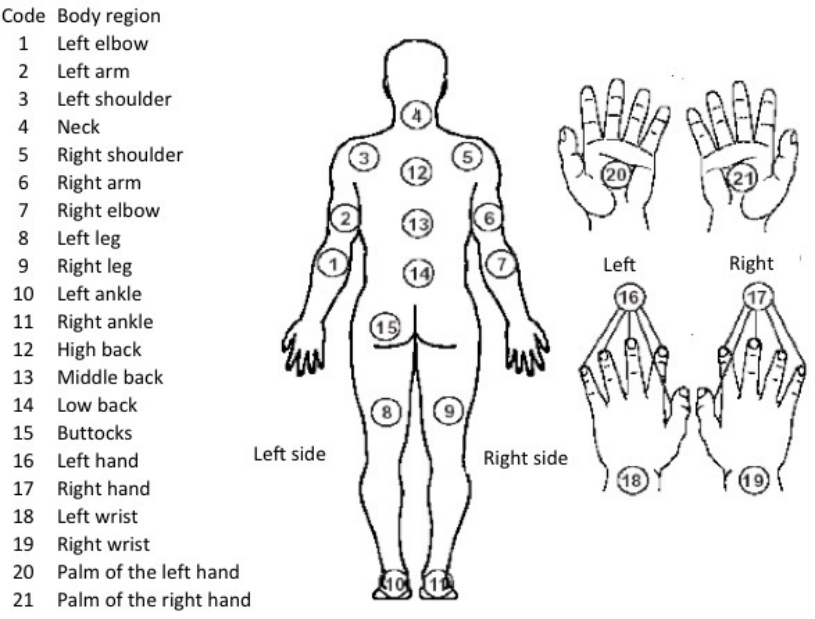
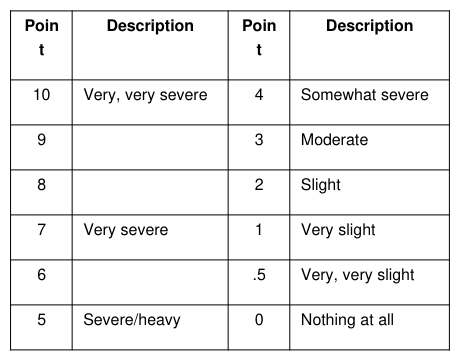
A three-part survey instrument was devised for the study. The first part incorporated Corlett-Bishop (1976) map (figure 2); the subjects were asked to point on the figure those sites where they had experienced some form of discomfort (however light this might be) over the prior 15-days period, and which they judged to be linked to their work for the company. In part two, they were asked to signal the intensity of the perceived sensation, using Borg’s 10 point scale of perceived physical discomfort (Borg, 1996) (shown as table 1). The third part of the instrument gathered information on a number of demographical features relevant to the purposes of the study.
Procedure The survey was applied during off-duty periods. After selection and screening of the subjects, trained research assistants administered the questionnaire. Selected participants were summoned to a meeting room where they received an oral explanation on the project and instructions on how to complete the questionnaire. The research associate was present at hand to answer any questions or doubts which arose from the questionnaire. Once they completed the questionnaire, every participant received a small present.
Data analysis Descriptive and proportion analyses were performed on all variables. In order to determine if differences of WMRSD between the two samples were significant, a two-proportion hypothesis test was applied. Level of significance was set at α = 0.05. The SPSS V17.0 software was used for data analysis.
Figure 2. Corlett-Bishop mapTable 1. Borg’s 10 point scale of perceived physical discomfort Poin Description Poin Description t t
RESULTS
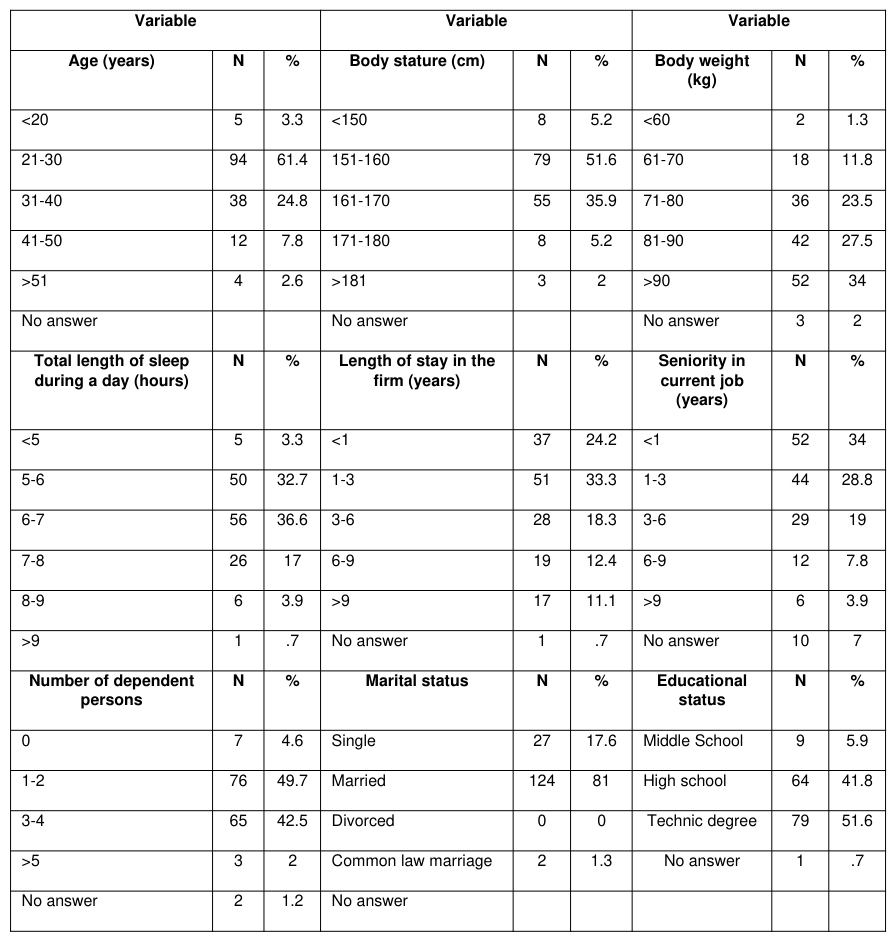
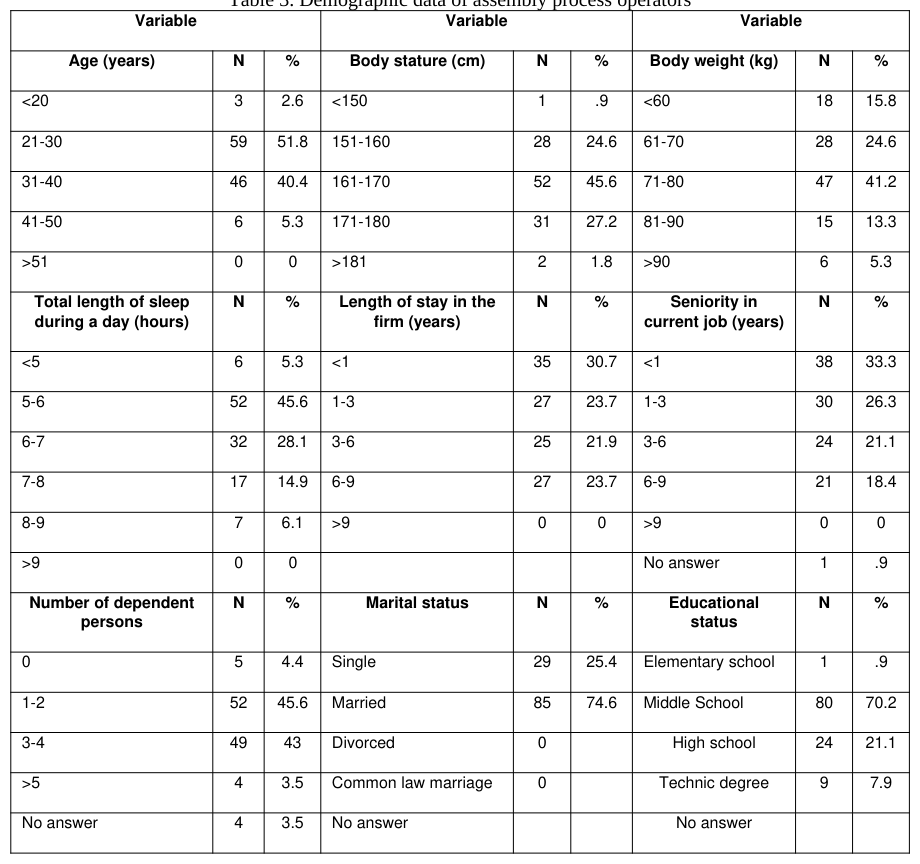
A total of 267 workers participated in the research. One-hundred and fifty-three of them operated a CNC lathe to manufacture some of the parts that later will form CVJ; the remaining 114 worked in a facility where CVJ are assembled through the operation of CNC hydraulic presses. All the subjects were male. Table 2 shows demographic data for machining operators; data for assembly workers appear in table 3.
Table 2. Demographic data of machining process operators Variable Variable VariableTable 3. Demographic data of assembly process operators Variable Variable Variable Age (years) N % Body stature (cm) N % Body weight (kg) N %
Work-Related Musculoskeletal Disorders
Figure 4 shows the absolute frequency of WRMSD on all 22 body segments depicted in Corlett-Bishop map. For both samples the highest frequency of WRMSD was observed on low back, high back, neck, right ankle and right wrist, precisely in that order.
Figure 4. Absolute frequency of WRMSD in both samples
Figure available in the original PDF paper.
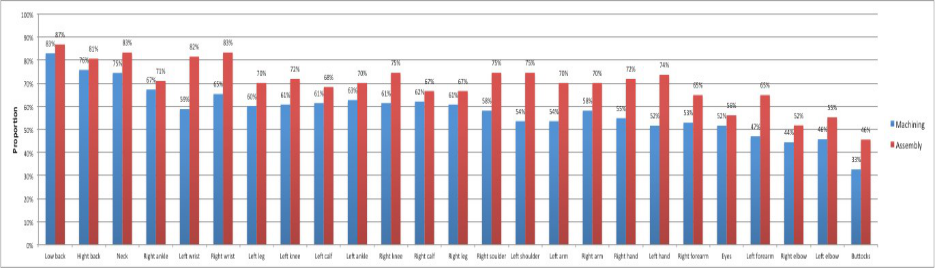
Because absolute frequency values might be misleading, the data was converted into sample proportions. The result is shown inf figure 5.
Figure 5. Proportion of WRMSD in both samples
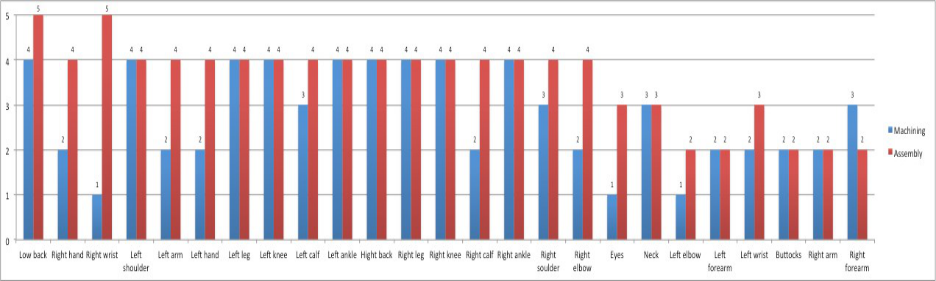
Modal values for the intensity level of WRMSD as reported were identified. This is shown in figure 6.
Figure 6. Intensity level of WRMSD. Modal values.
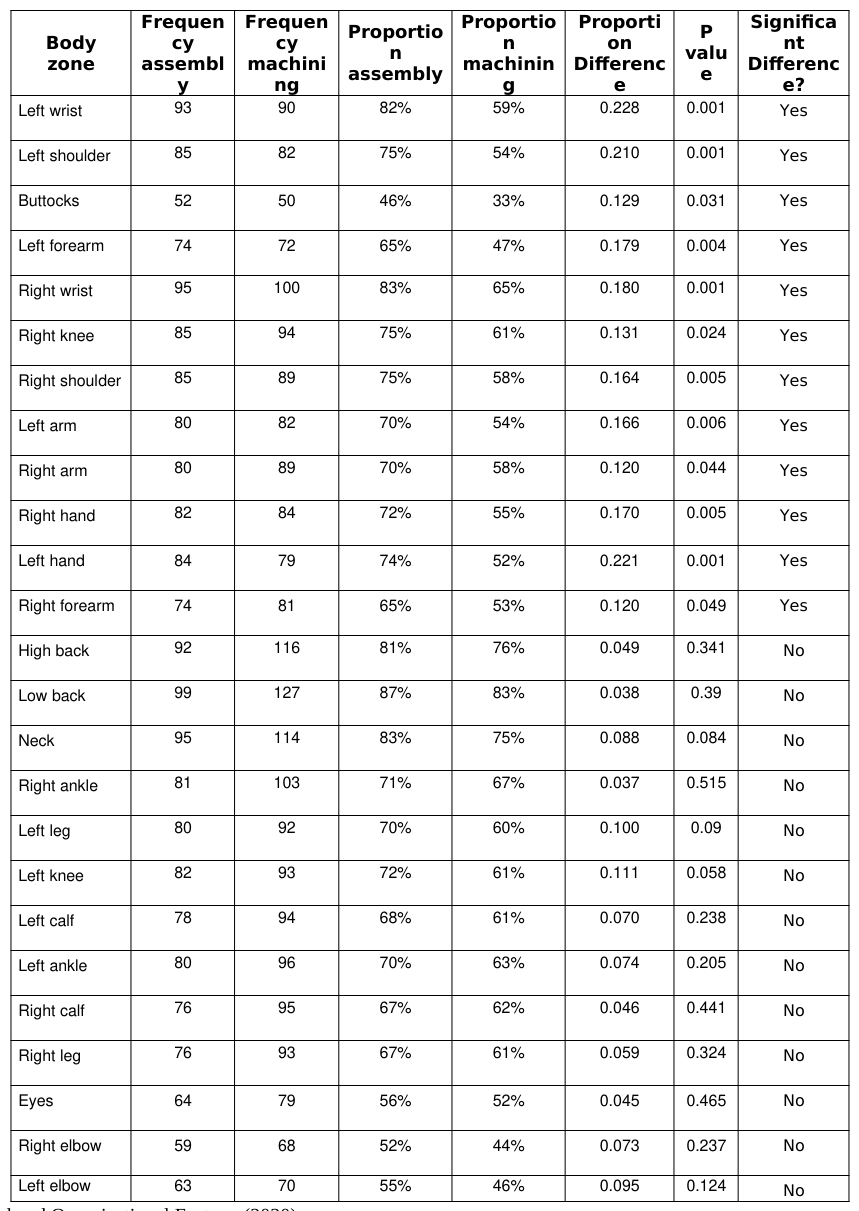
A two-proportion hypothesis test was applied probing for significant differences between the two groups of workers. The main results of this procedure showed that proportion of discomfort in assembly workers was significantly larger on left wrist, left shoulder, buttocks, and left forearm. On the other hand, proportion of discomfort was significant higher among machining operators on right wrist, right knee, right shoulder, left arm, right arm, right hand, left hand, and right forearm. No significant differences were found on the rest of body segments considered.
A summary of these findings, as well as the relevant descriptive measures is shown in table 4.
Table 4. Descriptive measures and statistical analysis results Frequen Frequen Proportio Proporti Significa ProportioEquation reproduced from the original PDF.
DISCUSSION
Body parts most affected by musculoskeletal complaints were strikingly similar for the two groups of workers who took part in the study. Both lower and upper back, neck, left wrist and right wrist were signaled as sites of complaint by over 80% of the assembly workers. Among the machining operators such rate was reached only for the low back, albeit high back and neck were quite close to it.
Another feature worth noticing in the results is that complaint rates were consistently higher for the assembly operators. Nonetheless, regarding the top 5 sites of complaint, statistical tests found equality of rates for lower back (87% assembly, 83% machining), upper back (81%, 76%) and neck (83%, 75%). In a stark contrast, significant differences were found for the rates of complaint for both left wrist (82% assembly, 59% machining) and right wrist (83%, 65%).
The affected body segments in both groups are very much in line with the findings of the review papers already cited. The biomechanical factors there mentioned are clearly present in their work circumstances, particularly forceful exertion, heavy lifting, awkward or non-neutral body postures and repetitive motion.
On a different approach, modal values for the intensity levels assigned on Borg’s scale offer a very interesting insight to the complaint patterns in the two groups. They are rather close for the low back, where the machining operators reported the highest intensity with a value of 5; here the assembly workers assigned a 4. A rather unexpected contrast comes with the values for the right wrist, for whilst the proportion of assembly workers who complained was significantly higher, the situation is markedly reversed in regards of the intensity level, with a mode of 5 for the machining operators and 1 for the assembly workers. This no doubt relates to repetitiveness and awkward postures, which are worse for machining operators. Other than that, most of the equalities shown for the proportion of complaint rates are replicated for the intensity levels.
CONCLUSIONS
The findings herein reported make a clear case for an urgent intervention seeking to enhance the ergonomics of the productive operations subjected to analysis. Rates of complaint over 80% are absolutely unacceptable. Fortunately the firm’s management fully agreed with this appreciation and has started an ergonomics program in both facilities involved.
REFERENCES
Borg G. (1996). Borg's Perceived Exertion and Pain Scales, Ed. Human Kinetics. Bruno R. da Costa, Edgar Ramos Vieira (2009). Risk Factors for Work-Related Musculoskeletal Disorders: A Systematic Review of Recent Longitudinal Studies. American Journal of Industrial Medicine, pp 1-39. Corlett, E. N., Bishop, R. P. (1976). A technique for measuring postural discomfort. Ergonomics, 9, 175-182. Punnett, L. Wegman D. H. (2004). Work-related musculoskeletal disorders: the epidemiologic evidence and the
debate. Journal of Electromyography and Kinesiology 14:13–23.
LISTED IN THE AHFE DIGITAL BOOKSTORE CATALOGUE
Explore the complete digital volume
Advances in Social and Organizational Factors
Read this individual research paper free through the original publisher, or explore the full digital proceedings book.
ISBN 978-1-4951-2102-9
Explore this ISBN in the AHFE Bookstore ↗Listed in the July 2026 bookstore catalogue; search by ISBN to confirm current availability · Digital book purchase optional