Aernout Kruithof, Valentijn Visch, Peter Vink, Owain Pedgley (2020). Comfort Design Through Music and Emotion: Effects of Passengers' Activities on Comfort. In: Advances in Social and Organizational Factors. AHFE Open Access, vol. 9. https://doi.org/10.54941/ahfe100368
Comfort experiences are not caused by a single factor, but are the result of diverse components such as postures, cognitive- and emotional experiences, as well as a person’s activity. The present empirical study investigated the experienced comfort of car passengers in the rear seat. We varied typical car passengers’ activities such as listening to music, working, and looking out the window. Dependent variables were the passenger’s comfort rating, his emotional valence- and arousal-related experience, his heart rate, and his seating position. The results (N = 23/16) showed that music positively influences comfort experiences. Moreover, correlation analysis between the dependent variables showed that comfort was significantly correlated only to the positive emotional valence component, and not to more physiological components such as emotional arousal, heart rate or seating position. The results suggest that car designers can improve the comfort of rear passengers by focussing on music and emotion design in contrast to the more conventional approach of physical ergonomics.
The domains of technology, ergonomics and design have potential to support the competitiveness of companies in the automotive sector. Technology expands possibilities, ergonomics supports the compatibility of products with people, whilst design provides a bridge between these domains. As an example, technology and ergonomics are implicated in seat design (Franz et al., 2011; Zenk et al., 2012).
A new field of interest for car manufacturers is the adaptation of the interior to the emotional state of the occupant, or to influence the emotional state of the occupant by the interior (Kamp, 2012). Emotions have multiple functions on both shaping and evaluating the interaction (Forlizzi and Battarbee, 2004), such as interaction between occupant and interior. However, a question remains regarding how emotions of the occupant can be recorded and how external stimuli influence emotional state.
In automotive design, applications and research on passenger experience are relatively limited in number. As an example, Kamp (2012) proposed a game design in the back seat, which showed to contribute to a fitter and more refreshed feeling compared to other activities such as reading a book, performing tasks on a laptop computer or playing games on tablet PC. Based on Kamp’s study, it can be argued that there is a relationship between an emotional feeling (such as ‘feeling refreshed’) and a performed activity.
The present study explores emotional effects and passenger activities. We studied the ordinary, typical activities of a passenger in a car context, such as listening to music, watching out of the window and working on a tablet computer. The research involves searching for the effects of these activities on passenger emotion and comfort, according to the main research question: "What are the effects of typical rear-seat passengers' activities on emotional state and what is their relation with comfort perception?"
Emotion A broad range of literature exists on measuring and inducing emotions and moods as different affective states (Scherer, 2005). Psychologists have used two major methods to obtain forced-choice self-reports of emotional experience: (1) the discrete emotions approach, and (2) the dimensional approach (Scherer, 2005). The discrete emotions approach use emotion concepts from commonplace lexicon such as ‘fear’ or ‘anger’ which are typically “about something”, i.e. an identifiable object or subject (Russell, 2003). Though different instruments exist to measure emotions following this approach, there are several problems that occur, including the analysis of different ‘blends’ of emotions (Scherer, 2005). The second (dimensional) approach is based on the original model of Wundt (1905, from: Scherer, 2005), which suggested a three-dimensional space defined by the axes: arousal (calm-exited); valence (positive-negative) and tension (tense-relaxed). Modern dimensional theorists often use a circular structure using only the valance and arousal axis (Scherer, 2005).
Related to components of emotion, Scherer (1987, 2001) defines emotion as "an episode of interrelated, synchronized changes in the states of all or most of the five organismic subsystems in response to the evaluation of an external or internal stimulus event as relevant to major concerns of the organism”. These 'subsystems' relate to several emotion components, among which a 'cognitive', 'neurophysiological' and a 'motor expression' component (Scherer, 2005). It is therefore arguable that measurement of emotion encompasses those emotion components. Furthermore, according to Scherer and Zentner (2001), self-report is "the only method that allows access to the subjective emotional experience". This argues for the use of self-report in the measurement of emotional effects in the present study.
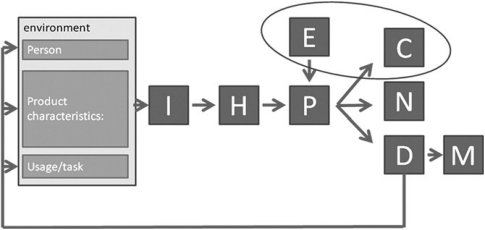
Comfort A similar distinction of ‘emotion components’ is made in several comfort models discussed by Vink and Hallbeck (2012). Inspired by these models, Vink and Hallbeck propose a new comfort model (see Figure 1). It proposes that perceived effects of an interaction are interpreted as comfortable, discomforting or a neutral feeling of nothing. This argues for the use of an overall comfort rating as well as individual measurements to study the relations of the different components to the overall comfort rating. An overall comfort rating is thus included in the self-report questionnaire of this present study. Vink and Hallbeck’s model relates 'human body effects' ('H') to the 'neurophysiological' (heart rate) and 'motor expression’ (seating position) emotion components, which brings the hypothesis of an existing relation between heart rate, seating position and comfort ratings. Furthermore, the described 'perceived effects' ('P'), as another component of comfort, might relate to the valence (pleasantness) levels of emotions.
Figure 1. New comfort model (Vink and Hallbeck, 2012)
METHOD
Experiment Setup BMW Group provided a BMW 3-serie passenger seat, for use in the experiments. Due to practical constrains of transportation (e.g. proportions of a whole rear-bench) and difficulty of using standalone (e.g. attachment of rear- bench in a setup and electrical equipment in high-end passenger seats), the usage of this mechanically adjustable seat was preferred above using a whole rear-bench or high-end passenger seat.
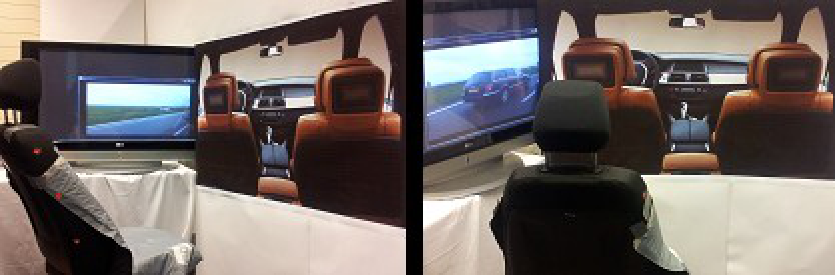
The experiment set-up is shown in Figure 2, with the apparatus consisting of the following elements: a BMW 3-serie passenger seat; two footrests (either 18mm or 72mm in height); partitioning walls; four cameras (ELRO; model: CS73Q); one microphone; two Logitech speakers (model S-120); one flat screen; 'Mflex FSA4' pressure mat, (model UT4010-7000); "Polar X-Trainer" heart rate equipment and body stickers. The two footrests were added to adjust the seating height to each subject's preference, minimizing the influence of seat height on possible discomfort scores. Subjects were seated in the black car seat that was covered with a grey pressure mat (see Figure 2).
Figure 2. Right and rear view of experiment setup
Independent Variables Three common activities of passengers were selected as independent variables: 1) music listening, 2) watching the landscape outside, and 3) working on a tablet. To be able to measure effects on emotion and its different components, the intention was to induce both low and high levels of arousal. Since negative valence levels (i.e. levels of unpleasantness) are generally not preferred by users and do not typically occur in rear seating situations, we aimed to use stimuli which induce a relatively neutral feeling of pleasantness.
Taking interpersonal preferences into account, for the ‘music listening’ activity subjects were asked to select four tracks of music from their own playlist. This was formulated in the procedure for the user to select "two tracks that have a calming effect on you" and "two tracks that have an energizing effect on you". By stressing the personal "effect" of the tracks, we tried to prevent a selection based on labelling e.g. 'this is a calm track'. Two tracks were needed to be sure that each type of music was sufficiently long in duration to not finish before completion of an experiment condition. By asking subjects to select specific tracks from their own playlist, and rate those tracks on a https://openaccess.cms-conferences.org/#/publications/book/978-1-4951-2102-9 fixed scale, it was possible to work around ‘personal liking’ (prevention of negatively induced emotions by playing disliked songs) while maintaining possibilities for inter-subject comparisons. To create a baseline for establishing the main effects of music, a non-music control condition was added.
Our second independent variable, 'looking out of the car window', is considered to be a calming, low arousal inducing task, in comparison with our third variable 'playing a game on a tablet'. To operationalize the second variable, three movies were recorded from the rear seat view of a car driving on a provincial road, in the Netherlands. All movies were captured in the same landscape at one day thus with similar weather conditions, and were therefore very similar but slightly different to prevent induction of negative valence levels originating from visual repetition of movie content (i.e. unchanging scenery). To enhance the feeling of looking outside a car window, a left view was recorded, capturing the opposite driving lane, with occasional passing cars. The flat-screen TV screen used to screen the movies was placed on a table covered with a sheet (see Figure 2). The size of the shown movie was 69.7 x 34.5 cm (width x height). To simulate the situation of staring out of the window, but being mindful to prevent neck strain, the screen and table were placed at an angle, placing it perpendicular on the view- direction when subjects turned their head 40 degrees left from the straight orientation.
Furthermore, to enhance the simulation of a car environment, the screen height was placed having the screen midpoint at eye height when sitting. An A1 poster of a BMW car interior was hung in front of the car seat to further give an impression of a car environment for the participant. The flat-screen was connected to the frontal panel in such a way that the edge of the screen was matching the poster in height and the perspective of the road in the movies matched with the poster view.
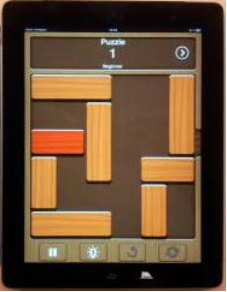
Working on a tablet computer bringing a reasonable cognitive load, with an added time pressure, is considered an arousing passenger activity, compared with looking out of the window. To standardize this cognitive load across the experiment, a puzzle-game was selected as the stimulus (see Figure 3). "Unblock Me" (Kiragames, 2009-2012) is a game in which blocks have to be moved out of the way to move a specific red block out of the screen. After solving each level of the puzzle, a new puzzle is presented with increasing difficulty. Subjects were instructed to solve as many levels as possible in each game condition. Subjects would start their first game condition (the conditions were randomized between subjects) with puzzle number one and would, in the subsequent game conditions, continue puzzling with at the puzzle at which they ended the previous game condition.
Figure 3. iPad with 'Unblock-me' screenshot
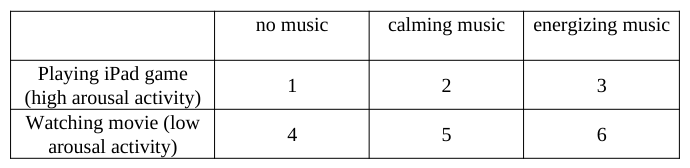
In total, the experiment comprised 6 combinational conditions of independent variables (1 – 6) depicted in Table 1 as a 2 x 3 matrix: (watching movie / playing iPad Game) x (no music / calming music / energizing music).
Table 1. Six test conditions
The six conditions were structurally randomized between subjects in a within subject design. Duration of each condition was set to 5 minutes, and the subjects remained seating throughout the experiment. Subjects received a 10 Euro compensation for participating.
Dependent variables Emotion
In this experiment, the five components of emotion (Scherer, 2005) as discussed earlier, are measured individually. We did not include the 'motivational' component in this research nor did we include the 'subjective feeling' component. The latter component might however be slightly related to our goal dependent variable comfort. Measurement of the remaining components is explained below;
- The cognitive component, emotional valence, is tested in our experiment through a self-report questionnaire on core affect, developed by Yik et al. (2011). The questionnaire of Yik et al. (2012) elaborated on the circumplex model of core-affect proposed by Russell (1980, 2003), with a similar intention of clarifying the emotion concept (compared to models with few dimensions) to be used in self-report methods. Furthermore, the study compares three different response formats, i.e., “adjective”, “agree-disagree” and “describes me” format on their ‘fit’ to the circumplex. Although the ‘fit’ of these formats is merely differentiated in some of the 12 segments of the circumplex, the ‘agree-disagree’ format seems to show the most evenly spread result over the whole circumplex, and seems to bias the results on reported emotions less. We applied the statements of Yik et al. (2011) using a 5-point Likert scale (from ‘strongly disagree’ to ‘strongly agree’).
- The neurophysiological component refers to bodily symptoms. Especially related to emotion induction through music, there is a wide range of literature studying bodily, physiological effects. Scherer and Zentner (2001), discussing and comparing existing studies on music-mood induction, conclude that it is difficult to argue that ‘prototypical’ physiological response patterns have been found distinguishing ‘discrete’ emotions. This shows that results in studies differ in outcomes, especially on physiological effects. It is also important to realize that some physiological measurements, such as ECG, are quite obtrusive and have potential to negatively influence comfort ratings. Heart rate, as a physiological response, was considered a non-intrusive measurement considering current sensing technologies. For the present test, heart rate changes were recorded using a "Polar X-Trainer" consisting of a chest-band sensor and a wristwatch. The measurement interval was set at 5 seconds throughout the experiment. As the first minute of each condition is considered as an emotion induction period, the first minute of data was not taken into account during analysis. It was also considered that subjects may sense the imminent completion of the 5- minute condition time, which in turn could influence their emotion. For this reason, also the last 30 seconds of data were omitted from analysis. Based on these decisions, and to keep the amount of data manageable, analysis of heart rate was limited to the second minute (min. 1:00 to 2:00) and half of third and fourth (min. 3:30 to 4:30) minute of each condition. For every condition, a mean value of heart rate was calculated for analysis. These means were calculated using the 24 heart rate values as measured in the two one-minute time segments.
- The motor expression component is reflected through posture. Conventionally an upright position is considered to be 'active' while a slumped position is considered as 'passive' (Riskind & Gotay, 1982). To test the hypothesis that energizing music and a high arousal iPad game induce an active seating position, and calming music and a low arousal movie induce a passive seating position, posture was measured using a pressure mat. The pressure mat was placed over the chair (see Figure 2) sensing posterior pressure. The pressure mat measurements were recorded and saved using "Flex" software with a log time of 5 frames a second throughout the experiment. Likewise heart rate analysis, the time periods 1:00-2:00min and 3:30-4:30min of each condition were analyzed. In the analysis it is https://openaccess.cms-conferences.org/#/publications/book/978-1-4951-2102-9 assumed that the highest pressure point indicates the position of the ischial tuberosity ('seating bones') as a reference of the seating position. The mean distance between the backrest of the chair and the seating position was determined for each of the six experiment conditions. A short distance indicates an upright and active seating posture and a longer distance indicates a slumped and passive seating posture. As a back-up measurement of posture, 9 stickers were applied on the right side of the participant (side of forehead, shoulder, elbow, wrist, 2*hip, knee, ankle and front of shoe) to be seen on one of the mounted camera's.
Comfort experience Based on the new comfort model by Vink and Hallbeck (2012), overall comfort experience is in this experiment measured through self-report. A question asking participants to rate their perceived level of comfort is added to the questionnaire of Yik et al. (2011). Subjects are asked to rate the 'comfort in this position' on a 10 point Likert scale from 'not comfortable at all' to 'very comfortable'.
Instructions The recruitment statement explained the experiments as part of a graduation research project in cooperation with BMW, concerning the subject of sound and sound speakers. This was so as not to cause bias for the subjects through an emphasis on mood and comfort. After entering the test lab, situated in the Faculty of Industrial Design (DUT), subjects received a verbal introduction in which the recruitment statement was repeated and the number of test conditions was explained. Furthermore, subjects were informed of the heart rate-, pressure mat-, camera- and sound-recording as well as the stickers placed for analysis of posture. After signing the informed consent, subjects strapped the chest band of the heart rate monitor onto their chest in a private area of the lab. The apparatus was then switched on, heart rate connectivity was tested, and reference stickers were applied. When sitting in the car seat, subjects were asked to indicate whether the height of the chair was satisfactory and when preferred, one of the two footrests (either 18mm or 72mm in height) was placed. The activity (game or movie) of the first condition was explained to the subject. On commencement of the test, the music was started to match the particular test condition. After each condition, the researcher approached the seated subject and handed a pen and self-report questionnaire, picking it up when the subject had completed and then proceeding to explain the next test condition. After finishing all six conditions, subjects were asked to stand up from the chair. The researcher then ended all recordings, body stickers were removed, and subjects took off the heart rate band. Finally, to gather morphological data, the height and weight of each subject was measured.
RESULTS
Twenty-four healthy subjects (12 female, 12 men) participated. All subjects were students at the Delft University of Technology, aged between 20 and 28 (mean = 24.1). The height of the subjects ranged from 1479 - 1900mm (mean = 1726mm), with a weight range of 46.9 - 95.8kg (mean = 70.3kg). On completion, one of the 24 participants was removed from the dataset since he skipped a considerable amount (20%) of emotion and comfort questions, leaving the total set of participants at 23.
A repeated-measures analysis of variance (RM ANOVA) showed that comfort impression was significantly influenced by music but not by activity (i.e. watching the movie, or playing the iPad game). Music, independently of activity or the kind of music being played (energizing and calming), significantly increased comfort: main effect of music on comfort (F (2, 22)= 4.16, ɳ p
2= .16, p < .05 including Huynh-Feldt correction). Helmert contrast analyses showed that music significantly increased comfort as contrasted to no music (F(1, 23) = 5.33, ɳ p
2= .20, p < .04).
A RM analysis was conducted for the factors activity (watching, working) and music (no music, calming music, energizing music) on emotional valence and arousal. Activity proved to have a significant main effect on emotional arousal (F (1, 22)= 53.72, ɳ p
2= .71, p < .001) but not on emotional valence (p = 0.51). Working resulted in more arousal than watching out the window. Music had a significant main effect on arousal (F (2, 44)= 34.87, ɳ p
Equation reproduced from the original PDF.
2= .45, p < .001). Interestingly, contrast analysis showed that calming music versus no music showed a significant increase in low arousal emotions and a decrease in high arousal emotions (contrast interaction effect p = .01). Calming music thus had a calming effect on arousal compared to a https://openaccess.cms-conferences.org/#/publications/book/978-1-4951-2102-9 situation where no music was played. Energizing music showed the opposite effect: an increase in high arousal emotions and decrease in low arousal emotions (contrast interaction effect calming versus energizing music on high arousal versus low arousal emotions p < .001). With regard to valence, calming music increased positive emotions and decreased negative ones (contrast interaction effect p = .01). Moreover, energizing music increased this effect (contrast interaction effect p = .02) resulting in most positive emotions.
A similar analysis was conducted for heart rate. Due to bad contact between the heart rate sensor (chest band) and skin of participants during 7 experiment sessions, considerable amount of heart rate data was missing. Limited elasticity of the strap of the chest band and/or too dry skin, seemed to cause these contact problems. Therefore these data had to be left out of the analysis. The remaining data of 16 participants were analysed, using the defined means of each experiment condition. Activity showed a significant effect on heart rate (F (1, 15)= 40.20, ɳ p
Equation reproduced from the original PDF.
2= .19, p < .05). As reflected by the difference in effect sizes, activity more strongly influences heart rate than music. Within the activity variable, all heart rate means of the three working conditions were higher than the three heart rate means in the watching condition – a significant difference as showed in the main effect. With regard to the music variable, only energizing music (not calm music) led to a significant increase of heart rate as compared to no music (F (1, 15)= 11.95, ɳ p 2= .44, p < .01).
A RM analysis on the effect of activity and music on seating position did not provide any significant results (resp. p = .38 and p = .88), using the described analysis method.
In order to gain the effects of the proposed comfort components, we performed a correlation analysis on comfort impression, emotion valence experience, emotion arousal experience, heart rate and seating position. All our subjects (N= 23) participated in the comfort and emotion questionnaire. However, due to technical problems some heart rate- and pressure mat-data were lost, leaving heart rate data of resp. 16 subjects and pressure mat-data of 20 subjects in those conditions. In order to compare the correlation effects between comfort rating and the proposed components in the research, we needed to reduce the data set to data representing only those participants whose data were gathered on all dependent variables. This resulted in a correlation analysis of 16 participants.
The emotional valence and arousal were analysed by computing the means of valence (V) and arousal (A) levels, in the following pairs: V-A+ and V+A+ to compute A+, V+A- and V-A- for A-, V-A- and V-A+ for V-, and V+A+ and V+A- for V+. The correlation analysis showed a significant relation of comfort with emotional positive valence (rp= .49, p < .001) and emotional negative valence (rp= - 0.43, p < .001) only, and not with emotional arousal, heart rate, or pressure mat differences.
An overview of the effects of passengers' activities on the dependent variables is given in Table 2.
Table 2. Overview of the effects of passengers' activities https://openaccess.cms-conferences.org/#/publications/book/978-1-4951-2102-9
Table available in the original PDF paper.
DISCUSSION
This study shows that music, more than activity, positively influences comfort experiences. Furthermore, energizing music leads to most positive emotional valence related emotions. Activity, in contrast, influences heart rate more than music did. Finally, we found that emotional valence is a more influential component of comfort than emotional arousal, heart rate or seating position. Altogether the results show that music and emotional valence are key components for design when designing for passengers' comfort. So it can be argued that, music and emotional valence should receive more attention than physical ergonomics when designing for comfort, at least concerning short term effects. Concerning the automotive industry, this study argues for a design approach in which users' activities take a central role. Long term effects of music and emotional valence on comfort is proposed as direction for future study.
Increased detailed measurement of physiological and physical variables might have led to more significant influences of activity and music. Especially the pressure mat data would qualify for a more robust statistical analysis. Despite a well calibrated pressure mat ('coefficient of variation' in the calibration <5%), the density of sensors in the mat proved to be too low to detect changes in seating position through the adopted analysis method. However, these physiological effects might still be less robust than the measured emotional effects.
It can be argued that undertaking work (iPad game play), watching outside (watching movie) and listening to calming/energizing music demand different levels of attention, but that inter-subject differences exist in the level of attention that is spend on each task as well. For instance, someone might attentively listen to calming music and look attentively out of the window, while another person might relax during work and during listening to energizing music. However, the results point in the typical and expected directions of effect: calming music was calming, energized music energizing and working was more demanding than looking outside the window. These directions support our choice of activities to induce calming and energizing effects. Yet, it can be argued that attention levels and performance of the activities might be different in real-life situations. Since emotions were measured on a fundamental level in this study, a similar tendency in the results would be expected in real-life traffic, though the influence of the different levels of activity might be distributed differently (e.g. calming music might prove less calming in real traffic situations). Furthermore, influences of context variables present in traffic might lead to different results. A study on emotion and comfort in real-life traffic situations is therefore proposed as future study topic.
Regarding the independent variables a non-task condition, e.g. sleeping, was not deemed suitable for inclusion since it cannot be practically combined with listening to music (or, more specifically, listening to energizing music). Furthermore, inducing sleep was considered experimentally out of scope of this research. Yet, the effects of sleep on comfort might be considerable, and is therefore another suggested topic for further study.
ACKNOWLEDGEMENT
The authors would like to thank the BMW group for their support and making this research possible.
REFERENCES
Forlizzi, J., Battarbee, K., 2004. Understanding Experience in Interactive Systems. Human-Computer Interaction Institute, paper 46. Franz, M., Zenk, R., Vink, P., Hallbeck, S., 2011. The effect of a light weight massage system in a car seat on
comfort and electromyogram. J Manipulative and Physiological Therapeutics 34(2), 107-113.13. Kamp, I., 2012. Comfortable car interiors. PhD, TU Delft. Mehler, B., Reimer, B., Pohlmeyer, A.E., Coughlin, J.F., 2008. The association between heart rate reactivity and driving performance under dual task demand in late middle age drivers. Advances in Transportation Studies an International Journal. Special Issue, 53-70. Riskind, J.H. and Gotay, C.C., 1982. Physical posture: could it have a regulatory or feedback effects on motivation
and emotion. Motivation and Emotion, vol. 6(3), 273-298. Russell, J.A., 2003. Core Affect and the Psychological Construction of Emotion, Psychological Review, 2003, vol.
110, (1), 145–172. Unal, A.B., 2013. "Please Don't Stop the Music..." : the influence of music and radio on cognitive processes, arousal and driving performance. PhD University of Groningen. Vink, P., Hallbeck, S., 2012. Editorial: Comfort and discomfort studies demonstrate the need for a new model.
Applied Ergonomics, vol. 43(2), 271-276. Yik. M., Steiger, J.H., Russell, J.A., 2011. A 12-Point Circumplex Structure of Core Affect. Emotion, vol. 11, no. 4. Zenk R, Franz, M., Bubb, H., Vink, P., 2012. Technical note: Spine loading in automotive seating. Applied Ergonomics, vol. 43(2), 290-295.
LISTED IN THE AHFE DIGITAL BOOKSTORE CATALOGUE
Explore the complete digital volume
Advances in Social and Organizational Factors
Read this individual research paper free through the original publisher, or explore the full digital proceedings book.
ISBN 978-1-4951-2102-9
Explore this ISBN in the AHFE Bookstore ↗Listed in the July 2026 bookstore catalogue; search by ISBN to confirm current availability · Digital book purchase optional