Soma Zsebi, János András Zsuffa, Cecilia Sik-Lányi, Renáta Cserjési (2026). The role of negative emotions in VR based cognitive testing: a pilot study. In: Metaverse, Virtual Environments and Game Design. AHFE Open Access, vol. 217, pp. 204–212. https://doi.org/10.54941/ahfe1007667
Virtual Reality functions as a modern and immersive tool that can be utilized to evaluate cognitive performance for both research and clinical purposes. A variety of VR-based cognitive tasks present increasingly intricate challenges, complicating the generalization of findings, especially when contrasting traditional paper-and-pencil assessments with VR-based evaluations. Furthermore, VR has the capacity to evoke emotions, potentially induce cybersickness, and alter anxiety levels in participants. To systematically enhance our comprehension of the benefits of VR-based testing, we have developed a 1:1 replica of the Corsi Block-Tapping Task within a virtual environment, integrating neutral and negative emotional induction settings. We performed tests with elderly participants across the two VR environments, in addition to the conventional 'physical' Corsi Task in both the forward and backward conditions, measuring their performance, emotional responses, levels of anxiety and depression, and symptoms of cybersickness. Initial findings suggest that emotional states hinder performance in the simpler forward condition but enhance performance in the more challenging backward condition. Our conclusion is that negative emotional states, whether intrinsic or extrinsic, influence performance in virtual environments, but the direction and magnitude of their effects vary depending on the task, resulting in an interactional phenomenon rather than a universal process.
Virtual reality (VR) based cognitive testing has become a modern and widely spread approach for neuropsychological research in the past two decades alongside classical paper-and-pencil based methods (Negut et al., 2016; Jin et al., 2020). Whilst VR assessment tools provide more ecologically valid approaches, they tend to have questionable validity and reliability, and oftentimes lack normative values (Pieri et al., 2023). The matter is further Received February 4, 2026; Revised March 30, 2026; Accepted April 14, 2026; Available online July 20, 2026
The Role of Negative Emotions in VR 205 complicated by the frequent occurrence of cybersickness, that is, symptoms, such as nausea, headache, and dizziness that users experience during or after virtual reality immersion (Caserman et al., 2021).
One of the main neglects in the literature, however, is the effects of emotions on cognition in VR based testing as emotional states are widely known to alter cognitive performance and virtual environments have been proven to induce emotions (Blair et al., 2007; Felnhofer et al., 2015; Diniz Bernardo et al., 2021). In current practice, VR researchers tend to measure either emotional variables or cognitive performance indicators but hardly ever the direct effects of virtual environment induced emotions on cognitive efficiency (Martingano et al., 2021; Somarathna et al., 2022). Furthermore, participants’ initial emotional states, such as depression and anxiety levels, pose fundamental factors to be accounted for. This gap in the literature is further aggravated by the tendency of researchers to continuously develop new tasks instead of thoroughly analysing and improving already existing ones (Parsons & Rizzo, 2022).
In order to overcome these obstacles, more systematic approaches are required in which the effects of controlled emotional inductions are directly analysed on cognitive performance. One of our previous studies, in which we implemented the Corsi Block-Tapping Task into a virtual environment, may pose an opportunity for that. In Zsebi et al. (2025), we created an exact, 1:1 replica of the original Corsi Block-Tapping Task, named “VR Corsi”, a widely known neuropsychological tool considered to measure spatial working memory. As our participants completed both the real life and the VR version of the task, we were able to directly compare their performance on the two versions on a full life-span sample. Our results showed low- moderate correlations, a surprising result considering that the nature of the task was completely the same in both versions. Additional questionnaire- based results indicated that emotional level changes and participants’ age were significant variables with older people showing smaller correlations between performance scores and higher emotional changes over the testing phase.
Our previous results with the VR Corsi study aligned with the scientific literature stating the presence of emotion induction in an otherwise not deliberately emotionally arousing virtual environment as well as it signified the importance of age in VR based testing. To strengthen the systematic approach, instead of developing a new paradigm, we decided to further improve the VR Corsi task and created the so-called “Affective Corsi” task – the exact same VR based task in which the original Corsi Block-Tapping Task is set in either neutral or negative emotion inducing environments. Based on our previous results with the VR Corsi, we decided to focus solely on the elderly by utilizing a within subject design in which all participants completed the real-life version of the task as well as in a neutral and negative virtual environment. This methodology allowed us to (1) employ a more evidence-based approach by relying on a widely known task and its already validated VR implementation; (2) more systematically examine the effects of emotions by adding emotional stimuli to an already tested virtual
environment instead of creating a fully new task; (3) directly test the effects of emotions on cognitive performance in a VR based testing scenario.
Our hypotheses are as follows:
1) Negative emotion inducing environments decrease performance. 2) Emotions induction is only present during testing but participants do not “carry on” their emotional states after testing has stopped.
METHODS
Materials
Participants Our sample consisted of 36 elderly participants with their minimum age being 60 and no maximum limit set (Mean = 73.440, SD = 6.403). The sample consisted of 6 males and 30 females. Participants were recruited from elderly shelters from two cities in Hungary as well as from a general practitioner doctor’s direct approaches to his patients. All participants were free from any psychiatric and neurological disorders and had no medical condition limiting free movement. All participants had normal or corrected-to-normal vision.
Materials
The standard Corsi Task utilized in this study involved a physical tapping task featuring nine blocks. The arrangement and size of the blocks and the plate under them adhered precisely to the configuration specified in the standardized version by Kessels et al. (2000). The execution of the task followed the original procedure, whereby the experimenter tapped the top of the blocks in a random sequence to demonstrate the order to the participant. Participants were required to either tap the same blocks either in the same sequence (forward condition) or in reverse (backward condition). All participants completed both conditions. The experimenter consistently initiated the task with a sequence of two blocks, progressively increasing the length by adding an additional block each time the participants successfully replicated the order. Participants were not permitted to make errors, as tapping an incorrect block or failing to maintain the order led to the termination of the task. The participants’ score was determined by the length of the longest sequence they successfully reproduced.
For the VR task, an Oculus Quest 2 virtual reality headset was employed, linked to a laptop via a USB-C cable. This VR device featured the standard resolution of 1832 × 1920 pixels for each eye and a field of view of around 90–95 degrees horizontally and 95–98 degrees vertically. The laptop was running the Windows 11 operating system and utilized the Meta Oculus Quest application to run the VR Corsi Task. The Affective Corsi task consisted of the same VR task used in Zsebi et al. (2025) with the exception of the environment. The blocks and the plate on which they were arranged represented the same organization as in the validation article by Kessels et al. (2000). Controllers appeared as hands in the virtual environment and participants could use either of them to touch the blocks. To successfully
The Role of Negative Emotions in VR 207 touch a block, participants did not only have to touch them, but also press the select button of the controller they were touching the block with. Environments consisted of neutral, negative and positive environments which were created based on
Besides the Corsi tasks, we employed the Positive and Negative Affective Scale (PANAS) questionnaire which independently measures the presence of positive and negative emotions on two subscales (Watson et al., 1998). The questionnaire consists of 20 items which are all statements of emotions (e.g. excited, sad, fearful) and participants must indicate on a 1–5 Likert-scale how much they feel the certain emotion at the moment. 10 out of the 20 items indicate positive, whilst the other 10 indicate negative feelings, thus creating two subscales. Each subscales’ points are summed up and create an ultimate positive and negative feeling score in which higher scores indicate more intense positive or negative feelings.
We also administered the Cybersickness in Virtual Reality Questionnaire (CSQ-VR) to measure our participants’ VR related physical symptoms (Kourtesis et al., 2023). The CSQ-VR measures three factors, namely nausea, vestibular and oculomotor related symptoms, and scores each of them separately, with each factor having two items. Additionally, it contains a total score which is the sum of all factors indicating the level of presence of overall physical symptoms.
At last, we employed the Beck Depression Inventory (BDI) and Beck Anxiety Inventory (BAI) questionnaires which, as their names suggest, measure participants’ depression and anxiety levels (Beck et al., 1993; Beck et al., 1996). Both questionnaires use a 21 item list in which participants indicate on Likert-scales of 0–3 points how much they have experienced certain symptoms in the past 30 days. Individual items’ scores are then summed up to a total score of which the higher score indicates a higher level of depression or anxiety.
Procedure Participants began with providing informed consent and demographic data including age, sex, education level and previous VR experience. After that, they filled out the PANAS questionnaire (named pre-PANAS), then went on to complete the physical version of the Corsi Block-Tapping Task. Besides it being a control variable, the physical Corsi task also served as a learning tool for the procedure of the Corsi task. Participants then completed the Affective Corsi in the VR device for all two emotional environments with the latin square method employed to generate two different combinations of the orders of the environments, thus counterbalancing them. Participants were also counterbalanced in the order in which they completed the forward and backward condition as participants consistently began with either of them in all conditions. Conclusively, participants completed the Corsi task in a physical form and in two different VR environments both with the forward and backward conditions, ultimately resulting in four performance scores for each participant. After finishing, participants again filled out the PANAS questionnaire (named post-PANAS), the BDI and BAI questionnaires and the CSQ-VR.
RESULTS
Jasp 0.95.4. was used for all statistical procedures. A direct comparison between each emotional environment’s forward and backward conditions using Wilcoxon signed-rank tests showed significant differences in the physical, neutral and negative environments with the backward conditions having lower performance scores in all cases (all p < 0.05). The positive environment, however, did not show any difference with the mean scores being completely identical in both conditions (W = 159.0, z = −0.094, p = 0.933) (Table 1).
Table 1: Descriptive results of mean performance scores in each environment.
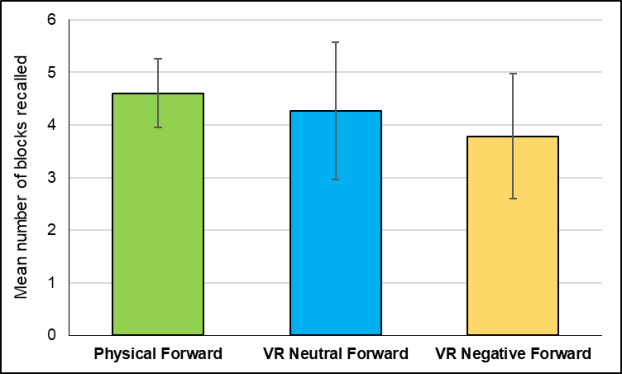
The non-parametric Friedman test was used to compare all emotions’ environments’ performance scores in each condition. The analysis returned a significant model for the forward condition with moderate agreement between item rankings (X2
F(2) = 21.85, p < 0.001, Kendall’s W = 0.352). On the contrary, the backward condition showed a non-significant, low effect size model (X2
F(2) = 4.289, p = 0.117, Kendall’s W = 0.069). Additional Conover’s post-hoc tests revealed significant differences in the negative environment compared to the physical and neutral environments in the forward condition showing a decrease in performance. In the backward condition, no significant comparisons were found at all (Figure 1).
Figure 1: Mean scores in each environment. Error bars represent standard deviations.
The Role of Negative Emotions in VR 209 Analysing the connection between anxiety and depression scores revealed a significant, positive, moderately strong correlation between them, an expected result. However, neither BDI, nor BAI scores showed significant predictive effects on any of the performance scores except for two comparisons. BDI revealed a weak but present negative predictive effect for the physical backward (R2 = 0.140, F(1, 29) = 4.720, p = 0.038) and the neutral backward (R2 = 0.146, F(1, 29) = 4.956, p = 0.034) conditions (Figure 2 and 3).
Figure 2 and 3: Predictive effects of depression scores in the two conditions.
Wilcoxon paired samples t-tests comparing pre-PANAS and post-PANAS scores showed no significant difference between either the positive and negative subscales. As a matter of fact, pre- and post-scores were significantly, positively and strongly correlated in each subscale (p < 0.001 and r > 0.600 in both cases). CSQ-VR total scores did not predict performance scores in any of the VR environments and conditions based on linear regression analyses (all p > 0.05); neither did it predict post-PANAS scores (all p > 0.05).
DISCUSSION
In the present study, we investigated the effects of negative emotionally inducing environments on cognitive performance in a virtual reality (VR) task. The presence of emotions has long been known to alter cognitive performance and VR is known to induce emotions (Blair et al., 2007; Felnhofer et al., 2015; Diniz Bernardo et al., 2021). Despite that, VR studies tend to separately examine either emotions or cognition but hardly their interconnected effects. The matter is further complicated by the frequent presence of cybersickness which also alters performance in VR based tasks (Rebenitsch & Owen, 2021). To fill this gap in the literature, we implemented the Corsi Block-Tapping Task into a virtual environment, based on our previous study of Zsebi et al. (2025), with neutral and negative emotion induction environments. Participants completed both the forward and the backward condition of the task in each environment.
Our results showed mixed outcomes as the presence of negative emotions appeared to decrease performance in the easier, forward condition of the task but didn’t change it in the harder, backward condition. Interestingly, depression and anxiety levels didn’t show noteworthy effects on performance except for depression in two cases. What is even more interesting is that only the harder, backwards condition was affected by depression in both cases, whilst the emotional environment caused a difference in the forward condition. Cybersickness did not show significant predictive power in any VR condition, thus, we conclude its relevance is negligible.
The difference between the two conditions raises attention to the role of task difficulty when examining the effects of emotions on cognitive performance. This could be an obvious thought as processing emotions has been presented to burden cognitive capacity, thus it can reduce performance (Storbeck, 2012; Hofstee et al., 2021). On the other hand, this possibility is hardly applicable in the current case as if emotions only tax cognitive load, worse performance should have been observed in both conditions regardless if they are extrinsic (induced by the virtual environment) or intrinsic (caused by depressive symptoms). Furthermore, cognitive resistance to emotion induced performance changes has been shown to be less present among older adults, which is again contradictory in our case as our sample only consisted of elderly participants and emotions still altered performance (Scheibe & Blanchard-Fields, 2009). In all consideration, our results provide new and opposite outcomes compared to previous findings.
One potential explanation for our results is that negative environments may have served as distractors shifting participants’ attention from the actual task. This could serve as an explanation for the difference between conditions as in the easier condition, participants might have more easily shifted to environmental stimuli; whilst in the harder condition, participants remained more focused on the task. However, as participants generally performed better in the forward task, this explanation is shaky. If we accept that negative environments were distractors, then in the forward condition, participants faced distractors and depressive symptoms; whilst in the backward condition, they “only” faced depressive symptoms. This is contradictory to the fact that
The Role of Negative Emotions in VR 211 participants still performed significantly better in the forward condition. The way it seems at the moment is participants are more vulnerable to extrinsic emotions in the easier conditions but more vulnerable to intrinsic ones in the harder condition. This assumption, however, requires further studies to confirm and remains only a preliminary assumption in our case.
CONCLUSION
The effects of emotions over cognitive performance in VR based testing scenarios remain underresearched and broad results appear contradictory. The performance altering effect, however, is undeniably present but more precise explanations are hard to provide besides raw results. Further studies should more deeply examine this topic with extra consideration to task difficulty. Considering emotions to tax cognitive capacity is an oversimplified approach. Overall, VR studies should pay more attention to emotionally inducing stimuli present in their environments and apply a more systematic approach when developing new tasks.
ACKNOWLEDGMENT
Project no. C2290534 has been implemented with the support provided by the Ministry of Culture and Innovation of Hungary from the National Research, Development and Innovation Fund, financed under the KDP-2023 funding scheme.
The authors would like to thank Euronet Magyarország Informatika Ltd. for their support with the development of the paradigm.
REFERENCES
Blair, K. S., Smith, B. W., Mitchell, D. G., Morton, J., Vythilingam, M., Pessoa, L., ...
& Blair, R. J. R. (2007). Modulation of emotion by cognition and cognition by emotion. Neuroimage, 35(1), 430–440. Beck, A. T., Steer, R. A., & Brown, G. K. (1996). Beck depression inventory. Beck, A. T., Epstein, N., Brown, G., & Steer, R. (1993). Beck anxiety inventory.
Journal of consulting and clinical psychology. Caserman, P., Garcia-Agundez, A., Gámez Zerban, A., & Göbel, S. (2021).
Cybersickness in current-generation virtual reality head-mounted displays: systematic review and outlook. Virtual Reality, 25(4), 1153–1170. Diniz Bernardo, P., Bains, A., Westwood, S., & Mograbi, D. C. (2021). Mood induction using virtual reality: A systematic review of recent findings. Journal of Technology in Behavioral Science, 6(1), 3–24. Felnhofer, A., Kothgassner, O. D., Schmidt, M., Heinzle, A. K., Beutl, L., Hlavacs, H.,
& Kryspin-Exner, I. (2015). Is virtual reality emotionally arousing? Investigating five emotion inducing virtual park scenarios. International journal of human- computer studies, 82, 48–56. Hofstee, G., Jansen, P. G., De Lange, A. H., Spisak, B. R., & Swinkels, M. (2021).
The cognitive costs of managing emotions: A systematic review of the impact of emotional requirements on cognitive performance. Work & Stress, 35(3), 301–326.
Jin, R., Pilozzi, A., & Huang, X. (2020). Current cognition tests, potential virtual reality applications, and serious games in cognitive assessment and non- pharmacological therapy for neurocognitive disorders. Journal of Clinical Medicine, 9(10), 3287. Kessels, R. P., Van Zandvoort, M. J., Postma, A., Kappelle, L. J., & De Haan, E. H.
(2000). The Corsi block-tapping task: Standardization and normative data. Applied neuropsychology, 7(4), 252–258. Kourtesis, P., Linnell, J., Amir, R., Argelaguet, F., & MacPherson, S. E. (2023, January). Cybersickness in virtual reality questionnaire (csq-vr): A validation and comparison against ssq and vrsq. In Virtual Worlds (Vol. 2, No. 1). MDPI. Martingano, A. J., Hererra, F., & Konrath, S. (2021). Virtual reality improves
emotional but not cognitive empathy: A meta-analysis. Neguț, A., Matu, S. A., Sava, F. A., & David, D. (2016). Virtual reality measures in neuropsychological assessment: A meta-analytic review. The Clinical Neuropsychologist, 30(2), 165–184. Parsons, T. D., & Rizzo, A. A. (2022). Virtual reality technology in
neuropsychological testing: Challenges and opportunities. Journal of Neuropsychology, 16(3), 165–180. Pieri, L., Tosi, G., & Romano, D. (2023). Virtual reality technology in neuropsychological testing: A systematic review. Journal of Neuropsychology, 17(2), 382–399. Rebenitsch, L., & Owen, C. (2021). Estimating cybersickness from virtual reality
applications. Virtual Reality, 25(1), 165–174. Scheibe, S., & Blanchard-Fields, F. (2009). Effects of regulating emotions on cognitive performance: what is costly for young adults is not so costly for older adults. Psychology and aging, 24(1), 217. Somarathna, R., Bednarz, T., & Mohammadi, G. (2022). Virtual reality for
emotion elicitation–a review. IEEE Transactions on Affective Computing, 14(4), 2626–2645. Storbeck, J. (2012). Performance costs when emotion tunes inappropriate cognitive abilities: implications for mental resources and behavior. Journal of Experimental Psychology: General, 141(3), 411. Watson, D., Clark, L. A., & Tellegen, A. (1988). Development and validation of brief
measures of positive and negative affect: the PANAS scales. Journal of personality and social psychology, 54(6), 1063. Zsebi, S., Sik-Lanyi, C., Szabó, P., Filotás, P., Zsuffa, J. A., & Cserjési, R. (2025). A virtual reality take on the Corsi-Block Tapping Task: Exploring VR for spatial working memory assessment. Acta Psychologica, 261, 105918.
LISTED IN THE AHFE DIGITAL BOOKSTORE CATALOGUE
Explore the complete digital volume
Metaverse, Virtual Environments and Game Design
Read this individual research paper free through the original publisher, or explore the full digital proceedings book.
ISBN 978-1-964867-93-9
Explore this ISBN in the AHFE Bookstore ↗Listed in the July 2026 bookstore catalogue; search by ISBN to confirm current availability · Digital book purchase optional