Daniel Munoz, Jeffrey C F Ho (2026). Fantasy, realism, and attention in virtual reality: An exploratory mixed-methods study of coherence factors and player judgments. In: Metaverse, Virtual Environments and Game Design. AHFE Open Access, vol. 217, pp. 96–107. https://doi.org/10.54941/ahfe1007658
Designers of virtual reality experiences routinely balance fantasy and realism to sustain the sense of being there while supporting performance and engagement. Yet we have limited factor-specific evidence about where fantasy attracts attention, when it taxes performance, and how users judge plausibility across different components of a virtual world. This paper integrates two exploratory studies from a dissertation project. Study 1 was a remote, between-groups experiment (n = 20) that introduced a single fantastical physics element during a dual-task activity and measured attentional performance and viewing behavior. Study 2 was a qualitative, video-cued recall study (n = 8) with semi-structured interviews examining how players judged realism along four coherence factors proposed in the presence literature: scenario, physics, virtual body, and virtual entities. Quantitatively, participants exposed to a localized physics fantasy showed reduced secondary-task accuracy in a directional test, and time spent looking at the fantastical object was positively associated with errors. Qualitatively, participants expressed two modes of judgment consistent with narrative psychology: external realism, comparing with the physical world and prior experience, and narrative realism, evaluating coherence within the story world. Physics was predominantly judged through external realism and invited testing behavior, virtual entities were judged through narrative realism and tolerated more fantasy when socially responsive, the virtual body elicited a dynamic blend that shifted over time, and scenario judgments prioritized internal style consistency over realism. We discuss how these converging findings inform the design of plausible fantasy in VR, emphasizing timing, justification, and factor allocation of non-real-world-like elements. We present these results as exploratory evidence intended to stimulate confirmatory research and to offer pragmatic heuristics for interaction designers.
Virtual reality affords the creation of worlds that are not bound by physical constraints, but the persuasive power of these worlds rests on sustained plausibility and attentional stability. The presence literature distinguishes the sense of being in a place from the judgment that what is happening there is credible relative to the user’s expectations and goals (Slater, 2009). Skarbez and colleagues have argued that plausibility depends on coherence across multiple factors, including scenario, physics, the virtual body, and other Received January 29, 2026; Revised April 2, 2026; Accepted April 18, 2026; Available online July 20, 2026
Fantasy, Realism, and Attention in Virtual Reality 97 virtual entities, and that disruptions in these factors can alter presence and behavior (Skarbez et al., 2017). In parallel, narrative psychology shows that audiences judge realism in two broad ways: by comparing content to the external physical and social world and by evaluating internal consistency within a story world (Hall, 2003; Shapiro and Chock, 2003; Busselle and Bilandzic, 2008). These traditions suggest a productive hypothesis for VR: fantasy will not be judged uniformly across factors, and its costs and benefits will depend on how users process realism in each factor.
We report two preliminary studies that approach this question from complementary angles. The first instrumented a dual-task activity with a localized physics fantasy and measured attentional performance. The second used video-cued recall and interviews to examine realism judgments across coherence factors while playing a commercial VR game that intentionally blends real-world-like and fantastical elements. Together, these studies explore when fantasy captures attention and how players make sense of it. Our aim is to use converging evidence to propose actionable design implications and testable propositions about how to allocate fantasy in VR without eroding plausibility or performance.
BACKGROUND
Presence research distinguishes between the sense of being in a place and the plausibility that events there are actually occurring (Slater, 2009; Skarbez, 2016). Coherence across scenario, physics, the virtual body, and virtual entities cultivates plausibility; mismatches among these factors can redirect attention and alter behaviour (Shapiro and Chock, 2003; Skarbez et al., 2017). In narrative psychology, realism is not a unitary construct. Shapiro and Chock (Shapiro and Chock, 2003) argue that audiences rely on schemas of typicality to judge whether events accord with real-world knowledge, while also forming expectations about the internal rules of a narrative. Busselle and Bilandzic (Busselle and Bilandzic, 2008) similarly distinguish narrative and perceptual realism and show that perceived realism interacts with engagement and comprehension. These accounts predict that VR users will sometimes judge content against the external world and sometimes against internal rules, and that the chosen mode will vary by factor and over time.
Attention is central to both presence and narrative processing. Novel or prediction-violating cues attract attention and can impose dual-task costs when users must maintain a primary activity while monitoring or interpreting an unexpected event. In VR, this capture may be amplified since spatialized, embodied cues have privileged access to attentional systems. Where fantasy is placed, when it is introduced, and whether it is justified relative to the user’s current goals should therefore matter for both performance and plausibility.
STUDY 1: FANTASY IN PHYSICS AND ATTENTIONAL PERFORMANCE Objective and Research Questions
Study 1 examined whether a localized fantastical physics element draws attentional resources away from an ongoing task and whether looking
98 Muñoz and Ho behaviour toward that element relates to performance decrements. We asked whether introducing a physics fantasy during a task would reduce secondary- task performance and whether increased attention to the fantastical element would correlate with more errors.
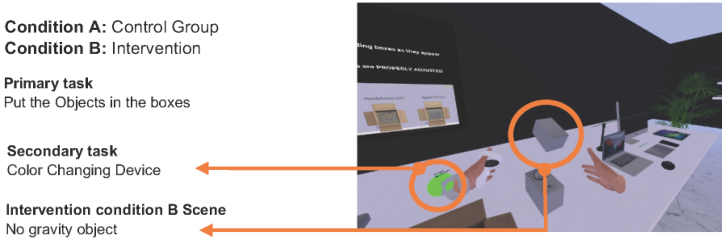
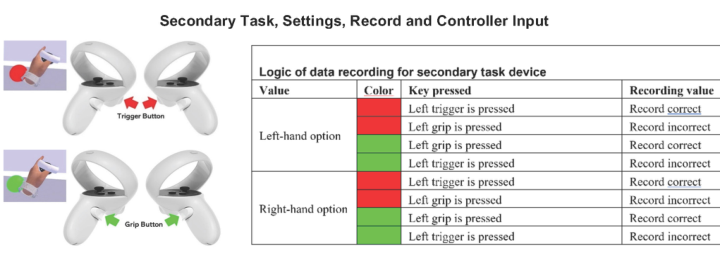
Design and Stimulus We implemented a between-groups experiment with two conditions. In the control condition, the physics behaved in a familiar manner. In the intervention condition, a single object in the environment exhibited a fantastical behavior relative to gravity. Participants engaged in a dual-task scenario situated in a virtual shop. The primary task required grabbing objects, placing them in boxes, and counting elements as specified on an information panel (see Figure 1 and 2). The secondary task provided a continuous measure of attention via a diegetic arm band with a glowing sphere that changed color every five seconds. Participants pressed the VR controller trigger or grip button to match the color shown. The device logged correct and incorrect responses, timestamps, and response delays. A program attached to the main camera recorded the cumulative time the participant’s head orientation was directed toward the fantastical object and the number of looks, which we used as a proxy for visual attention.
Figure 1: VR stimulus and tasks primary and secondary in scene.Figure 2: Button interaction in the controller and logic of the data recording for secondary task device.
Fantasy, Realism, and Attention in Virtual Reality 99 Participants and Procedures
We recruited 28 participants through Prolific platform; 20 met hardware requirements, followed instructions, completed the protocol, and provided usable data. Ten were assigned to each condition. The application ran on participants’ headsets and wrote log files locally, which were then retrieved. Each session comprised an onboarding scene with trials to ensure understanding of the secondary task, a main scene with both tasks, and an ending scene. The secondary task ran continuously during the main scene.
Measures and Analysis We computed the number of correct and incorrect responses on the secondary task and the cumulative time looking at the fantastical object in seconds. To compare secondary-task performance between conditions, we conducted an independent-samples t-test with a directional alternative hypothesis that the control condition would yield more correct responses than the intervention condition. Shapiro-Wilk tests indicated that the distribution of correct responses did not violate normality for either group (Table 2), and Levene’s test (Table 1) supported homogeneity of variance. We then examined the Pearson correlation between incorrect responses and cumulative look time. Analyses were conducted in JASP.
Table 1: Equality of variances Levene’s test.
Table available in the original PDF paper.
F df1 df2 p
1.406 1 18 0.251
Table 2: Normality test (Shapiro-Wilk).
Table available in the original PDF paper.
Group W P Control 0.928 0.426
Intervention 0.963 0.821
Table 3: Results, including group, correct answers and cumulative attention.
Table available in the original PDF paper.
Group Correct Incorrect Cumulative Attention in
Group Correct Incorrect Cumulative Attention in Seconds Seconds A 40 18 90.5 B 12 25 130.1
A 19 12 73 B 18 30 156 A 8 3 21.8 B 7 38 128 A 24 12 51.3 B 23 20 182.3
A 14 8 58.5 B 9 34 139 A 35 16 45 B 15 40 168.1 A 20 10 70.2 B 5 28 150
A 10 4 33 B 22 20 191 (Continued)
Table 6: Continued.
Table available in the original PDF paper.
Group Correct Incorrect Cumulative Attention in
Group Correct Incorrect Cumulative Attention in Seconds Seconds A 22 11 85.7 B 11 45 121
A 15 9 62.1 B 16 36 199 *A Control group
*B Intervention
Results
Descriptively, participants in the control condition produced more correct responses on the secondary task than participants exposed to the physics fantasy. The directional t-test indicated a statistically significant difference, t (18) = 1.830, p = 0.042, with an estimated effect size of Cohen’s d = 0.818. The 95 percent one-sided confidence interval for the mean difference had a lower bound of 0.361 and extended to infinity. Across all participants, the cumulative time spent looking at the fantastical object was positively associated with the number of incorrect secondary task responses, r = 0.746, p < .05. These patterns are consistent with the interpretation that the localized physics fantasy drew attention and that attending to it coincided with reduced accuracy on a concurrent task.
Table 4: Results of T-test of independent samples.
Table available in the original PDF paper.
95% CI for Mean Difference Lower Upper Cohen’s
Test Statistic df p Mean Difference
SE Difference
d
SE Cohen’s d Student 1.830 18.000 0.042 6.900 3.771 0.361 ∞ 0.818 0.483
Note: For all tests, the alternative hypothesis specifies that group Control is greater than group Intervention.
Table 5: Pearson correlations results.
Table available in the original PDF paper.
Time Incorrect Time Pearson Correlation 1.000 .746a Sig. (2-tailed) .000
N 20 20 Incorrect Pearson Correlation .746a 1.000
Sig. (2-tailed) .000 N 20 20
a. Significant at .05 level
This experiment provides preliminary evidence that even a single, localized physics fantasy object can act as an attentional spot during a dual-task activity. Participants in the intervention condition responded less accurately on the continuous secondary task, and those who spent more time oriented toward the fantastical object made more errors. While the sample is small and the inferences should be cautious, the results align with presence accounts in which coherence in physics supports plausibility and with narrative psychology in which atypicality triggers scrutiny relative to real-world schemas (Shapiro and Chock, 2003; Skarbez et al., 2017). Practically, introducing physics fantasy during periods of high cognitive demand may carry a measurable task performance cost. Methodologically, head orientation is an approximation of gaze and should be interpreted as a proxy. Future confirmatory work with eye tracking, response time analyses, and primary task performance would refine these inferences.
STUDY 2: REALISM JUDGMENTS ACROSS COHERENCE FACTORS Objective and Research Questions
Study 2 examined how players judge realism while encountering both real- world-like and fantastical content in a commercial VR experience and how those judgments vary across coherence factors. We asked how users articulate external and narrative realism in VR and how these modes of processing relate to scenario, physics, the virtual body, and virtual entities?
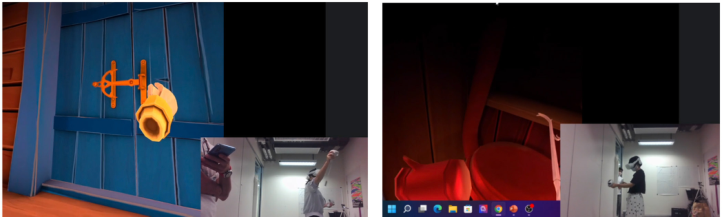
Stimulus and Instruments We selected A Fisherman’s Tale as the stimulus because it deliberately blends familiar and fantastical content challenging many dimensions of reality in its environment, including an infinity mirror mechanic in which actions in the main room affect a small-scale model of the same room. Players encounter a cartoonish scenario, a wooden puppet virtual body, and talking entities such as a seashell, alongside interactions that are sometimes familiar and sometimes not. Sessions were video recorded via headset casting, and a behavioral camera captured body movements. After gameplay, we conducted a video-cued recall interview. The interview included open questions about moments of judgment and a structured set targeting each coherence factor and both types of realism. For external realism, we probed comparisons to physical-world experience and asked about sources of reference when direct experience was lacking. For narrative realism, we probed judgments within the internal rules of the game world.
Table 6: Questions applied on the study separated by dimension.
Table available in the original PDF paper.
General questions
1. Was there any time in the experience that you judged the events happening in the game?
2. What were you thinking? How was that process?
3. Do you feel a distance between the things happening there and the things happening to you?
(Continued)
Table 6: Continued.
Table available in the original PDF paper.
4. What is your sensation about the physics of the game and the physical interactions? For example, the speed of things, gravity, and similar behaviors. Why?
Coherence factors judgement questions
5. What is your sensation about your body in the game? For example, the shape, the material, and the behavior. Why?
6. What is your sensation about the other virtual entities in the game? For example, is the seashell speaking to you? Why?
7. Do you remember any of these elements (Scenario, physics, body, virtual entities) breaking your sensation of feeling in the light house? Why?
8. Are these elements that break your sensation of being in the lighthouse inconsistent or incoherent?
9. Do you think the events happening on the experience are coherent or consistent? Why?
External and Narrative Realism Questions
10. Do you think you judge the content by comparing the elements of the game with the external physical world? Why? When do you think you do that?
11. Do you think you judge the logic of the world of the game and the states of affair by it own rules? Why?
12. Do you think you share both types of judgements? How do you deal with that?
Figure 3: Participants playing the stimulus in the lab.
Participants and Procedures Study 2 Eight participants between 25 and 35 years of age took part; six identified as female and two as male. All had used immersive VR at least once before; three reported more extensive VR experience and the others reported fewer than five prior VR sessions. All had experience with non-immersive games (see Table 7). After consent and instruction, participants played the introduction and first chapter for approximately 20 minutes. We then conducted a semi- structured interview while replaying the capture of their session. Interviews were transcribed, checked for accuracy, segmented by question, and thematically coded by the researcher with attention to judgments of external and narrative realism by coherence factor.
Table 7: Participants Demographics and VR experience.
Table available in the original PDF paper.
Age You Identify Yourself as Do You Have Experience With VR Before?
If Yes, How Many Times Have You Experience VR?
25 Female Yes less than 5
29 Female Yes Between 10 and 50
31 Female Yes less than 5
33 Male Yes More than 50
31 Female Yes less than 5
32 Female Yes less than 5
35 Female Yes less than 5
26 Male Yes Between 10 and 50
Findings Participants articulated realism judgments in both modes, and the mode varied by factor and sometimes shifted over time. For physics and physical interactions, all participants judged primarily through external realism. They contrasted falling, breakage, friction, and effort with real-world expectations and often engaged in testing behavior, such as dropping bowls repeatedly to see if they would break, or attempting to smash elements to elicit familiar feedback. Illustrative comments (Table 8) included P2, “I didn’t expect that it would mimic reality perfectly,” P1, “I assume that they will respond in a way that I can get from reality,” P3, “It simulates the real physics quite well, but it is not perfectly precise,” and P4, “Dropped something and that doesn’t break. Yeah, it doesn’t break and yeah, so it should break.” Several participants pointed to task effort as a cue, for example noting that pulling out nails required a single movement, which felt disproportionate to how heavy or stubborn such actions would be in real life. One summarized, “They are different activities, but everything works the same or in the same complexity.”
Table 8: Representative quotes of participants.
Table available in the original PDF paper.
P2 “I didn’t expect. That it would mimic reality perfectly.”
P1 “I assume that they will respond in a way that I can get from reality.”
P3 “It simulates the real physics quite well, but it is not perfectly precise.”
P7 “This makes me grab it from a fixed place. So that is a very I think it’s a trivial gap, but it is a gap.”
P5 “Good, but some physical interactions probably are not very detailed.”
P8 “But the speed of the things is like normal in reality so I feel it will hit me, especially for the speed and the gravity” P6 “That is not real because when you are, When I tried the first, I was actually I was even trying to do this to put my hand Iin the wood and like I was Trying to make like this, So yes, it’s too easy”
P4 “Dropped something and that doesn’t break Yeah, it doesn’t break and yeah, so it should break”.
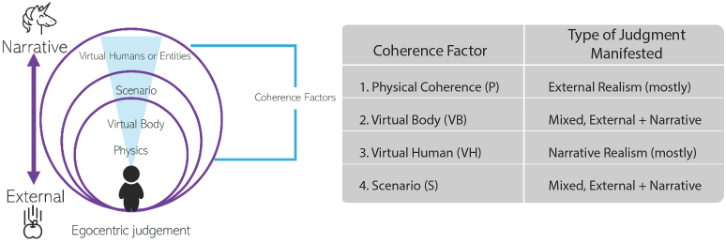
Figure 4: Participants type of judgement manifested during the study.
Judgments about the virtual body often began with external realism and then shifted toward narrative as the players adapted. Participants noticed the size of the body and the absence of legs in the wooden puppet avatar, which triggered comparison to the human body. P4 remarked, “I can brush my teeth, but I have no legs. It’s weird.” Several then reported a negotiation in which the avatar’s properties came to feel appropriate within the story world, for example, “I believed that I may not need legs to survive in this world.” Comments such as P2, “Character seems to fit the game,” and P3, “…is wooden. I would say it is still real because they are coherent with what I intend to do,” captured this shift from external to narrative realism as agency and ownership stabilized.
Virtual entities were judged primarily through narrative realism. Participants were largely untroubled by a seashell speaking or by an omnipresent narrator. P8 noted, “It is consistent with the narrative, definitely with the location,” P7 said, “I feel it is real; it is a character talking to me,” and P4 commented, “I think it is normal.” Some participants observed that certain entities felt scripted, which reminded them that this was a game. However, when entities addressed the player directly or responded contingently, participants reported a stronger sense of being acknowledged, which supported plausibility despite the fantastical premise.
Scenario judgments foregrounded internal style consistency over external realism. Participants described the environment as fairy tale-like and appreciated when elements fit the thematic style. P6 said, “It is like a fairy tale environment; everything has a function,” and P2 noted, “The story seems to have a certain theme about the seaman, and then they all have that consistent kind of environment.” Moments in which rendering styles were mixed, such as opening a lighthouse window to reveal a sea rendered with more real-world-like aesthetics, prompted renewed external realism scrutiny and suggestions to harmonize styles to maintain coherence. Across the interview, participants reported that some judgments felt automatic and not entirely under conscious control. Even those who entered with a declared intention to judge within the game’s internal rules found themselves applying external realism at junctures, especially during physics interactions and early encounters with the virtual body. Conversely, when elements were far from daily experience, participants drew on cultural references such as books or
Fantasy, Realism, and Attention in Virtual Reality 105 films to construct expectations and applied narrative realism. This duality aligns with Shapiro’s (Shapiro and Chock, 2003) account of typicality and schema-based processing and with Busselle’s (Busselle and Bilandzic, 2008) distinction between narrative and perceptual realism.
Discussion Study 2 The qualitative results reveal a factor-specific profile of realism judgments in VR. Physics was a frequent site of external realism and testing, consistent with its central role in guiding action and meaning attribution. Virtual entities fantasy was tolerated when their behaviour acknowledged the player and adhered to the story world’s rules. The virtual body began under external scrutiny and then blended toward narrative fit as agency was consolidated. Scenario judgments emphasized intra-world consistency, with style mismatches reactivating external comparisons. These patterns suggest that fantasy will be processed differently depending on where it appears, and that cognitive cost and plausibility are not uniform across factors.
General Cross-Study Discussion The two studies address complementary aspects of how players process fantasy in VR. The experiment shows that a localized physics fantasy captures attention and reduces concurrent secondary-task accuracy. The interview study indicates that physics most readily invites external realism, elicits testing, and anchors expectations about how the world should respond. Together, these findings support a pragmatic claim: fantasy in physics is more likely to tax attentional resources under load and to invite scrutiny against real-world schemas. Conversely, the interview study shows that responsive, story-consistent virtual entities and narrative scaffolding can sustain fantasy. This suggests a different cognitive profile: when fantasy resides in social or narrative elements that acknowledge the player and maintain internal rules, it tends to impose a smaller attentional cost while still delivering engagement and meaning. The virtual body and scenario sit between these poles, with judgments that can shift over time and are sensitive to calibration and stylistic coherence.
In narrative psychology external realism judgments are guided by typicality; when the player manipulates physics, any deviation from familiar causal relations is readily detected and triggers evaluation against real-world knowledge (Shapiro and Chock, 2003; Muñoz, 2022). Narrative realism judgments rest on internal consistency and justification; if a seashell speaks and reliably recognizes the player in a world that otherwise adheres to its rules, the content can be accepted as plausible even if it is fantastical (Ryan, 1991; Busselle and Bilandzic, 2008; Juul, 2011). Presence theory contributes the notion that plausibility depends on the alignment of cues and expectations across coherence factors (Skarbez et al., 2017; Skarbez, Brooks and Whitton, 2021). When fantasy is introduced without preparation during a high-demand activity in a factor that users treat as a benchmark for reality, it is more likely to divert attention and reduce performance. When fantasy is introduced with diegetic justification and stylistic consistency in a factor that is evaluated internally, it is more likely to be accepted and integrated.
These exploratory results suggest factor-specific strategies for allocating fantasy in VR. During continuous-attention tasks, be cautious about introducing physics fantasy that contradicts everyday schemas. If such elements are central, introduce them during lower-demand moments, foreshadow and justify them within the fiction, and reinforce with consistent multimodal cues so players can recalibrate expectations. Leverage social responsiveness to support plausibility for fantastical entities. When characters speak directly, acknowledge the player, and act contingently, players tend to accept fantasy under narrative realism. For the virtual body, early calibration of size, reach, and key affordances can reduce external scrutiny and support a shift toward narrative fit. For the scenario, stylistic consistency is more important than fidelity; mixing rendering styles at salient vistas can prompt unwanted comparisons to the real world and should be used sparingly or with explicit narrative justification. These implications are intended as heuristics. They should be refined through confirmatory studies that manipulate timing, justification, and factor placement of fantasy while measuring both performance and presence-related outcomes. The constructive contribution here is to link measurable attentional costs to a profile of realism judgments across factors, tying presence theory to narrative psychology in a way that is actionable for designers.
LIMITATIONS Both studies are exploratory with small samples. Remote deployment introduces hardware heterogeneity and compliance variability. The qualitative study used a single title, and interviews were coded by the researcher without a second coder; inter-coder reliability would strengthen credibility. Retrospective recall may introduce reconstruction biases, although video-cued replay helps anchor memory. These limitations do not negate the value of the converging pattern but counsel caution and motivate replication.
ACKNOWLEDGMENT
This work was supported in part by the Research Grants Council (RGC) of the Hong Kong SAR, Project “Improving Construction Workers’ Attitudes towards Safety Training with Virtual Reality: Perspective Taking of Victims of Construction Site Accidents” (Ref. 25214420; PI: Dr. Jeffrey C. F. Ho) and in part by the School of Design of the Hong Kong Polytechnic University (Ref.:P0054252).
REFERENCES
Busselle, R. and Bilandzic, H. (2008) “Fictionality and Perceived Realism in Experiencing Stories: A Model of Narrative Comprehension and Engagement,” Communication Theory, 18(2), pp. 255–280. Available at: https://doi.org/10.1111/ j.1468-2885.2008.00322.x.
Fantasy, Realism, and Attention in Virtual Reality 107 Hall, A. (2003) “Reading Realism: Audiences’ Evaluations of the Reality of Media
Texts,” Journal of Communication, 53(4), pp. 624–641. Available at: https://doi. org/10.1111/j.1460-2466.2003.tb02914.x. Juul, J. (2011) Half-Real: Video Games between Real Rules and Fictional Worlds.
MIT Press. Muñoz, D.A. (2022) “[DC] The impact of the Informational load of Presence Illusions on Users Attention and Memory,” in 2022 IEEE Conference on Virtual Reality and 3D User Interfaces Abstracts and Workshops (VRW). Ryan, M.-L. (1991) Possible Worlds, Artificial Intelligence, and Narrative Theory.
USA: Indiana University Press. Shapiro, M.A. and Chock, T.M. (2003) “Psychological processes in perceiving reality,” Media Psychology, 5, pp. 163–198. Available at: https://doi.org/10.1207/ S1532785XMEP0502_3. Skarbez, R. et al. (2017) “A Psychophysical Experiment Regarding Components
of the Plausibility Illusion,” IEEE transactions on visualization and computer graphics, 23(4), pp. 1369–1378. Available at: https://doi.org/10.1109/ TVCG.2017.2657158. Skarbez, R., Brooks, F.P. and Whitton, M.C. (2021) “Immersion and Coherence: Research Agenda and Early Results,” IEEE Transactions on Visualization and Computer Graphics, 27(10), pp. 3839–3850. Available at: https://doi.org/10.1109/ TVCG.2020.2983701. Slater, M. (2009) “Place illusion and plausibility can lead to realistic behaviour in
immersive virtual environments,” Philosophical Transactions of the Royal Society B: Biological Sciences, 364(1535), pp. 3549–3557. Available at: https://doi. org/10.1098/rstb.2009.0138.
LISTED IN THE AHFE DIGITAL BOOKSTORE CATALOGUE
Explore the complete digital volume
Metaverse, Virtual Environments and Game Design
Read this individual research paper free through the original publisher, or explore the full digital proceedings book.
ISBN 978-1-964867-93-9
Explore this ISBN in the AHFE Bookstore ↗Listed in the July 2026 bookstore catalogue; search by ISBN to confirm current availability · Digital book purchase optional