A K M Ishtyak Hossain, Rida Kamal, Janne Heilala, Jussi Kantola (2025). Evaluating Virtual Reality Fire Extinguisher Training: A Qualitative User Experience Analysis. In: Human Factors, Business Management and Society. AHFE Open Access, vol. 176, pp. 175–185. https://doi.org/10.54941/ahfe1006315
Virtual Reality (VR)-based technologies have changed the scenario regarding critical training industries. VR creates immersive and interactive experiences for users and it can easily replicate real-life scenarios and situations. The greatest advantage of VR-based training is that it provides a controlled and risk-free environment for training in critical industrial practices such as those undertaken during work using open fires, flames and the application of heat by means of tools or equipment, otherwise known as ‘hot works’. This study is based on qualitative open-ended survey questions that record participants’ perception on VR-based fire extinguisher training. This study focuses on measuring the effectiveness of VR as a training tool based on users’ evaluation of usability, strengths and challenges. The questions guide the users to evaluate the training method according to different themes such as clarity of the instructions, users’ experience and emotional response, physical and sensory challenges, positive and negative aspects of the training, future improvements and influence of prior experience with VR. Participants have provided critical feedback on key aspects such as the realism of the virtual environment and the level of engagement during training sessions. Furthermore, the responses were analyzed using deductive thematic analysis. The analysis addresses metrics that are required to further develop this transformative technology as a training tool. This study contributes to the ongoing development of VR-based training methods by analyzing user experience. It evaluates both the strengths and limitations of VR as a training tool as identified by the participants. The findings could have significant implications in the development of VR as a scalable and sustainable training tool for critical training methods thereby avoiding the chances of injury for the user while participating in the training.
One of the major contributing factors to fire-related fatalities is a lack of fire safety skills (Lovreglio et al., 2021). Fire safety training is a crucial element in preventing fire-related accidents and injuries (Puolitaival et al., 2024). In most cases early prevention can decrease the chance of significant damage. In general at present fire safety training is still conducted using traditional methods such as lectures and seminars, evacuation drills,
brochures, hands-on fire extinguishing and, in some cases, some digital platforms are used, for example, non-interactive videos and online exercises (Lovreglio et al., 2021). A person’s ability to understand and respond effectively to a certain situation is known as situational awareness (SA). SA is a necessary factor to prevent injuries especially during an emergency situation which requires prompt action such as an emergency evacuation during a fire (Kwegyir-Afful et al., 2023). Traditional fire safety training methods lack realism which is pivotal to preparing a person for emergency situations and often logistically challenging for training big groups. Recently, virtual reality (VR) has immerged as a transformative technology which offers long- term knowledge retention, skills acquisition and self-efficacy more effectively compared to non-interactive traditional methods (Saghafian et al., 2020). VR enables participants to practice fire extinguishing in a real-life setting which is controlled and does not present any risk. Participants can assess situational hazards and make critical decisions in a simulated environment which can improve their SA. Studies conducted by Oliveira et al. (2024) suggest that VR can be very effective in team-based training where firefighters participate in a multi-user VR environment.
Though in some cases the participants might feel a little nausea and motion sickness which can be mitigated through better VR optimization (Saghafian et al., 2020), some researchers also suggest that improving realism, including haptic feedback, smell and temperature simulation, can make VR a better alternative to traditional training methods.
A thorough evaluation of the user experience of VR-based fire safety training can enable a clearer picture to emerge of the areas for improvement regarding this type of training. Measuring the effectiveness of VR-based training ensures that the learning outcomes are achieved and the skills acquired are transferable to real-world scenarios (Abich et al., 2021). The Virtual Training Certification (VTC) project funded by Business Finland aims to establish a unified accreditation platform that facilitates remote and standardized verification of virtual training competencies ensuring usability, credibility and safety across diverse industries. This research paper serves as empirical evidence supporting the objective of the VTC project. This paper aims to assess the effectiveness of virtual reality-based fire extinguisher training using both quantitative and qualitative findings from research participants. However, the primary focus of this research paper will be on evaluating effectiveness through qualitative data. The evaluation further analyses nine key themes such as realism, engagement, knowledge retention and limitations of VR training etc. which are derived from these following research questions (RQ).
RQ1. To what extent does VR-based fire extinguisher training enhance knowledge retention and skill preparedness?
RQ2. What is the perception of participants regarding the realism, usability and engagement of the VR training environment?
RQ3. What are the usability challenges and limitations experienced by participants during VR training?
RQ4. What is the influence of participants’ prior VR experience on learning and interactions?
RQ5. What enhancements can be carried out to improve the efficacy of VR-based fire extinguisher training?
Evaluating Virtual Reality Fire Extinguisher Training 177
BACKGROUND
According to Klob’s experiential learning model (Kolb, 1984) practical, hands-on learning experience fosters skill acquisition and knowledge retention by allowing learners to engage in real-world applications of their training. Traditional fire safety training, such as lectures or videos, fail to replicate the urgency of real-world fire situations. On the contrary, VR allows trainees to engage in a simulation environment where they can experience emergency situations and reinforce their learning through real-time decision- making (Oliveira et al., 2024). VR has the potential to be a transformative training tool across various fields including healthcare, hospitality and cleaning, vocational training, and immigrant workforce training (Drake and Kauppinen, 2021). One of the greatest advantages of using VR-based training methods is repeatability and the need for minimal logistical support in the case of multi-user VR training environments.
Factors Affecting the Effectiveness of VR Fire Safety Training Since VR offers an immersive environment, there are multiple factors that can affect training effectiveness and these can be assessed through participant feedback. Studies suggest that simulations with interactive components and well-designed environments can improve training participants’ immersion in VR (Saghafian et al., 2020). Fire emergencies can be easily simulated through VR which is crucial to enhancing situational awareness among the participants, but it lacks physical sensations such as heat or the sense of the weight of the extinguisher, and this lack of haptic feedback limits the realism of handling real-world fire situations. The absence of a tactile response vastly affects the understanding of fire dynamics (Namid and Ojgoosh, 2024). Users who are familiar with VR equipment or have previous experience with immersive technology show better adaptability compared to novice users (Lovreglio et al., 2021). Therefore, clarity of instruction plays a pivotal role in ensuring that the participants can smoothly interact during the training program. Some participants face navigation challenges or require additional time to adjust to the VR equipment and in some cases participants feel nausea while navigating inside the immersive environment (Aldaba and Moussavi, 2020). Hands-on fire extinguishing is still required to develop muscle memory for skill preparedness even though participants have better engagement and immersion in VR, therefore, Shaw et al. (2019) have recommended developing a hybrid training model combining VR and physical fire extinguishing training.
Thematic Analysis for the Evaluation of Effectiveness Thematic analysis is a systematic approach utilized to analyze qualitative data by identifying, analyzing and reporting patterns (themes). Braun and Clarke (2006) state that it is a rigorous, flexible and accessible method though they emphasize the need for transparency in the process. When
the themes are directly derived from raw data without any pre-conception or expectations this is known as inductive thematic analysis (Fereday and Muir-Cochrane, 2006). This is a data-driven approach. Deductive thematic analysis is a theory-driven approach where predefined themes which can be referred as codes or frameworks guide the data analysis process (Fereday and Muir-Cochrane, 2006). Thematic analysis has been utilized in various fields of research and is also used by researchers to evaluate training effectiveness by analyzing experiential data in order to improve elements of the training method. For instance, Alturkistani et al. (2019) employed thematic analysis to interpret qualitative data from a semi-structured interview to identify key themes related to learner experience in a massive open online course (MOCC). Thematic analysis provides a structured method to analyze open- ended participant interview responses which can later formulate key themes to evaluate the effectiveness of a training method and pointing out the factors and scope of improvement in the training method.
METHOD
Since this research project is part of the VTC initiative, an industrial partner developed a simulated VR training environment to replicate real-world fire extinguishing. This provided the participants with an interactive environment where they could interact with the fire scenario, use a virtual fire extinguisher and navigate through the emergency scenario. Accordingly, a practical fire extinguishing exercise was carried out in the presence of a fire safety expert. This dual-experience approach was adopted to judge the skill preparedness of the participants.
Experimental Setup and Data Collection The total number of trainees (n) was 71 and they were all fourth-year engineering students. The VR fire safety training was conducted in Turku Game Lab, and multiple VR headsets were stationed side-by-side for the experimentation. While the participants arrived at the lab, primary instructions regarding the virtual realm were given. The instructors remained with the participants during the training session in case the participants required any assistance during the training. At the end of the session the participants were given instructions on participating in the practical fire extinguishing exercise to be undertaken a few days later. Trainees participated in the practical fire extinguishing with the supervision of a fire safety expert. The participants had to carry a fire extinguisher and put out a fire in a gas- controlled flame generator which was the exact task they had performed during the VR fire training session. Then, printed out questionnaires were handed out to the participants to collect their feedback.
Research Design To evaluate the effectiveness of the fire safety training, a qualitative open- ended questionnaire was developed to gather detailed feedback from the participants. There were 15 questions in the questionnaire, divided into two primary categories “General” and “VR training interview questions”.
Evaluating Virtual Reality Fire Extinguisher Training 179
Deductive thematic analysis was used to analyze the qualitative feedback of the training participants. Since the research questionnaire was already designed to measure specific metrics to evaluate the effectiveness of the training, deductive thematic analysis was adopted to analyze the qualitative feedback data of the participants. Table 1 describes the key themes and their subsequent themes; the themes are represented in order of frequency. Theme clarity and usability of the instruction got the highest response (71), and influence of prior VR experience received the lowest response (36). NVivo 20 was used as the data analysis tool. Firstly, interview transcripts were imported in NVivo, and then they were divided into two categories: category 1 - “Previously used VR” and category 2 - “No previous VR use”. Secondly, the transcripts were coded into their corresponding themes. Thirdly, a word frequency query and a text search query were used to find out the most frequent responses. Finally, the responses that did not fit any of the themes were filtered out as outliers.
Table 1: Key themes and sub-themes (author’s creation).
Table available in the original PDF paper.
Key Themes Sub-Themes Description Assesses clarity of the Clarity and Usability of Clarity of instructions, Instructions points of confusion, suggestions for improving guidance
Explores how realistic the
instruction given before the VR training and areas of confusion Realism of the Training
Perceived realism of fire
Environment
scenarios, immersion in VR, alignment with real-world experiences
Evaluates how immersive
fire scenario felt for the users and their sense of immersion Engagement and
Immersive aspects of VR
Interactivity
training, ease of interaction, emotional responses
Measures how confident
and interactive the VR training environment felt including emotional responses such as joy and frustration Skill Preparedness and
Confidence in handling
Knowledge Retention
fire emergencies, transferability of skills, long-term know-ledge retention
the participants felt while interacting with a real fire, the retention of the knowledge learned in VR and whether they transfer it into real life Usability Challenges Motion sickness or
Identifies the difficulties
nausea, navigation and control issues, external or virtual distractions
faced by participants such as motion sickness, navigation problems or any other distraction that affect their VR experience Continued
Table 1: Continued Key Themes Sub-Themes Description
Table available in the original PDF paper.
Comparison with
Effectiveness of VR vs.
Compares the
Traditional Training Methods
participant’s experience of traditional and VR training methods
traditional training, realism and engagement differences, preferred training methods
Advantages and
Advantages, limitations Highlights the strengths
Limitations of VR Training
and weaknesses of VR-based fire extinguishing training Suggestions for
Enhancing realism and
Focuses on enhancing the
Improvement
fidelity, reducing usability issues
Explores how previous
training experience such as improved realism, and addresses usability issues Influence of Prior VR
Ease of navigation,
Experience
adaptability to the virtual environment, engagement differences
exposure to VR can influence a trainee’s adaptability and overall engagement
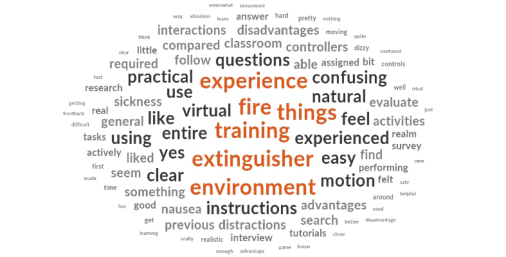
RESULTS AND DISCUSSIONS This section provides the answers for research questions 1 to 5 through the results of the qualitative analysis done in NVivo. Among the total 71 participants, 49 had previous experience with VR and 22 had not previously been exposed to virtual environments before the experimentation. This analysis is based on word frequency, and Figure 1 depicts the results of the word frequency query for all the themes - it covers the 100 most frequent words which were dominant from all the themes.
Figure 1: Word cloud of the most frequent words from the participants’ responses (author’s creation using NVivo 20).
Evaluating Virtual Reality Fire Extinguisher Training 181
Derivation From Thematic Analysis Of the participants 90% have positive feedback regarding the instructions given before the VR training. Some of the frequent responses were “Yes”, “Clear”and “The instruction was easy to follow”. They did not find anything confusing, and the participants also mentioned that the guidance from the instructor was good before the training. Whereas the participants who were confused regarding the instructions mentioned that “It could be more clear and easier if we could see some guidance video”, and others simply said, “It was confusing”. One of the respondents suggested integrating voice-based instruction into the VR environment and providing a video tutorial before the game thereby making it more engaging.
Regarding the realism of the VR environment, the participants provided mixed feedback. Most of them perceived that the virtual fire scenario closely resembled a real-world fire and they responded “Pretty well”, “Natural” and “Realistic environment”. Some trainees gave a score to the realism with responses such as “Seven out of 10”and “Three out of five”. On the contrary, there were neutral responses from some of the participants for instance, “Basic”, “Neutral”, “Felt okay”. A few of them provided negative feedback by responding “Unrealistic”, “Unnatural”, “Worse”. Further investigations of these responses revealed that the game felt very slow for some participants and they were confused about the wind direction as there was no indication in this regard. There was also mention of the teleportation movement which felt a little bit buggy for one participant.
In the case of engagement, the most frequent emotional responses were “Exciting” and “Fun”. Some of the immersive aspects mentioned by the trainees were design of the fire extinguisher, aiming method for shooting water on the fire, virtual movement and, movement of the camera angle inside the VR environment, and 23 participants found it very easy to interact with the virtual elements.
In terms of skill preparedness, almost half of the participants (35) felt that VR fire training boosted their confidence, and that they could transfer this skill into a real-life firefighting situation, which is evident in this response: “I think it is useful before practicing in real life”. In the case of knowledge retention, the participants found the feedback given after making mistakes in the training to be very useful. However, there are some interesting findings in the usability challenges theme, with 18 participants facing navigation issues while moving around in the virtual realm - they found it very confusing to guide the movement using the controllers in the virtual realm. One trainee mentioned that the controller provided was right- handed and since he was a left-handed person it was very difficult for him to use the virtual fire extinguisher. Motion sickness was also a significant issue for some participants, with 10 students mentioning that they felt motion sickness while participating in the VR training and four students feeling dizzy. A few participants felt slight vertigo when the training started but later they recovered. Some students mentioned that they got distracted due to the loose fit of the VR glasses which meant their vision was blurred, and two trainees mentioned that they were distracted due to some other participants
talking beside them. There were a few virtual distractions as well, with two participants mentioning that their simulation was buggy and slow.
Most of the participants mentioned that they liked the VR training more in comparison to classroom training or a complete theory-based training program. Others however preferred the practical fire training exercise more. The feedback after participating in the VR fire training was crucial as most of the participants perceived that it had helped them to prepare for an emergency situation and increased their situational awareness. The trainees pointed out more advantages than limitations of VR training and they mentioned factors such as safety, repeatability, ease of interaction, less logistical support and no waste as advantages of the VR training. Frequent responses for advantages were “It’s safer”, “It is safer without a real fire”, and “No fear or real damage”. Some limiting factors that affected the VR experience are that the sense of weight of the fire extinguisher or heat of the fire cannot be sensed in the VR fire training. A few participants felt that the risk did not feel real to them in the virtual fire scenario. There was feedback also about navigation issues and control issues as limiting factors for the realism of the VR fire scenario. Trainees suggested some improvements to make the VR fire extinguishing experience more engaging for the user. Most suggestions were related to enhancing the realism of the fire scenarios so that the danger and urgency can be felt, that the duration of the training should be a bit longer, and that virtual feedback and an in-game tutorial should be provided so that the user could get used to the environment and the VR controllers at the beginning. The users who had previously used VR showed better adaptability compared to the novice users. Most of the novice users had difficulties with the controller and navigation in the virtual realm, but a significant portion mentioned that they got used to it after taking the tutorial. Key findings of the thematic analysis are represented in Table 2 - it summarizes the key aspects based on the users’ overall perceptions of the VR fire extinguisher training.
Table 2: Overview of the analysis result (author’s creation).
Table available in the original PDF paper.
RQs Themes Key Findings
Knowledge retention rate is higher in VR
RQ1 Knowledge retention training Skill preparedness Participants are confident about transferring
the skills learned in the virtual realm into a real-life scenario RQ2 Realism Perceived realism among trainees is neutral Usability 75% of the trainees had no usability issue Engagement The virtual environment was very engaging Button controlled navigation, motion sickness, and immersive RQ3 Usability
challenges Prior VR exposure makes it easy to get used to
virtual and physical distraction Limitations Lack of urgency factor RQ4 Prior VR experience the virtual realm Continued
Evaluating Virtual Reality Fire Extinguisher Training 183
Table 2: Continued RQs Themes Key Findings
Table available in the original PDF paper.
Amplification of realism, real time feedback,
RQ5 Enhancements required
tutorial for practicing in the virtual realm before the original training
Discussion and Future Implications The qualitative analysis data show that most of the participants perceived VR fire extinguishing training as a positive experience. According to the responses it can be concluded that the instructions before VR training are very helpful and this helps the participants to get used to the training, but introducing an in-game video tutorial or voice command instructions could make the experience more engaging. In the case of realism and engagement, the participants perceived the virtual fire scenarios as fairly realistic and found the interaction in the virtual realm quite easy. Though the knowledge retention rate is higher, a hybrid training approach is more effective than stand-alone VR training in the case of skill preparedness. VR-based training could be introductory training before the real fire extinguishing exercise. The training should be conducted in a sufficiently large area that supports room-scale VR. Though most novice users faced this navigation issue, it shows that the participants can get used to the VR environment by trying out pre-training interactive tutorials so that they do not face issues during the actual training. VR provides a controlled and safe environment to train participants for fire extinguishing, however, inclusion of haptic feedback devices such as customized headsets, heat suits or extinguisher gear should be used so that the trainees sense heat and weight (Wijkmark et al., 2021). The analysis of the responses received shows that VR has a distinct advantage over classroom or theory-based training. Around 20% of the trainees felt motion sickness and vertigo which was also evident in participants from other studies (Saghafian et al., 2020). Factors such as low frame rates, unnatural locomotion, and latency are reasons for motion sickness during immersive experiences (Saredakis et al., 2020). The contribution of this research work is that it provides a deductive thematic analysis framework to evaluate the effectiveness of VR fire extinguisher training, and it also factors out elements that hinder effectiveness.
Limitations and Future Research Although this study provides valuable research, various limitations and constraints were encountered. Firstly, the sample size is relatively low and future studies should involve a large number of participants. Most of the respondents were engineering students and they provided insights based on their perceptions; however, involving fire safety experts and industrial expert participants could provide more insightful suggestions to improve the VR environments. The students did not participate in any classroom lecture for fire extinguishing during this study and the response they provided for the comparison of VR experience vs. traditional training was based purely on their own previous experiences. Additionally, extensive research
is necessary to eliminate the issue of motion sickness during immersive VR experiences, which could significantly improve VR-based training modules. Future research is also necessary to develop innovative customizable haptic feedback devices that can enhance the immersivity of VR experiences.
CONCLUSION
This research paper evaluates the effectiveness of VR fire extinguishing training based on user experience data from the training participants. Most of the participants indicated a positive perception of this training method, however there were factors such as navigation challenges, motion sickness, lack of realism due to the graphics issues and previous exposure to VR that affected the overall effectiveness of this training method. VR-based training provides a safe environment for trainees and VR could serve as an introductory and complementary training method to be used side-by- side with the practical fire safety training. However, user-centric virtual environment development will play a crucial role in establishing VR-based fire safety training as a complementary training method.
ACKNOWLEDGMENT
The authors would like to acknowledge Business Finland for sponsoring the Virtual Training Certification project. Heartfelt gratitude goes to the late Ebo Kwegyir-Afful for his excellent contribution towards the VTC project. Many thanks also to all the students who participated in the study for providing their time, effort and valuable insights.
REFERENCES
Abich, J., Parker, J., Murphy, J. S., Eudy, M., 2021. A review of the evidence for training effectiveness with virtual reality technology. Virtual Real. 25, 919–933. https://doi.org/10.1007/s10055-020-00498-8 Aldaba, C. N., Moussavi, Z., 2020. Effects of virtual reality technology locomotive
multi-sensory motion stimuli on a user simulator sickness and controller intuitiveness during a navigation task. Med. Biol. Eng. Comput. 58, 143–154. https://doi.org/10.1007/s11517-019-02070-2 Alturkistani, A., Majeed, A., Car, J., Brindley, D., Wells, G., Meinert, E., 2019. Data Collection Approaches to Enable Evaluation of a Massive Open Online Course About Data Science for Continuing Education in Health Care: Case Study. JMIR Med. Educ. 5, e10982. https://doi.org/10.2196/10982 Braun, V., Clarke, V., 2006. Using thematic analysis in psychology. Qual. Res.
Psychol. 3, 77–101. https://doi.org/10.1191/1478088706qp063oa Drake, M., Kauppinen, R., 2021. New technology - a new approach to further vocational training? [www document]. 51064. URL: http://www.theseus.fi/ handle/10024/704448 (accessed 2.3.25). Fereday, J., Muir-Cochrane, E., 2006. Demonstrating Rigor Using Thematic
Analysis: A Hybrid Approach of Inductive and Deductive Coding and Theme Development. Int. J. Qual. Methods 5, 80–92. https://doi.org/10.1177/ 160940690600500107 Hammar Wijkmark, C., Heldal, I., Metallinou, M.-M., 2021. Experiencing Immersive VR Simulation for Firefighter Skills Training.
Evaluating Virtual Reality Fire Extinguisher Training 185
Kolb, D., 1984. Experiential Learning: Experience as the Source of Learning and Development, Journal of Business Ethics. Kwegyir-Afful, E., Heilala, J., Kantola, J., 2023. An Immersive Virtual Simulation
to Assess the Effects of Engaging Tasks on Situational Safety Awareness, in: Human Factors in Virtual Environments and Game Design. Presented at the AHFE (2023) International Conference, AHFE Open Access. https://doi.org/10.54941/ ahfe1003871 Lovreglio, R., Duan, X., Rahouti, A., Phipps, R., Nilsson, D., 2021. Comparing the effectiveness of fire extinguisher virtual reality and video training. Virtual Real. 25, 133–145. https://doi.org/10.1007/s10055-020-00447-5 Namid, D., Ojgoosh, K., 2024. VR Technology in Fire Safety Training. Eur. Econ.
Lett. EEL 14, 3009–3015. Oliveira, J., Aires Dias, J., Correia, R., Pinheiro, R., Reis, V., Sousa, D., Agostinho, D., Simões, M., Castelo-Branco, M., 2024. Exploring Immersive Multimodal Virtual Reality Training, Affective States, and Ecological Validity in Healthy Firefighters: Quasi-Experimental Study. JMIR Serious Games 12, e53683. https:// doi.org/10.2196/53683 Puolitaival, M., Somerkoski, B., Lindfors, E., Laakkonen, E., 2024. Safety
competence promotion in secondary education – A case of the Finnish NouHätä! Programme. Heliyon 10, e28099. https://doi.org/10.1016/j.heliyon.2024.e28099 Saghafian, M., Laumann, K., Akhtar, R. S., Skogstad, M. R., 2020. The Evaluation of Virtual Reality Fire Extinguisher Training. Front. Psychol. 11. https://doi.org/ 10.3389/fpsyg.2020.593466 Saredakis, D., Szpak, A., Birckhead, B., Keage, H. A. D., Rizzo, A., Loetscher,
T., 2020. Factors Associated with Virtual Reality Sickness in Head-Mounted Displays: A Systematic Review and Meta-Analysis. Front. Hum. Neurosci. 14, 96. https://doi.org/10.3389/fnhum.2020.00096 Shaw, E., Roper, T., Nilsson, T., Lawson, G., Cobb, S. V. G., Miller, D., 2019. The Heat is On: Exploring User Behaviour in a Multisensory Virtual Environment for Fire Evacuation, in: Proceedings of the 2019 CHI Conference on Human Factors in Computing Systems, CHI ‘19. Association for Computing Machinery, New York, NY, USA, pp. 1–13. https://doi.org/10.1145/3290605.3300856
LISTED IN THE AHFE DIGITAL BOOKSTORE CATALOGUE
Explore the complete digital volume
Human Factors, Business Management and Society
Read this individual research paper free through the original publisher, or explore the full digital proceedings book.
ISBN 978-1-964867-52-6
Explore this ISBN in the AHFE Bookstore ↗Listed in the July 2026 bookstore catalogue; search by ISBN to confirm current availability · Digital book purchase optional