A K M Ishtyak Hossain, Rida Kamal, Pawel Krolas, Jowita Trzcielinska, Jussi Kantola (2026). A Comparative Case Study of Crane Operation Training Methods: Immersive Training, Theory-Based Training, and Real Crane Operation. In: Metaverse, Virtual Environments and Game Design. AHFE Open Access, vol. 217, pp. 12–21. https://doi.org/10.54941/ahfe1007649
Overhead crane operation is typically performed indoors to lift heavy loads. During operation, the operator must be fully aware of all hazards and potential dangers, as these directly affect the safety of other shopfloor workers in the same facility. The traditional approach to training these operators involves theory-based lessons and supervised real crane operation for a set period, whereas virtual reality (VR)-based simulation environments provide an engaging training experience with repeatability and scenarios that resemble real-life hazards and difficulties. In this case study, 13 trainees participated in overhead crane training, conducted in three modalities: first, theory-based training, then real crane operation, and finally, training in a VR simulation environment. After that, participants’ responses were recorded using a Likert scale-based self-evaluation questionnaire, in which they rated the training methods according to their perceptions across five competency domains. The goal of this work is to compare the effectiveness of the three training methods for overhead crane training across the key competency domains. Given the small sample size and the ordinal nature of the data, non-parametric analyses were conducted. This paper investigates the effect of integrating immersive technologies with traditional training methods and provides empirical evidence for the establishment of a safe and cost-effective mixed-mode training method for overhead crane training.
The manoeuvring of heavy machinery such as tower and overhead cranes is a critical task that requires situational awareness, coordination with shopfloor workers, and effective machine control. In 2023, losing control of the machine accounted for 27.1% of fatal accidents in the European Union, while 0.32% of the non-fatal ones at work occurred inside an industrial site where overhead cranes are common equipment for carrying heavy loads (Eurostat, 2023). The human factor remains one of the primary causes of these accidents (Raviv et al., 2017), which is also evident in previous studies where researchers claim that 90% of the time, injuries in crane accidents are Received February 20, 2026; Revised April 5, 2026; Accepted April 24, 2026; Available online July 20, 2026
A Comparative Case Study of Crane Operation Training Methods: Immersive Training 13 caused by operators’ human errors (Sun et al., 2023). Improper operation, loss of stability during crane operation, cognitive load due to performance pressure, and misunderstanding signals are among the main causes of operator error during crane operation (Chen et al., 2025; Sun et al., 2023). These studies also point out a crucial fact: crane operators are the central link in any type of crane operation, and many crane failure incidents occur due to the inadequate training they receive.
Traditionally, overhead crane operators undergo training utilizing rented facilities or inside training institutions that simulate real crane operations. In actual crane operation, there is an inherent risk of injuries and facility damage, primarily due to the inexperience of operators, and this is often associated with significant costs owing to high fuel consumption and equipment rentals (Dhalmahapatra et al., 2021; George et al., 2016). In contrast, virtual reality (VR)-based training offers a safe immersive environment where trainees can be trained for safe operation without exposure to real-world hazards (Das et al., 2020). Simulation-based training solves logistical and space constraints, while enhancing operators’ ability to handle complex tasks, thereby improving their situational awareness (Priambodo et al., 2022). As the adoption of digital twins has increased since Industry 4.0, the training industry is seeking alternatives to deliver training to workers through immersive technologies such as VR and extended reality (XR) simulations. Measuring the effectiveness of such training methods is crucial to determine whether the participants can apply the skills acquired during their training in real-world scenarios. In immersive simulations, trainees receive adequate opportunities to develop their skills because the scenarios are repeatable, whereas the maintenance and inspection of cranes and prechecks necessitate practical training involving real equipment (Dhalmahapatra et al., 2021; George et al., 2016). Therefore, the question arises about which training method is the most effective for trainees.
The objective of this research is to evaluate the effectiveness of three training methods, namely theory, VR, and practical training, to provide empirical evidence on whether a mixed-mode training approach combining simulation and conventional methods is the most effective way of delivering overhead crane training to trainees. The following research questions have been formulated to evaluate the effectiveness of the training methods: RQ1: To what extent do the three training methods differ from each other
across the five competency domains according to their perceived effectiveness? RQ2: How do the perceptions of the training effectiveness of VR compared to real crane operation differ across the key themes? RQ3: Does VR demonstrate a comparable level of effectiveness to theory-
based training according to all the participants?
BACKGROUND
Immersive technologies are being employed in vocational schools for initial heavy equipment training before operating physical units (Tsauri et al.,
2024), while in the context of the construction sector, industries are utilizing VR for riggers and crane operation for hazard identification and complex tasks prior to onsite work (Shringi et al., 2022). The logging industries are implementing immersive simulators for equipment operators, which have been proven to be cost-effective, and participants develop proficiency with machine controls while training in a safe environment (Burk et al., 2023). Manufacturing industries such as the automotive sector are implementing digital twins and VR-based operations for technicians alongside maintenance and quality assurance. Low-cost head-mounted VR gears are used in industries to train workers to practise manual assembly before they assemble sophisticated products (Buń et al., 2018).
Studies comparing vocational training methods indicate that VR-based training outcomes are higher compared to traditional training (Mun et al., 2024). In some cases, VR is more engaging than conventional training (Li and Kim, 2021), and is proven to significantly improve participants’ perception of safety, because they are allowed to practise the scenarios multiple times (Zhang, 2024). However, the effectiveness of VR training significantly depends on fidelity and realism. Realism refers to the simulator’s ability to emulate real-world scenarios, thereby increasing participants’ ability to identify hazards and familiarizing them with workplace failures. Researchers suggest that realistic visual realism in VR training improves trainees’ cognitive and decision-making skills (Luo et al., 2023). VR is being used as a complementary method to physical training in sectors such as forklift and crane operation, steel structure assembly, and the military, among other sectors (Luo et al., 2023).
VR training enhances safety knowledge and situational awareness by offering a risk-free environment for trainees. Simultaneously, it improves efficiency by decreasing task completion times and operational costs relative to physical training. Although VR presents numerous advantages, it does have limitations, such as its inability to accurately replicate the tactile feedback necessary for certain clinical skills (Tsukada et al., 2024). Accordingly, this study evaluates the effectiveness of three training methods (VR, theory, and practical) based on the numerical ratings provided by participants to understand their perceptions of knowledge acquisition, perceived realism, cognitive engagement, behavioural transfer, and their future intention to recommend the training to others. This research provides empirical evidence to justify the integration of these training modalities for overhead crane operation training and contributes to the expanding body of literature on blended training approaches, which combine immersive and practical methods.
METHOD
This study adopted a within-subject comparison design to evaluate perceived effectiveness across three overhead crane training modes: immersive virtual reality (VR), theory-based, and real crane operation. The evaluation was based on the participants’ responses to a structured self-assessment questionnaire completed after the training. As not every participant completed all three
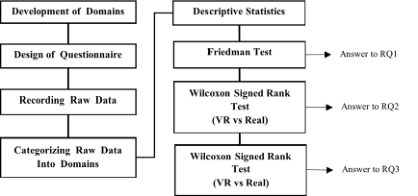
A Comparative Case Study of Crane Operation Training Methods: Immersive Training 15 modes, analysis was completed using paired comparisons for two modes and a complete case subset of three-mode comparisons. In total, there were 13 participants, of whom nine engaged in three training modes, while the other four did not participate in the actual crane operation. Figure 1 provides a brief overview of the overall research workflow.
Training Mode The study involved employees representing different organizational levels, including production workers and managers of organizational units. The diverse participant structure enabled the capture of varied perspectives on the use of virtual reality (VR)-based training, taking into account both operational and managerial viewpoints.
The training mode was divided into three elements: Pre-training guidance (theory) – A brief introduction was provided, covering the purpose of the work, the research procedure, and safety guidelines for the use of VR equipment (including scheduled breaks and procedures for reporting discomfort). An informed consent form was obtained from all participants prior to the study. VR training (on-site training course) – The training was conducted under controlled conditions. The following equipment was used: VR head-mounted display (VR glasses), VR control box (control/communication unit), and VR hand controllers.
The training consisted of three components:
Instructor-led demonstration: the instructor presented the correct execution of the task in the VR environment step by step, including an explanation of correctness criteria and common errors;
VR practical exercises: participants performed tasks in the virtual environment, with opportunities for repetition, correction, and instructor feedback;
Standardization: an identical task sequence, training duration, and scenario difficulty level were maintained for all participants, where permitted by the system.
On-site training course (real crane operation)–During the on-site training conducted in a real-world environment, a summary of the training process was provided, and its main advantages and limitations were discussed.
Competency Domains In order to evaluate the effectiveness of the training modalities, five key competency domains are used, which are adapted from Kirkpatrick’s (Kirkpatrick and Kirkpatrick, 2016) model for training evaluation. Table 1 explains the competency domains and provides an example question for the consequent item.
Table 1: Competency domains.
Table available in the original PDF paper.
Domains Explanation Sample Question Knowledge Understanding of core crane operation concepts This training has provided you with adequate crane knowledge.
Realism Training content’s ability to recreate real crane work
The demonstrations represented real factory situations.
Cognitive Engagement
Trainees’ active thinking and mental involvement
You concentrated during the crane training.
Behavioural Transfer
Applying the training knowledge in the workplace
The training will most likely help you avoid accidents at the workplace.
Satisfaction Overall satisfaction with the training methods
The time spent training was a worthwhile investment.
Research Instrument Trainees’ perception of training effectiveness was measured with a Likert scale-based questionnaire consisting of 16 items. These questions collected responses across five key competency domains. The scale ranges from 1 to 5 (strongly disagree to strongly agree).
Statistical Analysis The focus of the study is to compare the effectiveness of the training methods and perform a within-subject comparison following that, since the participants remain the same. The responses provided by the trainees on a five-point Likert scale are ordinal, and the complete sample size (n = 9) is quite small, therefore, a non-parametric within-subject analysis was chosen rather than the repeated measures analysis of variance (RM-ANOVA). This approach is consistent with recent works related to VR training comparison that explicitly reported using the Friedman test with the Wilcoxon signed-rank test for comparing VR vs face-to-face training (Choi et al., 2023; Macchi and De Pisapia, 2024). The Friedman test provided insight regarding any statistically significant difference between the training methods for each domain in the complete case subset (n = 9). If the Friedman test revealed a statistically significant difference between training methods across the domains, post-hoc pairwise comparison would be conducted. Pairwise comparisons were performed with the Wilcoxon signed-rank test for VR vs theory (n =13) and VR vs practical (n = 9). In addition, effect sizes with Kendall’s W for Friedman and the number of non-zero paired differences were recorded.
Figure 1: Research workflow.
RESULTS AND DISCUSSION
Results from the statistical analysis are reported according to the five competency domains and presented separately based on the three modalities. Table 2 outlines the descriptive statistics results, which indicate high perceived effectiveness across all five domains for the training modalities. Domain means clustered around the upper end of the five-point Likert scale (4.1–4.7) and the medians largely ranged between 4.3 and 5. In the knowledge domain, VR (M = 4.4) and theory (M = 4.4) mean scores were slightly higher than practical crane operation training, indicating a comparable level of knowledge acquisition.
Theory 13 4.36 0.49 4.5 Real 9 4.39 0.65 4.5 Cognitive Engagement VR 13 4.46 0.43 4.3
Theory 13 4.3 0.56 4.3 Real 9 4.4 0.55 4.3 Behavioural Transfer VR 13 4.28 0.52 4.5
Theory 13 4.33 0.47 4.25 Real 9 4.11 0.73 4.5 Satisfaction VR 13 4.72 0.52 5
Theory 13 4.69 0.52 5 Real 9 4.69 0.49 5
Participants’ perception of the realism of the training scenarios was similar for both VR and theory, M = 4.36, whereas practical training had a slightly higher mean score, M = 4.39. However, a common median score across all methods was recorded, which reflects that the delivered training contents closely resembled real workplace scenarios. In terms of cognitive engagement, VR showed the highest mean with M = 4.46, relative to theory- based training (M = 4.3) and real training (M = 4.4), suggesting a higher engagement in immersive training. According to the mean score, behavioural transfer trainees perceived that the knowledge acquired in theory and VR training is easily transferable to workplace scenarios compared to real training. Participants showed a higher level of satisfaction for all the training modalities, which is evident in the higher median scores.
The Friedman test (n = 9) revealed that there is no statistically significant difference between the training methods across the key domains (all p values ≥ 0.34; satisfaction p = 1). The small chi-square values indicated that the
participants’ ranked domain scores were very similar across the training modalities.
Table 3 presents the paired Wilcoxon-signed-rank test results. The test evaluates if the median within-participant difference (VR and theory) differs from zero using the ranks of the non-zero paired differences. The very small non-zero values (0–4) inferred that most of the participants rated both training methods identically across all five domains, which limits the power of the test. In the satisfaction domain, all paired differences were 0, therefore, the W value is not applicable, and p = 1 suggested identical ratings were observed for both the training methods. Effect sizes revealed small to moderate differences in knowledge = −0.2 and behavioural transfer = −0.7, indicating a tendency for participants being in favour of the theory. These results should be interpreted cautiously because the non-zero value was only 4, thus indicating very limited precision. Table 4 presents the signed-rank test results for VR against practical crane training.
Table 3: Wilcoxon-signed rank test (VR vs theory).
Table available in the original PDF paper.
Domains Number of Pairs
Non-Zero W P Effect Size (R) Knowledge 13 4 4 0.85 −0.2 Realism 13 4 5 1 0
The P values indicate that there is no statistically significant difference between the two training methods. The non-zero values (2–6) reveal that several participants provided identical responses for both VR and real crane operation. Although some effect sizes appear moderate to large, these should be interpreted cautiously, because the sample size is very small (n = 9). The statistical analysis confirmed that there is no statistically significant difference between the training methods according to the trainees’ responses, which answers RQ1. RQ2 and RQ3 are addressed by the signed-rank test results, which demonstrated that in the cases where participants were in favour of theory and VR-based training due to the low sample size and identical responses across the domains, this should be interpreted cautiously. Although non-significant results dominate, the descriptive statistics results provide actionable insights for future training design. Participants felt more engaged while participating in the VR-based training, which is also moderately evident when combined with the satisfaction and realism score. This aligns with the expectation that immersive environments can attract participants’ attention and increase involvement in training. Participants were in favour of theory training for behavioural transfer, which suggests that interaction with instructors significantly improves participants’ perception of skill transfer. Practical training showed the largest variability across some domains, which refers to the fact that the perception of hands-on training differs substantially depending on the task.
A Comparative Case Study of Crane Operation Training Methods: Immersive Training 19 It can be concluded that the participants rated the three training methods identically, and VR is as effective as practical and theory-based training, since there is no statistically significant difference based on the ratings. Similar conclusions are suggested by multiple studies where VR-based training was found to be effective for competency development among trainees (Liaw et al., 2023; Tsukada et al., 2024). However, given the small sample size and VR’s low mean score in realism and behavioural transfer, the authors would like to propose that blended training combining immersive technology for practice and trial training prior to real overhead crane operation is more efficient than only stand-alone VR-based or practical training, considering the logistical and financial constraints.
Table 4. Wilcoxon-signed rank test (VR vs real).
Table available in the original PDF paper.
Domains Number of Pairs
Non-Zero W P Effect Size (R) Knowledge 9 6 10 1 −0.05 Realism 9 2 3 0.34 1
Limitations and Future Implications This paper provides practical insights for the future development of overhead crane training for novice operators, but several limiting factors constrain the conclusion. Firstly, the complete case study for three-mode comparison has a very small sample size (n = 9). Secondly, the effectiveness outcome is based on self-recorded competence compared to task-based performance. Thirdly, there were multiple occasions where participants rated all the methods identically, which suggests a limitation of the research tool. Future research should focus on works with a higher sample size and should be conducted over a longer period, rather than measuring knowledge acquisition and safety behaviour right after the training. A comparison between the self- reported competencies and an objective performance metric would be able to provide in-depth insights regarding the training method’s effectiveness and the development of training content.
CONCLUSION
This comparative case study assessed the perceived training effectiveness of virtual reality, theory-based, and real crane operation across five constructs relevant to overhead crane work. Overall, trainees rated all the methods very highly, and the patterns of responses closely aligned across domains. The findings indicate that VR-based training delivers an experience which is comparable to the other two methods in terms of knowledge acquisition, perceived realism, and behavioural impact. However, from a human-factor point of view, VR is a credible opponent for other crane training methods, specifically where repeatability, safety, and challenging scenarios are
required. The evidence points towards establishing a hybrid overhead crane training methodology combining immersive technologies with conventional methods.
ACKNOWLEDGEMENT
This project is part of the “Virtual Training Certification” project funded by “Business Finland”. The authors would like to sincerely thank “Business Finland” for their financial and logistical support.
REFERENCES
Buń, P., Trojanowska, J., Ivanov, V., Pavlenko, I., 2018. The use of virtual reality training application to increase the effectiveness of workshops in the field of lean manufacturing, in: 4th International Conference of the Virtual and Augmented Reality in Education, VARE 2018. pp. 65–71. Burk, E., Han, H.-S., Smidt, M., Fox, B., 2023. Effectiveness of simulator training
compared to machine training for equipment operators in the logging industry. Int. J. For. Eng. 34, 373–384. https://doi.org/10.1080/14942119.2023.2194751 Chen, J., Man, F., Han, S., Kim, M., Du, Q., Chi, H.-L., 2025. Integrating lean thinking into crane operator training with a digital coach to enhance safety and productivity in virtual environments. Autom. Constr. 178, 106430. https://doi. org/10.1016/j.autcon.2025.106430 Choi, J.Y., Yi, S., Shim, D., Yoo, B., Park, E.S., Rha, D., 2023. Home-based virtual
reality-enhanced upper limb training system in children with brain injury: a randomized controlled trial. Front. Pediatr. 11, 1131573. https://doi.org/10.3389/ fped.2023.1131573 Das, S., Maiti, J., Krishna, O.B., 2020. Assessing mental workload in virtual reality based EOT crane operations: A multi-measure approach. Int. J. Ind. Ergon. 80, 103017. https://doi.org/10.1016/j.ergon.2020.103017 Dhalmahapatra, K., Maiti, J., Krishna, O.B., 2021. Assessment of virtual reality
based safety training simulator for electric overhead crane operations. Saf. Sci. 139, 105241. https://doi.org/10.1016/j.ssci.2021.105241 Eurostat, 2023. Accidents at work - statistics on causes and circumstances. George, A.K., McLain, M.L., Bijlani, K., Jayakrishnan, R., Bhavani, R.R., 2016. A Novel Approach for Training Crane Operators: Serious Game on Crane Simulator, in: 2016 IEEE Eighth International Conference on Technology for Education (T4E). Presented at the 2016 IEEE Eighth International Conference on Technology for Education (T4E), pp. 116–119. https://doi.org/10.1109/T4E.2016.030 Kirkpatrick, J.D., Kirkpatrick, W.K., 2016. Kirkpatrick’s four levels of training
evaluation. Association for Talent Development. Li, J., Kim, J.-E., 2021. The Effect of Task Complexity on Time Estimation in the Virtual Reality Environment: An EEG Study. Appl. Sci. 11, 9779. https://doi. org/10.3390/app11209779 Liaw, S.Y., Sutini, Chua, W.L., Tan, J.Z., Jones, L.-J., Ahokka, B., Pan, T.L., Lau,
S.T., Ignacio, J., 2023. Desktop Virtual Reality Versus Face-to-Face Simulation for Team-Training on Stress Levels and Performance in Clinical Deterioration: a Randomised Controlled Trial. J. Gen. Intern. Med. 38. https://doi.org/10.1007/ s11606-022-07557-7 Luo, Y., Ahn, S., Abbas, A., Seo, J., Cha, S.H., Kim, J.I., 2023. Investigating the impact of scenario and interaction fidelity on training experience when designing immersive virtual reality-based construction safety training. Dev. Built Environ. 16, 100223. https://doi.org/10.1016/j.dibe.2023.100223
A Comparative Case Study of Crane Operation Training Methods: Immersive Training 21 Macchi, G., De Pisapia, N., 2024. Virtual reality, face-to-face, and 2D video
conferencing differently impact fatigue, creativity, flow, and decision-making in workplace dynamics. Sci. Rep. 14, 10260. https://doi.org/10.1038/s41598-024- 60942-6 Mun, S.-Y., Oh, H.-J., Lee, S.-J., 2024. A Comparative Study between Vocational Training Using Virtual Reality and Traditional Training: Focusing on Industrial Cranes. J. Pract. Eng. Educ. 16, 529–540. https://doi.org/10.14702/JPEE.2024.529 Priambodo, A.P., Nurhamsyah, D., Lai, W.-S., Chen, H.-M., 2022. Simulation-based
education promoting situation awareness in undergraduate nursing students: A scoping review. Nurse Educ. Pract. 65, 103499. https://doi.org/10.1016/j. nepr.2022.103499 Raviv, G., Fishbain, B., Shapira, A., 2017. Analyzing risk factors in crane-related near-miss and accident reports. Saf. Sci. 91, 192–205. https://doi.org/10.1016/j. ssci.2016.08.022 Shringi, A., Arashpour, M., Golafshani, E.M., Rajabifard, A., Dwyer, T., Li, H.,
2022. Efficiency of VR-Based Safety Training for Construction Equipment: Hazard Recognition in Heavy Machinery Operations. Buildings 12. https://doi. org/10.3390/buildings12122084 Sun, Z., Zhu, Z., Xiong, R., Tang, P., Liu, Z., 2023. Dynamic human systems risk prognosis and control of lifting operations during prefabricated building construction. Dev. Built Environ. 14, 100143. https://doi.org/10.1016/j. dibe.2023.100143 Tsauri, C., Sudira, P., Luthfi, M.I., 2024. Transforming heavy equipment engineering
learning using virtual reality: A literature review and case study. J. Pendidik. Vokasi 14, 43–52. https://doi.org/10.21831/jpv.v14i1.61298 Tsukada, K., Yasui, Y., Miyata, S., Fuyumuro, J., Kikuchi, T., Mizuno, T., Nakayama, S., Kawano, H., Miyamoto, W., 2024. Effectiveness of Virtual Reality Training in Teaching Personal Protective Equipment Skills: A Randomized Clinical Trial. JAMA Netw. Open 7, e2355358. https://doi.org/10.1001/ jamanetworkopen.2023.55358 Zhang, J., 2024. Virtual Construction Safety Training System: How Does it Relate to
and Affect Users’ Emotions?, in: Brilakis, I. (Ed.), . Presented at the Proceedings of the 41st International Symposium on Automation and Robotics in Construction, International Association for Automation and Robotics in Construction (IAARC), pp. 599–606. https://doi.org/10.22260/ISARC2024/0078
LISTED IN THE AHFE DIGITAL BOOKSTORE CATALOGUE
Explore the complete digital volume
Metaverse, Virtual Environments and Game Design
Read this individual research paper free through the original publisher, or explore the full digital proceedings book.
ISBN 978-1-964867-93-9
Explore this ISBN in the AHFE Bookstore ↗Listed in the July 2026 bookstore catalogue; search by ISBN to confirm current availability · Digital book purchase optional