Ida Kuck, Lotte Wagner-douglas, Lena Wirtz, Stefan Ladwig (2025). An autonomous shuttle for everyone: What information do users need when using shuttles?. In: Intelligent Human Systems Integration (IHSI 2025): Integrating People and Intelligent Systems. AHFE Open Access, vol. 160, pp. 559–568. https://doi.org/10.54941/ahfe1005861
One of the objectives of the publicly funded autotech.agil project is to develop an autonomous on-demand shuttle to make public transport more flexible. In this context, the goal is to develop an inclusive interface solution that provides relevant information to all user groups. As autonomous on-demand shuttles also open up new perspectives regarding mobility for people with disabilities, the user-centered development process will also consider participants with special needs. For this purpose, six workshops with 28 participants from different user groups were conducted: people with undisclosed disabilities (n = 12), retired (n = 4), cognitively (n = 3), physically (n = 4), and visually impaired (n = 4) were conducted. The information needed at the stages, “arrival of shuttle at station”, “traveling with shuttle”, “arrival at destination”, and the preferred location of the information, “display” vs “smartphone” vs “both”, were assessed. The analysis showed that at both stages, arrival of shuttle as well as traveling, all groups needed similar information. Apart from general information such as the time of arrival, the information needed when arriving at destination differed between the groups. Regarding the location of information presentation, most user groups (except retired participants) went for redundant presentation on both, smartphone and display. A subsequent step is to use the information gathered to develop a suitable inclusive HMI for an autonomous shuttle. Further studies need to investigate the comprehensibility of such a solution.
Autonomous shuttles offer more flexible and adaptable public transport. In particular, autonomous shuttles with an on-demand service that allows the user to choose the origin and destination station increase the flexibility of public transport, and thus make it more efficient for users. Although this is also true for people with undisclosed impairments, it is even more relevant for people with disabilities, for whom the use of public transport can be made more flexible and appropriate. For example, people with physical disabilities can book the shuttle on the route they need without having to transfer between different bus lines, allowing them to reach stations they would normally not be able to reach due to the absence of barrier-free transfer points. In addition, people with cognitive impairments can plan a
route without complex transfer situations where they would need assistance. Besides physical barriers of the shuttle itself, there are also barriers regarding the information that people get when using an autonomous shuttle. If people do not get the information needed for the shuttle usage, this could lead to a non-successful implementation of autonomous shuttles into the market. In addition, not considering people with special needs could lead to a lack of societal participation. Therefore, it becomes important to develop interfaces that are inclusive and present all relevant information for the users. In order to develop such an interface, it seems to be relevant to be able to address the potentially different information needs in an accessible and appropriate way. While much is known about the type of assistive presentation needed for different types of disabilities (for a review see Golbabaei et al., 2024), little is known about the information needed for different types of disabilities when traveling in autonomous vehicles, particularly public shuttles. For example, Nanchen et al. (2022) investigated disabled people’s perceptions of autonomous vehicles. They focused mainly on physical barriers and relevant environmental conditions that need to be considered for people with disabilities. Huff et al. (2020) interviewed a visually impaired person to derive the information needed when using shuttles. They found that the participant focused on nine important pieces of information that needed to be presented when using shuttles. However, other groups of disabled people were not considered. Additionally, more people with visual impairments need to be considered to not adapt the information to one specific person.
Therefore, workshops were conducted with participants with different types of disabilities (visual, physical, and cognitive), participants with undisclosed impairments and with elderly people who were assumed to have a combination of different mild disabilities. The focus was to assess what information shuttle users need when using an autonomous shuttle, focusing on three different scenarios, arrival of the shuttle at the origin station, traveling with the shuttle, and arrival at the final destination. The research question was whether different user groups have different information needs. Additionally, we aimed to assess, what information the different user groups need.
METHOD
Sample A total of 28 participants (17 male, 11 female) were tested in autumn 2023. The age of the participants ranged from 19 to 82 years (M = 49.71, SD = 21.58). Most participants (n = 10) had completed high school, six had completed vocational training, and four had completed general secondary school. Two participants each had a bachelor’s degree, a master’s degree or a secondary school leaving certificate. One participant did not have a school-leaving certificate, and one did not mention what type of school leaving certificate they had obtained. Participants either had no disclosed impairments, a physical, visual, or cognitive impairment or were retired. Descriptive statistics of the sample characteristics per subsample are presented in Table 1. In general, the participants reported a medium affinity
An Autonomous Shuttle for Everyone 561
for technology interaction (M = 16.39, SD = 5.02) and a medium propensity to trust (M = 3.63, SD = 0.51). Participants were recruited near Aachen, Germany.
Table 1. Subsample characteristics.
Table available in the original PDF paper.
Subsample n Age M (SD) Range Male (m) / Female (f) No disclosed impairment 12 37.17 (20.48) 19 – 72 9 m / 3 f Retired 4 76.25 (5.91) 69 – 82 3 m / 1 f Cognitive impairment 3 31.67 (4.04) 28 – 36 3 m Physical impairment 4 62.75 (4.19) 57 – 67 4 f Visual impairment 4 55.00 (14.83) 38 – 74 4 f
Procedure A total of six workshops were conducted. One workshop was conducted with participants with visual impairments, one with participants with cognitive impairments, one with retired participants, and three workshops were conducted with a mix of participants with undisclosed impairments and those with physical impairments. A workshop was conducted with three to six participants. At the beginning, the participants completed the pre- questionnaire, which included questions about their age, gender, highest level of education, type of impairment, the ATI-S, and the Propensity to Trust.
After completing the pre-questionnaire, the participants were introduced to the shuttle and its functionalities. Then the first scenario “arrival of the shuttle” started. After completing the first scenario, the participants were invited to enter the shuttle. Here, the second scenario “traveling with the shuttle”started. The participants then experienced the third scenario “arrival at the destination”. There was a short break between the scenarios.
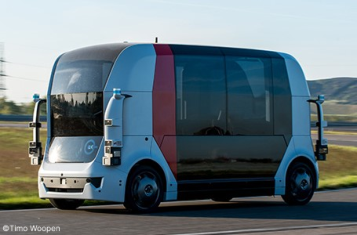
Material The workshops took place near the static shuttle (see Figure 1). The shuttle was not able to run, but the participants were able access the shuttle via a ramp. To increase immersion, the participants were told that the shuttle is an electrically driven, fully automated shuttle that can carry six people, has two displays inside to present information, and one display that can be used via a touch screen when information is needed. They were also told that the shuttle can travel from any Station A to any Station B, which can be booked individually. They were further told that the shuttle could be booked through a specific app that could also present information about the shuttle.
The participants experienced three different scenarios. For the shuttle arrival scenario, the participants were asked to imagine the following: “Imagine you are going to meet friends in the city. You are at the bus stop in front of the institute and you want to go into town. This is your first time using the autonomous shuttle. Your shuttle has already been booked. You stand at the stop. After a few minutes, a shuttle arrives at the station and stops in front of you.” In the traveling with the shuttle scenario, participants
sat in the shuttle and were asked to imagine that they were traveling with the shuttle. In the arrival at the destination scenario, participants again sat in the shuttle and were asked to imagine that they were standing directly in front of the destination stop and were about to get off. For each scenario, participants were asked to indicate which information they would need in the specific scenario in a group discussion. For each information, participants indicated individually whether they would like to see the information on the shuttle display, on their phone, on the shuttle display and on their phone, or if they were not interested in seeing the information. For each presentation location and scenario, the participants ranked the importance of the five most important pieces of information.
Figure 1: Autonomous shuttle used in this study.
In addition, participants indicated their affinity for technology interaction by using the German version of the Affinity for Technology Scale (ATI-S; Wessel et al., 2019) on a 5-point Likert scale (1 – completely disagree to 5 – completely agree). Propensity to trust was measured using the 3-item Propensity to Trust subscale of the Trust in Automation questionnaire (Körber, 2019) on a 5-point Likert scale (1 – Strongly disagree to 5 – Strongly agree, No response).
Design The workshops had a one-factor within-subject design (scenario). Each participant experienced all three scenarios: information needed when the shuttle arrives, information needed while traveling with the shuttle, and information needed just before the shuttle arrives at the destination.
RESULTS
All information were clustered by two independent raters. The clusters were then verified by a third rater. Each group of impairment was analyzed separately to detect differences. Thus, one person was excluded from the analysis because they did not indicate whether they had an impairment or not. First, the location preference per participant group was analyzed. Subsequently, the preference of the piece of information per device (shuttle vs smartphone) was quantified using a rating system, with a score of
An Autonomous Shuttle for Everyone 563
five indicating the highest preference, four indicating the second highest preference and so on. Some pieces of information were summarized in the same category, and thus, only the highest score per category and participant was considered. Consequently, the maximum score per category and group was 5 times the number of participants per group.
Arrival of the Shuttle During the arrival of the shuttle, participants with undisclosed impairments tended mostly to prefer a redundant presentation of information on the shuttle display and their phone, or an exclusive presentation only on their phone. The information that was the most relevant to them was the arrival and departure time and the bus number, both presented on their phone or on the display. Participants with cognitive, physical, and visual impairments also preferred redundant information on their phone and display. For participants with cognitive impairments, the route, departure time, and technical information were the most relevant. For participants with physical impairments, the most important information was the destination, the arrival and departure time, and the structure of the shuttle stop. Participants with visual impairments rated the arrival and departure time, the entering of the destination stop and the destination as the most important information. They also considered it very important to have contact options via the shuttle display. The group of retired participants preferred to have information presented only on the shuttle display. They rated travel time, route, and bus number as the most relevant information. The most relevant information for each user group during the arrival of the shuttle is shown in Table 2. The information categories with the highest scores per group are highlighted. Information with missing numbers indicate that this information was not that relevant for this group.
Table 2. Information needed during the arrival of the shuttle per device phone (P) and shuttle display (D).
Table available in the original PDF paper.
Equations and mathematical formulas are available in the original paper PDF.
Cognitive Impairment
Physical Impairment
Visual Impairment
P D P D P D P D P D Arrival & departure time 38 21 0 5 10 10 14 7 Boarding & exit points 14 7 3 0 0 8 Booking 12 0 0 7 6 5 5 5 Bus number 28 35 0 10 5 7 Connections 3 2 2 4 Contact options 2 1 0 1 0 1 1 9 Delay & consequences 8 1 3 1 1 1 9 6 Departure time 5 5 Destination 12 19 4 4 13 13 9 8 Emergency behavior 0 8 1 1 Enter destination stop 10 0 Entry & exit 0 2 4 0 Free seats 1 6 5 0 7 3 Recognized by shuttle 0 3 1 0 9 8
(Continued)
Table 2. Continued No Disclosed Impairments
Table available in the original PDF paper.
Cognitive Impairment
Physical Impairment
Visual Impairment
P D P D P D P D P D Route 5 3 2 10 6 8 4 4 Safety concept 2 10 0 8 Speed 0 4 Structure of shuttle stop 3 12 5 10 0 5 Technical information 3 5 0 1 0 5 Travel time 3 12 3 5 Waiting time 12 13 8 5
Traveling With the Shuttle When traveling with the shuttle, participants with undisclosed impairments, participants with cognitive impairment, and participants with visual impairment preferred redundant or exclusive information presentation on the shuttle display. Participants with undisclosed impairments found the next stop presentation to be the most relevant. In addition, the safety concept, the route, and the arrival time were rated as relatively important. Participants with cognitive impairments rated information about connections, destination, and route as most relevant. Participants with visual impairments rated information about the route, a possible relocation of stop, the destination, and delays as the most important. Physically impaired and retired participants preferred the information presented on the shuttle display only. For the physically impaired participants, the presentation of the next stop, the destination and any delays were most relevant. For the retired, information about the next stops, opening and closing of doors, and travel time was most relevant. The most important information during traveling with the shuttle is shown in Table 3. The information categories with the highest scores per group are highlighted. Information with missing numbers indicate that this information was not that relevant for this group.
Table 3. Information needed while traveling with the shuttle per device phone (P) and shuttle display (D).
Table available in the original PDF paper.
Cognitive Impairment
Physical Impairment
Visual Impairment
P D P D P D P D P D Arrival time 18 8 0 5 2 1 0 2 Acoustic message 0 7 Leaving & boarding behavior 0 2 0 5 0 1 Booking 4 4 8 2 Connections 14 3 3 9 1 0 7 6 Contact option 0 5 5 2 2 0 Current stop 5 4 Delay 15 10 4 2 5 6 11 4
(Continued)
An Autonomous Shuttle for Everyone 565
Table 3. Continued No Disclosed Impairments
Table available in the original PDF paper.
Cognitive Impairment
Physical Impairment
Visual Impairment
P D P D P D P D P D Destination 9 13 3 6 11 9 5 10 Travel time 15 9 2 8 4 0 Emergency stop 0 5 4 5 0 2 Internet 2 5 7 5 5 0 5 0 Next stop 18 37 1 3 5 14 Opening and closing the door 3 8 0 7 Operating interior display 0 8 0 5 Relocation of stop 8 10 Route 0 17 3 3 6 5 0 5 9 15 Safety concept 11 19 0 2 2 5 Scheduled stop 0 15 5 3 Seat reference 3 4 8 0 Sightseeing & events 4 4 Ticket validity 5 0 Waiting time 10 6 6 4
Arriving at the Destination When the participants imagined that they were close to arriving their destination, those with undisclosed impairments and those with visual impairment did not show a specific pattern regarding the location of the information, resulting in a mixture of display only, phone only, and display and phone redundant presentation preferences. They rated a personalized stop announcement as well as the destination and the arrival time as the most relevant information in this situation. Participants with cognitive impairments again preferred either a display only or a combined display and phone presentation. They indicated that information about transfer options, the structure of the stop and a safe exit, as well as delays were most important. Participants with physical impairments preferred information presented either on the shuttle display only or on the shuttle display and their phone in combination, with a slight increase in preference for information presented on the phone. They rated information about the destination, exit aids, and transfer options as most relevant. Again, the retired participants preferred an exclusive presentation of information on the shuttle display. They rated destination information and transfer options as most relevant. The most relevant information during arrival at the destination is shown in Table 4. The information categories with the highest scores per group are highlighted. Information with missing numbers indicate that this information was not that relevant for this group.
Table 4. Information needed during the arrival at destination per device phone (P) and shuttle display (D).
A total of six workshops were conducted with participants with different types of disabilities (cognitive, physical, and visual), as well as retirees and participants with undisclosed impairments. The goal was to derive specific user needs per disability group when traveling with autonomous shuttles. We focused on three different scenarios: arrival of the shuttle at the station, traveling with the shuttle, and arrival at the destination. Also of interest was whether the participants wanted the information to be presented on the shuttle’s display, on their smartphone, or in both locations.
We found that participants with undisclosed impairments, and with physical, cognitive, and visual disabilities, mostly preferred a redundant presentation of information on both, the shuttle display and their smartphone. This was particularly evident upon the arrival of the shuttle. While traveling with the shuttle and before arriving at the destination, it was found that they preferred to get general information (e.g., arrival time) on the shuttle display, while the preference to present the information on their smartphone increased with the individuality of the information type (e.g., personalized stop announcement). Here, the type of information and the location of the information reflect each other. Information that could be relevant to everyone should be visible to everyone, while information that is more relevant to the individual should be presented on the individual’s personal device. Only the retired participants preferred to see information only on the shuttle display. This is in line with the idea that elderly people do
An Autonomous Shuttle for Everyone 567
not use their smartphones as often and efficiently as younger people (Ziefle & Bay, 2005). Also, some of them do not have a smartphone or leave it at home, so they would need more information on the shuttle itself. In terms of information interest, participants rated bus number, destination, route, and departure and arrival time as most relevant for shuttle arrivals. All groups of participants rated similar information as most relevant. This allows interface designers to implement the same information, but potentially with different information presentation due to different perceptual requirements.
When traveling with the shuttle, the most relevant information was the route and next station, as well as connections and delays. In addition, retired and visually impaired participants wanted more information about the opening and closing of the door, which may be due to problems seeing the doors state.
When arriving at the destination, all participants rated the destination, arrival time, delays, and transfer options as the most relevant information. Participants with physical disabilities also needed information about exit aids, which could include information about a ramp or other assistance. Participants with cognitive disabilities requested information about safe exit. Retired participants indicated that information about contact options was also relevant, while participants with visual impairments again needed information about opening of the door for example the distance that need to be kept to the door as well as a personalized stop announcement. In general, the results show that most of the information needed is common to all participants and should therefore be visible to all. Other information seems to be more relevant to specific user groups due to their specific impairments and should therefore be added to the shuttle display or to the information presented on the individual device connected to the shuttle. These different information needs should be considered when designing inclusive interface solutions for autonomous on-demand shuttles.
The results provide a first insight into the information needs of users traveling with autonomous shuttles. However, it should be noted that each user group consisted of only three to four participants with a specific disability. Although they provided first insight into their specific user needs, the needs cannot be considered exhaustive. Especially considering that disabilities are very complex and individual, specific other user information needs may become relevant when using shuttles. Therefore, it seems to be important to allow shuttle users to customize the interface to ensure that specific needs are met. In addition, this paper has not focused on presentation requirements, although they are critical to the design of inclusive interfaces. Presentation requirements have been well studied (for a review see Golbabaei, 2024). Future research should explore how the relevant information needs to be presented to each user group by satisfying the presentation requirements of each user group. Presentation requirements could lead to different presentations of the same information for different user groups.
CONCLUSION
This paper investigated the information needs of participants with different types of disabilities when using autonomous shuttles. It also focused on the location of the information needed. We found that all groups of participants rated general information (e.g., the arrival time) as the most relevant information. There were only a few differences due to their disabilities, such as a personalized stop announcement for people with visual impairments. In addition, all participants mostly preferred redundant information presentation on the shuttle displays and their individual devices. Only retired participants wanted a single presentation on the shuttle display. In addition, the more general the information, the more likely the participants were to want it presented on the shuttle display. The more personalized the information, the more likely they were to prefer information presented on their personal device. The study provides a first glimpse into the information needs of people with special needs. However, further research is needed in this area to facilitate the development of inclusive interface solutions.
ACKNOWLEDGMENT
The data collection and analysis was funded by the Federal Ministry of Education and Research Germany (BMBF) within the project autotech.agil. The authors would like to acknowledge Laura Kremer, Tabea Mahler, Malte Reichart, Berenike Schmidt, and Nina Wirtz for their support in the conduction of the workshops and in the analysis of the data. We have no conflicts of interests to disclose.
REFERENCES
Golbabaei, F. Dwyer, J. Gomez, R. Peterson, A. Cocks, K. Bubke, A. and Paz, A.
(2024) Enabling mobility and inclusion: Designing accessible autonomous vehicles for people with disabilities, Cities. Huff, E. W. Lucaites, K. M. Roberts, A. and Brinkley, J. (2020) Participatory Design in the Classroom: Exploring the Design of an Autonomous Vehicle Human-Machine Interface with a Visually Impaired Co-Designer. Proceedings of the 2020 Human Factors and Ergonomics Society 64th International Annual Meeting. Körber, M. (2019) Theoretical considerations and development of a questionnaire to
measure trust in automation. Proceedings of the 20th Congress of the International Ergonomics Association (IEA 2018). Colume VI: Transport Ergonomics and Human Factors (TEHF), Aerospace Human Factors and Ergonomics, Springer. Nanchen, B. Ramseyer, R. Grèzes, S. Wyer, M. Gervaix, A. Juon, D. and Fragnière, E.
(2022) Perceptions of People with Special Needs Regarding Autonomous Vehicles and Implication on the Design of Mobility as a Service to Foster Social Inclusion. Frontiers in Human Dynamics. Wessel, D. Attig, C. and Franke, T. (2019) ATI-S – An Ultra-Short Scale for Assessing Affinity for Technology Interaction in User Studies. Proceedings of Mensch und Computer 2019. Ziefle, M. and Bay, S. (2005). How older adults meet complexity: Aging effects on
the usability of different mobile phones. Behaviour & Information Technology.
LISTED IN THE AHFE DIGITAL BOOKSTORE CATALOGUE
Explore the complete digital volume
Intelligent Human Systems Integration (IHSI 2025): Integrating People and Intelligent Systems
Read this individual research paper free through the original publisher, or explore the full digital proceedings book.
ISBN 978-1-964867-36-6
Explore this ISBN in the AHFE Bookstore ↗Listed in the July 2026 bookstore catalogue; search by ISBN to confirm current availability · Digital book purchase optional