Franziska Braun, Koray Hergül, Alina Bachofer, Katharina Bolius, Antonio Ardilio (2024). Enhancing the mental health through a multisensorial experience in the vehicle interior. In: Human Factors in Design, Engineering, and Computing. AHFE Open Access, vol. 159, pp. 2140–2148. https://doi.org/10.54941/ahfe1005782
Mental health is becoming increasingly important in today's society. More and more people are turning to mindfulness exercises, relaxation techniques, and sports to unwind, alleviate stress, and enhance resilience. However, amidst the stress of daily life and the constant demands of work, family, and leisure activities, many individuals still struggle to find time to nurture their mental well-being. An often-overlooked opportunity to do so lies in daily commuting. In German cities, daily commute times can reach up to 60 minutes due to traffic jam and heavy traffic. This time can be used more effectively, especially with the increasing automation of vehicles, to focus on the personal health. In order to investigate this potential, an innovative multisensory experience was developed for the vehicle interior of a ride-hailing vehicle to promote mental health. This experience was implemented in a real vehicle and examined for its efficacy in a user study. To shape the experience, insights from psychology, environmental psychology, and design research were combined to respond to the passenger's emotional and physical states during the journey. The approach is based on chromotherapy, where different light colors and intensities are used to reduce physical and mental illnesses. Furthermore, an acoustic guidance for a breathing exercise, based on the success of Pranayama practice, was developed to be practiced simultaneously by the passenger, along with a haptic element on the belt, which further enhances the emotions during the experience. The immersive experience is individualized based on an analysis of the LIMBIC types, i.e. personality models, in order to achieve the greatest possible relaxation effect.The research methodology included comprehensive literature review on existing concepts and technologies, expert interviews with both light and sound designers as well as psychologists, and two quantitative user surveys to gather requirements and define specific design elements of a holistic immersive experience. Based on the preliminary work and findings of a previous study on light combined with a breathing exercise to enhance mental health, a multisensory concept was developed and integrated into a Hyundai Ioniq 5. To achieve this, legroom on the rear bench was expanded, the driver's cabin was shielded, flexible LED panels were attached to the back of the front seats, and a 360-degree sound system was integrated. Additionally, a belt concept was designed, equipped with vibration sensors that can transmit controlled haptic impulses to the passenger during the journey. To test the success of the designed experience, a qualitative user study was conducted with 12 participants. For this purpose, a travel scenario was recreated, which all passengers had to go through. Before and after the journey, the participants were interviewed about their well-being during the entire testing period. In parallel, the vital data heartbeat and electrodermal activity were collected through a wearable device (wristband) in order to compare them with the personal assessments. The results of the ongoing study will be presented in the full paper. In summary, based on the previous interviews and quantitative user studies, there is a need for applications to improve mental health. There is also a demand to use commuting times more effectively for personal well-being, particularly in the future with automated driving. The positive effects that have already been achieved in the areas of light and sound interaction as well as breathing exercises for relaxation also speak in favor of a combination of the principles. After conducting and analyzing the user study with the prototype, the insights into the success of the immersive multisensory experience will be presented in the final version of the scientific work. In conclusion, this paper emphasizes the importance of design innovations in the field of mobility that prioritize the psychological well-being of users. The research illustrates that by skillfully combining technology and design psychology, vehicle interiors can be created that actively contribute to mental health and thus provide added value to society.
Advances in vehicle automation, driven by improvements in artificial intelligence, sensor technology and machine learning, are enabling vehicles to navigate within complex environments with little or no human intervention.
Enhancing the Mental Health Through a Multisensorial Experience 2141
This turns the driver more and more into a passenger, which opens a range of new possibilities for activities while driving.
The “Value of Time” study by Fraunhofer IAO and Horvath & Partner GmbH explores which activities passengers prefer to pursue during an automated journey (levels 4–5) (Fraunhofer-Institut für Arbeitswirtschaft und Organisation -IAO-, Stuttgart und Horvath & Partner GmbH 2016). The study revealed that, alongside working, the activities “eating”, “relaxing” and “sleeping” are perceived as particularly important to the customer. This highlights the growing demand for relaxation and recreational activities while driving, aligning with the prevailing trend towards mental health and resilience. The fast pace of trends, along with the constant stream of news from portals, networks, and social media, contributes to increased stress levels, making stress-relief activities more essential than ever (Keith Neil Hampton et al., 2015). Therefore, implementing individual well-being and stress reduction activities in autonomous rides, offers a great potential for optimizing the value of time in a vehicle.
Braun (Braun, et al., 2022, Braun, et al., 2024) presented an approach, where the combination of light with a breathing exercise for relaxation and concentration has been investigated. The two studies have shown that human-centric and adaptive lighting in combination with supported auditorial autogenic exercises can have a positive influence on stress relief of the passenger.
Based on these studies, it has been demonstrated that engaging multiple senses (in this case, audio-visual) is effective in addressing stress relief. We hypothesize that the integration of additional senses will further enhance the impact on stress relief. A sense that has not been utilized for this purpose is the haptic sense, as the driver was previously occupied with driving. With the advent of autonomous driving, this changes, leading us to pose the following research question: “How can the visual, auditory, and haptic elements of an autogenic exercise be synchronized in vehicle interiors to create a holistic experience that positively impacts the mental health of passengers?”
LITERATURE REVIEW
The integration of advanced sensory technologies in vehicle interiors offers a unique opportunity to enhance passenger well-being and mental health. By leveraging the principles of chromotherapy, breathing techniques and haptic feedback, it is possible to create a multi-sensory environment that addresses the diverse needs of passengers. This literature review explores the foundational theories and practical applications of these elements, aiming to inform the development of a holistic mental health concept for future autonomous vehicles.
Chromotherapie Chromotherapy, also known as colour therapy, is a complementary therapy that utilizes colours and light to treat various physical and/or emotional conditions in humans. The premise of chromotherapy lies in the belief that
different colours correspond to distinct aspects of physical or emotional well- being, influencing mood, energy levels, and overall health outcomes. Through targeted use, human mood can be positively influenced and a therapeutic effect achieved (Humble, 2010).
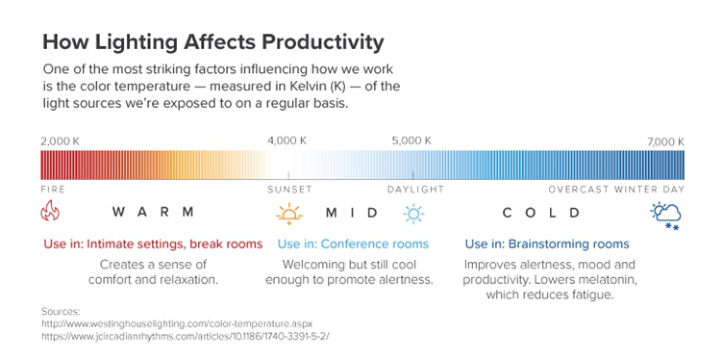
For instance, light at approximately 2700 Kelvin is perceived as warm, fostering a calming and cozy atmosphere conducive to promoting relaxation and aiding in sleep induction. In contrast, light at 6500 Kelvin is perceived as cool, resembling daylight, which enhances alertness, concentration, and overall focus in individuals.
For instance, light at approximately 2700 Kelvin is perceived as warm light, fostering a calming and cozy atmosphere conducive to promoting relaxation and aiding in sleep induction. In contrast, light at 6500 Kelvin is perceived as cool light, resembling daylight, which enhances alertness, concentration, and overall focus in individuals (Lsacks, 2013).
Figure 1: Effect of light colour on human productivity (Lsacks, 2023).
Light colours influence all vegetative body functions such as metabolism, breathing, blood pressure and muscle tone. People perceive colours not only through their eyes but also through skin sensors. These affect the biochemical and biophysical processes of the human body and can influence the heartbeat, pulse and breathing (Axel Buether und Dr. Hans Thorsten Körner, 2022).
Stress and Limbic System Stress can be categorized into two primary types: positive stress, known as eustress, and negative stress, often referred to as distress. Positive stress (eustress) is often seen as motivating and crucial for personal growth, enabling effective navigation of future stressful situations. In contrast, distress, also known as negative stress, is perceived as draining and exhausting. This is experienced as negative, overwhelming and is often associated with low reward (Balaban, 2019). The study focuses on dis- stress, which can be motivated in different ways depending on the individual
Enhancing the Mental Health Through a Multisensorial Experience 2143
character of the passenger. To take this into account, the personality structures of limbic types were examined more closely. Limbic types are based on the limbic system, a brain region in which the autonomic nervous system controls and coordinates emotions. These are decisive for personal perception of emotions, stress and sensitivity. The Limbic Types, a so-called multiscience approach, combines various scientific disciplines and creates a comprehensive personality model (Häusel und Henzler, 2018). The Limbic Quick Test can be used to provide an initial assessment of the level of emotion. A distinction is made between harmony, stimulation, balance and dominance types. The harmony type is examined for the study, as it is particularly susceptible to dis-stress.
Haptic Products for Stress Reduction Weighted blankets, also known as gravity blankets, are therapeutic blankets that weight between 5 to 30 pounds (2.3 to 13.6 kg). They are designed to provide a gentle, even pressure over the body, mimicking the sensation of being hugged or held. This effect is known as “deep pressure stimulation,” which can help calming the nervous system and helps reducing anxiety, enhancing focus and improving sleep (Yu, et al, 2024). This haptical effect will be used for the study concept and additionally supplemented by simulated breathing and simulated heartbeat. These two simulations are already being used successfully in soft toys to calm newborns and puppies. The heartbeat sound is intended to remind newborns and/or puppies of their mother’s heartbeat in the womb, while the gentle movements encourage calm breathing. A similar principle is used for the therapy seal “Paro”which is used for dementia patients. The haptic stimulation provided by the moving seal has been proven to relax patients and relieve anxiety (Pu, et al., 2020). For the haptical component of the concept the principle of deep pressure stimulation will be combined with movements that imitate breathing and heartbeat to complete the multi-sensory experience.
METHODOLOGY
In the course of the design thinking process, the needs of the target group were identified through interviews, and knowledge was built up in the area of stress reduction through light and autogenic training. For this purpose, it was possible to build on existing knowledge gained from previous lighting studies conducted by the Fraunhofer IAO like “Value oriented design of vehicles along emotional personality structures and character traits of customers” (Stegmueller et al., 2023) and “Enhancing driver’s experience through emotion sensitive lighting interaction” (Braun et al., 2022).
These studies have already revealed promising light interaction concepts which have been further refined in the current study. Additional knowledge was gathered from lighting installation experts, sound designers and psychologists. The gained insights were transferred into a multisensory concept which was implemented in a real vehicle with the help of maker tools. The technology prototype was examined for its positive effect on mental health as part of a qualitative user study.
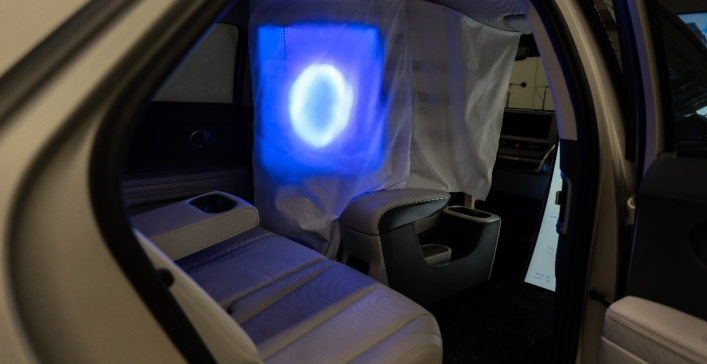
PROTOTYPING To implement the immersive concept, the front passenger seat was removed from a Hyundai Ioniq 5 to create more legroom for the passenger in the back seat row. The driver’s seat has been covered with a textile for more privacy and to better visualize the light interaction. LED panels were fitted around the seat and a textile was stretched over the panels to create a more diffuse lighting experience (see Figure 2).
Figure 2: Integrated LED panels in the test vehicle.
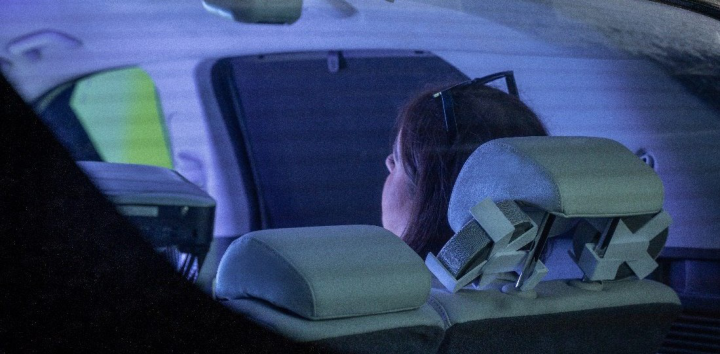
Additionally, speakers have been installed along the headrest of the rear seat for a 360-degree sound experience. This configuration was necessary for effectively guiding the breathing exercises, ensuring that auditory cues are consistently delivered in a spatially encompassing manner to enhance the overall sensory experience (see Figure 3).
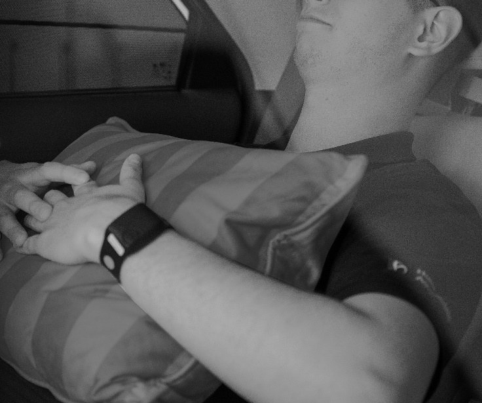
For the implementation, several features aimed at enhancing the passenger experience were incorporated. A monitor was installed at the foot end of the interior to provide real-time feedback on both, the progress of the breathing exercises and the travel route. For the haptic experience, a specially designed heavy pillow was equipped with an actuator capable of simulating the sensation of a heartbeat as well as the rhythm of breathing in and out.
USER TESTING In conducting the user test, our approach aimed to recreate a realistic driving environment within the vehicle. Therefore, monitors were positioned around the vehicle to simulate various aspects of driving, including a synchronized driving video and ambient traffic sounds. This setup was designed to immerse participants in a lifelike driving scenario, enhancing the authenticity of their experience.
The study involved 12 participants characterized by their limbic types, specifically those aligned with “harmony” and “balance,” spanning an age
Enhancing the Mental Health Through a Multisensorial Experience 2145
Figure 3: Speakers along the headrest for 360-degree sound experience.Figure 4: Heavy pillow with breathing functionality.
range from 25 to 55 years. This demographic selection ensured representation across key psychographic profiles within our target audience.
Each participant underwent two test drives: one without immersive elements and another with the immersive experience. This comparative approach enabled a direct assessment of how the immersive elements influenced the participants’ reactions to stress.
To capture relevant insights, structured interviews were conducted both before and after each test drive session. These interviews were crucial for evaluating participants’ subjective perceptions of stress before and after exposure to the immersive environment.
In addition to subjective assessments, objective physiological data were collected using sensor wristbands worn by participants throughout the
journey. These devices tracked vital metrics such as heart rate variability (HRV) and electrodermal activity (EDA), providing quantifiable indicators of participants’ physiological stress responses. This dual data collection approach facilitated a robust analysis, enabling comparisons between participants’ subjective experiences and their physiological reactions.
To ensure consistency and reliability of results, the testing timeline was structured as followed:
Arrival (5 minutes): Participants were given time to acclimate and stabilize their vital signs.
First Test Ride (10 minutes): Participants experienced driving conditions without immersive features, serving as a control scenario.
Second Test Ride (10 minutes): Participants then experienced the immersive driving environment, allowing for direct comparison.
Post-Test Interview (3 minutes): Participants provided feedback on their individually perceived stress levels following the immersive experience.
General Feedback Session (10 minutes): Participants shared overall impressions and detailed feedback on their experience.
Throughout the test rides, participants had the option to choose whether to keep their eyes open or closed, allowing them to engage with the immersive elements according to their personal preferences and comfort levels.
By integrating qualitative insights from interviews with quantitative data from sensor wristbands, our methodology enabled a comprehensive evaluation of the immersive vehicle interior’s impact on stress reduction. This approach ensured that findings were grounded in both subjective participant experiences and objective physiological measurements, thereby enhancing the study’s validity and providing valuable insights into the effectiveness of our design interventions.
RESULTS
Out of the 12 data sets collected during our study, only 7 were deemed suitable for analysis due to incomplete data records caused by technical problems. Among these 7 participants, all demonstrated a recognizable positive effect resulting from the immersive experience.
One notable physiological indicator of stress reduction was observed in the participants’ skin conductance levels (electrodermal activity), which decreased significantly from an average of 3.33 Siemens to 1.85 Siemens. This reduction of approximately 44.44% suggests a marked decrease in stress- related perspiration during and after exposure to the immersive environment.
Moreover, heart rate variability (HRV), a key measure of autonomic nervous system activity, showed a beneficial increase from an average of 77.24 beats per minute (bpm) to 79.60 bpm. This 2.96% increase indicates that participants tended to experience greater relaxation during the immersive rides. Higher HRV reflects enhanced parasympathetic nervous
Enhancing the Mental Health Through a Multisensorial Experience 2147
system activity, facilitating improved recovery phases characterized by lowered heart rates and reduced cortisol levels, indicative of reduced stress.
Qualitative feedback from participants further reinforced these physiological findings. All participants reported feeling notably more relaxed following their experience with the immersive setup.
In addition to these physiological insights, participants provided valuable feedback regarding potential enhancements to the immersive vehicle interior. Suggestions included the adoption of headphones over loudspeakers to enhance noise isolation, thereby further immersing passengers in a contemplative environment. Participants also expressed interest in incorporating olfactory stimulation, a massage function, and integrating visual elements such as vehicle sky projections to enrich the sensory experience.
Regarding specific tactile experiences, while the breathing cushion received positive ratings for its calming effect, feedback indicated a preference for a more pronounced tactile sensation. Participants suggested that the breathing movements and heartbeat simulation could be intensified to enhance the overall immersive experience.
CONCLUSION
The testing conducted that the combination of breathing exercises, sound, light and haptic components within vehicle interiors can significantly enhance passenger relaxation and overall experience. Across all participants, the immersive environment consistently elicited positive feedback and induced a state of heightened relaxation.
However, the study also revealed opportunities for refinement and customization of individual components. Participants expressed varying preferences regarding the intensity of lighting and the volume of instructions for the breathing exercises. Tailoring these elements to individual preferences could further optimize the effectiveness of the immersive experience in reducing stress.
Notably, feedback regarding the haptic component highlighted the need for substantial improvements. Participants suggested enhancing the haptic experience by increasing weight and introducing more pronounced tactile sensations. These adjustments are crucial for achieving deeper sensory engagement and maximizing the therapeutic benefits of tactile stimulation.
The next stage of development should incorporate an additional sense by providing olfactory components to enrich the holistic sensory experience. Introducing scents tailored to promote relaxation could further enhance the overall effectiveness of the immersive environment. Here, the question arises, how individualized the olfactory experience needs to be provided, to maximize relaxation.
ACKNOWLEDGMENT
The authors would like to acknowledge the experts and interviewees as well as the test subjects who took part in the study.
REFERENCES
Axel Buether; Dr. Hans Thorsten Körner (2022): Research paper Color Health Hospital Bremen Neonatology 031122. Balaban, Silvia (2019): Stress objektiv messen – der neue holistische Ansatz. In:
Jutta Heller (Hg.): Resilienz für die VUCA-Welt. Wiesbaden: Springer Fachmedien Wiesbaden, S. 153–167. Fraunhofer-Institut für Arbeitswirtschaft und Organisation -IAO-, Stuttgart; Horvath & Partner GmbH (2016): The value of time. Häusel, Hans-Georg; Henzler, Harald (2018): Buyer Personas. Wie man seine Zielgruppen erkennt und begeistert. 1. Auflage. Freiburg, München, Stuttgart: Haufe Gruppe. Online verfügbar unter https://www.haufe.de/. Keith Neil Hampton; Lee Rainie; Weixu Lu; Inyoung Shin; Kristen Purcell (2015):
Social Media and the Cost of Caring. Lsacks. (2023, June 26). How Lighting Affects the Productivity of Your Workers | MBA@UNC. UNC-MBA. https://onlinemba.unc.edu/news/how-lighting-affects- productivity/ Pu, Lihui; Moyle, Wendy; Jones, Cindy; Todorovic, Michael (2020): The Effect
of Using PARO for People Living With Dementia and Chronic Pain: A Pilot Randomized Controlled Trial. In: Journal of the American Medical Directors Association 21 (8), S. 1079–1085. Stegmüller, S., Ardilio, A., Braun, F. (2023). Value oriented design of vehicles along emotional personality structures and character traits of customers. In: Evangelos Markopoulos, Ravindra S. Goonetilleke and Yan Luximon (eds) Creativity, Innovation and Entrepreneurship. AHFE (2023) International Conference. AHFE Open Access, vol 74. AHFE International, USA. Yu J, Yang Z, Sun S, Sun K, Chen W, Zhang L, Xu J, Xu Q, Liu Z, Ke J, Zhang L, Zhu
Y. The effect of weighted blankets on sleep and related disorders: a brief review. Front Psychiatry. 2024 Apr 15;15:1333015.
LISTED IN THE AHFE DIGITAL BOOKSTORE CATALOGUE
Explore the complete digital volume
Human Factors in Design, Engineering, and Computing
Read this individual research paper free through the original publisher, or explore the full digital proceedings book.
ISBN 978-1-964867-35-9
Explore this ISBN in the AHFE Bookstore ↗Listed in the July 2026 bookstore catalogue; search by ISBN to confirm current availability · Digital book purchase optional