Christian Blessmann, Deike Hessler, Thomas Hofmann (2023). Envision - Testing Platform For User-Centered Visualization and Interaction Concepts. In: Ergonomics In Design. AHFE Open Access, vol. 77, pp. 422–429. https://doi.org/10.54941/ahfe1003400
ENVISION is an ongoing research project of the Osnabrück University of Applied Sciences (HSOS), the German Aerospace Center (DLR) and the software development company FREQUENTIS ORTHOGON. Within the project, a testing platform for user-centered visualization and interaction concepts is being developed. This paper discusses the methodological approach as well as basic conceptual decisions for the selection of a design process for the development of new systems. The scientific focus of this paper is on the user-centered design of future radar interfaces and Controller Working Positions (CWPs).With increasing digitalization and automation in the field of safety-critical air traffic control systems, functional adaptations and enhancements of CWPs are becoming the standard case. The interdisciplinary cooperation between air traffic controllers, software developers and usability experts outlines a procedural model for the development and testing of future cooperation with air traffic controllers and their better integration into the development process of new systems.
Due to software designs that have been established and outdated for years, the industry will increasingly be required to design modular and so-called adaptive, “open” systems in the future. Especially highly safety-critical inter- faces (CWPs) require enormous entrepreneurial effort in their development and further adaptation.
The adaptations of correspondingly complex systems require a great deal of work and cost, and in practice only limited resources are available to implement this. Decision-making and the development and implementation of visionary ideas for later users are therefore inhibited by a conservative star- ting position: ‘Never touch a running system’. This is especially true for the interactions provided in the system, which must be executed by the user in order to be functional.
The majority of existing interfaces from the air traffic control context have been in daily use for many years and function perfectly technically, but do not correspond to the interaction paradigms known from the current
ENVISION - Testing Platform for User-Centered Visualization and Interaction Concepts 423
consumer sector - their GUI design seems out of date, not very innovative and, compared to consumer interfaces, not very motivating for the user.
Often, software developers are tasked with design-related processes in addition to their core competence, but in many cases they are not sensitised to the design of such processes from UI & UX design. Accordingly, there are various systems that have been developed without design expertise, which has led to the status quo becoming increasingly distant from the current require- ments and wishes of users and appearing outdated - especially in comparison to consumer products and established entertainment solutions.
OBJECTIVE One of the overarching goals of the research project described here is to improve and promote all processes necessary for software development as well as the cooperation of the various actors. Through an agile approach, solution and design approaches as well as methodological approaches from design, resources are to be saved in development along the way.
Through a strong and early involvement of users and the application of cur- rent UX design principles, the identification between later users and systems (HMIs) is to be increased and improved. Through various novel design tools and strategies, an adaptable software toolbox will be developed.
Through the design process outlined here, software developers are to be sensitised to the needs of users in order to be able to act continuously with a view to improving the interaction between humans and machines. In this way, an improvement of usability from the user’s point of view should be strived for and established. Aspects such as the adaptability of operational systems, the resulting user acceptance, ensuring future security and increasing the efficiency of the software are among the project’s funding goals. As is the possibility of being able to respond better to changing needs and routine user workflows in the future.
The technological goals focus on scalability and subsequent adaptability. New development methods from design are included to sensitise software development to them and their application. In this context, iterative and agile development cycles are to be established in the development environment. New user-centred approaches can be pursued through new design tools and the associated opportunities for collaborative work. Software developers and later users of the system are actively and participatively involved in the design development.
PROCEDURES FOR USER-CENTERED UI DEVELOPMENT The later users of the software construction kit include software developers, UI & UX designers and air traffic controllers. The respective user groups have individual requirements for the development process and the later handling of the software. Each group has a multi-perspective view of the system to be developed (must be able to take on different roles in system development accordingly) and is significantly involved in the development and creation process of new user interfaces (UIs).
In the further course of the project, they adopt the user perspective in order to define the basis for further optimisations in the form of user tests. Vari- ous methods from the fields of design and software development are used to record all processes necessary for the development and to align them in a user- centred way. User-specific requirements for the development process and its tools are defined through regular interim presentations, opinion surveys using questionnaires and interdisciplinary workshops. Through the selection and strategic use of methods, the development processes in particular are shaped in addition to concrete UI & UX design. In the ongoing project, a large num- ber of low-fidelity prototypes were developed to visualize the resulting ideas and transfer them from the academic perspective to the operational world. This also applies to graphical user interfaces (GUI), which can be concretely used and experienced as interactive prototypes. In addition to the formal- aesthetic design of the interface, the interactions with software components and UI elements are coordinated to adapt the processes to the approach of the users. In an iterative process, the further development is refined, validated and expanded through a series of design sprints. Depending on the develo- pment effort of the individual software components, the required iterations are repeated.
DESIGN METHODOLOGY AND PROJECT SPECIFIC APPROACH The ENVISION process model developed in the project is based on the DIN EN ISO 9241 set of standards. This methodical path of HMI develo- pment includes a participatory development process that involves the core users of the software. At the centre of the model is an analysis-development- evaluation cycle through which concrete user requirements can be recorded. The DIN standards series defines ergonomic requirements and guidelines for the interaction and hardware of various systems (DIN EN ISO 9241-1, 2020).
DIN EN ISO 9241–210 describes the interactions between the activities of human-centred design and is divided into four generic development phases:
Understanding and describing the context of use.
Specifying the requirements for use
Developing design solutions and
Evaluating the design In the first phase of the process, the context of use is analysed. Then the user requirements are specified together with the future users of the sof- tware. Based on this, design solutions are developed that fulfil the usage requirements. With the help of these design solutions, the user perspective is evaluated. If this results in a need for action for the preceding process steps, the corresponding contents are iteratively adapted until the design solutions meet the user requirements. By constantly adapting the design activities, the working basis is sharpened and finalized from the user’s perspective (DIN EN ISO 9241-210, 2020).
However, practical examples dealing with the application of this methodo- logical approach show that a strict approach and the linear working through of the individual process phases, especially in large complex project plans,
ENVISION - Testing Platform for User-Centered Visualization and Interaction Concepts 425
does not fit the everyday work of software development (Theory & Practice in UX Design, 2020). In practice, the DIN series of standards can be seen as a guideline, since in the context of an economic commission and for its success, other economic aspects must be taken into account that are not part of the DIN model. In the lecture “connecting worlds - how to blend acade- mic teaching & industrial projects in design” (Hofmann, T., 2022). a model is described that is basically oriented towards the DIN process, but strives for a freer, non-linear approach. Through a strongly practice-oriented appro- ach, the distance between theory and practice in the environment of HMI development is to be reduced.
Since the objective of the project is focused on the economic efficiency of the development of complex ATM systems, a more flexible, non-linear approach is chosen for the ENVISION project. The approach chosen here is determined by academic and methodological correctness. In addition, it is characterised by a workmanlike and participatory approach in an interdisciplinary group of experts with a high level of practical relevance.
DESIGN PROCESS The aim of incorporating a process shaped by the design methodology is to improve user-centricity. Through an approach based on DIN EN ISO 9241- 210, the user and later user of the software is placed at the centre of the design. The limitations already mentioned and a corrective approach lead to the fact that not all possibilities and ways of order execution are always illuminated.
By transferring the design approaches into the development process, esta- blished paths of software development are left behind and new approaches are tested. Especially in the area of design development, the design of low-fidelity prototypes offers uncomplicated possibilities for user validation without having to make high implementation efforts beforehand. By networ- king different digital prototypes, basic design changes can be implemented in and on the software construction kit. This offers new possibilities in dealing with the development of the front-end system architecture.
UNDERSTAND AND DEFINE The basis of understanding for working with highly complex controller work- places - as foussed in this project - is developed using a CWP system from the company FREQUENTIS ORTHOGON and supplemented by work content and know-how of the stakeholders involved in the project.
The first step in the team was to jointly understand the perspectives of the participants and the context of use of the software in order to capture the individual requirements for the development process. The perspectives of all participants were recorded at the beginning of the methodological procedure with the help of questionnaires in order to be able to define an actual state of the work situation and the work processes. The early integration of the later highly professional users was identified as an essential factor for a better usability of the software to be developed.
To this end, interdisciplinary remote workshops were first held to define the requirements for the processes, with the end user at the centre. A team of experts from air traffic control, software developers from DLR, two air traffic controllers from DLR, software developers from the company FREQUENTIS ORTHOGON and designers from Osnabrück University of Applied Sciences were involved.
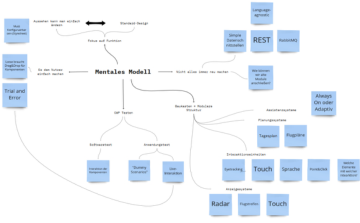
In the first of three design workshops, the test persons dealt with their own visualised (drawings) mental models (Figure 1). Mental models play an essential role in the handling and successful use of software. Users have more or less concrete ideas and mental concepts on the basis of which they interact with the human-computer interface. Accordingly, systems can be designed more efficiently for users if their system architecture and informative stru- cture are based on generally valid user assumptions about how they work (Nielsen, J., 2010).
With the software tool MIRO, the participants were able to sketch their individual mental models of the software construction kit. In addition to per- sonal ideas about the software, user-specific requirements were also defined. The overview gained clarified the multi-perspective view of the stakeholders and defined the basis of the context of use.
In order to select and adapt an agile process model, another remote work- shop was held on the topic of “collaborative workflow”. For this purpose, the development team was divided into two groups consisting of stakehol- ders from different professional fields. With the help of a digital whiteboard, the different tools of the stakeholders were collected and documented. Sub- sequently, the interfaces of the tools and the working approaches were linked and merged into interdisciplinary workflows. As a result, common infrastru- ctures and communication channels were defined (such as Github, Zulip and
ENVISION - Testing Platform for User-Centered Visualization and Interaction Concepts 427
a suitable meeting platform). On this basis, a way to share data was cre- ated. From this point on, selected collaborative design tools such as Adobe XD and FIGMA also enabled all team members to directly access prototypes, development information and process knowledge.
SPECIFY USER REQUIREMENTS In a third workshop, the first prerequisites for a catalog of requirements for the software were created. In this context, findings from the previous work- shops were used to meet the specific usage requirements and the ideas of the later users. Throughout the project, further user requirements will be iden- tified in a participatory exchange with air traffic controllers and experts in the air traffic control context, documented and integrated into the project process.
SUMMARY Through the workshop series, it became clear that software developers must also be understood as users of the software construction kit. This also expands the focus of user-centeredness to include controllers and software developers as user groups. UI & UX designers are additionally used as exe- cuting co-developers and interact as communicative interface between the stakeholder groups. Developing a design for a user interface early on means that concrete designs can be discussed in the early stages of development. These digital mockups are available locally as well as online and represent classic functions of a controller workstation in different ways. The basis of the design is research in the field of consumer software as well as compari- son with the findings from the workshops. Functional mechanisms can be represented with little effort in the form of wireframes and thus become tan- gible. Early drafts and sketches of initial design directions and interactive prototypes with high fidelity to reality offer the opportunity to simulate a real working situation.
EVALUATION AND DESIGN Design mockups that allow for a constant exchange about what has been achieved not only enable internal discussions but also provide a solid basis for evaluation by the end user.
It turns out to be complicated to recruit experienced air traffic controllers for user tests, as they experience a high workload and, as trained controllers, are indispensable in day-to-day business. Nevertheless, in cooperation with the DLR in Braunschweig, two air traffic controllers from the air traffic con- trol in Maastricht were recruited for an exemplary evaluation of the design status. The evaluations were carried out on two consecutive days, each with the air traffic controllers at DLR.
During the meetings, the project-related design approach was explained to the test persons, drafts, ideas, newly developed design elements of the sof- tware and animations regarding interaction were demonstrated. In this way,
conceptual approaches regarding the front-end architecture and the graphi- cal user interface (GUI) of the software were conveyed. With the help of a reduced test setup, an interactive FIGMA prototype could be tested. In this way, the project was able to gain initial experience in the use and handling of interactive design mockups.
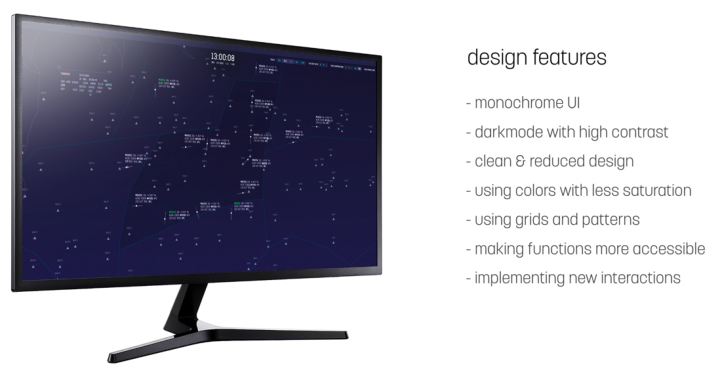
Through the expertise of the test persons, it was possible to quickly and accurately validate which visualisations are suitable for working at the air traffic controller’s workplace and which are not. Characteristics such as the so-called ‘negative display’ of the radar screen were found to be very positive and realistic, as these provide good results especially during prolonged use due to their high contrast (Figure 2). The highly reduced approach to the presentation of information was also highlighted as positive. With regard to interaction, a clear position was taken by both test persons.
In future, only a computer mouse should be used as an input medium for interaction with the radar interface. This means that all necessary systemic digital interfaces in the user interface must be designed for mouse interaction. The central element here is the ‘track label’. All the necessary commands and instructions that the controller needs to carry out his or her work must be available to him or her at all times via a short route. Through detailed feedback on the presented design ideas, the prototypes and the state of the design were subsequently revised and further design ideas were formed in cooperation with air traffic controllers and software developers.
CONCLUSION
Based on the course of the project so far (duration until the end of 2024), it can already be seen that it is not the rigid academic and methodological path that leads to concrete prototypes at an early stage, but rather the participatory and non-linear course of the process.
ENVISION - Testing Platform for User-Centered Visualization and Interaction Concepts 429
User presentations and expert interviews show that low-fidelity prototypes already provide a sufficient basis for an initial user evaluation. It can also be said about the expert meetings in the project that their regularity has a strong influence on the pursuit of and adherence to the goals and strategies. The success of workshops depends not only on good preparation and a concrete objective, but is above all shaped by the mental flexibility and willingness to participate of the test persons.
The participatory, hands-on design approach can also be better implemen- ted in physically held workshops than in the digital space. Besides the usual technical hurdles, such as connection problems, that participants had in the online workshops, these digital meetings suffer above all from fluctuating attention and performance of the participants.
The course of the project so far shows that the physical meetings not only offer a higher potential for project success, but also lead to a significantly higher identification by the users. It also became clear in the workshop situ- ations that a strong abstraction and simplification of a complex user process lead to more creative approaches in the team than is the case in traditional software development.
Designing the visual design of new user interfaces at an early stage through innovative thinking strengthens the identification of all participants within the expert group.
On the part of the stakeholders involved, there is a desire for further exch- ange and more frequent personal meetings. Therefore, further work science approaches in the form of ‘design sprints’ are being pursued to further dee- pen the participative collaboration between air traffic controllers, software developers and designers.
REFERENCES
DIN EN ISO 9241–1 (2002): Ergonomische Anforderungen für Bürotätigkeiten mit Bildschirmgeräten - Teil 1: Allgemeine Einführung. Beuth Verlag. Berlin. P. 6–10. DIN EN ISO 9241–210 (2020): Ergonomische Anforderungen für Bürotätigkei-
ten mit Bildschirmgeräten - Teil 210: Menschzentrierte Gestaltung interaktiver Systeme. Beuth Verlag. Berlin. P. 15. DIN EN ISO 9241–220 (2020): Ergonomische Anforderungen für Bürotätigkeiten mit Bildschirmgeräten - Teil 220: Prozesse zur Ermöglichung, Durchführung und Bewertung menschzentrierter Gestaltung für interaktive Systeme in Hersteller- und Betriebsorganisationen. Beuth Verlag. Berlin. Hofmann, T., (2022): Connecting worlds - how to blend academic teaching & indu-
strial projects in design, 2nd Tongji Design and intelligent Manufacturing Summit (IDIM 2022), Shanghai. Knothe, S., Hofmann, T., Bleßmann, C. (2020): Theory & Practice in UX Design - Identification of discrepancies in the development process of user-oriented HMI. Nielsen, J. (2010): Mental Models. Nielsen Norman Group. Verfügbar unter:
https://www.nngroup.com/articles/mental-models/.
LISTED IN THE AHFE DIGITAL BOOKSTORE CATALOGUE
Explore the complete digital volume
Ergonomics In Design
Read this individual research paper free through the original publisher, or explore the full digital proceedings book.
ISBN 978-1-958651-53-7
Explore this ISBN in the AHFE Bookstore ↗Listed in the July 2026 bookstore catalogue; search by ISBN to confirm current availability · Digital book purchase optional