Christian Niermann, Lars Ebrecht, Jari Küls, Marc Sebastian Findeisen, Thomas Hofmann (2023). Development process for a remote co-pilot to support single-pilot operation in a next-generation air transportation system. In: Human-Centered Aerospace Systems and Sustainability Applications. AHFE Open Access, vol. 98, pp. 1–11. https://doi.org/10.54941/ahfe1003914
This paper is one of two complementary papers which describes the development process of a remote co-pilot from the engineer’s point of view. The development process from the designer's point of view is described by Findeisen et al. in the work “User centered design process for a high-risk future aerospace system”.The Next Generation Intelligent Cockpit (NICo) project at the German Aerospace Center (DLR) is conducting a holistic research regarding the opportunities and risks that arise when only one person is left in the cockpit of an airliner. These so-called Single Pilot Operations (SPO) are subject of controversial discussions among researchers, manufacturers, pilots and other stakeholders. NICo's mission is to evaluate SPO in a scientific neutral way and to identify novel technologies for the next generation of aircraft. As part of the project, the research focuses the development of a remote co-pilot. Among other developments, assisting pilots in the air from the ground is an expected key technology. With more comprehensive information, faster data links to other stakeholders, and modern design flexibility in hardware and software, the neutral research free from any bias considers the technical side and the development of human-centered automation.This paper gives an overview of the development process of the conceptual consideration, about the change of the task division in the cockpit up to the design of the user interface for the future remote co-pilot. Due to an ongoing integration of technologies in everyday life and a subsequent migration in all other areas of life, mankind is experiencing a change towards more and more automation. This trend can also be observed in aviation. Manufacturers equip aircraft with increasing levels of automation designed to make flying safer and more efficient. As part of these changes, the question is being raised as to whether the concept of single pilot operation, i.e. the reduction of two pilots in the cockpit to one person, represent the logical next step. In the NICo project, a holistic approach was taken. First, the current state of technology was systematically surveyed. The scope was on "regulation and laws", "operational context", "avionics and technology", "data link technologies" and "human aspects". With this basis, an intensive analysis of the cockpit workplace with all its main and secondary tasks was conducted. The concept of SPO for one aircraft and SPO for multiple aircraft with support of a remote co-pilot will be introduced in this paper.The research results and the resulting concept SPO clearly show that for a possible shift to a single pilot in the cockpit fundamental changes in the division of tasks, as it is common in today's cockpits, have to be discussed. In the classic two-man cockpit, there is a pilot flying and a pilot monitoring. The task assignment of these two roles is clearly defined and has been adapted over time to the conditions in modern aviation. In the SPO concept, the division of tasks cannot be transferred 1:1. Our investigations show that a remote co-pilot cannot take over all the tasks of pilot monitoring. The spatial separation of the pilot in the air and the pilot on the ground prevents instant-direct, in part nonverbal communication. Since a live bidirectional video image between the aircraft and the ground control station is not to be expected even with future radio technologies, other ways of communication and data representation must be found for a common understanding of the situation. The division of tasks explored in the project, which according to current knowledge also form a major challenge for the technology, are reported in this paper and form a fundamental basis for future SPO research work.All these changes make it vital that the design of a remote co-pilot workstation must also be fundamentally redeveloped. In the future, the RCP is expected to play an important part in single pilot operations in the next generation of air transportation. The concept developed in NICo foresees the RCP supporting multiple aircraft simultaneously. This fact and the research results of the work mentioned at the beginning of this paper clearly show that the implementation of a classical cockpit 1:1 on the ground is a dead end for future developments. The next generation must be radically rethought. Together with the Osnabrück University of Applied Sciences and the students of the Industrial Design program, the modern display of flight-relevant information in the ground control station was fundamentally developed. A "minimum viable product approach" was chosen for the further iterations. In several workshops, these were optimized together with aviation experts for the application goal and then implemented in software. This process and initial results are described in detail in the paper. Identified challenges both in the product and in the implementation with pilots are discussed.
In commercial aviation, flights are performed with one, two or more pilots in the cockpit. Since the 1980s, two-pilot cockpits have become standard. Pilot roles are generally divided into flying and monitoring, and the responsibilities and division of tasks depend on the aircraft and airline specifications. For some time, aircraft manufacturers and researchers have been investigating single pilot operation (SPO), which describes flights with only one person in the cockpit. In SPO, the single person in the cockpit is assisted by technology to perform the flight with the same or an even higher level of safety. In the context of SPO, the idea of the remote co-pilot (RCP) has emerged. The RCP is a person monitoring one or more aircraft from the ground and assisting a single pilot in flight. The concept always involves a controlled flight, together with automation in the aircraft itself, rather than active flying through direct input via control interfaces.
The Next Generation Intelligent Cockpit (NICo) project at the German Aerospace Center (DLR) is conducting a holistic research regarding the opportunities and risks that arise when only one person is left in the cockpit of an airliner.
Single pilot operation is the subject of controversial discussion among rese- archers, pilots, manufacturers and other stakeholders. NICo’s mission is to evaluate SPO in a scientifically neutral way and to identify novel technolo- gies for the next generation of aircraft. As part of the project, the research has focused on the development of a remote co-pilot environment. Among other developments, assisting pilots in the air from the ground is expected to become an essential technology.
The fundamental concept of the NICo project is to take advantage of ground-based information processing. Higher information density through the inclusion of multiple flights and extended data sources for traffic, wea- ther and risks along the route can be utilized for added value. At the same time, there are no physical space or environmental constraints on the ground as there are in a cockpit. On the negative side, there is no direct (some- times non-verbal) communication between the single pilot and the remote co-pilot due to the physical separation. The loss of “feel” for the aircraft also causes difficulties. These issues have been discussed in expert interviews and it has become clear that an RCP workstation cannot be a simple dupli- cate of a modern airline cockpit. The workstation needs to be fundamentally redesigned, and the common specifications for a flying cockpit need to be questioned.
This work provides an overview of the conceptual development of this process. It considers the changes in task division in the cockpit as well as the design of the user interface for the future remote co-pilot.
FUNDAMENTALS AND CONCEPTUAL CONSIDERATIONS The project began with an analysis of the state of the art in current com- mercial air transport. Four main domains were considered in the analysis: regulations, operation, avionics and technologies, as well as human factors. Present commercial air transport is mainly conducted by two pilots. Three main regulatory fields specify the requirements for commercial air transport, namely requirements for airplane certification, pilot licenses and air opera- tion. From the point of view of certification, there exist two standards, one applying to small and the other to large transport airplanes. Small normal air- planes are defined by a maximum takeoff mass of 8,618 kilograms (19,000 pounds) and a maximum of 19 passenger seats (CS-23; EASA 2020a). Larger airplanes are treated by EASA certification specification CS-25 or the FAA’s Part 25 (CS-25; EASA 2020b). Many small airplanes are allowed to be ope- rated by one pilot. In comparison, large transport airplanes must be operated by two pilots in the cockpit according to the multi-crew coordination (MCC; EASA 2020c) and crew resource management (CRM) concepts (FAA 2004). MCC forces a task division among the pilot flying (PF) and the pilot moni- toring (PM) as well as a quality and safety feature called cross check (FAA 2015).
Development Process for a Remote Co-Pilot to Support Single-Pilot Operation 3
Regulations for pilot licensing differ between the commercial pilot license (CPL) and the airline transport pilot license (ATPL; EASA 2020c). Although the CPL represents the “lesser”license, allowing pilots to conduct commercial air operations with small normal airplanes single-piloted as the responsible pilot (the pilot in command, PIC), pilots holding an ATPL are allowed to operate large transport airplanes for commercial operations with a two-pilot crew.
Based on the regulations for airplane certification and pilot licensing, the rules for air operations (EASA 2021) specify requirements for the execution of commercial air transport with small and large airplanes.
These requirements address the experience and competences of the pilots as well as the equipment of the airplanes. The requirements for both the pilots and the airplanes depend on the operation that is intended for the commercial flight, for example conducting flights at night, in instrument meteorological conditions, using automatic landing operation, in demanding surroundings such as in the mountains or performing take-offs and landings under difficult weather and wind conditions.
Due to the demanding all-weather operation of commercial air transport, small airplanes are operated by two pilots in most cases, even though these airplanes may be operated by one pilot only. Despite the assurance and perfor- mance offered by present advanced avionics, the analysis of the fundamentals and the state of the art produce a question regarding what is needed in the future to enable SPO with large airplanes in daily, commercial, all-weather air transport.
As a starting point to address these issues, subject-matter experts were interviewed regarding the needs and challenges of current commercial air transport and future SPO with large transport airplanes. 19 pilots with an ATPL or CPL were asked about their experiences with daily commercial fli- ghts. 11 were airline pilots, five were flying military operations and three were flying executive charters. Five pilots had experience with SPO. The inte- rviews resulted in the identification of 74 relevant aspects and situations, which were assigned to five areas:
1. Normal operations and situations 2. Demanding conditions and situations 3. Abnormal and problematic events and situations 4. Emergency situations 5. Special aspects concerning SPO These aspects were prioritized according to their relevance to NICo, and 19 of the 74 aspects and events were selected to develop possible RCP functions featuring SPO.
Based on the general task split into tasks related to aviate, navigate, com- municate and manage aircraft systems, other colleagues assigned several tasks that had been previously assigned to crew members in multi-pilot operation to a ground operator as support for a single pilot. The rationale of their approach was that SPO with a ground operator lies between current multi- pilot operation and the operation of remotely piloted aerial systems. The
approach foresees additional support by the ground operator to reduce the workload of the single pilot in extreme situations or conditions as well as during approach and landing or in the case of pilot incapacitation (Lim 2017).
Another report has differentiated task allocation by defining several roles for a ground operator (Wolter 2015). In this case, a ground operator can sup- port more than one single-piloted airplane. The initial conditions involve the case of normal operation. In the case of an abnormal situation for one sup- ported single-piloted airplane, the approach provides one ground operator to offer dedicated support for the airplane and another ground operator to take over the support of the other, previously supported airplanes. Alternatively, a specialized spare ground operator could support single-piloted airplanes in case of an abnormal situation or emergency.
CHANGE OF TASKS In modern commercial aircraft, the roles in the cockpit are divided roughly into pilot flying and pilot monitoring. The pilot flying flies the airplane (avi- ate and navigate). This is done either by actively moving the sidestick or yoke or by input to the autopilot or flight management system. The pilot monito- ring observes the flight and all relevant aircraft parameters and assumes the tasks of communication and monitoring aircraft status (communicate and manage system). Prior to the flight, the roles are coordinated and defined. Changes during the flight are possible and clearly verbalized. The experienced pilot in command (PIC) always remains responsible for the flight. The PF–PM concept is a basic principle and an essential aspect of two-person cockpits. It has been designed to ensure the safety and reliability of the pilots’ actions. Special attention must be paid to this concept in future new propositions such as the single-pilot plus remote co-pilot approach presented here.
Direct communication between the two crew members is currently both verbal and non-verbal, beginning with the briefing for the flight. Together, the necessary documents are reviewed, instructions are evaluated, and possible special events and challenges of the flight are discussed and viewed together using analog or digital documents. The exchange continues in the cockpit, using all levels of interpersonal communication. Words and actions, such as pointing to certain displays or switches with a finger, signal to the other person the mutual understanding of the situation and the required actions. Gestures and facial expressions are statements of agreement or disagreement with what has been communicated. All of these interactions create a sense of teamwork within the crew, combined with the common goal of conducting a safe and efficient flight; the two people work together. Together, they are able to operate the aircraft system and address any challenges that may arise during the flight.
Direct communication, either verbal or non-verbal through body langu- age, indicates to the other person that the situation is understood. It is important to ensure the correctness of the pilot’s actions by short glances and checks, especially for the pilot monitoring. This process begins with the comparison of displays and values, some of which are displayed on the left and right sides of the cockpit. The PM assists the PF in the task by
Development Process for a Remote Co-Pilot to Support Single-Pilot Operation 5
announcing actions or commands. The PF can be provided with important information in a time-critical manner without having to turn away from their primary task. In addition, tactile confirmation of actions and, in special cases, physical blocking of incorrect switches and levers may be necessary. This pro- cess is important when confusion is an immediate threat to the flight or is irreversible.
The transition from a two-pilot cockpit to a single-pilot cockpit with the additional support of a remote co-pilot breaks with this standard division of responsibility in the cockpit, and the current communication structures are not directly transferable. The current results of NICo have shown that a direct implementation of the PF–PM concept is not possible. Pilot monitoring cannot simply be transferred to a second cockpit on the ground, as it would disrupt the previously described communication paths.
In addition, current and future aircraft data links are not expected to be powerful enough to transmit all information from the aircraft to the RCP on the ground anywhere in the world in real time. It is therefore necessary to rethink these concepts and adjust the tasks.
In principle, three actors must be considered in new concepts: the indi- vidual pilot in the aircraft with training, system knowledge and creativity; the next-generation aircraft with its advanced capabilities and automation; and the human on the ground as a remote co-pilot, supported by their system, responsible for one or more aircraft. Pilot tasks in NICo were divided into the following areas: flying, navigation, communication, systems management, mission management, and FORDEC (facts, options, risks & benefits, deci- sion, execution, control). Analysis of the individual tasks and discussions with aviation experts have indicated that in the normal case (in which all systems in the aircraft are working as intended, with no external risks for the flight), the remote co-pilot does not need to be actively involved. The RCP monitors the flight and supports the individual pilot by processing and fusing information from all available sources. At the request of the SP, or in the event of a malfunction or anomaly, the remote co-pilot can provide assistance and active task sharing can apply (Zinn et al., 2023).
The remote co-pilot concept also takes advantage of data analysis. Because many aircraft can be monitored in an RCP center and the corresponding data is available, an analysis – partly supported by artificial intelligence – can be performed. This would allow evaluation of data from aircraft flying ahead and identification of trends before the sensors on the aircraft itself identify a problem. The concept of a remote co-pilot is explained in detail in the next section.
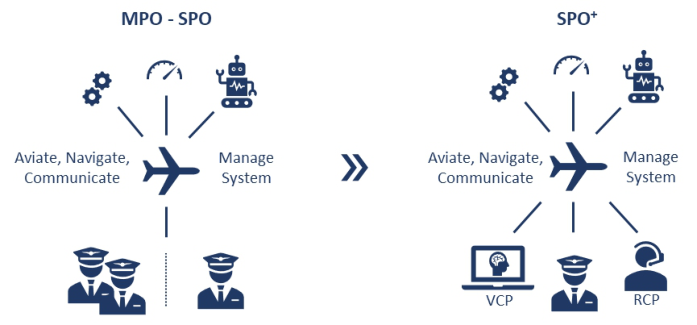
CONCEPT OF A REMOTE CO-PILOT NICo has developed an enhanced concept for remote pilots, featuring future single-pilot operation. NICo intends to investigate enhanced, robust automation and onboard support provided by a VCP on the one hand and on-demand support by an RCP on the other in order to develop new and improved functions to investigate the feasibility of future SPO (see Figure 1).
Figure 1: Envisioning future SPO with enhanced, robust automation and onboard support by a VCP as well as on-demand support provided by an RCP.
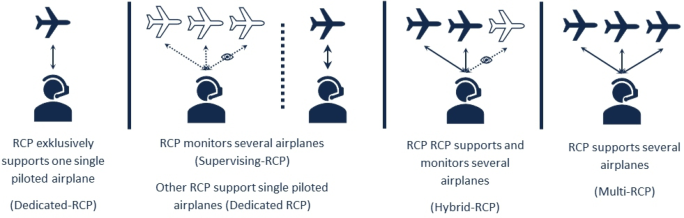
The concept differentiates four different types of roles for an RCP: dedi- cated, supervising, hybrid and multi. The dedicated role means that an RCP exclusively supports only one single pilot. By contrast, an RCP may supervise and monitor one or more single-piloted airplanes as a supervising RCP. If direct support is necessary, the concept foresees a handover of the previously supervised airplane from a supervising RCP to a dedicated RCP. The concept defines two additional roles: the multi role, in which an RCP manages several single-piloted airplanes, and the hybrid role, which is an intermediate mix of the supervising and the multi role (see Figure 2).
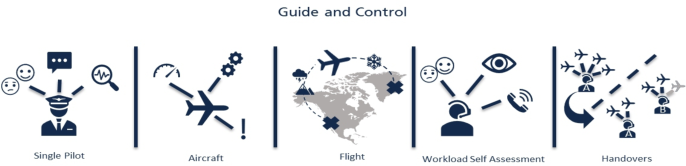
In addition, the concept includes four levels of support: Level 0: Normal operation, addressed by a supervising RCP Level 1: Intensive monitoring and light support by a hybrid RCP Level 2: Light support of several single-piloted airplanes by a multi RCP Level 3: Exclusive support by a dedicated RCP The support provided by an RCP includes certain main tasks, including supervision of the flight path and mission, the state of the airplane and the pilot state. If a single pilot requests or requires direct support, an RCP will support the single pilot accor- dingly, for example in cases of demanding situations, technical problems or
Figure 2: Roles of an RCP, illustrating different ways of supporting single-piloted airplanes.
Development Process for a Remote Co-Pilot to Support Single-Pilot Operation 7
Figure 3: Tasks of an RCP related to the support and management of single-piloted airplanes.
emergencies. The concept also covers the distribution and handover of the supported airplanes (see Figure 3).
Thus, an appropriate working place and control station that would enable an RCP to perform their job must display the different relevant information, for example information related to the mission and environment, the state of airplane and the single pilot. The working place must also provide proper communication equipment and features for communication with the single pilot, air traffic controllers and the airline.
Finally, the RCP working place must allow the management of several airplanes, including handovers and the starts and ends of service.
UI DESIGN FOR AN RCP GROUND CONTROL STATION The characteristics of a remote co-pilot workstation are situated among those of an actual cockpit, the workstation of an air traffic controller and the control center of a drone operator with an extended information display.
The NICo project has determined that direct duplication of a modern cock- pit cannot be successful. Modern cockpits are mainly based on the previous generation. This condition is due to the limited space in the aircraft on the one hand; on the other hand, manufacturers attempt to keep transition costs from one model to the next as low as possible. Within an aircraft family, pilots should be able to fly the new aircraft safely and efficiently after a short trai- ning period. Nevertheless, cockpits have undergone several changes in recent years. The switch from analog circular instruments to digital displays was a major step toward combining and integrating information, making it possi- ble to extend beyond the mere display of information and provide tailored recommendations for action in the cockpit. In the generations that followed, the displays in the cockpit became increasingly larger in size. In addition to classic operation using buttons and softkeys, operation via touch screens has now become available. However, even the most advanced designs must consider the limited space in the cockpit. In addition, they must be easy to use at all times, even in conditions of turbulence or poor lighting. A remote co-pilot workstation on the ground does not face these limitations. Lighting and climate conditions can be kept constant, and display surfaces and input concepts can be optimized for the tasks at hand.
The concepts developed by NICo for the remote co-pilot, the remote co- pilot center, and the division of work between the single pilot and the remote
co-pilot were evaluated at the beginning of the design process, and the fra- mework for further developments was established. The paper by Findeisen (Findeisen et al., 2023) describes these design developments in detail. Modern cockpits tend to display all information at all times; however, the opposite approach was chosen in the NICo project. Only minimal information and highly simplified representations were selected and transferred into the ove- rall concept. In workshops with pilots, flight missions and tasks of the RCP were tested against different design concepts. Areas that could be fully utili- zed despite the reduction in information or detail were identified; other areas showed the need for more detail. An additive approach proved to be appro- priate for this particular project. Pilots are used to having all information in view at all times. This information density was to be opened in the project. Using modern data analysis, this information processing can be transferred back from the human to a machine. The issues of “trust in automation” and “human–machine teaming” quickly begin to play important roles.
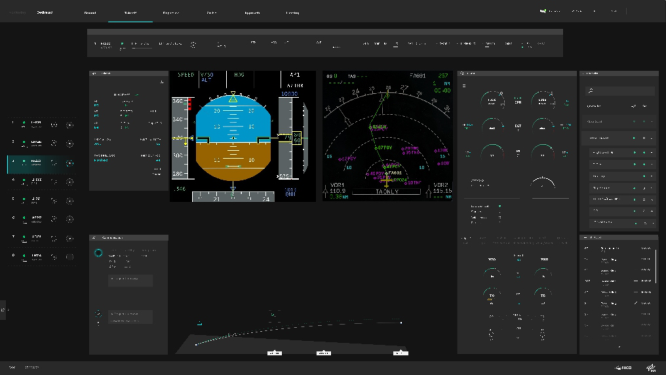
To implement the main tasks of the RCP, the HMI can be divided into two main views. Monitoring views allow the RCP to monitor multiple aircraft simultaneously and prepare information for the SP. Dedicated views display flight-phase-specific content and allow direct task sharing between the RCP and the SP.
For simultaneous monitoring of multiple aircraft, the monitoring views provide a holistic impression of the current status of flights and aircraft.
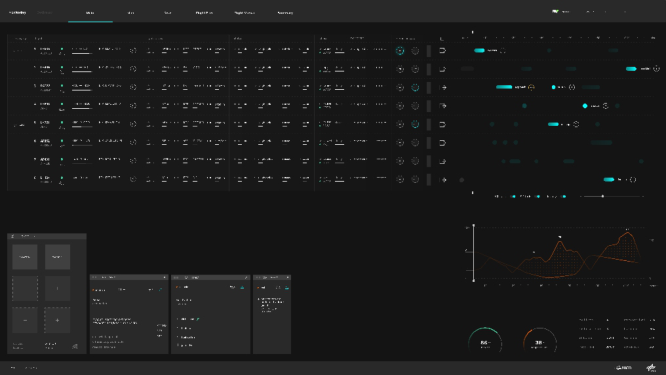
Figure 4 shows the main page of the monitoring view, which displays infor- mation regarding all aircraft under the RCP’s responsibility in tabular form. If a status changes, the RCP is notified and the new situation can be viewed and evaluated.
Based on the evaluation the RCP can initiate possible actions. The other pages of the monitoring views allow the user to view, for example, cur- rent weather conditions and possible risks along the planned flight path.
Development Process for a Remote Co-Pilot to Support Single-Pilot Operation 9
Processed information from multiple data sources provides significant added value for the safe execution of the flight. For the monitoring views, the HMI has been optimized to contain a large amount of diverse information to ensure efficient and safe operation of the RCP.
To support an SP directly during high workloads, the flight-phase-specific dedicated views include cockpit-like information displays that enable active task sharing between the RCP and the SP (see Figure 5). For consistent situ- ational awareness, the relevant displays in the aircraft cockpit have been integrated into the RCP-HMI.
Supplementary information helps the RCP to quickly build a complete picture of the aircraft, even in time-critical situations. In this direct support of the SP, the HMI is primarily focused on direct communication between the RCP and the SP and on providing the fastest and most comprehensive overview of any anomaly.
CONCLUSION
Single-pilot operation is a highly controversial and sometimes emotional topic of discussion among stakeholders. As an independent research project, NICo aims to provide a neutral and holistic assessment of what issues are involved. The current development process of the remote co-pilot concept has clearly shown that early and direct participation of all stakeholders is essen- tial. At the same time, it has become clear that approaches that break with the common standards will face difficulties in the aviation industry. Howe- ver, to develop the next generation of air transportation systems and achieve significant positive changes in aviation, these approaches are necessary. Sim- ply optimizing existing technologies will not enable generational change. The aviation research community should be encouraged to explore unconventi- onal approaches and to investigate new ideas. Open communication at an
early stage, especially with pilots, is essential. The most vocal critics have been invited especially to the project. For further single-pilot research, it is recommended to bring together critics and those who are already successfully performing SPO. In the case of NICo, an open and moderated dialog betw- een airline pilot representatives and SP pilots from military aviation could be beneficial. It needs to be clear that the focus is on evaluation of these concepts and ideas in a scientifically neutral way. Maintaining or improving safety at its current high level must always be the goal of these developments. Further research into SPO and RCPs must be conducted with an open mind.
The collaboration between industrial designers and aerospace researchers has been a great success. A high level of understanding of the system from the research side has been successfully integrated into the design process. A strong basis for further cooperation has been provided by combined develo- pment based on novel approaches, agile design concepts and known elements from the cockpit. An unbiased approach from design to project has allowed transformation processes to occur in legacy concepts and standards. In the development process, an additive approach has been chosen. The amount of information and functionality has been drastically reduced, and only those elements felt to be missing have been added. The reduced design achieved in this way has opened new possibilities for further development. The next step will be to validate the current results through pilot projects.
OUTLOOK The RCP station will be further developed and tested against the key scena- rios identified in the NICo project. Testing with pilots in the DLR simulator is planned for 2023. The goal is to verify whether the chosen compression of information can allow safe flight. In addition, support in case of in-flight emergencies will be tested. In parallel, research regarding the RCP-center concept is already underway.
The use of multiple remote co-pilots raises questions about the division of labor, load balancing between RCPs and handover procedures. Future results will be evaluated and discussed with pilots on a semi-annual basis in the NICo project.
The lessons learned from the development process of a remote co-pilot to support single-pilot operations in a next-generation air traffic system will be incorporated into other research projects as well. At the end of the NICo project, the results will be demonstrated in flights and tested for use in real- world conditions.
REFERENCES
EASA (2020a). Certification Specifications for Normal-Category Aeroplanes (CS- 23), https://www.easa.europa.eu/certification-specifications/cs-23-normal-utility -aerobatic-and-commuter-aeroplanes. EASA (2020b). Certification Specifications and Acceptable Means of Compliance for
Large Aeroplanes (CS-25), https://www.easa.europa.eu/certification-specification s/cs-25-large-aeroplanes.
Development Process for a Remote Co-Pilot to Support Single-Pilot Operation 11
EASA (2020c). Part-FCL, https://www.easa.europa.eu/sites/default/files/dfu/Easy_Ac cess_Rules_for_Part-FCL-Aug20.pdf. EASA (2021). Easy Access Rules for Air Operations, https://www.easa.europa.eu/d
ocument-library/easy-access-rules/easy-access-rules-air-operations. FAA (2004). 22.01.2004 - AC Crew Resource Management Training. FAA (2015). SAFO15011: Roles and Responsibilities for Pilot Flying (PF) and Pilot Monitoring (PM). Findeisen M. et al., (2023). User-centered design process for a high-risk future
aerospace system. AHFE 2023. Lim Y, et al., (2017). Commercial airline single-pilot operations: System design and pathways to certification. IEEE Aerosp. Electron. Syst. Mag. 32:4–21. doi:10.1109/MAES.2017.160175. Wolter CA, Gore BF (2015). A Validated Task Analysis of the Single Pilot Operations
Concept. Moffet Field, California. Zinn F. et al., (2023). Lecture Notes in Artificial Intelligence (LNAI) Electronic ISSN: 2945-9141, Print ISSN: 2945-9133.
LISTED IN THE AHFE DIGITAL BOOKSTORE CATALOGUE
Explore the complete digital volume
Human-Centered Aerospace Systems and Sustainability Applications
Read this individual research paper free through the original publisher, or explore the full digital proceedings book.
ISBN 978-1-958651-74-2
Explore this ISBN in the AHFE Bookstore ↗Listed in the July 2026 bookstore catalogue; search by ISBN to confirm current availability · Digital book purchase optional