Jessica Sanchez Russi, Jeff Feng (2023). An ergonomic and design review of the Lunar Terrain Vehicle. In: Human-Centered Aerospace Systems and Sustainability Applications. AHFE Open Access, vol. 98, pp. 23–31. https://doi.org/10.54941/ahfe1003916
Through a literature study, this paper examines the lunar rover ergonomics and design from an industrial design perspective, considering the history of the lunar rover, the astronauts' experience, human factors, sustainability, and rising industry standards.By analyzing the upcoming missions, the terrain, and previous rovers, this paper identifies a set of criteria and proposes a concept for the seating design of the next-generation lunar terrain vehicles, focusing only on unpressurized vehicles.The Lunar Terrain Vehicle requires a human-center design process and an understanding of the astronauts' critical needs during the operation. The seating needs to accommodate the suited astronauts, restrain the astronauts without interfering with their mobility, and provide stability during the traverse. The industry expects the new vehicles to last in extreme environments for many years; the new design must be lightweight, durable, and practical.Despite being subject to change by many influencing factors out of the designer's control, this paper presents a unique process emphasizing the ergonomics and usability of the astronaut that can serve as a guideline for future lunar rovers for exploration and commercial purposes. The proposed design concept provides safety and comfort to the astronauts during the EVAs while accommodating the environmental requirements.The industrial design perspective in this study highlights the benefits of a multi-disciplinary approach in the space industry. Beyond exploration, the human space flight endeavor demands more than functionality. The future of spaceflight is sustainable, safe, and more human-centered than ever.
Space exploration has been the mission of NASA since 1958. In recent years, NASA and the rest of the space industry objectives progressed toward long- duration missions. NASA’s first step for deep spaceflight is to return to the Moon. Long-term goals include a permanent base camp. To aid in the initial phase, NASA needs a Lunar Terrain Vehicle (LTV) to extend exploration beyond the astronauts’ ability to walk, scout the site before them, and store and transport samples (Erin Mahoney, 2020). Approaching this subject from the perspective of different fields would benefit the development of the new generation of LTVs. This paper analyzes the lunar rover from the stance of industrial design and presents the characteristics that future exploration and commercial lunar rovers must deliver.
THE MOON For a successful mission and a better understanding of design requirements, it is necessary to know the environment. The focus of this paper is a Lunar Ter- rain Vehicle. Therefore, it is essential to understand the Moon. It is the Earth’s only natural satellite, 238,855 miles away from Earth, has 0.166 of Earth’s gravity, and the temperatures range from −414 to 253 degrees Fahrenheit. From Earth, humans can distinguish the light and dark areas on the Moon. The light areas are the highlands, and the dark ones, called maria, are impact basins. These create treacherous uneven terrain and challenging visibility in some sites. The almost non-existent atmosphere does not protect the surface or humans from impacts or solar radiation. The lunar regolith is tiny, sharp charcoal-gray dust and rocky debris that covers the lunar surface almost enti- rely (NASA’s Jet Propulsion Laboratory, 2023). The lunar regolith is a health hazard for astronauts and harm suits, vehicles, and other equipment.
APOLLO AND ARTEMIS The Apollo program went from 1963, successfully landing humans on the Moon in 1969, until 1972. Fifty years later, NASA has a new program with the goal of going back. The Artemis program intends three missions. Artemis I launched without a crew on November 15th, 2022. Its objective was to orbit the Moon and go back to Earth. As of now, Artemis I is still on its mission. If successful, Artemis II will follow a similar trajectory, but this time with a crew. Artemis II will launch in 2024. Following, Artemis III will launch in 2025, and this time NASA plans to land the first woman and the next man on the Moon (NASA, 2020).
For the Artemis missions, NASA identified 13 possible landing sites. All the locations are within 6 degrees of latitude of the lunar south pole and are geo- logically diverse. The criteria for these selected sites include the availability of sunlight, permanently shadowed regions (PSRs), ease of communication with Earth, data of resources, and terrain suitability (SSERVI, 2022).
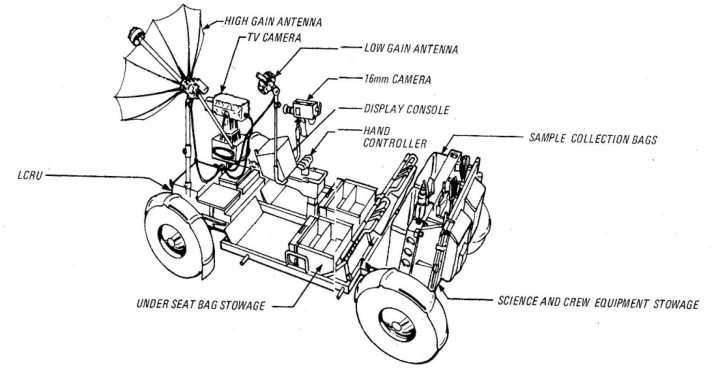
THE LUNAR ROVING VEHICLE During the Apollo era, engineers started researching lunar surface vehicles. Despite successfully landing humans on the Moon, exploration was minimal on foot. In 1969, the Marshall Space Flight Center took on designing, deve- loping, and testing the Lunar Roving Vehicle (LRV) for the Apollo missions. In 1970, Boeing started working on the LRV along with General Motors and other subcontractors. In 1971, Boeing delivered the first model to the Ken- nedy Space Center. The rover was reviewed, folded inside the lunar module of the Apollo 15 spacecraft, carried, and deployed on the Moon (Figure 1). The rovers that served in the Apollo mission carried two astronauts. They were about 10 feet, 2 inches long, 44 inches high, and weighed about 450 pounds. Despite minor errors, it performed successfully (Mike Wright and Bob Jaques, 2002).
The rover had the instrumentation panel and the T-handle joystick in the center, between the two seated astronauts, for easy access. The joystick handle
An Ergonomic and Design Review of the Lunar Terrain Vehicle 25
Figure 1: Lunar roving vehicle (Boeing, 1972).
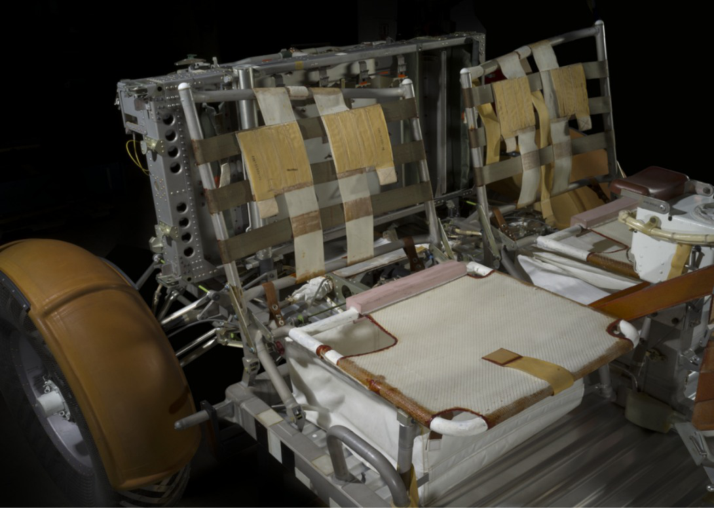
had the spacesuit gloves into consideration; it was sized and shaped accor- dingly, and it handled all vehicle motion control. The seating design consisted of aluminum tubing and nylon webbing with a Velcro Strip that secured the astronauts’ Portable Life Support System (PLSS). The lightweight seating design included interior and exterior handholds and a seat belt (Figure 3) (Chauhan et al., no date).
This design and the astronauts’ experience during the subsequent Apollo missions are the grounds for the lunar and Mars vehicles that followed. Despite the engineering marvel of the Apollo rovers, this paper will discuss the lessons learned and the opportunities for design improvement for future lunar rovers.
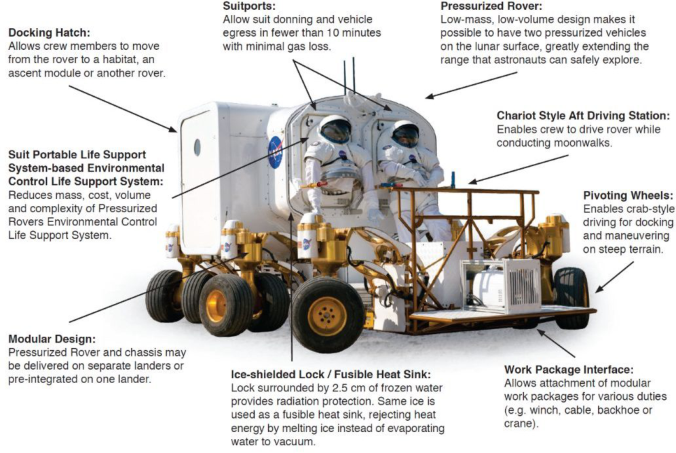
THE LUNAR ELECTRIC ROVER Even though human spaceflight missions to the Moon stopped after 1972, during the fifty-year gap, NASA kept exploring vehicle designs. One of the main concepts is the Lunar Electric Rover (LER). The initial concept is over twelve years old. It is a pressurized cabin module that holds two astronauts for up to thirty days. It counts with a suitport, an attachment on the vehi- cle for easier ingress and egress. The suitport keeps the inside dust-free and reduces air loss inside the cabin (Figure 2). The ease of use for the astro- nauts can serve as a guideline for the design of the LTV. According to NASA’s social media, just last November, during the Desert Research and Technology Studies (D-RATS), NASA and Japan Aerospace Exploration Agency joined to test the latest model of pressurized rover operations for future Artemis missions. However, for this study, the focus is on unpressurized vehicles only.
THE LUNAR TERRAIN VEHICLE For Artemis III, NASA expects to land the crew and an unpressurized LTV on the Moon. The agency launched a request for information (RFI), where
26 Sanchez Russi and Feng
Figure 2: The small pressurized rover concept characteristics (NASA, 2008).Figure 3: Lunar roving vehicle seating (National air and space museum, no date).
they list the LTV requirements. The new LTV needs to support two suited Astronauts who will be able to drive it. However, it also must be remotely operated from Earth and count on autonomous features for safety and com- munications. It should be able to traverse through Lunar terrain and slopes,
An Ergonomic and Design Review of the Lunar Terrain Vehicle 27
20km without recharging, operate continuously for 8 hours or 2 hours when inside PSR + 2 outside, communicate and exchange data, reach a top speed of 15km/hr., and serve for ten years or more, and be easily maintained. The LTV needs to overcome challenges like the extreme environmental conditions of the Moon, including the extreme temperature ranges, the lunar regolith, and the radiation (Advanced Exploration Systems Division and Human Explora- tion and Operations Mission Directorate, 2020). Beyond technical needs, the LTV will also need to accommodate the needs of the suited astronauts. The designer should understand their experience and their challenges. Therefore, it will require a human-center design solution.
Besides NASA, commercial contractors have been very involved in deve- loping lunar rovers. The RFI opened to American organizations, and almost every major vehicle company is developing a rover. The Lunar Mobility Veh- icle by General Motors and Lockheed Martin is the best known until now. Their team has been very open about their concept (Evan Orensten, 2022). Their progress and some of their design decisions are part of the discussions in this paper.
THE ASTRONAUT EXPERIENCE Astronauts go to space with the bare minimum for survival and enough ame- nities for sanity and productivity. Most of the studies on their well-being have been inside the ISS and pressurized vehicles. The main design issues usually concern the domains of habitat, human factors, and physical and mental health (Alexander and Bannova, 2021).
There is little research about astronauts’ extravehicular activities (EVAs). During EVAs, astronauts expose themselves to extreme conditions, solar radi- ation, and space debris. The known facts about their experience are mostly medical hazards and injuries caused by the suit and the tools. Throughout an EVA, astronauts can do multiple tasks that Haney et al. categorized into four types: Engineering, operational, scientific, and traverse. Engineering- type activities require mechanical or physical labor; operational tasks are transitional and descriptive; scientific activities involve geology, sample col- lection, or photography; traverse is mainly driving (Haney and Graff, 2020). Astronauts can perform some or all actions while interacting with the rover. These activities can be simultaneous, but due to the restrictive nature of the EVA suits, astronauts will prioritize one task at a time. These activities are critical for the design and development of a new LTV. EVAs will influence the astronauts’ experience and behavior with the LTV, consequently, the LTV requirements and layout.
THE EVA SUIT After many years of investing in the development of EVA suits, NASA deci- ded to outsource the project and partnered with Axiom space and Collins Aerospace. Similarly to the LTV, NASA experts provided the technical and safety requirements for the chosen companies to follow.
28 Sanchez Russi and Feng
“The commercial partners will be responsible for design, development, qualification, certification, and production of spacesuits and support equi- pment to enable space station and Artemis missions”(Gerelle Dodson, 2022). So far, neither partner has officially published any progress on the design. However, the EVA suit specifications will be necessary for LTV design considerations.
LESSONS LEARNED This paper examines the narrative and commentary from the Apollo missi- ons to understand the LTV driver experience and their requirements. After reviewing the lessons learned from Apollo 15 and Apollo 16, four main pro- blems were identified and studied from an industrial design perspective: The console, the seating, the seatbelts, and the ingress and ingress (NASA, 2022a).
The LRV instrumentation panel did not have screens or digital displays. After 50 years of technological advancements, the LTV will have a new arran- gement for easier access and better visualization. The console design includes the re-evaluation of the interface, the controls, and the displays. The LTV speed, the astronauts’ experiences, and the bulky gloves are critical concerns for the console design, development, and testing. David Scott spoke about his experience. “Could not even look at the instrument panel. You had to consci- ously focus on where you were going and what you were doing because the surface was so irregular, and things happened so quickly even at 8 km/h”(qtd. in Teasel Muir-Harmony, 2021). His commentary could direct the design team towards using AI and voice-activated commands.
Furthermore, another common complaint was that the seatbelts were too tight and uncomfortable. Despite that, the restraints did not provide the sen- sation of safety. “Jim Irwin, who rode shotgun in the Apollo 15 rover, likened it to a bucking bronco and to a small boat in choppy seas. Apollo 16’s Charlie Duke told me it was squirrely, and fishtailed like a car on an icy road. All of the crews professed thanks for their seat belts”(qtd. in Teasel Muir-Harmony, 2021). The LRV comprised handles, foot restraints, and other mobility aids. Besides facilitating the ingress and egress of the vehicle, they can provide a sense of security. These attachments will need to adjust to the LTV design accordingly. These design issues can assess features like adjustability and automatization. The seatbelts need to restrain the astronauts safely without interfering with their range of motion. For better support and easier reach, the design needs to explore the use of an armrest, headrest, and proper space for the PLSS.
These design issues overlap with each other, and design choices of one topic will affect the others. However, this study focuses on one: Seating design.
SEATING DESIGN Despite performing incredibly well during the Apollo missions, the LRV seating design was inadequate. The seats looked like old patio chairs, the PLSS accommodation was not accommodating, and even though it carried
An Ergonomic and Design Review of the Lunar Terrain Vehicle 29
the astronauts, the video footage shows an astronaut without proper sup- port. Understandably, some design decisions prioritized lightweight seats over durability and quality. NASA meant the LRVs to be single-mission rovers.
For Artemis, the seating must remain lightweight and endure a minimum of ten years in the lunar environment. A challenge that 50 years ago was not easily doable. In 2013, the automotive industry realized they could mass- manufacture lighter seats. The development of composite materials had a marked impact on the industry and seating design. The most significant adva- ncement since the Apollo missions is carbon fiber materials. These materials provide steel-like strength and performance but at a much lower weight (Paw- sey, 2015). Now there is titanium, carbon fiber, and reflective paint (Evan Orensten, 2022).
Naito et al., evaluate different material properties for space radiation protection. They concluded that “composite materials such as carbon fiber, reinforced plastic, and SiC composite plastic have shielding effectiveness of 1.9 times greater than aluminum”. Besides the standard automotive mate- rials, there are ongoing investigations into materials, smart fabrics, and protective coatings.
Moreover, Chauhan et al. evaluated the LRV cockpit design for better ergo- nomics. Their study contrasted the upright, seating, and reclined postures during a lunar rover ride. The study concluded that the elevated posture bene- fits the ingress and egress of the vehicle, the seated posture is good enough and tested already, and the reclined posture is better for stability. They also notice that the reclined posture reduces visibility and work/reach envelope. Nevertheless, by adjusting the design of the rest of the LTV, the designer can overcome these challenges. Chauhan et al. suggest that more research is necessary for a better solution. However, based on their findings, a viable option is an adjustable seat. An adjustable seat can allow the astronaut to ingress, secure, and accommodate in an upright position. Then the astronaut can adjust the seat to their seated or reclined position for better stability and comfort while driving.
NASA GUIDELINES NASA Human Systems Integration (Witt, 2015), The Human Integration Design Handbook (NASA, 2014), and the NASA spaceflight human-system standard (Volume 2) (NASA, 2022b) are only a few sources that provide numerous human factors and EVA guidelines that will conduct the design, development, and testing of the LTV.
CONCLUSION
From the posture of industrial design, this paper highlights the critical aspects the space industry demands when developing a new Lunar Terrain Vehi- cle. And it offers fundamental questions to answer during the research and ideation process.
The structure, materials, and functionality must stand extreme tempera- tures, the lunar regolith, and radiation. How can the layout and form be
30 Sanchez Russi and Feng
optimized for safety? What materials can withstand the environment? What limitations does technology have under these conditions?
A successful LTV will consider the EVA-suited astronaut in every aspect, from their work to ergonomics, safety, and comfort. What is the rover- astronaut interaction? What will the LTV need to support their work? How can they safely drive it? How can the LTV provide a sense of safety during EVAs? Will the astronaut be seated? How can they easily handle the rover? Who has control of the rover? Can they easily adjust the rover to fit their needs?
Moreover, the finalized suit will add to the list of questions and presumably develop adaptations of the ideal LTV. It will alter anthropomorphic data, the design for the PLSS support, and other factors like the envelope and reach. Although the expectations of the new EVA suits are more range of motion and lightweight, the suit will still limit natural body movement. What measu- rements need to be adjusted? How to best support the PLSS? Can the gloved hand of the astronaut handle the rover controls? Do they require any extra support or constraints?
With the answer to these questions, a designer can formalize a concept and ideate accordingly. Ideally, this process will provide a successful design that guarantees safety and comfort during EVAs. However, these aspects should not be forgotten and must continue to be part of the process and development. They also should be answered by every party involved. Proper research and the collaboration of different perspectives will result in a successful LTV.
The disciplines already highly involved in the space industry can profit immensely from collaborating with other fields. The industrial design perspe- ctive in this study aims to highlight this benefit. The future of space demands more than a good performance. The approaching industry requires human space flight to be sustainable, inclusive, secure, and more human-centered than ever.
ACKNOWLEDGMENT
The authors would like to acknowledge the support provided by Dr. Gordon Voss and the Department of Industrial Design at Gerald D. Hines College of Architecture and Design.
REFERENCES
Advanced Exploration Systems Division and Human Exploration and Operations Mission Directorate (2020) Lunar Terrain Vehicle (LTV) Request for Information. Washington D. C. Alexander, S. and Bannova, O. (2021) ‘University based interdisciplinary space
lab: Designing for astronaut health and wellbeing’, Acta Astronautica, 186, pp. 382–395. Available at: https://doi.org/10.1016/j.actaastro.2021.05.043. Boeing (1972) Lunar Roving Vehicle. Chauhan, S. et al., (no date) Lunar Roving Vehicle Cockpit Layout to Optimize Ergonomics.
An Ergonomic and Design Review of the Lunar Terrain Vehicle 31
Erin Mahoney (2020) NASA to Industry: Send Ideas for Lunar Rovers. Available at: https://www.nasa.gov/feature/nasa-to-industry-send-ideas-for-lunar-rover s (Accessed: 24 February 2023). Evan Orensten (2022) Behind the Scenes of General Motors and Lockheed Martin’s
Lunar Rover., Cool Hunting. Available at: https://coolhunting.com/tech/behind- the-scenes-of-general-motors-and-lockheed-martins-lunar-rover/ (Accessed: 24 February 2023). Gerelle Dodson (2022) NASA Partners with Industry for New Spacewalking, Moonwalking Services, NASA. Available at: https://www.nasa.gov/press-release/nasa- partners-with-industry-for-new-spacewalking-moonwalking-services (Accessed: 24 February 2023). Haney, N. C. and Graff, T. G. (2020) ‘APOLLO 17 EVA-1 AND EVA-2 TASK
DECOMPOSITION: PLANNING FOR ARTEMIS AND FUTURE MARS MIS- SIONS’, in. Available at: https://ntrs.nasa.gov/citations/20200001774 (Accessed: 24 February 2023). Mike Wright and Bob Jaques (2002) A Brief History of the Lunar Roving Vehicle.
Huntsville, Alabama. Available at: http://history.msfc.nasa.gov. Naito, M. et al., (2020) ‘Investigation of shielding material properties for effective space radiation protection’, Life Sciences in Space Research, 26, pp. 69–76. Available at: https://doi.org/10.1016/j.lssr.2020.05.001. NASA (2008) ‘Small Pressurized Rover Concept’. Available at: https://www.nasa.g
ov/pdf/284669main_spr_factsheet_web.pdf (Accessed: 24 February 2023). NASA (2014) HUMAN INTEGRATION DESIGN HANDBOOK (HIDH). Available at: https://www.nasa.gov/sites/default/files/atoms/files/human_integration_d esign_handbook_revision_1.pdf (Accessed: 19 November 2022). NASA (2020) Artemis. Available at: https://www.nasa.gov/specials/artemis/ (Acces-
sed: 24 February 2023). NASA (2022a) LRV and UPR Lessons Learned Matrix. Available at: https://airandspace.si.edu/stories/editorial/apollo-15-and-lunar-roving-vehic le-interview-earl-swift (Accessed: 24 February 2023). NASA (2022b) NASA SPACEFLIGHT HUMAN-SYSTEM STANDARD VOLUME 2: HUMAN FACTORS, HABITABILITY, AND ENVIRONMENTAL HEALTH. NASA’s Jet Propulsion Laboratory (2023) Earth’s Moon. Available at: https://solars
ystem.nasa.gov/moons/earths-moon/in-depth/ (Accessed: 24 February 2023). National Air and Space Museum (no date) Lunar Roving Vehicle, National Air and Space Museum. Available at: https://airandspace.si.edu/multimedia-gallery/nasm 2020-00056-sjpg (Accessed: 24 February 2023). Pawsey, C. (2015) ‘Lightweight Automotive Seating Structures-Concepts and Chal-
lenges’, Automotive IQ, International Quality & Productivity Center [Preprint]. SSERVI (2022) Map of the Artemis Regions from Moon Trek. Available at: https:// sservi.nasa.gov/articles/map-of-the-artemis-regions-from-moon-trek/ (Accessed: 24 February 2023). Teasel Muir-Harmony (2021) Apollo 15 and the Lunar Roving Vehicle: An
Interview with Earl Swift, National Air and Space Museum. Available at: https://airandspace.si.edu/stories/editorial/apollo-15-and-lunar-roving-vehicle -interview-earl-swift (Accessed: 24 February 2023). Witt, E. (2015) Human Systems Integration (HSI) Practitioner’s Guide. Available at: http://www.sti.nasa.gov.
LISTED IN THE AHFE DIGITAL BOOKSTORE CATALOGUE
Explore the complete digital volume
Human-Centered Aerospace Systems and Sustainability Applications
Read this individual research paper free through the original publisher, or explore the full digital proceedings book.
ISBN 978-1-958651-74-2
Explore this ISBN in the AHFE Bookstore ↗Listed in the July 2026 bookstore catalogue; search by ISBN to confirm current availability · Digital book purchase optional