Hannah Ritchie, Min Kang, Jeff Feng, Elham Morshedzadeh, Jose Luis Contreras-vidal, Shantanu Sarkar, Aime Judith Aguilar Herrera, Paige Willson (2025). Designing Adaptive Wearables for Children With Cerebral Palsy: A Holistic Approach to Lifestyle-Centric. In: Interdisciplinary Practice in Industrial Design. AHFE Open Access, vol. 183, pp. 111–120. https://doi.org/10.54941/ahfe1006432
Cerebral Palsy (CP) is a lifelong neuromuscular condition requiring continuous physical assistance to manage symptoms, improve mobility, and enhance quality of life. While many passive and active exoskeleton technology advancements have shown promise, few solutions are tailored to meet the unique needs of children with CP. The Gross Motor Function Classification System (GMFCS) categorizes the functional ability of individuals with CP into five levels, ranging from level 1 (full mobility with some difficulties) to level 5 (limited independent mobility). Many assistive devices serve the needs of those with higher GMFCS levels (4-5), but children with GMFCS levels 1 to 3 have limited access to appropriate assistance. This study aims to identify the key factors that drive the design of a rehabilitative, assistive, and diagnostic wearable tailored to integrate into the daily lives of children with CP, GMFCS levels 1-3. A comprehensive literature review, interviews with physical and occupational therapists, and ethnographic research provided insights into the key factors influencing children with CP’s experiences in their daily lives. This collaborative and innovative study between industrial design and engineering programs have led to identifying the required technological and functional components that will bridge the gap between theory and practice in a holistic exoskeleton design approach. Finally, a series of prototypes initiated the first phase of concept generation, which explores the impact of aforementioned factors into an adaptive lifestyle-centered soft-suit that integrates seamlessly into children with CP’s lives. The final prototype is currently undergoing user and functional testing and development. Future implications of this work emphasize user-centered design, calling for the involvement of children and parents as stakeholders in the design process. As exoskeletons become more available in-home settings beyond clinical applications, it is essential to understand and meet children's physical, emotional, social, and mental needs with CP GMFCS levels 1-3 to create meaningful, lifestyle-aware solutions.
Cerebral palsy (CP), the most common physical disability among children, affects one in 343 individuals (Cerebral Palsy Guide, 2023). Its symptoms— spasticity, abnormal muscle tone, and motor control issues—require continuous management. Early intervention is essential, as therapies can leverage the plasticity of the childhood brain to rewire neural pathways and improve mobility (Novak et al., 2017). Beyond physical challenges, CP impacts broader aspects of development. Friendships formed in childhood influence long-term well-being, identity formation begins as early as age three, and early lifestyle habits can shape habitual behaviors in adulthood (Lioret et al., 2020). Interventions must therefore address physical, social, and emotional needs. Exoskeletons and robotic wearables have emerged as promising rehabilitative tools, offering powered assistance for mobility and muscle activation. Designs such as Lerner et al.’s exoskeleton for crouch gait and soft wearables like Exopulse explore artificial muscles and electrical stimulation to aid therapy (Lerner & Damiano, 2017; Pennati et al., 2021). These devices primarily serve clinical settings or adult users, leaving children with moderate mobility challenges (GMFCS levels 1–3) underserved. These children often rely on gait trainers, crutches, or wheelchairs, which can hinder muscle development, restrict movement, and limit play. Without adequate support, fatigue and reduced participation in daily activities are common (Lauruschkus et al., 2015). Assistive devices typically prioritize physical rehabilitation, often overlooking their integration into children’s social and daily lives. Wilkinson highlights how clothing influences self-perception and social dynamics, mediating identity and connection (2019). For children with disabilities, clothing can either conceal or emphasize their condition, depending on personal preferences. A garment integrating the rehabilitative potential of exoskeletons with the adaptability of clothing could empower children to navigate physical challenges and express personal identity on their own terms. This study aims to identify and implement key factors that will shape a rehabilitative, assistive, and diagnostic garment into a lifestyle-aware medical solution for children with CP, GMFCS levels 1–3.
METHODOLOGY
A mixed-methods approach, including case studies, expert interviews, ethnographic research, and iterative prototyping, explores the key factors driving the design of an adaptive, lifestyle-aware, exoskeleton for children with cerebral palsy (GMFCS levels 1–3). This study was structured in four key phases: literature review and background research, and healthcare professional interview and participatory design. The interview and participatory sessions with providers and pediatric physical and occupational therapists was essential in understanding the key factors and initial concept generation during early stage of design process as well as informed decision making while developing the prototypes and user testing preparations.
Background research consisted of publicized therapy recommendations, case studies, and some qualitative data from user caregivers or other public CP care community members blogs and personal testimonies, which informed
Designing Adaptive Wearables for Children With Cerebral Palsy 113
therapeutic goals, challenges, and gaps in current assistive solutions for children with CP. The emerging themes from these insights informed the second phase of participatory design: expert matter survey and interviews. Expert feedback sessions with 6 clinicians and therapists (approximately 10 hours) provided critical insights into the general physical, social, and emotional needs of children with CP, as well as practical challenges in implementing assistive devices. Subsequently, responses were sorted into themes to identify important factors for designing an adaptive wearable for children with CP, GMFCS 1–3. Tours of a pediatric rehabilitation center provided insight into current therapy practices and contextual factors shaping device usability. As initial prototypes were developed and refined iteratively, the prototypes were brought to the team engineers to hypothesize ideal comfort, functionality, and practicality. Three design students tried on the concept prototype and provided verbal feedback on the fit and usability of the garment. Ultimately, a physical therapist professional with experience with kids with CP provided their concerns, questions, and feedback on the design. Since this is an agile process of design, testing, and refinement, their feedback will be used in future development as well usability and user testing preparation. This mixed-method approach ensured that the study addressed both technical feasibility and user-centric design. Case studies and ethnographic observations provided real-world context, while expert feedback sessions offered targeted insights into clinical and therapeutic needs. Insights gathered became guidelines for design features and material choice in a series of prototypes, leading to a concept prototype design that addressed the most critical needs expressed through research findings (see Table 1). Iterative prototyping began the initial phases of bridging the gap between research findings and practical application, enabling the future development of a holistic, lifestyle-aware solution for children with CP.
Table 1: Expert insights from physical & occupational pediatric therapists.
Table available in the original PDF paper.
Adjustability Expert 1 “Every child is completely different, even kids with the same diagnosis have different skills and abilities. My goal is maximizing function for each child - I want all my patients to leave therapy a little bit more flexible and strong than when they came.” Expert 2 “Walkers are getting more customizable, which is nice, but it adds to
the weight of the walker. It tires out kids. Fatigue from their assistive devices can hinder these kids’ learning in school. Parents also often have to choose one assistive device - which leads to kids getting more support than they need, slowing improvement. They really need something customizable to their size and ability.” Expert 3 “It would be great to be able to turn one muscle group on, one muscle group off, because the support that a given kid needs changes from day-to-day.” Expert 4 “The earlier gait training starts, the better, but kids grow so fast, its
hard for equipment to keep up.”
Continued
Table 1: Continued Expert 5 “Most kids with CP have custom Ankle/Foot Orthotics (AFOs). It’s not just about what each kid physically needs, but also what their goals are. Being able to change the amount of assistance a child receives from an assistive device is critical.”
Table available in the original PDF paper.
Discretion Expert 1 “These kids already move and look different than their peers - on top of that, gait trainers and assistive devices can draw a lot of unwanted attention.” Expert 2 “Kids ask why they are focusing on something that is so hard for
them. Reaching limits can be really challenging, they say ‘my friend can run and do these things but I can’t.’ That effects their self esteem.” Expert 3 “Kids can be brutal with each other, looking different and using different equipment can be tough.” Expert 4 “If they can, kids will try to hide their condition around their peers,
even if it means tiring themselves out from moving in a way that is incredibly unnatural to them.”
Independence Expert 1 “Sometimes the walking trainer is too supportive - if they have the option to sit, they just sit there, but if you take away support, they can’t stand on their own...you have to find the right things that help them be more independent but doesn’t limit their independence at the same time.” Expert 2 “Kids need the least restrictive device possible in terms of navigating
the external environment. If a kid is trying to open a door at school and they are in a gait trainer, they have to try to reach the door to open it, and sometimes doorways are not even wide enough. Even if their gait is pretty good, kids will opt for a wheelchair becuase assistive devices are too much hassle at school, and without any support, they get fatigued.” Expert 3 “Underused muscle groups grow weak over time. As therapists, we come in and try to retrain the child’s muscle memory, they need to feel what their muscle activity is supposed to feel like...but it would be really helpful if our patients could practice these motions during the week.” Expert 4 “Kids with CP struggle with tense plantar flexors and calf muscles so
they walk on tip toe because the tibialis has been constantly unused, leading to muscle weakness. Humans move in a way that is most energy efficient, but kids with CP learn alternative methods of mobility based on their ability. This causes fatigue and long term negative impacts.” Expert 5 “A holistic solution would be great for improving gait - for instance, if the abs are engaged, it firms up the kids’ extremities - all the muscles impact each other.”
Designing Adaptive Wearables for Children With Cerebral Palsy 115
RESULTS: KEY FACTORS DRIVING MEDICAL EXOSKELETON DESIGN FOR CHILDREN WITH CEREBRAL PALSY This study identifies three key factors influencing the integration of adaptive exoskeletons for children with cerebral palsy (GMFCS levels 1–3) into daily life: discretion, adjustability, and independence adaptability. Therapists, parents, and children prioritize discreet assistive solutions that minimize unwanted attention, allow personal expression, and address social stigma. Current devices, often designed for controlled environments, overlook the social and emotional implications for daily use (Morris et al., 2023). Literature review and expert feedback revealed that parents emphasize the need for devices that integrate seamlessly into each individual lifestyle to ensure social acceptance and practical usability, especially in public settings (Tagore & Turin, 2024; Kenyon et al., 2025).
Adjustability is critical for accommodating varying symptoms, growth, and individual needs. Rehabilitation experts highlight the need for solutions that adapt to individual progress and goals. Existing devices often require frequent adjustments or replacements, which can be costly, time-consuming, and frustrating (Morris et al., 2023). Expert interviews and ethnographic research identified that a flexible, modular solution that allows for customization based on task-specific challenges, like one-sided support or targeted muscle activation, is essential for usability, accessibility and effectiveness.
Fostering independence is crucial for children’s mobility and self-esteem (Olford et al., 2022). Expert feedback identified that supportive devices can potentially limit muscle development and hinder independence during their developmental years, as children can become accustomed to an overreliance on external support (Morris et al., 2023). Garments that support self-dressing and integrate into daily routines are seen as key to reducing reliance on caregivers. Devices also need to accommodate practical daily needs, such as toileting, to ensure they are usable in all contexts without compromising independence.
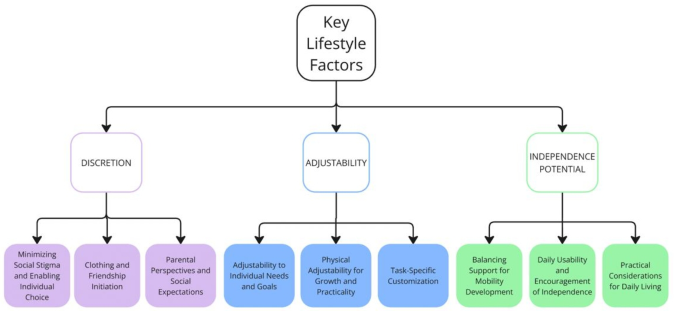
The results underscore that discretion, adjustability, and independence are fundamental considerations when designing an adaptive exoskeleton that integrates into the daily lives of children with CP (see Figure 1). These factors guide the development of socially, psychologically, and practically viable solutions.
DISCUSSION
The iterative prototyping and testing process highlighted how discretion, adjustability, and independence adaptability can shape adaptive exoskeleton design, making it a socially inclusive, practical, and clinically effective solution for children with cerebral palsy (GMFCS levels 1–3). These factors were key in creating the initial concept Myostep prototype, which aims to integrate seamlessly into daily life while addressing both physical and psychological needs.
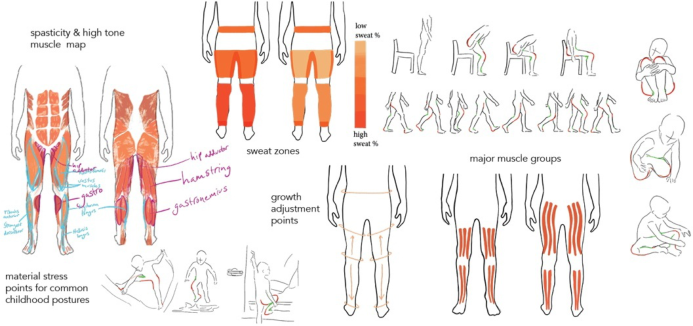
Figure 1: Key lifestyle factors influencing daily life integration.Figure 2: An illustration of the Ideation process, considering lifestyle factors that influenced prototype design: including adjustment points, children’s movement & positioning, muscle activity, and sweat zones.
Discretion The Myostep design aims to prioritize discretion to reduce stigma and promote social inclusion. Consultations and collaborations with material scientists and physical therapists led our team to utilize flexible, lightweight materials and minimize visible components, to allow children to navigate their environment without drawing unnecessary attention. Therapists also emphasized that this approach was essential for encouraging acceptance and consistent use. Additionally, the inclusion of artificial muscles into the garment could offer customizable support by acting as additional muscle power without being visually or audibly disruptive, especially relevant in contexts where noisy movements could draw unwanted attention. Based on expert matter feedback, the Myostep team hypothesized that the integration of these flexible, thin materials will ensure a more comfortable experience during both seated and active postures. Technology advancements identified by the engineer team further reinforced the feasibility of a discreet assistive
Designing Adaptive Wearables for Children With Cerebral Palsy 117
garment. These design features, along with the technology integration, are currently undergoing testing to determine the impact of these material choices.
Adjustability Myostep’s modular design addresses the need to adapt to individual needs. Based on therapist insights, the Myostep team incorporated adjustment points to allow the garment to grow with the child and accommodate diverse symptoms of CP. Fasteners, modular components, and removable sensors could provide customizable support and diagnostic accuracy, as the anatomical positioning of sensors will vary depending on the child. Feedback from physical therapists confirmed that such flexibility not only meets clinical requirements but also enhances usability, allowing caregivers to tailor settings to specific needs. Myostep is a system-focused concept that permits replacement of individual components, empowering children and caregivers to personalize the device and invest in a solution that adjusts with their needs.
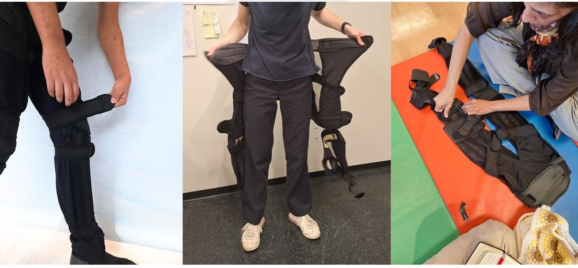
Independence The Myostep design concept focuses on promoting independence through features that provide support while offering opportunities for self-reliance. Expert feedback confirmed that incorporating therapist-guided settings and real-time muscle activation feedback could encourage muscle strengthening and neural retraining. The engineer team identified the sensing technology needed to provide this rehabilitative assistance. The technical components alone, however, will not be as impactful if not designed with the lifestyle and body requirements of children (Aguilar-Herrera et al., 2025). Feedback from student fittings provided insights into the garment prototype’s usability and how a wearable design can accommodate varying body types (see Figure 3). Wrap-style closures and adjustable straps became a key feature to accommodate poor balance and coordination, to allow children to dress with minimal assistance. Future iterations should include visual or tactile indicators to improve understanding of the donning process, as well as simplified attachment points. Kinematic studies and expert feedback revealed the importance of incorporating active and passive support throughout the lower extremities, including support at the waist (Sung & Ha, 2020). For a daily assistive device, this approach enables the child to utilize their full body for movement, minimizing over reliance on a particular muscle group and leveraging the natural efficiency of the human body.
IMPLICATIONS AND FUTURE DIRECTIONS This study emphasizes the value of user-centered design and stakeholder feedback to create effective, practical assistive technologies. The scope and timeline of this study permitted an effort to lay groundwork for future research to further test these principles in real world application. Limitations experienced during this study involve the lack of access to a child with cerebral palsy. Direct input from users, their parents/guardians, and expert
matters throughout the entire prototyping process would have provided invaluable insights into the application of lifestyle factors to a physical design. As part of a long-term research and design project, the key factors identified in this study informed the initial prototypes generated, which would be developed further in the next stage of user testing and usability assessment with healthy subjects in summer 2025. This comprehensive assessment includes both design and user-centric point of view (garment’s improvement of the three key factors identified in this study) as well as functional engineering aspects. Nevertheless, this study identified the high value that stakeholders place on adaptive solutions that consider lifestyle factors. Such solutions, though invaluable for daily use, can also benefit clinical environments as therapists can provide children with more realistic preparation for navigating their daily activities. Future research should further investigate how lifestyle factors can best be incorporated into adaptive exoskeleton designs to further advance the development of daily-use rehabilitative, assistive, and diagnostic solutions.
Figure 3: Usability and expert feedback.
CONCLUSION
This study seeks to identify key lifestyle factors for designing a rehabilitative, assistive, and diagnostic garment for children with cerebral palsy, GMFCS levels 1–3. The three factors identified - discretion, adjustability, and independence adaptability - address the physical, social, and emotional needs of children, facilitating the integration of an adaptive wearable into daily life. By addressing lifestyle factors, this research takes a holistic approach of adaptive exoskeleton design and acknowledges the complex experiences of a child with cerebral palsy. While technological advancements are crucial to improving the daily experience of such individuals, thoughtful application of this technology to the daily lifestyle ensures that the end user experiences the benefits of rehabilitative, assistive, and diagnostic technology to its full extent. Instead of requiring the user to accommodate the needs of the device,
Designing Adaptive Wearables for Children With Cerebral Palsy 119
the field of exoskeletons can be advanced by exploring how rehabilitative, assistive, and diagnostic devices accommodate the needs of the end user and stakeholders involved.
ACKNOWLEDGEMENTS
I would like to thank Dr. Zheng Chen, Dr. Jiming Bao, and Dr. Francisco Hernández, and the electrical and computer engineering senior design student team for their contribution regarding the electrical and mechanical components of Myostep. This research was supported in part by NSF IUCRC BRAIN Award No. 2137255 and an IEEE EDS Humanitarian award.
REFERENCES
Aguilar-Herrera, A. J., Kim, D., Park, H., Kumar, P., & Misra, D. (2025). Walking into a new era of soft exoskeletons for children with cerebral palsy: A humanitarian impact of electron device technologies and applications. IEEE Electron Devices Magazine, 3(1), 24–33. https://doi.org/ 10.1109/MED.2025.3541178 Cerebral Palsy Guide (2023). Cerebral Palsy Statistics. UpToDate. Retrieved December 10, 2024, from https://www.cerebralpalsyguide.com/cerebral-palsy/ statistics/. Kenyon, L. K., Sloane, B. M., Beers, L. N., Chung, K. J., Doty, J., Erlenbeck,
A. R., Herrenkohl, M., Logan, S. W., & Feldner, H. A. (2025). Tiny drivers, big decisions: Parental perceptions and experiences of power mobility device trials for young children with cerebral palsy. Disability and Rehabilitation. Assistive technology, 1–8. Advance online publication. https://doi.org/10.1080/ 17483107.2025.2459884 Lauruschkus, K., Nordmark, E., & Hallström, I. K. (2015). “It’s fun, but…” Children with cerebral palsy and their experiences of participation in physical activities. Disability and Rehabilitation, 37, 283–289. Lerner, Z. F., Damiano, D. L., & Bulea, T. C. (2017). A lower-extremity
exoskeleton improves knee extension in children with crouch gait from cerebral palsy. Science Translational Medicine, 9(404), eaam9145. https://doi.org/10.1126/ scitranslmed.aam9145 Lioret, S., Campbell, K. J., McNaughton, S. A., Cameron, A. J., Salmon, J., Abbott, G., & Hesketh, K. D. (2020). Lifestyle Patterns Begin in Early Childhood, Persist and Are Socioeconomically Patterned, Confirming the Importance of Early Life Interventions. Nutrients, 12(3), 724. https://doi.org/10.3390/nu12030724 Morris, L., Diteesawat, R. S., Rahman, N. et al. (2023). The-state-of-the-art of soft
robotics to assist mobility: A review of physiotherapist and patient identified limitations of current lower-limb exoskeletons and the potential soft-robotic solutions. Journal of NeuroEngineering and Rehabilitation, 20(18). https:// doi.org/10.1186/s12984-022-01122-3 Novak, I., Morgan, C., Adde, L., Blackman, J., Boyd, R. N., Brunstrom- Hernandez, J., Cioni, G., Damiano, D., Darrah, J., Eliasson, A. C., de Vries, L. S., Einspieler, C., Fahey, M., Fehlings, D., Ferriero, D. M., Fetters, L., Fiori, S., Forssberg, H., Gordon, A. M., Greaves, S., … Badawi, N. (2017). Early, Accurate Diagnosis and Early Intervention in Cerebral Palsy Advances in Diagnosis and Treatment. JAMA Pediatrics, 171(9), 897–907. https://doi.org/10.1001/ jamapediatrics.2017.1689
Oldford, L., Hanson, N., Ross, I., Croken, E., & Bleau, L. (2022). Exploring the psychosocial impact of simple robotic assistive technology on adolescents with neuromuscular disease. Journal of Rehabilitation and Assistive Technologies Engineering, 9, 20556683221087522. https://doi.org/10.1177/ 20556683221087522 Pennati, G. V., Bergling, H., Carment, L., Borg, J., Lindberg, P. G., & Palmcrantz, S.
(2021). Effects of 60 Min Electrostimulation with the EXOPULSE Mollii Suit on Objective Signs of Spasticity. Frontiers in neurology, 12, 706610. https://doi.org/ 10.3389/fneur.2021.706610 Sung, Y. & Ha, S. (2020). The Vojta approach changes thicknesses of abdominal muscles and gait in children with spastic cerebral palsy: A randomized controlled trial, pilot study. Technology and Health Care, 28(3), 293–301. doi: 10.3233/ THC-191726 Tagore, G. & Turin, A. (2024). Parent’s Perspectives on the Service Delivery System of
Assistive Devices for Persons with Cerebral Palsy. International Journal of Biology, Pharmacy, and Allied Sciences, 13(6), 2921-2928. doi: 10.31032/ijbpas/2024/ 13.6.8111 Wilkinson, C. (2019). Intersectionality and Difference in Childhood and Youth: Global Perspectives (1st digital ed.). Routledge. https://researchonline.ljmu.ac.uk/ id/eprint/12375/3/Childhood%20disability%20and%20clothing%20(Un) dressing%20debates.pdf
LISTED IN THE AHFE DIGITAL BOOKSTORE CATALOGUE
Explore the complete digital volume
Interdisciplinary Practice in Industrial Design
Read this individual research paper free through the original publisher, or explore the full digital proceedings book.
ISBN 978-1-964867-59-5
Explore this ISBN in the AHFE Bookstore ↗Listed in the July 2026 bookstore catalogue; search by ISBN to confirm current availability · Digital book purchase optional