Carlo Emilio Standoli, Maximiliano Romero, Giancarlo Vazzoler, Giuseppe Andreoni (2021). An Innovative Bike for Children Play and Rehabilitation. In: Advances in Human Aspects of Healthcare. AHFE Open Access, vol. 13. https://doi.org/10.54941/ahfe100501
Design is strategic for rehabilitation engaging and social inclusion. According to this vision, we developed a bike to promote physical and ludic activities among children, with great care of the needs of children with Cerebral Palsy. Regular physical activity, such as cycling, improves their health condition, and specifically strength and cardiorespiratory performances. A bike adds to the benefits of physical activity, the opportunity to perform outdoors rehabilitation and to socialize with other children. The methodology started with a deep analysis consisting in several steps: literature and patents research, direct observations, questionnaires and interviews of all involved users (children, parents, clinicians). A new bike was designed and developed and some tests were performed. These tests were addressed to children (with or without CP), to their parents and physiotherapists, in order to understand if the new bike was useful, safe and desirable.
This project experience underlines the importance of the good design in the development of rehabilitation tools. This paper presents the development phases and testing of a bike for children, designed according to the universal. The main goal is to design a bike that can be useful for children’s rehabilitation and for their everyday life. In this way, the new bike has to be design in an inclusive way (Maldonado, T., 1991; Norman, D., 1998): it must be attractive and desirable for every children and for their parents, and it has not to look like a rehabilitation tool. It is to be hoped that this bike could be used (and purchased) from all children, for which needs a rehabilitation aid and for which needs a bike for everyday life.
We defined “inclusion” as a goal, according to the changes of the definition of disability and impaired people, developed by the World Health Organization (WHO, 44th World Health Assembly, 2001). Actually for the WHO, disability “results from the interaction between persons with impairments and attitudinal and environmental barriers that hinder their full and effective participation in society on an equal basis with others”. This definition represents a radical change of view and the acknowledgement of impaired people’s rights.
This change of view reflects also on the classification of disability. The International Classification of Functioning, Disability and Health (ICF, 44th World Health Assembly, 2001) is a classification of health and health related domains. Unlike its predecessor, the International Classification of Impairments, Disabilities and Handicaps (ICIDH – 39th World Health Assembly, 1976), which defined the disability as the result of the linear process “disease → impairment → disability → handicap”, the ICF puts the notions of health and disability in a new light. It acknowledges the importance of socio-cultural and environmental context of life, to evaluate the relationship between the health condition and the effect on social inclusion for people with impairments.
The project is addressed to children with Cerebral Palsy, a non-progressive lesion of the Central Nervous System developing, due to a brain injury before birth, during birth or immediately after birth. It is the most important cause of disability in childhood. Compared with other children, those with CP have lower muscle strength, a muscular hypertonia, decreased range of motion, posture and motor control alterations and changes in gait (Bax, M.CO., 1964). These are the reasons why it is important to propose them a regular physical activity, such as cycling, to improve their health condition (Fowler, E.G., Knutson, L.M., DeMuth, S.K., Sugi, M., Siebert, K., Simms, V., Azen, S.P., Winstein, C.J., 2007). Several studies suggest the importance of physical activity (Fowler, E.G., Kolobe, T.HA, Damiano, D.L., Thorpe, D.E., Morgan, D.W., Brunstrom, J.E.,Coster, W.J., Henderson, R.C., Pitetti, K.H., Rimmer, J.H., Rose, J., Stevenson, R.D., 2007). Cycling could be useful for reaching the rehabilitation goal and also could lead children outside, to have the opportunity to perform physical activity outdoors and to enhance the experience necessary to the children development, such as the socialization with other children (Massenz, M., Simonetta, E., 2002; Zocca, E., Biino, V., 2009).
The actual cycles are a raw adaptation of existing models with poor results, making evident the presence of motor difficulties.
METHODS
The designing process followed a multi-step process (Standoli, C.E., Romero, M., Vazzoler, G., 2012). First of all, a two-level market analysis has been performed. After that, the users were involved through a questionnaire, to understand how they perceive and use the bicycle. A new vehicle was identified and, starting from an existing bicycle frame, a prototype was developed. Then a new bike was designed; from those technical drawings, an esthetic and functional prototype was developed and tested. Afterwards, it was modified and tested again in a pediatric hospital, with children, parents and medical personnel.
Two Step Market Analysis and Users’ Involvement For designing a new bicycle, especially if it is addressed to disabled, a thorough knowledge of the bicycle’s market is needed, to understand for example if there are differences between local and global market.
It was performed a two-step market analysis, to identify the most important bike manufacturers and to characterize the different kinds of existing (and most used) bicycles in Italy and throughout the world.
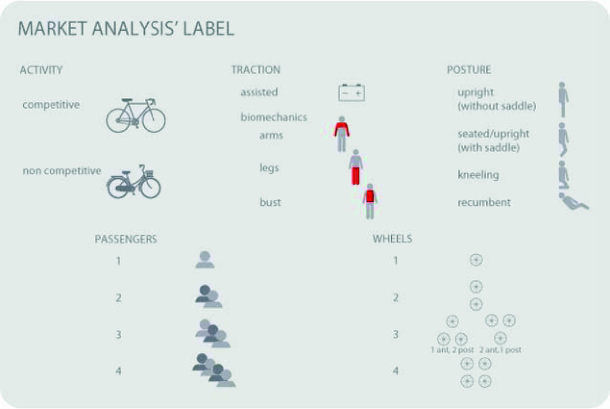
The first classification system was based on 5 parameters: a. The kind of activity (competitive or non-competitive);
b. The kind of traction (assisted or biomechanics: in that case, from which muscle group is activated, for example, arms or legs); c. The rider’s posture;
d. The number of riders/passengers; e. The number of wheels.
Then each product has been ranked according to this label.
Figure 1. Market analysis' Label
The second step of the market analysis was done to underline the main features of the bicycles for disabled children. Besides these features, a very important data emerges: for disabled, there is a difference between the Italian market and throughout the World. In Italy, the National Health System prescribes and often pays a bike or a aim for disabled children. And this vehicle is often adapted, not designed: starting from a standard bike or tricycle, a technician adds the compulsory tools to make it appropriate. The Italian bike manufacturers do not propose any different solutions. In the rest of the World, there are the greater manufacturers that offer “different shape” bike, that can be used from everybody and that answer to the needs of impaired people.
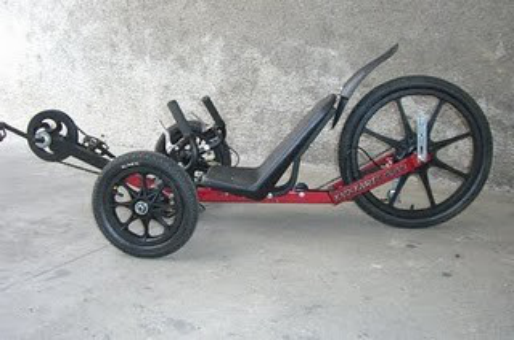
At the end of these analysis, two different typologies of bike were identified: a classical one, fitted with all the compulsory tools, typical of the Italian market and a recumbent trike, mostly used in other countries. The choice of these two typologies of bike was justified by the fact that we would provide users with different solution, to understand if they could accept a new design or if they prefer the classical one.
Figure 2. Example of bikes shown in the questionnaire
These two bikes were shown to the users, in a questionnaire. This first survey was addressed to adults, mostly with children. This sample of users was non-significant (40 people answered), but useful to choose which kind of design the next bike must have. The users had to answer to several questions, centered on their use of the bike and, if they had children, on the use of the bike with them. At the end of the questionnaire, the two bikes were shown and a preference was asked. In most cases, they had chosen the recumbent bike. This answer was also useful for us, to understand in which way we have to develop the new bike. As already said, even before this survey, our idea was to develop a bike that could be used (and purchased) from all children, for which needs a rehabilitation tool and for which needs a bike for everyday life. For this reason, we thought that we have to propose a really new shape for this bike.
The Bike Development The first prototype of this bike was a tricycle, with two wheels in front and one back. This new configuration was made both to ensure stability and to propose a vehicle that could represent something new for all the children. During the research phases, we have highlighted several requirements that the new bike must respect to be suitable for all children, especially for whom with CP. For example, it must be accessible for autonomous child’s ascent and descent; the vehicle must be stable both during standstill and in motion and it must be easily maneuverable; each component must be reachable during use, and so on.
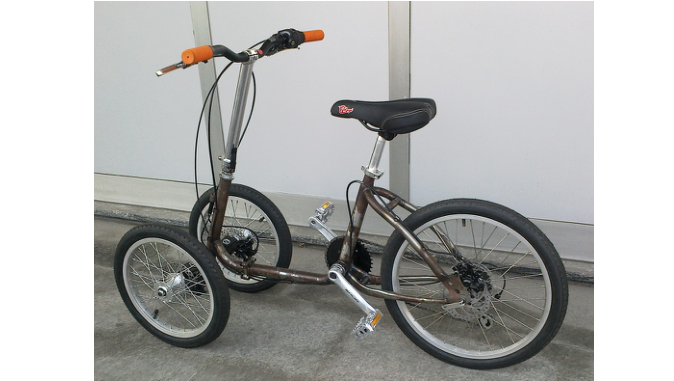
According to the Italian and international market trend and to the know-how of a bike manufacturer (Atala SpA), it was determined to choose a classic posture frame, instead of a recumbent one. These milestones (the 3 wheels configuration and the classical posture) were the basis to achieve a very first functional prototype, based on an adaptation of an existing bike.
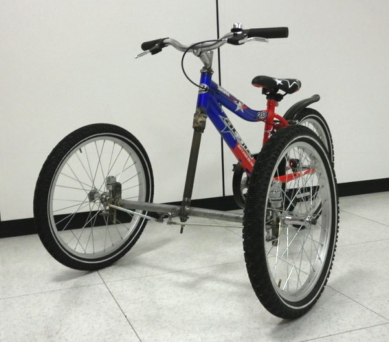
Figure 3. First functional prototype developed, front view and detail of the steering mechanism.
A new fork was made, welded to the existing frame. It was designed for supporting two wheels and to ensure the maneuverability of the vehicle. The handlebar worked directly on a plate at the end of the fork’s sleeve: from this, there were two tie rods that leverage on the wheels’ joint. This prototype was very useful to understand how the bicycle works and its dimension. And it became the starting point of the new bike, shown in the picture.
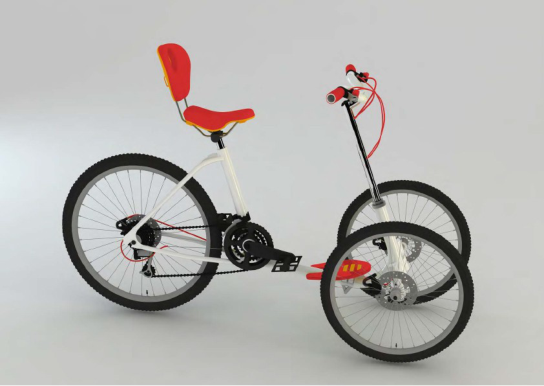
Figure 4. "3ike" digital model
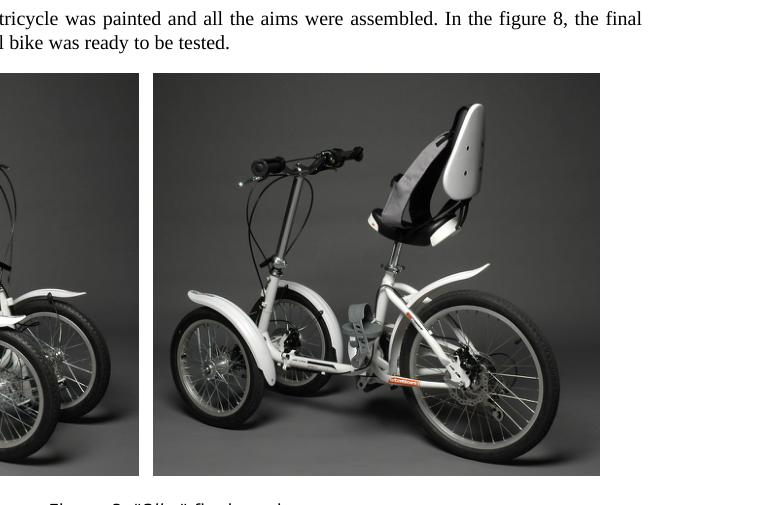
This tricycle, named “3ike”, was the intermediate result. The particular shape of the frame facilitated the autonomous accessibility for children. The backrest guarantees the stability and the right posture for the users; there are also the possibility to add the seat-belts, for enhances safety. Also on the handlebar there are two belts that could be used if the child has muscle spasm. To avoid this problem during the use of the bike, also the pedals have belt, that could be used in case of need. The problems linked to the maneuverability are resolved, thanks to camber of the wheels. The fork could be also dismantled, to ease the storage and the carriage.
Starting from this, a new functional prototype was engineered.
Figure 5. Functional prototype
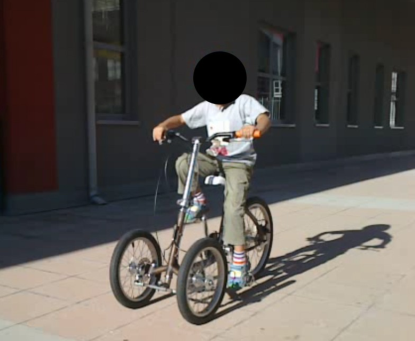
But during the very first test, with a healthy kid, we understood that the bike was undriveable, especially when the user took a bend. When he turned right or left, the bike tilted from the opposite side. This trend was very mischievous, for all kids. It was due to several mistakes, both in building and in assembling. For example, there was a wrong camber of the front wheels, and the rotation axis of these wheels was not adequate.
Figure 6. First testing phase
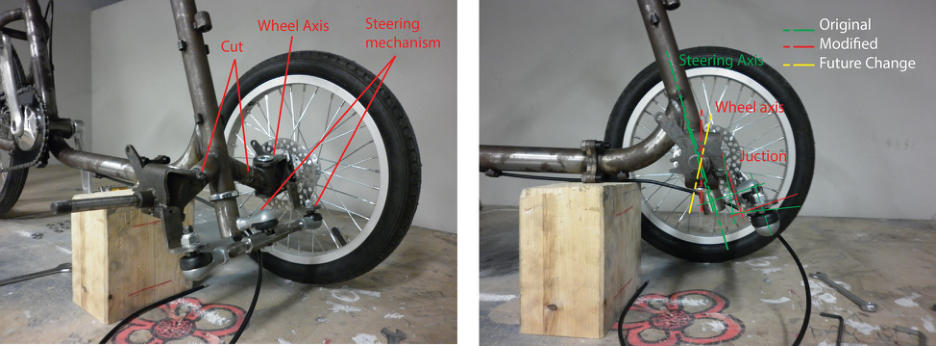
As shown in the picture, several changes were made in our laboratory. Firstly, the two arms of the fork were cut, rotate and welded again. It was done to correct the tilt angle throughout the turn: after this change, the bike bends inside each curve, to facilitate the maneuverability and the stability during the ride. Secondly, the steering mechanism (the pivot at the end of the handlebar and the pivot of each front wheel) were aligned, to make the steering movement more fluent. Lastly, the camber of the front wheels was increased, to make the vehicle more stable.
Figure 7. Fine tuning of the prototype
After these functional changes, the tricycle was painted and all the aims were assembled. In the figure 8, the final version of “3ike” is shown. The final bike was ready to be tested.
Figure 8. "3ike" final version
RESULTS
We carried out the evaluation tests in a Scientific Institute, specialized in research and rehabilitation in the developmental age. We recruited four children, their parents and two physiotherapists to submit them our bike. We made a comparison between an already existing vehicle and our new bike, and we administrated a structured questionnaire to assess functions, feelings and impressions.
The protocol was based on 6 steps:
1. Introduction of the team to the each children and make a small talk with them to explain what we were going to do;
2. Introduction of the vehicles and wait for the choice of the kid between one bike or the other;
3. Testing phase, riding the bike in the corridors of the rehabilitation center, paying close attention to autonomous ascent and descent and to the maneuverability during the ride;
4. During the tests, light conversations with parents and technicians (for example, ask them if the posture of the child is correct or not..);
5. After the tests, interviews to children (for example, if they enjoy to ride that bike..);
6. Questionnaire administration for evaluations, conclusions and future developments.
Four children joined the test, three of them according to the level of impairment between the 3 rd and the 4th of the Gross Motor Function Classification (GMFCS, Palisano, R., Rosenbaum, P., Walter, S., Russell, D., Wood, E., Galuppi, B., 1997). Those children can walk using a hand-held mobility devices or can move autonomously with limitations. Also according to the market rules (the frame’s dimensions are usually related to the age group), the goal users were children in the age group between 6 and 8 years old. Results are presented for each single case.
First User: This child was 13 years old, but his physiotherapist explained us that his physical development was comparable to a 10 years old child. He was not included in our age group and his GMFCS level was close to the 5 th. In spite of it, we showed him the bikes and we asked him if he would like to try one of those. This choice was related to the philosophy that drives this project: emotional involvement and socialization. He was very impressed by our new bike and he asked us to try it. There were several problems to fit the bike to his dimension. He was very big for that bike and, both for his handicap and for the length of his legs, he couldn’t perform a complete pedal. Because of muscle spasm, often his foot came out form the pedals. He was in a tight spot also in driving the bike. He didn’t try the other bike.
On one hand, this test was useless because the user couldn’t ride a bike. On the other hand, he was very impressed from our bike, in comparison with the other one, and he asked us to try it. In this case, we can assert that we have reached the goal to design a pleasurable and attractive bike.
Second User: This child was 8 years old and his GMFCS level was appropriate to our test. This was the first time ever that the user rode a bike. As well as the previous user, this child preferred the new bike.
The child could ascent and descent from “3ike” autonomously. Because of it was the first time riding a bike, there were several problems for the user to understand how to pedal. Sometimes the user has pedaled in the opposite way: the therapist affirmed that this movement was due to muscle spasm and stress. The seat and the backrest were useful for this child. He didn’t need belt for his rest or for his hands. Helped in driving, the user has performed several path in the corridors of the center. The user was very impressed by this experience.
We asked the user to try the classic bike, the one with the stabilizers. We had to lift up the user, to place him on the bike. The same efforts in pedaling emerged in this second test. Also with this bike, several path were performed.
When the test ended, the user on his own volition, ascent and descent from “3ike” and tried to use it.
In this case, the test was very useful, both for the functional aspects and for the aesthetic aspects.
Third User: the third user was 16 years old but his age did not coincide to his physical development. As the doctor said, the user could be considered as a 8 years old child. His GMFCS level corresponded to our level.
Facing the bikes, he was very impressed from the one we designed. Immediately he asked us to try it. In the eyes of the regulations, h didn’t need seat with backrest or seatbelt. He could ascent and descent autonomously. Also, he didn’t have problems in pedaling, like the other users. In fact, he began to go very fast with the bike along the corridors. At the first bend, he risked to overturn. But he understood how to drive that bike (that is, during a bend, you have to shift your body weight inside the bend itself). According to the opinion of the therapists, the user could ride a normal bike, without the stabilizers. But the stabilizers make him more self-confident in riding a bike. And they represent a safety for the parents too.
In the second part of the test, we asked the user to try other bike. As happened for the previous user, we had to lift up him, because the autonomous ascent and descent were absolutely impossible for him, due to the shape of the bike. Except that, he rode the bike without problems, reaching high speed.
In this case, the user was able to ride a bike. With our bike, he could ride it whenever he wanted: he was able to ascent or descent autonomously, he could decide to ride it or not. With the other bike, the bike that usually is sold and used in the rehabilitation center, he always needed someone that helped him to lift up on the seat.
After a few meters driving our bike, he understood how it works and what he has to do for driving it in a good way.
Fourth User: The last user was 8 years old and his GMFCS level was lower than our target. He had problems in walking, due to a leg injury. In this case, the user was very shy. His mother encouraged him to try our bike. She was very fascinated by our bike. She explained that his child already had a bike, but he didn’t use it because it was ugly. In fact, he needed some aids to adapt a normal bike to his disability. But these aims make the bike ugly. Also his parents did not encourage him to use it, because they didn’t like the bike. She said that now the bike appears like a disability aid, no more like something useful for his children’s play. It always reminded the disability of their child.
The user could ascent and descent autonomously and could pedal without problems. He rode the bike for a few meters, than he stopped. He said that was exhausted. The therapists said that his fatigue was due to his lesion.
CONCLUSIONS
The sample of users that tested our vehicle was not significant for statistics. At the same time, the test phase highlights both the importance of the design aspects in rehabilitation tools and the need to engage the users from the earliest steps.
One of the goals of this project was to develop a bike that should answer to the needs of disabled children and that could be attractive for all children. To this end, we have perceived a lot of interest during the development of the functional prototype and during the test phase. Anyone who saw the bike, asked us for more information about it. Children asked to try it and the bike also impressed the parents. The very first test was performed thanks to some not disabled kids and also they were stunned by the bike.
This means that it is possible to design a rehabilitation aid that has not “the shape” of a rehabilitation tool. Surely, it has to satisfy the requirements linked to the needs of a disabled. But at the same time, it mustn’t ignore the aesthetic aspects. Besides the functional ones, the aesthetic aspects are at the base of the acceptance of an aid and of a useful relationship between man and aids.
Above all that, we must emphasize the importance of the development of several mock-ups and prototypes. These were very useful to understand how the bike works: a great part of our original project has been changed after the first prototype. Thanks to all these prototypes, we had also the possibility to involve the users in the development of this project, and to bring the test phases forward.
ACKNOWLEDGEMENT
The project is the result of a collaboration between University and Industry, and is co-founded by a Grant from Regione Lombardia. The Authors would like to express their gratitude to Atala SpA, that brings its know-how in manufacturing bicycles, and to Fumagalli SrL, that brings its expertise in developing aids for impaired people. A special thanks goes to “Ircss E.Medea – La Nostra Famiglia” for their contribution in the testing phases. We would like to thank the children and their families, that helped us for reaching the goals of this research project.
REFERENCES
Bax, M.CO., (1964), “Terminology and classification of Cerebral Palsy”, Develomental Medicine and Child Neurology Fifty-fourth World Health Assembly, (2001), “International Classification of Functioning, Disability and Health (ICF)”, World Health Organization Fowler, E.G., Kolobe, T.HA, Damiano, D.L., Thorpe, D.E., Morgan, D.W., Brunstrom, J.E.,Coster, W.J., Henderson, R.C.,
Pitetti, K.H., Rimmer, J.H., Rose, J., Stevenson, R.D., (2007), “Promotion of physical fitness and prevention of secondary conditions for children with cerebral palsy: section on pediatrics research summit proceedings”, Physical Therapy Volume 87 Number 11 Fowler, E.G., Knutson, L.M., DeMuth, S.K., Sugi, M., Siebert, K., Simms, V., Azen, S.P., Winstein, C.J., (2007), “Pediatric endurance and limb strengthening for children with cerebral palsy (PEDALS) – a randomized controlled trial protocol for a stationary cycling intervention”, BMC Pediatrics 7:14 Maldonado, T., (1991), “Disegno industriale: un riesame”, Feltrinelli Editore, Milano Norman, D., (1998), “La caffettiera del masochista. Psicopatologia degli oggetti quotidiani”, Giunti Editore, Milano Massenz, M., Simonetta, E., (2002), “La valutazione psicomotoria”, Franco Angeli Editore, Milano Palisano, R., Rosenbaum, P., Walter, S., Russell, D., Wood, E., Galuppi, B., (1997), “Gross Motor Function Classification
System (GMFCS)”, CanChild, McMaster University Standoli, C.E., Romero, M., Vazzoler, G., (2012), “Learning product design for particular needs. 3ike Case Study: a bike for children with Cerebral Palsy”, Proceedings of EDULEARN12 Conference, pp 2348-2355 Twenty-ninth World Health Assembly, (1976), “International Classification of Impairments, Disabilities and Handicaps
(ICIDH)”, World Health Organization Zocca, E., Biino, V., (2009), “Motricità e gioco : forme naturali e culturali del movimento e del gioco”, Ulrico Hoepli, Milano
LISTED IN THE AHFE DIGITAL BOOKSTORE CATALOGUE
Explore the complete digital volume
Advances in Human Aspects of Healthcare
Read this individual research paper free through the original publisher, or explore the full digital proceedings book.
ISBN 978-1-4951-2093-0
Explore this ISBN in the AHFE Bookstore ↗Listed in the July 2026 bookstore catalogue; search by ISBN to confirm current availability · Digital book purchase optional