Andrea Catalano, Giuseppe Andreoni, Nicola Francesco Lopomo (2026). Assessing the Subjective Effects of a Passive Low-Back Exosuit in Manual Urban Waste Collection: A Pilot Study. In: Physical Ergonomics and Human Factors. AHFE Open Access, vol. 223, pp. 151–161. https://doi.org/10.54941/ahfe1008072
This pilot study evaluated the subjective effects of a commercial low-back support exosuit during standard work operations in manual urban waste collection, a sector characterized by high prevalence of work-related musculoskeletal disorders (WMSDs). Although occupational exoskeletons (OEXOs) and exosuits are considered a viable solution to mitigate the risk of developing WMSDs, their actual workplace adoption remains limited. Empirical field data regarding the real-world use of OEXOs, particularly exosuits, is still scarce, necessitating more field studies to investigate real-world complexities. Moreover, while manual waste collection stands out due to its physically demanding nature, with repetitive bending and lifting, awkward postures and high operational pacing, there is little knowledge about OEXOs use in this context. This study addressed both gaps by providing insights into subjective contextual exosuit experience and potential barriers to the integration of wearable assistive technologies into work procedures.Ten waste collectors from an Italian waste management company participated in the study, wearing the Herowear Apex 2, a passive soft low-back exosuit, for approximately two hours during standard work shifts. This device features a backpack-like module, thigh sleeves, a clutch mechanism and elastic bands that store energy during bending and return it during lifting. The device was selected for its quick-engagement clutch mechanism and low-profile architecture. Participants received exosuit training the day prior to the trial and were supervised by researchers throughout the study. A mixed-methods approach was adopted. Quantitative data were collected post-trial using the NASA-TLX scale, the Local Body Discomfort (LBD) scale and an ad hoc five-point Likert-like questionnaire. Qualitative data included post-trial semi-structured interviews. Given the pilot sample size (n=10), descriptive statistical analysis was performed on quantitative data, while thematic analysis was used for qualitative data.NASA-TLX results indicated that the overall perceived workload with and without exosuit was comparable, with slight improvements in physical demand and performance when wearing the device. The LBD scale showed the participants found the exosuit generally comfortable, with light discomfort reported across the body regions. The Likert questionnaire revealed high variability regarding perceived usefulness, while participants broadly agreed on ease of operating the device, social acceptability, preserved range of motion and increased sweating due to the device.Qualitative findings provided critical operational insights. Significant concerns were raised regarding increased thermal discomfort, with unanimous worry about summer usability when sweat could make the device difficult to tolerate. Although there was general agreement on the simplicity of the clutch mechanism, high operational pacing and traffic pressure discouraged continuous manual activation. Participants also noted that the device did not address discomfort in the shoulders and knees, highlighting the regional limitations of a low-back support system in this context. A key functional trade-off was identified: in the passive system, users must exert effort to load the elastic element during trunk flexion to receive assistive force during the subsequent lift, a dynamic that may reduce perceived benefits.These findings contribute field-level evidence on OEXO use and point to contextual factors that must be addressed for successful integration of exosuits in physically demanding occupational settings.
Work-related musculoskeletal disorders (WMSDs) are a prevalent issue in contemporary working settings. Particularly, low back pain (LBP) constitutes a primary contributor to disability worldwide (Hoy et al., 2014). While the underlying factors contributing to LBP are often multifaceted, crucial biomechanical risk factors include high peak forces and accumulated loads on the back during occupational activities related to manual material handling (Coenen et al., 2013; Norman et al., 1998). Among different working contexts, manual waste collection stands out due to its physically demanding nature that results in high prevalence of WMSDs (Kuijer et al., 2010; Poulsen et al., 1995). Urban waste collection involves the manual retrieval of refuse from kerbside bins, wheeled containers, and bags. This task requires workers to frequently alternate between operating collection vehicles and performing manual handling tasks under high operational pacing, driven by tight schedules and urban traffic. Repetitive bending and lifting, even from the ground, forces waste collectors into sustained, repetitive and excessive trunk flexion, axial rotation, and arm abduction, predisposing them to WMSDs (Ziaei et al., 2018). This risk profile is further modulated by crew organization. While two- and three-person crews allow for task specialization, where one individual drives and the remaining personnel handles waste retrieval, single-person operations demand a driver-collector who must continuously climb on and off the vehicle, introducing additional ergonomic stress.
Improving working conditions to reduce the risk of MSDs and physical workloads requires following general prevention guidelines. When collective solutions (e.g., organizational changes or mechanical tools) have proven ineffective, occupational exoskeletons (OEXOs) offer a viable alternative for individual physical assistance (Baldassarre et al., 2022). These wearable devices generate supportive force or torque around human joints to reduce physical workload (Schwartz et al., 2021). OEXOs are typically categorized by the body part supported (upper limb vs. back), actuation type (active/ powered vs. passive/spring-based), and structural rigidity (rigid vs. soft exosuits) (de Looze et al., 2016; Crea et al., 2021). While rigid structures can be bulky and restrict mobility, soft exosuits lack a rigid kinematic frame, making them generally preferred for their comfort and unobtrusive design (Riemer and Wischniewski, 2023; Jakob et al., 2023; Siedl et al., 2021).
However, the actual adoption of OEXOs in real scenarios is limited compared to the expectations (Crea et al., 2021). While OEXOs can reduce physical strain and mitigate MSDs, they introduce new challenges that hinder their large-scale adoption. Empirical field data regarding the real-world use of OEXOs, particularly exosuits, is still scarce, necessitating more field studies to investigate real-world complexities and user experience variables. Furthermore, despite the high physical demands and awkward postures characteristic of manual waste collection, there is little knowledge about OEXOs use in this context (Ziaei et al., 2021).
Assessing the Subjective Effects of a Passive Low-Back 153 In order to deepen the understanding, this study addressed these dual gaps by providing novel insights into subjective, contextual user experience of a passive low-back exosuit, while identifying potential barriers to the integration of these wearable assistive technologies into standard waste collection work procedures.
METHODS
The field trial was conducted in January 2026 following approval by the Ethical Committee of Politecnico di Milano (67/2025 – 22/09/2025). A total of ten male driver-collectors from an Italian waste management company voluntarily participated in the study and provided written informed consent. All participants operated as single-person crews, tasked with both driving the collection vehicle and manually retrieving waste along assigned routes. To capture variations across waste streams, the sample included workers collecting paper (n = 2), organic waste (n = 2), plastics (n = 2), and residual waste (n = 4).
Table 1: Waste collection methods and characteristics.
Table available in the original PDF paper.
Waste Typology Frequency Main Activities ~ 430 bags/shift; ~ 80 bins/shift.
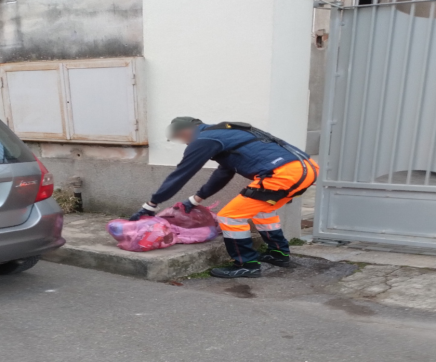
Participants wore the HeroWear Apex 2, a passive, soft low-back exosuit, for approximately two hours during their standard work shifts. This specific device features a backpack-like module, thigh sleeves, and elastic bands that store energy during trunk flexion and return it during lifting to alleviate lower-back muscular strain. This exosuit was selected based on preliminary field observations and a market analysis, specifically for its low-profile architecture and its quick-engagement clutch mechanism, both of which are critical for compatibility with the high-intensity operational pacing of driver-collectors.
Figure 1: Participant using HeroWear Apex 2 during standard work.
One day prior to the field trial, participants gathered for a collective training session. During this session, researchers demonstrated the functioning of the exosuit, took anthropometric measurements to adjust the device components and elastic bands according to the manufacturer’s guidelines, and briefed the participants on the experimental procedures. During the five-day trial (two participants per day), researchers accompanied operators on their routes to monitor safety, ensure proper usage, and assist as needed, while participants retained full autonomy over when and how to use the device during their shifts. All the participants were able to discontinue the use of the exoskeleton whenever they required to.
Table 2: Participants descriptive data.
Table available in the original PDF paper.
Descriptive data Average ± SD Median Range Age (years) 45.4 ± 3.69 45.5 39 – 52 Height (cm) 178.2 ± 6.88 177.5 169 – 189
A mixed-method approach was used to collect subjective data at the conclusion of each trial. Quantitative data included the NASA-TLX scale to evaluate subjective workload differences between work with and without exosuit, a Local Body Discomfort (LBD) scale to evaluate physical comfort across different body regions and an ad hoc five-point Likert-like questionnaire evaluating user experience. The Likert-like questionnaire was composed of 15 items spanning multiple dimensions, including comfort, usability, cognitive demand, perceived usefulness and effectiveness, task compatibility and interference, social perception and overall exosuit acceptance.
Assessing the Subjective Effects of a Passive Low-Back 155 Qualitative data consisted of spontaneous field comments, researchers’ direct observations and a post-trial semi-structured interview designed to synthesize the user experience and deepen questionnaire items. Given the pilot sample size (n=10), descriptive statistical analysis was performed on quantitative data, while thematic analysis was used for qualitative data. Interview transcripts were systematically coded through an iterative process, and related codes were clustered into overarching themes representing recurring participant experiences.
RESULTS AND DISCUSSION
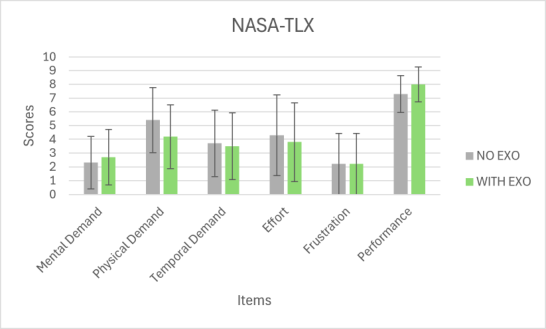
Perceived Physical Benefit and Workload NASA-TLX results indicated that overall perceived workload was comparable with and without the exosuit, with slight improvements in physical demand when wearing the device (control: 5,4 ± 2,8, exosuit: 4,2 ± 2,3), a pattern consistent with findings from other occupational settings. In emergency medical services and construction work, NASA-TLX for physical demand, was similarly lower when the same exosuit was worn (Mukherjee et al., 2024; Bennett et al., 2023).
Figure 2: Perceived workload (NASA-TLX scale) with and without exosuit.
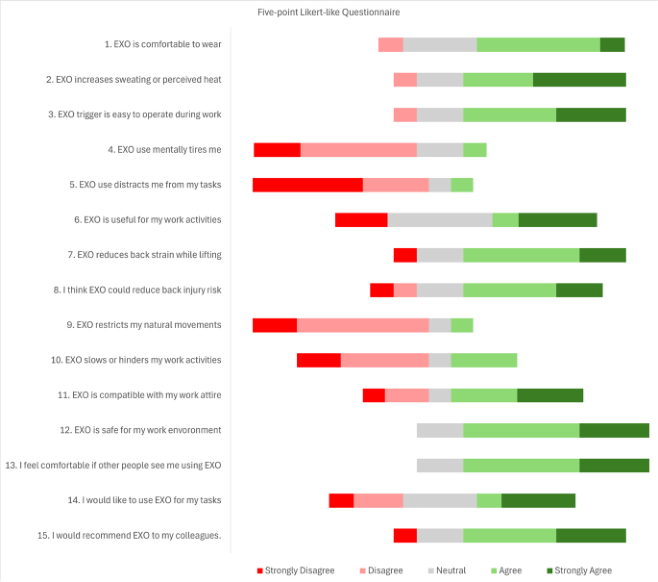
In the Likert questionnaire, most participants reported perceiving less back strain with the device (item 7) and believed it could reduce the risk of back injury (item 8), suggesting meaningful perceived ergonomic benefit at the lumbar level. Similar subjective benefits of passive back exoskeletons have been documented across multiple industrial sectors. Specifically, the device reduced perceived physical effort or muscle loading for warehouse workers and logistics personnel (Yandell et al., 2022; Cardoso et al., 2024). Furthermore, workers reported mitigated lower-back strain in construction tasks (Bennett et al., 2023), improved posture in healthcare settings (Saurio et al., 2023), and an average reduction of one effort level during waste management operations (Ziaei et al., 2021).
However, perceived usefulness was highly variable in our sample (item 6). While several participants reported immediate lumbar relief during the interviews, others maintained a neutral stance, perceiving the device as neither assistive nor restrictive. Participants noted that waste collection work is not just about back strain, pointing out that the areas also affected are the shoulders and knees. Consequently, while the exosuit effectively attenuated lower-back strain, its perceived systemic utility was mitigated by unaddressed physical demands on other joints.
Furthermore, a technically important observation emerging from the interviews concerns a functional trade-off. In fact, to receive assistive force during lifting, users had to actively load the elastic element during trunk flexion, effectively increasing the effort required to bend forward. This dynamic may reduce the net perceived benefit, particularly in high-frequency, time-pressured collection routes where the cost-benefit ratio of engaging the system is less favourable.
Figure 3: Likert-like questionnaire results.
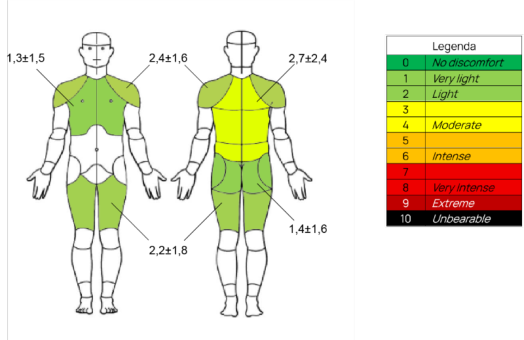
Comfort and Thermal Load The LBD scale indicated that participants found the exosuit generally comfortable, with slight discomfort concentrated in the body regions interfacing with the device (back, shoulders, chest, thighs, and glutes). The back was identified as the primary discomfort site, which the interviews
Assessing the Subjective Effects of a Passive Low-Back 157 attributed to the semi-rigid backplate and augmented heat accumulation in that region.
Figure 4: Local body discomfort map.
Thermal discomfort emerged as the most critical barrier in the qualitative data. Most of the participants expressed concern about summer usability, with unanimous agreement that sweat would make the device difficult to tolerate in hot conditions. This finding is consistent with the literature. Workers across multiple settings have reported that exoskeletons become uncomfortably hot during use, particularly when worn over uniforms that restrict airflow (Ziaei et al., 2021; Saurio et al., 2023). In agriculture, this high heat combined with poor device fit significantly increased both physical discomfort and the workers’ perceived risk of use (Jakob et al., 2023). Thermal management therefore represents one of the most pressing design challenges for exosuit adoption in physically demanding outdoor occupations.
Ease of Use and Operational Integration Participants broadly agreed on the simplicity of the clutch activation mechanism (item 3), and the interviews confirmed unanimous appreciation for its intuitiveness. However, a critical operational limitation emerged: the need for continuous manual and dynamic activation conflicted with the pace and traffic pressure of door-to-door waste collection. A similar learning curve was reported by healthcare workers using a comparable system, who identified remembering to activate and deactivate the support as the most challenging aspect of use (Saurio et al., 2023). During the interviews, it emerged that the device was perceived as better suited to repetitive, linear tasks, such as logistics operations, or for slower and more predictable routes within the work week, such as large bag accumulations, than to the dynamic, fragmented nature of standard door-to-door collection. This task- specificity nature of the exosuit could explain the mixed perceived usefulness and is coherent with literature findings: in logistic tasks exosuits showed
compatibility and low interference ratings (Hess et al., 2025; Cardoso et al., 2024), while in emergency medical services and care, benefit was confined to a specific task type (Mukherjee et al., 2024; Saurio et al., 2023).
Mobility and Range of Motion Most of the participants did not feel their natural movements were restricted by the device (item 9), while responses regarding task slowdown and hindrance (item 10) were more mixed. The interviews reinforced this ambivalence: the flexion trade-off described above was identified as a hindering concern in high-pacing conditions.
The literature suggests that movement restriction is a context- and subject- dependent issue. In order-picking studies, range of motion ratings varied substantially between tasks and participants (Cardoso et al., 2024). In care settings, squatting positions were identified as particularly problematic, causing the suit to feel tight and compressive on the thighs and shoulders (Saurio et al., 2023).
Social Acceptability and Adoption Intention The exosuit was perceived as safe for the work environment and socially acceptable, with no participants disagreeing on either dimension (items 12 and 13). Recommendation to colleagues was rated positively overall (item 15), indicating that despite reservations, participants recognised potential value in the device.
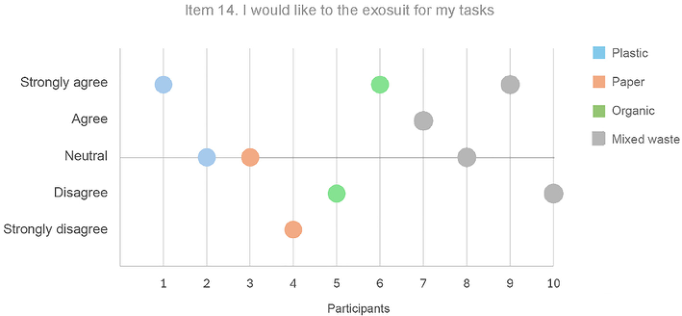
Acceptance of the device (item 14), however, showed high variability, even within the same collection route type (Fig. 5), reflecting the subjective nature of exosuit experience and the degree to which willingness to adopt depends on individual perception of need, subjective response to provided support, and environmental factors such as season and task characteristics.
Figure 5: Exosuit acceptance per participant and waste type.
CONCLUSION
This pilot study provides field-level evidence on the subjective effects and adoption barriers of a passive low-back exosuit in manual urban waste collection, an operationally complex and understudied context. Results indicate that the device generally delivers perceived ergonomic benefit at the lumbar level, with most participants reporting reduced back strain, comparable overall workload, and high social acceptability and ease of use, findings consistent with evidence from other occupational settings.
However, the overall occupational utility of the exosuit is heavily mediated by the multi-joint, high-pacing dynamics characteristic of waste collection. Adoption is constrained by several contextual barriers: the device does not address physical demands on the shoulders and knees, thermal discomfort raises serious concerns about summer usability, and the need for continuous manual clutch activation conflicts with operational pacing on dynamic door-to-door routes. The inherent functional trade-off of the passive system, requiring users to overcome elastic resistance during trunk flexion in order to receive assistive force during lifting, may further reduce net perceived benefit under time-pressured conditions.
These findings underscore that successful exosuit integration in waste collection requires targeted design improvements in thermal management and activation mechanisms, as well as careful matching of device characteristics to specific task types and route profiles. Future research should involve larger and more diverse samples, longitudinal observation across seasons, and objective biomechanical measures to complement the subjective data presented here. Extending this work to multi-person collection crews and different waste streams would further clarify the conditions under which passive exosuits can deliver consistent and meaningful benefit in this occupational context.
ACKNOWLEDGMENT
The authors gratefully acknowledge Partitalia S.r.l. for co-financing the doctoral research within which this study was conducted, Impresa Sangalli Giancarlo & C. S.r.l. for providing operational access and supporting the field trial, and to Homberger S.p.A. for providing the exosuits used in this research.
REFERENCES
Baldassarre A, Lulli LG, Cavallo F, Fiorini L, Mariniello A, Mucci N and Arcangeli G (2022) Industrial exoskeletons from bench to field: Human-machine interface and user experience in occupational settings and tasks. Front. Public Health 10:1039680. doi: 10.3389/fpubh.2022.1039680. Bennett, S.T.; Han, W.; Mahmud, D.; Adamczyk, P.G.; Dai, F.; Wehner, M.;
Veeramani, D.; Zhu, Z. Usability and Biomechanical Testing of Passive Exoskeletons for Construction Workers: A Field-Based Pilot Study. Buildings 2023, 13, 822. https://doi.org/10.3390/buildings13030822. Cardoso, A.; Colim, A.; Carneiro, P.; Costa, N.; Gomes, S.; Pires, A.; Arezes, P. Assessing the Short-Term Effects of Dual Back-Support Exoskeleton within Logistics Operations. Safety 2024, 10, 56. https://doi.org/10.3390/safety10030056.
Coenen, P., Kingma, I., Boot, C.R.L. et al. Cumulative Low Back Load at Work as a Risk Factor of Low Back Pain: A Prospective Cohort Study. J Occup Rehabil 23, 11–18 (2013). https://doi.org/10.1007/s10926-012-9375-z. Crea S, Beckerle P, De Looze M, De Pauw K, Grazi L, Kermavnar T, Masood J,
O’Sullivan LW, Pacifico I, Rodriguez-Guerrero C, Vitiello N, Ristić-Durrant D, Veneman J. Occupational exoskeletons: A roadmap toward large-scale adoption. Methodology and challenges of bringing exoskeletons to workplaces. Wearable Technol. 2021 Sep 17;2:e11. doi: 10.1017/wtc.2021.11. PMID: 38486625; PMCID: PMC10936259. de Looze, M. P., Bosch, T., Krause, F., Stadler, K. S., & O’Sullivan, L. W. (2016).
Exoskeletons for industrial application and their potential effects on physical work load. Ergonomics, 59(5), 671–681. https://doi.org/10.1080/00140139.201 5.1081988. Hess A, Jacobs JV, Sullivan S, Roberts Williams DO, Awad LN, Dalton D, Walsh CJ, Quirk DA. Active back exosuits demonstrate positive usability perceptions that drive intention-to-use in the field among logistic warehouse workers. Appl Ergon. 2025 Jan;122:104400. doi: 10.1016/j.apergo.2024.104400. Epub 2024 Oct 9. PMID: 39388886; PMCID: PMC11608431. Hoy D, March L, Brooks P, Blyth F, Woolf A, Bain C, Williams G, Smith E, Vos T,
Barendregt J, Murray C, Burstein R, Buchbinder R. The global burden of low back pain: Estimates from the Global Burden of Disease 2010 study. Ann Rheum Dis. 2014 Jun;73(6):968–74. doi: 10.1136/annrheumdis-2013-204428. Epub 2014 Mar 24. PMID: 24665116. Jakob, M., Balaguier, R., Park, H., & Trask, C. (2023). Addressing Exoskeleton Implementation Challenges: Case Studies of Non-Acceptance in Agriculture. Journal of Agromedicine, 28(4), 784–796. https://doi.org/10.1080/10599 24X.2023.2236605. Kuijer, P.P.F.M., Sluiter, J.K. and Frings-Dresen, M.H.W. (2010), Health and safety in
waste collection: Towards evidence-based worker health surveillance. Am. J. Ind. Med., 53: 1040-1064. https://doi.org/10.1002/ajim.20870. Norman R, Wells R, Neumann P, Frank J, Shannon H, Kerr M. A comparison of peak vs cumulative physical work exposure risk factors for the reporting of low back pain in the automotive industry. Clin Biomech (Bristol). 1998 Dec;13(8):561–573. doi: 10.1016/s0268-0033(98)00020-5. PMID: 11415835. Poulsen OM, Breum NO, Ebbehøj N, Hansen AM, Ivens UI, van Lelieveld D,
Malmros P, Matthiasen L, Nielsen BH, Nielsen EM, et al. Collection of domestic waste. Review of occupational health problems and their possible causes. Sci Total Environ. 1995 Aug 18;170(1-2):1–19. doi: 10.1016/0048-9697(95)04524- 5. PMID: 7569875. Riemer, Julia & Wischniewski, Sascha. (2023). Long-term effects and user acceptance of back-support exoskeletons in the workplace. Zeitschrift für Arbeitswissenschaft. 77. 1–7. 10.1007/s41449-023-00381-7. Sandra Maria Siedl, Matthias Wolf and Martina Mara. 2021. Exoskeletons in the
Supermarket: Influences of Comfort, Strain Relief and Task- Technology Fit on Retail Workers’ Post-Trial Intention to Use. In Proceedings of 2021 ACM/IEEE International Conference on Human-Robot Interaction Companion, March 8–11, 2021, Boulder, CO, USA. ACM, New York, NY, USA, 5 pages. Saurio, R., Pekkarinen, S., Hennala, L., Melkas, H. (2023). Exoskeletons—Human- Centred Solutions to Support Care Workers?. In: Pfannstiel, M.A. (eds) Human- Centered Service Design for Healthcare Transformation. Springer, Cham. https:// doi.org/10.1007/978-3-031-20168-4_23.
Assessing the Subjective Effects of a Passive Low-Back 161 Schwartz, M.; Theurel, J.; Desbrosses, K. Effectiveness of Soft versus Rigid Back-
Support Exoskeletons during a Lifting Task. Int. J. Environ. Res. Public Health 2021, 18, 8062. https://doi.org/10.3390/ijerph18158062. T. R. Mukherjee, T. X. Do Vale Gunter, E. Manchanda, O. Tyagi, R. K. Mehta and P. Pagilla, “Assessing the Effects of a Soft Passive Low-Back Exoskeleton for Emergency Medical Services,” 2024 IEEE 4th International Conference on Human-Machine Systems (ICHMS), Toronto, ON, Canada, 2024, pp. 1-4, doi: 10.1109/ICHMS59971.2024.10555734. Yandell, M.B., Wolfe, A.E., Marino, M.C., Harris, M.P., Zelik, K.E. (2022). Effect of
a Back-Assist Exosuit on Logistics Worker Perceptions, Acceptance, and Muscle Activity. In: Moreno, J.C., Masood, J., Schneider, U., Maufroy, C., Pons, J.L. (eds) Wearable Robotics: Challenges and Trends. WeRob 2020. Biosystems & Biorobotics, vol 27. Springer, Cham. https://doi.org/10.1007/978-3-030-69547- 7_2. Ziaei, M., A. Choobineh, M. Abdoli-Eramaki, and H. Ghaem. 2018. “Individual, Physical, and Organizational Risk Factors for Musculoskeletal Disorders among Municipality Solid Waste Collectors in Shiraz, Iran.” Industrial Health 56 (4): 308–319. doi:10.2486/indhealth.2018-0011. Ziaei M, Choobineh A, Ghaem H, Abdoli-Eramaki M. Evaluation of a passive low-
back support exoskeleton (Ergo-Vest) for manual waste collection. Ergonomics. 2021 Oct;64(10):1255–1270. doi: 10.1080/00140139.2021.1915502. Epub 2021 May 10. PMID: 33866962.
LISTED IN THE AHFE DIGITAL BOOKSTORE CATALOGUE
Explore the complete digital volume
Physical Ergonomics and Human Factors
Read this individual research paper free through the original publisher, or explore the full digital proceedings book.
ISBN 978-1-964867-99-1
Explore this ISBN in the AHFE Bookstore ↗Listed in the July 2026 bookstore catalogue; search by ISBN to confirm current availability · Digital book purchase optional