John Kenneth Punongbayan, Benette Custodio (2026). Ergonomic risk assessment of agricultural tractors: a systematic review of literature. In: Physical Ergonomics and Human Factors. AHFE Open Access, vol. 223, pp. 117–127. https://doi.org/10.54941/ahfe1007803
Agriculture plays a vital role in a country’s economy and development by providing food, employment, and economic contributions. Mechanization of processes such as land preparation, threshing, grinding, and milling improves productivity and product quality, prompting many developing countries to import standardized agricultural machinery. However, many technologies overlook occupational health and ergonomic principles, leading to operator–machine mismatches, limited adjustability, and repetitive tasks that increase safety risks. This highlights the need to adapt imported mechanized technologies to local conditions while minimizing risks to workers. Among agricultural machinery, tractors are essential but are also a leading source of fatal and non-fatal injuries in the sector. Integrating ergonomic considerations into tractor design is therefore critical to enhance both safety and performance. This study systematically reviews existing literature on the risk assessment of agricultural mechanization and emerging technologies, with a focus on tractors. Relevant literature was collected from the SCOPUS database using the Preferred Reporting Items for Systematic Reviews and Meta-Analyses (PRISMA) guidelines. VOSviewer software was used to analyze keyword trends and their co-occurrences. The initial search was limited to publications from 2015 to the present, yielding 2,614 documents. Further screening based on publication year, subject area, document type, journal ranking, language, and conceptual relevance reduced the dataset to 165 documents for final review. The review examined operator health and safety risks associated with tractor operations, including operation types, risk factors, and ergonomic assessment methods. Findings emphasize the need for a comprehensive understanding of tractor ergonomics, particularly during real-world implement use, and of the interactions among vibration, posture, muscle workload, and comfort. The results also highlight the importance of ergonomic evaluations that integrate observational, instrumental, and self-report methods.
Agriculture is considered a national security concern for many countries as its byproducts are deemed essential to existence (Beckman & Countryman, 2021). Economically, this accounts for 4% of global Gross Domestic Product (GDP) and about 25% in other developing countries (World Bank Group,
118 Punongbayan and Custodio 2024). Agriculture has been a source of vast employment, making it a top priority in development (Anik et al., 2020). Agriculture has helped reduce poverty and raise incomes for about 80% of people living in rural areas, whose primary occupation is farming. Hence, this proves its vital contribution to achieving the 2nd Sustainable Development Goal – Zero Hunger related to food security (Viana et al., 2022).
An integral aspect of achieving sustainable agriculture is the mechanization of land preparation, threshing, grinding, milling, and other power-intensive agricultural operations (Diao et al., 2016). Sustainable agriculture consequently results in better opportunities for farmers, maximizing their ability to earn a profit from their produce, especially in rural areas. An example of mechanization in the agricultural sector is the use of different types of machinery. The use of agricultural machinery has improved the utilization of agricultural resources (He et al., 2018; Nam et al., 2021). According to Qu et al. (2021), the use of standardized machinery has significantly reduced losses and improved agricultural product quality.
In developing countries with limited budgets, importing advanced technologies is often seen as a way to keep pace with neighbouring nations. However, these technologies may not meet the unique needs of each country (Agyei-Holmes, 2016b). Unlike developed nations with larger budgets, developing countries must adjust to technologies from the EU, Japan, and the USA (Agyei-Holmes, 2016b). Beyond productivity, operator-machine compatibility and worker safety are key concerns, as many technologies fail to account for occupational health risks (Lincoln & Elliott, 2023). This emphasizes the importance of ensuring that imported mechanized technologies align with local needs and protect worker safety.
As Qiu et al. (2023) discussed, several problems are now more commonly observed with increased machinery, including machine and operator mismatch, lack of adjustable features, highly repetitive tasks, and lack of application of engineering principles in creating ergonomic machinery designs. In agriculture, specifically in farming, one of the most crucial pieces of machinery is the tractor. Modern tractors, even smaller models, can perform a wide range of agricultural tasks—such as planting, cultivation, harrowing, and fertilization—when equipped with appropriate implements (Vorozhtsov et al., 2022). Despite their versatility, agricultural tractors expose operators to occupational hazards. For instance, Dridi et al. (2023) reported that 92% of tractor operators experience health problems associated with whole-body vibration during extended periods of seated operation.
Thus, ergonomic assessments in agricultural machinery, particularly tractors, require risk assessments (Shutske et al., 2023; Gejdoš et al., 2021; Benos et al., 2020). Identifying potential hazards that may lead to MSD development is a crucial aspect of mitigating its impact on workers in the long run. Its prevalence and adverse effects on users call for better regulations to improve agricultural productivity without sacrificing workers’ health. This study systematically reviews literature on the risk assessment of mechanization and emerging agricultural technologies, focusing on agricultural tractors. It examines key risk factors in agricultural machinery and compares tools and methods used for ergonomic risk assessment.
METHODOLOGY
The existing literature on mechanization and emerging agriculture technologies to be utilized in the study, particularly the mechanized ones, was gathered from the SCOPUS Database. Specifically, a systematic literature review was conducted using the Preferred Reporting Items for Systematic Reviews and Meta-Analyses (PRISMA) guidelines. Moreover, the VOSviewer software was used to visualize the relationships among the keywords used in the identified works of literature, particularly their co-occurrences. Additionally, the list initially set for the screening was limited to the year 2015 up to the present.
SCOPUS DATABASE SEARCH The database search captured multiple aspects of the study, which included concepts related to biomechanics, emerging technologies, agriculture, mechanization, workload assessment, ergonomics, and safety. These keywords were used to ensure that the resulting list of literature would encapsulate the needed concepts to establish the gap of the study. The search string that was used in the advanced SCOPUS Database Search is as follows:
TITLE-ABS-KEY (biomechanic* AND (assess* OR eval* OR measure* OR inspect*) AND ((new OR emerg* OR advance* OR modern*) AND (agricultur* OR agro* OR farm*) AND (techno* OR tool* OR innov* OR mechani*)) AND (workload* OR ergonomic* OR “Human Factor” OR safety OR risk* OR hazard*) AND (tractor* OR vehicle*)) The search string has resulted in 2,614 documents related to the concepts identified. Further filtering was done based on the year of publication, subject area, document type, journal ranking, language, and other relevant concepts. After the screening process, the final list resulted in 165 documents. The summary of the document screening is presented in Table 1.
Table 1: Summary of the screening process for identified literature using the SCOPUS database.
Table available in the original PDF paper.
Criteria Limitations Documents Found Initial search string 2614
Year of Publication 2015 – present 2019
1076
Subject Area Engineering, Agricultural and Biological Sciences Document Type Article 529
Journal Ranking* Quartile 1 and Quartile 2 490 Language English 297
(Continued)
Table 1: Continued Criteria Limitations Documents Found
Table available in the original PDF paper.
165
Relevant concepts Humans, Biomechanics, Ergonomics, Vibration, Agricultural Robots, Vehicles, Tractors, Whole Body Vibration, Safety, Risk Assessment, Musculoskeletal Disorder, Occupational Exposure, Muscle, Safety Engineering, Artificial Intelligence, Posture, Agriculture, Equipment Design, Anthropometry, Tractor, Risk Factor, Physiological Models, Health, Body Position, Occupational risks, Ride comfort, and Accident Prevention *Journal rankings were checked using the SCImago Journal Rank.
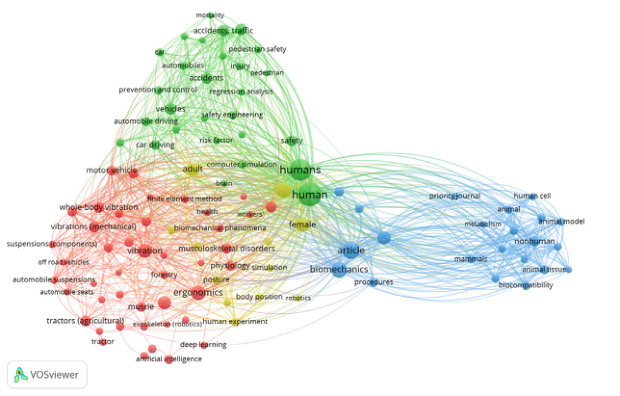
KEYWORD TREND ANALYSIS The identified 165 articles were subjected to bibliometric analysis using the VOSviewer software. A graphical representation of the keyword trend was utilized to visualize the strength of the co-occurrences among the keywords used in the articles.
Figure 1: VOSviewer network map of keywords.
Two thousand nine hundred five keywords were identified from the articles, including those set by the authors and indexed in the SCOPUS database. After refining the keywords, 106 appeared exactly five times. These keywords were used to create a network map, which was grouped into four clusters: ergonomics (red, 44 items), humans (green, 28 items), biomechanics (blue, 22 items), and equipment design (yellow, 12 items). The map revealed that
Ergonomic Risk Assessment of Agricultural Tractors 121 equipment design received the least attention compared to the others. This underscores the need to explore ergonomics concerning equipment design and the hazards associated with it, particularly in agricultural machinery.
REVIEW RESULT The review examining operator health and safety risks associated with tractor operations resulted in the evaluation of various aspects, including types of operations, risk factors, and ergonomic assessment methods.
Operation Type The experimental setup is crucial in understanding the tractor’s suitability for specific tasks and its optimization level. This also indicates the level of information that the analyst can gather from the experiment to make relevant conclusions. Studies typically employed three experimental setup or operation types: laboratory, static, and dynamic.
Six studies (Adam et al., 2020; Kim et al., 2017b; Mehta and Tewari, 2015; Rekem et al., 2024; Tian and Ji, 2024; Xu et al., 2023) employed a combination of laboratory and static setup, with majority simulating vibration transmission.
A dynamic setup was implemented by several studies. The setup allowed the simulation and evaluation of real-world conditions such as dynamic postures (Possebom et al., 2018), dynamic muscular workload during tractor-driving tasks (Hota et al., 2023), effect of steering wheel position and elbow angle on tractor driving comfort (Kuta et al., 2019), effect of speed and terrain on vibration and comfort (Oncescu et al., 2021), relationship of speed, tillage depth, draft setting, and hand-arm vibration (Prakash et al., 2024), seat comfort during plowing, harrowing, and haying (Romano et al. , 2019), vibration transmissibility in tractors with multiple implements (Santos et al., 2019), testing skidders at various speeds to assess vibration levels (Šušnjar et al., 2021), and impact of whole body vibration and awkward posture on MSDs (Upadhyay et al., 2021).
Implement Inclusion Implements are attached to mobile agricultural platforms, such as tractors, to perform specific field tasks (Mocera et al., 2023b). Including tractor implements is vital to assessing the full scope of tractor performance in farming operations. Among the reviewed articles, only two articles (Romano et al., 2019, and Santos et al., 2019) included the use of implements in their experiments.
Risk Factors Key risk factors assessed by studies include vibration, postural score, and muscle workload. Most studies focused on vibration and comfort, as these are key risk factors due to the tractor’s bulk and exposure to rough terrain.
122 Punongbayan and Custodio Kim et al. (2017b) examined vibration levels, comfort, and muscle workload in 11 tractor operators using a laboratory setup with tractor seats featuring single-axial and multi-axial suspensions on different road profiles. Adam et al. (2020) studied how sitting postures and vibration affected vibration transmission through the tractor seat’s suspension system, testing four postures—relaxed, slouched, tensed, and with backrest support—in 11 male operators. Upadhyay et al. (2021) assessed the effect of seat suspension systems on WBV and musculoskeletal disorders (MSDs). Santos et al. (2019) tested a 4x2 TDA tractor at speeds of 3.5 kph and 6.1 kph, using four implements, to estimate vibration transmissibility and measure the amplitude of vibrations experienced by the operator. Similarly, Šušnjar et al. (2021) and Prakash et al. (2024) included speed in their studies of average daily vibration exposure (A(8)) over an 8-hour workday. Šušnjar et al. (2021) found that while hand- arm vibration (HAV) on the steering wheel stayed below the action value of 2.5 m/s², whole-body vibration (WBV) on the seat exceeded it for both skidders. Prakash et al. (2024) showed that increasing speed notably raised HAV levels, suggesting an optimal tractor setting with a speed of 0.8 m/s, draft setting of 2 kN, and tillage depth of 0.14 m to minimize HAV. Oncescu et al. (2021) examined the impact of speed and terrain on vibration and comfort, testing speeds of 5 kph and 10 kph on arable and straight terrains.
Posture and comfort are crucial factors when assessing the risks associated with seated operations. Mazloumi and Kouhnavard (2025) highlighted the importance of posture in tractor drivers, as limited workspace increases the likelihood of MSDs. Lantoine et al. (2021) found neck and lower back discomfort common in seated environments due to improper posture and seat design. Awkward postures often result in back, neck, shoulder, and limb pain (Omidi et al., 2023), prompting Guruguntla and Lal (2022) to recommend focusing on the pelvis and back regions in seat design for improved comfort. Possebom et al. (2018) conducted an ergonomic evaluation of dynamic postures using RULA, REBA, OWAS, and TOR-TOM, with RULA and REBA being the most consistent and relevant. Rekem et al. (2024) examined operator comfort by analyzing transmitted vibrations using a multi-body model and ride simulations based on ISO 5008 standards. In another study, Xu et al. (2023) evaluated steering wheel handling comfort using a biomechanical model and EMG, recommending an optimal steering wheel inclination of 31°, a front-to-back distance of 431 mm, and an upper-lower height of 375 mm to reduce arm muscle fatigue. Romano et al. (2019) assessed seat comfort through barometric mapping of the operator’s buttock-seat interface, testing three seat designs with eight tractor operators during tasks like plowing, harrowing, and haying, and measuring maximum pressure peak (Pmax), average pressure value (Pavg), and the percentage of activated pressure cells.
Fethke et al. (2018) studied the effect of posture on the vibration levels experienced by operators. The study involved 55 farmers using 112 machines, including 64 tractors, 18 combines, 15 heavy utility vehicles, 7 ATVs, and nine other vehicles. The findings showed that the combines had the lowest WBV levels and the best trunk posture. Of the 64 tractors, 44 reached the A(8) action value of 0.5 m/s². In another study, Huang et al. (2025) explored how lumbar support affected ride comfort. Ten male operators with over
Ergonomic Risk Assessment of Agricultural Tractors 123 five years of experience tested three lumbar support thicknesses (3 cm, 6 cm, and 9 cm) at different speeds. Results revealed that increasing lumbar support improved comfort initially, but higher thicknesses decreased comfort. Shoulder comfort consistently worsened. Most operators preferred the 6 cm lumbar support, as the 3 cm support showed limited benefits, and the 9 cm support applied excessive pressure on the lumbar spine. Most studies focused on vibration and comfort, as these are key risk factors due to the tractor’s bulk and exposure to rough terrain. In contrast, posture, muscle workload, and physiological responses received less attention.
Ergonomic Evaluation Techniques The studies employed three methods to assess system ergonomics. The observational method involves a trained analyst observing operators during tasks, noting factors such as posture, movements, workstation design, and any discomfort affecting performance. The instrumental method uses specialized tools to collect data on force, posture, motion, and environmental conditions. Lastly, the self-report method relies on workers sharing their personal ergonomic experiences, including discomfort, pain, and workplace perceptions, often through surveys or interviews.
Possebom et al. (2018) applied four observational methods—RULA, REBA, OWAS, and TOR-TOM—to assess dynamic postures during soil preparation. They found OWAS easy to use, while REBA and RULA focused on postural variables, with RULA (upper body) being most suitable for additional variables, followed by REBA (whole body). Upadhyay et al. (2021) used RULA and anthropometric measurements to examine static and dynamic tractor postures, highlighting a mismatch between operator body dimensions and seat design.
Instrumental methods provide quantitative data to identify ergonomic risks, with tri-axial accelerometers frequently used in vibration studies (Adam et al., 2020; Fethke et al., 2018; Kim et al., 2017b; Oncescu et al., 2021; Prakash et al., 2024; Rekem et al., 2024; Santos et al., 2019; Šušnjar et al., 2021; and Upadhyay et al., 2021). Additional tools, such as tri-axial gyroscopes, tri-axial magnetometers (Kim et al., 2017b), seat adequate transmissibility amplitude (Adam et al., 2020), and multi-body models (Rekem et al., 2024), were also used for vibration analysis. Surface EMG is commonly used for muscle workload analysis (Mehta and Tewari, 2015; Hota et al., 2023; Kuta et al., 2019; Xu et al., 2023). Comfort is assessed through tools like body pressure distribution indexes (Huang et al., 2025), heart rate monitors, oxygen consumption meters (Hota et al., 2023), biomechanical models (Mehta and Tewari, 2015; Kuta et al., 2019), barometric mapping for buttock-seat interfaces (Romano et al., 2019), and machine learning (Tian and Ji, 2024).
Self-report methods capture subjective worker experiences, typically through interviews and the Borg 10 Comfort Rating Scale and Wong-Baker FACES Pain Rating Scale.
124 Punongbayan and Custodio Most studies employed instrumental ergonomic tools, such as tri-axial accelerometers, vibration simulators, machine learning, biomechanical models, surface EMG, heart rate monitors, oxygen meters, barometric pressure maps, and lumbar support. Observational and self-report methods were used less frequently, likely due to their subjective nature.
CONCLUSION
Despite existing information on safety hazards, methods, and operation types, a comprehensive understanding of tractor operation ergonomics remains limited. Most studies overlook real-world implement use— considered in only two articles—despite tractors being designed primarily for land preparation and cultivation. Moreover, imported tractors may not fit the local context, warranting further investigation into their long-term effects on operator safety and health, alongside gaps in the risk factors assessed. While vibration and comfort are typically linked due to their relationship with whole-body and hand-arm vibrations (Hota et al., 2023; Kim et al., 2017b; Oncescu et al., 2021; Rekem et al., 2024; Tian and Ji, 2024), vibration levels are also influenced by posture, which highlights the need to explore how posture impacts other hazards as well (Adam et al., 2020; Fethke et al., 2018). Additionally, muscle workload is connected to vibration, posture, and comfort (Hota et al., 2023; Kim et al., 2017b; Kuta et al., 2019; Xu et al., 2023). While Hota et al. (2023) examined these risk factors, no clear relationships were established. Therefore, it is important to address these hazards and explore how they interact and affect operator safety individually and collectively. Lastly, incorporating three ergonomic evaluation techniques to ensure a comprehensive assessment: observational, instrumental, and self-report methods is recommended. By combining these methods, the risk assessment will cover various aspects of the operator’s experience. Triangulating the results from all three techniques will enhance the accuracy of the findings and help reduce any potential biases, providing a more reliable understanding of the ergonomic impact on the operator.
ACKNOWLEDGMENT
The authors acknowledge the support of the engineering research and Development for Technology (ERDT) program of the Department of Science and Technology–Science Education Institute (DOST-SEI) in conducting this research.
REFERENCES
Adam, S., Jalil, N. A., Rezali, K. M., & Ng, Y. (2020). The effect of posture and vibration magnitude on the vertical vibration transmissibility of tractor suspension system. International Journal of Industrial Ergonomics, 80, 103014. https://doi. org/10.1016/j.ergon.2020.103014 Agriculture Overview. (2024). World Bank. https://www.worldbank.org/en/topic/
Ergonomic Risk Assessment of Agricultural Tractors 125 Agyei-Holmes, A. (2016b). Technology transfer and agricultural mechanization
in Tanzania: institutional adjustments to accommodate emerging economy innovations. Innovation and Development, 6(2), 195–211. https://doi.org/10.108 0/2157930x.2016.1196545 Anik, A. R., Rahman, S., & Sarker, J. R. (2020). Five Decades of Productivity and Efficiency Changes in World Agriculture (1969–2013). Agriculture, 10(6), 200. https://doi.org/10.3390/agriculture10060200 Beckman, J., & Countryman, A. M. (2021). The Importance of Agriculture in the
Economy: Impacts from COVID-19. American Journal of Agricultural Economics, 103(5), 1595–1611. https://doi.org/10.1111/ajae.12212 Benos, L., Bechar, A., & Bochtis, D. (2020). Safety and ergonomics in human-robot interactive agricultural operations. Biosystems Engineering, 200, 55–72. https:// doi.org/10.1016/j.biosystemseng.2020.09.009 Benos, L., Tsaopoulos, D., & Bochtis, D. (2020). A review on Ergonomics in
agriculture. Part II: Mechanized Operations. Applied Sciences, 10(10), 3484. https://doi.org/10.3390/app10103484 Diao, X., Silver, J., & Takeshima, H. (2016). Agricultural mechanization and agricultural transformation. SSRN Electronic Journal. https://papers.ssrn. com/sol3/Delivery.cfm/SSRN_ID2778723_code1123746.pdf?abstractid= 2778723&type=2 Dridi, I., Hamza, A., & Yahia, N. B. (2023). A new approach to controlling an active
suspension system based on reinforcement learning. Advances in Mechanical Engineering, 15(6). https://doi.org/10.1177/16878132231180480 Fethke, N. B., Schall, M. C., Merlino, L. A., Chen, H., Branch, C. A., & Ramaswamy, M. (2018). Whole-Body vibration and trunk posture during operation of agricultural machinery. Annals of Work Exposures and Health, 62(9), 1123–1133. https://doi.org/10.1093/annweh/wxy076 Gejdoš, M., Hitka, M., & Balážová, Ž. (2021). Anthropometric Analysis of Selected
Body Dimensions and Comparison with the Design Approach for Forestry and Agricultural Machine Operators. Forests, 12(8), 1038. https://doi.org/10.3390/ f12081038 Guruguntla, V., & Lal, M. (2022). Multi-body modelling and ride comfort analysis of a seated occupant under whole-body vibration. Journal of Vibration and Control, 29(13–14), 3078–3095. https://doi.org/10.1177/10775463221091089 He, J., Li, H. W., Chen, H. T., Lu, C. Y., and Wang, Q. J. (2018). Research Progress
of Conservation Tillage Technology and Machinery. Trans. Chin. Soc. Agric. Machinery. 49, 1–19. https://doi.org/10.6041/j.issn.1000-1298.2018.04.001 Hota, S., Tewari, V. K., & Chandel, A. K. (2023). Workload Assessment of Tractor Operations with Ergonomic Transducers and Machine Learning Techniques. Sensors, 23(3), 1408. https://doi.org/10.3390/s23031408 Huang, Q., Gao, M., Wei, Y., Zhang, J., & Jin, X. (2025). Research on the impact
of lumbar support on tractor operators’ ride comfort considering body pressure distribution and subjective assessment. Agriculture, 15(4), 410. https://doi. org/10.3390/agriculture15040410 Kim, J. H., Dennerlein, J. T., & Johnson, P. W. (2017). The effect of a multi-axis suspension on whole body vibration exposures and physical stress in the neck and low back in agricultural tractor applications. Applied Ergonomics, 68, 80–89. https://doi.org/10.1016/j.apergo.2017.10.021 Kuta, Ł., Stopa, R., Szyjewicz, D., & Komarnicki, P. (2019). Determination
of comfortable position for tractor Driver’s hands based on dynamic load. International Journal of Industrial Ergonomics, 74, 102866. https://doi. org/10.1016/j.ergon.2019.102866
126 Punongbayan and Custodio Lantoine, P., Lecocq, M., Bougard, C., Dousset, E., Marqueste, T., Bourdin, C., Allègre,
J., Bauvineau, L., & Mesure, S. (2021). Influence of car seat firmness on seat pressure profiles and perceived discomfort during prolonged simulated driving. Applied Ergonomics, 100, 103666. https://doi.org/10.1016/j.apergo.2021.103666 Lincoln, J. M., & Elliott, K. (2023). Emerging technology in agriculture: Opportunities and considerations for occupational safety and health researchers. Journal of Safety Research, 86, 92–95. https://doi.org/10.1016/j.jsr.2023.06.001 Mazloumi, A., & Kouhnavard, B. (2025). Investigation of Observational Techniques
Ergonomic Risk Assessment of Work-Related Musculoskeletal Disorders among Farmers - A Systematic Review. Journal of Agromedicine, 1–24. https://doi.org/1 0.1080/1059924x.2024.2436447 Mehta, C., & Tewari, V. (2015). Biomechanical model to predict loads on lumbar vertebra of a tractor operator. International Journal of Industrial Ergonomics, 47, 104–116. https://doi.org/10.1016/j.ergon.2015.02.006 Mocera, F., Somà, A., Martelli, S., & Martini, V. (2023). Trends and Future
Perspective of electrification in Agricultural Tractor-Implement Applications. Energies, 16(18), 6601. https://doi.org/10.3390/en16186601 Nam, K., Suk, S. D., and Byeong-il, A. (2021). The Empirical Analysis of Production Cost Reduction Effects from the Agricultural Machinery Rental Policy. J. Rural Dev. 44, 51–78. https://doi.org/10.36464/jrd.2021.44.2.003 Omidi, M., Van De Perre, G., Hota, R. K., Cao, H., Saldien, J., Vanderborght, B.,
& Makrini, I. E. (2023). Improving Postural Ergonomics during Human–Robot Collaboration Using Particle Swarm Optimization: A Study in Virtual Environment. Applied Sciences, 13(9), 5385. https://doi.org/10.3390/app13095385 Oncescu, T. A., Petcu, A., & Tarniță, D. (2021). Evaluation of whole-body vibrations and comfort state of tractor driver for different types of terrain and speeds. Acta technica napocensis - series: applied mathematics, mechanics, and ENGINEERING, 64(1). https://atna-mam.utcluj.ro/index.php/Acta/article/download/1565/1284 Possebom, G., Alonço, A. D. S., Bellochio, S. D. C., Lopes, T. G., Carpes, D. P., Becker,
R. S., Moreira, A. R., Francetto, T. R., Rossato, F. P., & Zart, B. C. C. R. (2018). Comparison of methods for postural assessment in the operation of agricultural machinery. Journal of Agricultural Science, 10(9), 252. https://doi.org/10.5539/ jas.v10n9p252 Prakash, C., Singh, L. P., Gupta, A., & Singh, A. (2024). Prediction of hand-arm vibration among tractor operators in different soil tillage operations using artificial neural network-based model. Computers and Electronics in Agriculture, 230, 109858. https://doi.org/10.1016/j.compag.2024.109858 Qilu Machinery. (2023, June 4). What is the Role of Tractors in Agriculture? Qiu, B., Zhang, Y., Shen, H., Zhou, J., & Chu, L. (2023). Ergonomic researches
in agricultural machinery- a systematic review using the PRISMA method. International Journal of Industrial Ergonomics, 95, 103446. https://doi. org/10.1016/j.ergon.2023.103446 Qu, X., Kojima, D., Nishihara, Y., Wu, L.-P., and Ando, M. (2021). Can Harvest Outsourcing Services Reduce Field Harvest Losses of rice in China? J. Integr. Agric. 20, 1396–1406. https://doi.org/10.1016/S2095-3119(20)63263-4 Rekem, J., Janečková, R., Otipka, V., Prokop, A., Řehák, K., & Žlábek, P. (2024).
Multi-Body model of agricultural tractor for vibration tra¸nsmission investigation. Applied Sciences, 14(18), 8451. https://doi.org/10.3390/app14188451 Romano, E., Pirozzi, M., Ferri, M., Calcante, A., Oberti, R., Vitale, E., & Rapisarda, V. (2019). The use of pressure mapping to assess the comfort of agricultural machinery seats. International Journal of Industrial Ergonomics, 77, 102835. https://doi.org/10.1016/j.ergon.2019.102835
Ergonomic Risk Assessment of Agricultural Tractors 127 Santos, V. C. D., De Almeida Monteiro, L., Macedo, D. X. S., & Costa, E. (2019).
Whole body vibration in operators using agricultural soil preparation equipment. Ciência Rural, 49(11). https://doi.org/10.1590/0103-8478cr20190109 Shutske, J. M., Sandner, K. J., & Jamieson, Z. (2023). Risk assessment Methods for Autonomous Agricultural Machines: A review of current practices and future needs. Applied Engineering in Agriculture, 39(1), 109–120. https://doi. org/10.13031/aea.15281 Šušnjar, M., Pandur, Z., Zečić, Z., Kopseak, H., & Bačić, M. (2021). Skidder operator
vibration exposure. In Advances in intelligent systems and computing (pp. 25–32). https://doi.org/10.1007/978-3-030-66937-9_3 Tian, H., & Ji, A. (2024). Real-time Adaptive Tractor Ride Comfort Adjustment System Based on machine learning Method. IEEE Access, 1. https://doi. org/10.1109/access.2024. Upadhyay, R., Senapati, A., Chau, K., Bhattacherjee, A., Patra, A. K., & Chau, N.
(2022). Development of an intervention program to reduce whole-body vibration exposure based on occupational and individual determinants among dumper operators. International Journal of Occupational Safety and Ergonomics, 30(1), 41–55. https://doi.org/10.1080/10803548.2022.2159176 Viana, C. M., Freire, D., Abrantes, P., Rocha, J., & Pereira, P. (2022). Agricultural land systems importance for supporting food security and sustainable development goals: A systematic review. The Science of the Total Environment, 806, 150718. https://doi.org/10.1016/j.scitotenv.2021.150718 Vorozhtsov, O. V., Plaksin, I. E., & Trifanov, A. V. (2022). The use of small-sized
tractors in agriculture. IOP Conference Series Earth and Environmental Science, 979(1), 012034. https://doi.org/10.1088/1755-1315/979/1/012034 Xu, H., Yang, H., Shang, Y., Zhang, Y., Liu, Z., Wang, Q., & Zhang, G. (2023).
Optimization of key position parameters for tractor steering wheel based on a driver’s arm muscle load analysis. International Journal of Agricultural and Biological Engineering, 16(5), 236–247. https://doi.org/10.25165/j. ijabe.20231605.7996
LISTED IN THE AHFE DIGITAL BOOKSTORE CATALOGUE
Explore the complete digital volume
Physical Ergonomics and Human Factors
Read this individual research paper free through the original publisher, or explore the full digital proceedings book.
ISBN 978-1-964867-99-1
Explore this ISBN in the AHFE Bookstore ↗Listed in the July 2026 bookstore catalogue; search by ISBN to confirm current availability · Digital book purchase optional