Sergio Alberto Valenzuela Gomez, Sergio Neri-Ledezma, Diana-Enid Alatorre-López (2026). Design of a rapid assessment tool to identify ergonomic risk factors due to manual material handling tasks in mexican workers. In: Physical Ergonomics and Human Factors. AHFE Open Access, vol. 223, pp. 110–116. https://doi.org/10.54941/ahfe1007802
1 Department of Health and Disease as an Individual and Collective Process, University Center of Tlajomulco, University of Guadalajara, Tlajomulco de Zúñiga, JAL, 45641 México ↗
2 University of Guadalajara, University Center of Tlajomulco, University of Guadalajara Tlajomulco de Zúñiga, JAL, 45641, México ↗
The project focuses on the design of a rapid assessment tool to identify exposure to ergonomic risk factors associated with manual material handling (MMH) tasks, such as lifting, lowering, pushing, pulling, carrying, and holding loads. The tool was developed using five evaluation criteria, each divided into 10 items rated on a scale from 0 (not met) to 4 (optimal compliance). The final version of the instrument consists of a checklist with 50 items, considering the evaluation criteria mentioned above. This format was conceived to make an easy-to-applied assessment in real working conditions, particularly by health and safety managers or other stakeholders who understand workplace procedures but are not necessarily experts in human factors and ergonomics. This rapid assessment tool allows for a structured and practical overview of compliance with ergonomic requirements and standards. In addition, this instrument may facilitate the implementation of ergonomic regulations in workplaces by making their interpretation and application more accessible. Ultimately, the evaluator can independently follow up on each item or address the entire criterion if necessary.
Manual Material Handling (MMH) encompasses a set of work-related activities such as lifting, lowering, carrying, pushing, pulling, transporting, or holding loads manually, without the predominant use of mechanical aids. This type of task is widely applied in many workplaces and productive sectors; for example, manufacturing, agriculture, construction, and services. It’s a low-cost method with operational flexibility; however, when these activities are not designed or performed under appropriate ergonomic principles, they become dangerous and one of the main risk factors for workers (Yang & Jeong, 2019).
Design of a Rapid Assessment Tool to Identify Ergonomic Risk Factors 111 Several studies indicate that physical risk factors are intensified by heavy loads, repetitive movements, and awkward postures maintained throughout the workday. In this regard, Suhimi and Rahman (2024) report that continuous exposure to manual material handling without adequate ergonomic criteria leads to a progressive accumulation of physical load, increasing the likelihood of developing musculoskeletal disorders, particularly among workers subjected to repetitive exertion.
Similarly, Kumar et al. (2021) report that the lack of ergonomic adjustments in manual handling tasks promotes muscle fatigue and long-term functional issues. As noted above, factors such as excessive load weight, postures, lifting frequency, and exposure time increase the biomechanical load and have a direct relation with the development of work-related musculoskeletal disorders, particularly in the lower back, shoulders, and upper extremities (Das, 2023). Despite ergonomic improvements in many productive sectors, certain work activities still require physical capabilities to perform repetitive tasks or manual material handling (Yang and Jeong, 2019).
From an ergonomics and human factors perspective, MMH involves a direct interaction between the worker’s physical capabilities, task demands, and environmental conditions. Studies conducted in different occupational settings have shown a significant association between MMH and the prevalence of musculoskeletal symptoms, as well as decreased performance and increased work absenteeism (Pratiwi et al., 2020).
Ergonomic assessment of manual handling tasks is a fundamental tool for the identification and classification of risk factors in exposed workers. Recent research has explored alternative methods and other ergonomic indicators to assess the risk associated with MMH (Rezvanizadeh et al., 2023). But also, it’s important to recognize the most well-known methods like NIOSH, which is one of the most popular and specific for these kind of activities.
All these findings underscore the need to implement preventive strategies based on scientific evidence and ergonomic work system design. In the Mexican context, the importance of preventing ergonomic risks factors from MMH is recognized in the Official Mexican Standard (NOM-036- 1-STPS-2018), which establishes guidelines for the identification, analysis, prevention, and control of ergonomic risk factors associated with MMH. This regulation defines criteria for risk assessment, maximum load limits, and employer obligations; one of it’s aims is to reduce the incidence of musculoskeletal disorders in workplaces (Department of Labour and Social Welfare [STPS], 2018).
Nevertheless, despite this regulatory framework, working conditions often fail to meet the required ergonomic criteria, particularly in sectors with high physical demands and limited automation. Leggieri et al. (2023) highlight that the lack of integration of ergonomic assessment tools into real manual handling tasks limits the effectiveness of preventive actions, even when regulatory guidelines exist. These authors emphasize the importance of systematic assessments of working conditions, noting that risks associated with manual material handling persist and manifest as a high physical workload on workers.
Therefore, this work aims to design a rapid assessment tool that can promptly identify exposure to ergonomic risk factors associated with manual
material handling. This encompasses any activity or movement that requires workers to lift, lower, push, pull, carry, throw, move, hold, or restrain objects, equipment, or tools. The proposed tool is structured as a checklist to enable quick evaluation and classification of the general organizational conditions and to identify workstations exposed to these risks.
UNDERSTANDING BIOMECHANICAL AND PHYSIOLOGICAL IMPLICATIONS IN MATERIAL MANUAL HANDLING TASKS The physical load refers to the effect of force exerted during material handling operations, resulting from the interaction with material handling equipment or the material itself (Rajesh, 2016). Manual material handling continues to play a significant role in processes such as manufacturing, warehousing, raw material supply, and distribution centers, where loading and unloading tasks are common; consequently, substantial human input is required for these operations.
In this sense, Wahlström et al. (2025) demonstrated that construction workers face an increased risk of serious injuries requiring surgical intervention and physical rehabilitation. In a large cohort study of 262,850 workers, they identified high-risk tasks such as frequent lifting, extreme flexion/extension, and significant whole-body vibration exposure. Notably, construction workers who underwent surgery for lumbar disc herniation (LDH) often left the labor market with a disability pension, with a mean retirement age between 51 and 55 years.
The scenario described above is also prevalent in developing countries such as Mexico, where a high percentage of the population works in conditions lacking systematic implementation of preventive strategies or any formal occupational health programs. According to the National Institute of Statistics and Geography (INEGI), labor informality in Mexico is projected to reach nearly 55% of the total working population in 2025. This underscores the urgent need to improve workplace conditions and operations, as well as to address the lack of infrastructure needed to conduct research that accurately documents specific aspects, such as biomechanical and physiological effects, in the Mexican workforce.
Nevertheless, there is research that provides valuable quantitative and qualitative data. For example, Rahman and Ryu (2026) developed a multimodal physical fatigue assessment involving 22 participants (15 males and 7 females). They collected physiological data, including heart rate (HR) and skin temperature (ST), as well as kinematic data using a wearable sensor. The study found that HR, ST, and human kinematic jerk increased as tasks became more demanding, which correlated with higher Borg’s Rating of Perceived Exertion (RPE) scores.
Rahman et al. (2026) also found that gender influenced physiologically and perceived exertion, emphasizing the importance of demographic and anthropometric factors in the execution of physical tasks. Nugraha and Widajati (2024) document that in highly physically demanding production environments, the absence of ergonomic management grounded in human factors principles perpetuates unsafe working conditions, increasing the
Design of a Rapid Assessment Tool to Identify Ergonomic Risk Factors 113 likelihood of musculoskeletal disorders and affecting both worker well-being and overall work system performance.
Finally, Suksa-nga et al. (2025) conducted a study to predict the compressive force at L5/S1among Thai workers, who were exposed to lifting activities. Participants aged from 18 to 24 and divided by gender, performed lifting activities in diferent frequencies (from 1 to 12 lifts per minute). Afterwards, the collected data was analyzed using the software 3D Static Strength Prediction Program (3DSSPP) to estimate the spinal compression at L5/S1. The results of this research showed that lift origin, load weight, trunk angle, body mass index, and perceived exertion directly affect the task performance and low back integrity.
This study also contributed to the identification of additional ergonomic risk factors associated with manual material handling (MMH) and the estimation of appropriate weight limits to help prevent musculoskeletal injuries or symptoms. In agreement, Suksa-nga et al. (2025) emphasize the importance of training programs that focus on improving lifting techniques and promoting self-awareness among workers during manual handling tasks.
DESIGN AND DEVELOPMENT OF THE ASSESSMENT TOOL The assessment tool was developed as a rapid self-assessment instrument to identify workstations that involve manual material handling. In addition to the incorporation of biomechanical and physiological aspects, as previously discussed, the design was based on the NOM-036-1-STPS-2018 standard. This regulation provides the framework for the analysis, prevention, and control of ergonomic risk factors associated with manual material handling activities.
One of the main goals in developing this assessment tool is to make all requirements more accessible and easier to apply. Because NOM-036-1- STPS-2018 is a technical and specialized regulation within the health domain, many operational staff and supervisors may not be fully aware of the critical points that should be prioritized. Hence, the tool was designed to bridge this gap by presenting all concepts and key points in a clear, practical format that supports effective understanding and compliance.
This tool is intended for use in any workplace where manual material handling (MMH) activities are performed. While it is broadly applicable, special attention is given to micro, small, and medium-sized organizations, recognizing their unique challenges—such as limited access to technical and specialized ergonomic analysis methods. By addressing these challenges, the assessment tool aims to bridge gaps in ergonomic management and promote safer, more effective practices across organizations of all sizes.
For the design, the chapters, requirements, and compliance obligations directly associated with NOM-036-1-STPS-2018—particularly those relating to manual material handling activities—were systematically identified and analyzed. Based on this analysis, five key dimensions or evaluation criteria were established, each reflecting the principal components required for workplace compliance (see Table 1).
Table 1: Evaluation criteria according to the NOM-036-1-STPS-2018.
Table available in the original PDF paper.
Criteria Total of Items per Criteria Identification and classification of exposed workstations 10 items
10 items
Use of auxiliary loading equipment and enviromental conditions Personnel training and health surveillance 10 items
10 items
Dissemination and registration of ergonomic policies and strategies Preventive and control measures 10 items
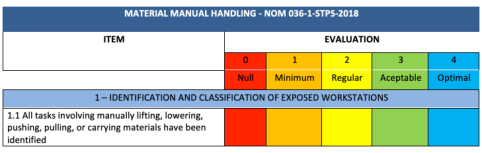
The final version of the assessment tool layout consists of a checklist format, where each criterion is divided into 10 specific items. Each item is rated on a scale from 0 to 4, with 0 indicating null implementation or identification and 4 indicating optimal implementation or identification, as perceived by the respondent. This structure facilitates a rapid, systematic identification of workstations or processes that need to be prioritized (see Figure 1).
Figure 1: Final version of the assessment tool layout.
RESULTS
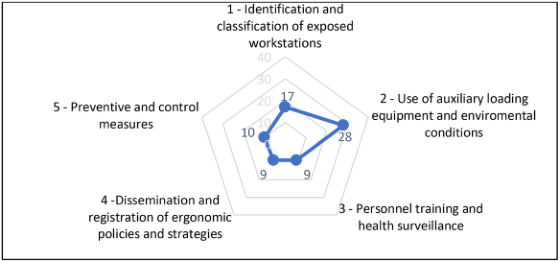
A rapid self-assessment instrument was developed, comprising 50 items organized into 5 evaluation criteria. Upon completion, the results can be analyzed at multiple levels: (1) Each item highlights a potential area for improvements, allowing targeted interventions to address those points where the lowest scores were reported; (2) Each evaluation criterion can be assessed by summing the scores of all the 10 items, providing an overview of its overall condition; and (3) All evaluation criteria can be compared to determine which areas are most critical or require priority attention (see Figure 2).
Figure 2: Evaluation criteria comparison output.
CONCLUSION
Implementing a self-assessment tool to identify ergonomic risk factors can serve as a critical first step for organizations or companies on the path to regulatory compliance, the systematic development of prevention strategies, and the promotion of healthy work environments. By facilitating early identification of risks, such tools empower workplaces to take proactive measures, foster a culture of safety, and contribute to the overall well-being of their workforce. Organizational self-awareness is an essential prerequisite for effective action, decision-making, and learning processes (Zacarias et al., 2008).
Therefore, it is essential to have tools that help identify priority areas for intervention, thereby enabling organizations to exercise greater control over workplace events and risks. However, beyond building this organizational self- awareness, it is equally important to sustain it through ongoing engagement, communication, and proactive participation of all members. Continuous interaction and initiative at every level are fundamental to maintaining a culture of prevention and safety.
As discussed throughout this work, a primary objective was to translate the key concepts and evaluation criteria of ergonomic risk management into an operational instrument that facilitates compliance with regulatory requirements for manual material handling. This is particularly important because the technical language and specialized content of current regulations can often be confusing or inaccessible to those responsible for implementation.
The scope of this project includes the dissemination of the self-assessment tool across productive sectors. To ensure its effectiveness, pilot tests will be conducted to validate the evaluation criteria, confirm that users understand them, and verify that results are interpreted correctly.
Based on the findings from these pilot tests, the tool may be iteratively revised or reorganized, ensuring that the information provided is both accurate and closely aligned with official regulations while remaining user- friendly for workplace application.
REFERENCES
Das, B. (2023). Work-related musculoskeletal disorders in agriculture: Ergonomics risk assessment and its prevention among Indian farmers. Work, 76(1), 225–241. Kumar, M., Mishra, G., Vaibhav, R., Priyadarshini, S., & Turagam, N. (2021).
Assessment of knowledge about ergonomics and determining musculoskeletal disorders in dentists: An original research. Journal of Pharmacy and Bioallied Sciences, 13(Suppl 1), S391-S394. Leggieri, S., Fanti, V., Caldwell, D. G., & Di Natali, C. (2023). Online ergonomic evaluation in a realistic manual material handling task: proof of concept. Bioengineering, 11(1), 14. Nugraha, A., & Widajati, N. (2024). Ergonomic risks in manual material handling
activities and musculoskeletal disorders complaints in the animal feed industry production area in East Java, Indonesia. World Journal of Advanced Research and Reviews, 22(1), 1028–1034. Pratiwi, I., & Kalyana, V. S. (2022). Ergonomic risk evaluation of manual material handling in brick production. Jurnal Ilmiah Teknik Industri, 21(1), 113–124.
Rahman, M. H., & Ryu, J. (2026). A multimodal physical fatigue assessment method using a biomarker and accelerometer-embedded wearable wristband. International Journal of Industrial Ergonomics, 111, 103867. Rajesh, R. (2016). Manual material handling: A classification scheme. Procedia
Technology, 24, 568–575. Rezvanizadeh, M., Mohammad-Ghasemi, M., Soltanzadeh, A., & Sadeghi-Yarandi, M. (2023). Development of an ergonomics management model in the workplace: Introduction of the TUGA ergonomics management and analysis model (TEMA). Work, 76(1), 205–224. Suhimi, M. L. H., & Rahman, M. N. A. (2024). Ergonomic Risk Assessment for
Manual Handling Activities in Automotive Workshop. Journal of Sustainable Manufacturing in Transportation, 4(1), 1–8. Suksa-Nga, N., Sombatsawat, E., Charoenporn, N., & Kaewdok, T. (2026). A biomechanical model for predicting the compressive force exerted on L5/S1 in manual material handling by Thai youth in Thailand. Work, 10519815251365093. Wahlström, J., Liv, P., Stjernbrandt, A., Sayed-Noor, A. S., Mukka, S., Lewis, C., &
Jackson, J. A. (2025). Occupational risk factors for surgically treated lumbar disc herniation–a 33-year follow-up. Scandinavian Journal of Work, Environment & Health, 51(6), 550. Yang, S. T., & Jeong, B. Y. (2019). Comparison of accident characteristics between manual materials handling (MMH) and non-MMH works in the automobile parts manufacturing industry: Based on South Korea and the US. Work, 62(2), 197–203. Zacarias, M., Magalhães, R., Caetano, A., Pinto, H. S., & Tribolet, J. (2008).
Towards organizational self-awareness: an initial architecture and ontology. In Handbook of ontologies for business interaction (pp. 101–121). IGI Global Scientific Publishing.
LISTED IN THE AHFE DIGITAL BOOKSTORE CATALOGUE
Explore the complete digital volume
Physical Ergonomics and Human Factors
Read this individual research paper free through the original publisher, or explore the full digital proceedings book.
ISBN 978-1-964867-99-1
Explore this ISBN in the AHFE Bookstore ↗Listed in the July 2026 bookstore catalogue; search by ISBN to confirm current availability · Digital book purchase optional