Hironao Yamada (2026). Enhancing Operability of Glove-Type Power-Assist Systems: Descent-Assist Mechanism based on Human Centered Design. In: Human Interaction and Emerging Technologies (IHIET-FS 2026): Future Systems and Design Applications. AHFE Open Access, vol. 235, pp. 1–7. https://doi.org/10.54941/ahfe1007255
Power assist devices can reduce the physical burden on factory workers; however, conventional control methods often induce hand pain and unstable operation during lowering tasks. Guided by human centered design (HCD), we adopted a design policy that does not require fine grip force modulation from operators during the most demanding phase. To this end, we developed and integrated a descent-assist switch (DAS) into the glove type interface of a traction type power-assist device (TPAD), enabling explicit switching of assistive behavior during lowering to improve operability and reduce physical/mental workload. We conducted comparative experiments with and without the DAS during lowering. Objective physical burden was assessed via lumbar joint torque, focusing on the peak value (maximum mechanical stress) and the time integral (sustained load). Subjective operability and perceived workload were measured using a Semantic Differential (SD) questionnaire, and factor analysis identified three latent dimensions: Sense of Security, Operability, and Fatigue. With the DAS, both the peak and time integral of lumbar joint torque during lowering were reduced relative to the no DAS condition, indicating lower physical burden. Questionnaire outcomes likewise showed higher ratings across Sense of Security, Operability, and Fatigue. Collectively, these findings demonstrate that the descent-assist switch reduces user burden and improves operability of the TPAD during lowering tasks.
Despite ongoing advances in factory automation, many production lines continue to rely on complex manual operations. In heavy load transfer tasks, workers frequently grasp and manipulate objects directly, as manual handling remains appropriate in certain contexts. Power-assist devices are therefore regarded as an effective means of reducing worker burden (de Looze, 2016). Guided by human centered design (HCD), this study aims to reduce physical and mental workload and improve operability for operators.
Conventional arm type power-assist devices employ end effectors tailored to the geometry of the handled objects (Yamada et al., 2021). However, pre grasp alignment and fixation are typically required, which can degrade work Received January 19, 2026; Revised February 5, 2026; Accepted February 24, 2026; Available online June 22, 2026
efficiency and increase operator burden. An approach is needed that enables operation through natural, hand like motions without presupposing specific gripping skills or advanced training.
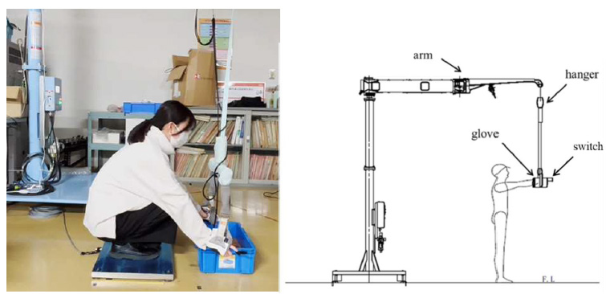
Building upon a commercial arm type device (Aikoku Alpha Co., Ltd.), we utilize a traction type power-assist device (TPAD) whose gripping section is redesigned as a glove type interface. Figure 1 illustrates the device in use and an overview of the apparatus employed in the experiments.
Figure 1: Device in use and an overview of the apparatus employed in the experiments.
Force sensors embedded in the glove detect the assistive force required to supplement operator input during vertical motion, and a pneumatic actuator provides power-assistance accordingly. By adopting a glove shaped gripper, the device allows handling irrespective of object shape while preserving a tactile experience comparable to bare hand manipulation.
During lowering, operators must reduce grip force while supporting the load, which requires coordinated activation of antagonistic muscles (Lazzaroni, 2021). Fine modulation of grip force is intrinsically difficult under such conditions; as a result, sensor inputs can become unstable and the intended assist may not be delivered. From an HCD perspective, we therefore adopt a design policy that does not impose fine grip force adjustments on the operator. We incorporate a descent-assist switch (DAS) that explicitly switches assistive behavior during lowering to improve operability and reduce physical and mental workload.
We conducted comparative experiments with and without the DAS. Physical workload was evaluated via joint torque (peak value and time integral), while mental workload and operability were assessed using an SD questionnaire (Osgood, 1955). By integrating subjective and objective measures with real users, we verify the effectiveness of the proposed approach.
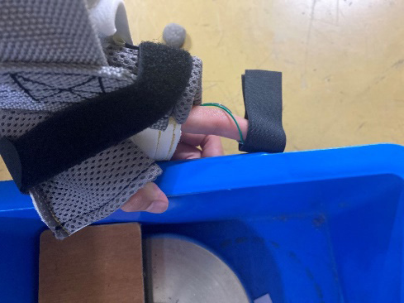
Descent Assist Switch (DAS) To improve operability and reduce both physical and mental workload during lowering with the TPAD, we mounted a descent-assist switch (DAS) on the left hand glove (Fig. 2).
Enhancing Operability of Glove-Type Power-Assist Systems 3 The DAS is used only during lowering and, while ON, maintains the assistive force at a constant value. This reflects the hypothesis that operability improves during the most demanding phase—lowering—if the operator can obtain stable assistance without tuning the right hand grip force sensor.
When the operator presses the DAS while the system is in the standard right hand grip force sensor control mode, the controller ignores the grip force input and holds the assistive force at the pre press value minus 9.8 N. Upon releasing the DAS, the assistive force is set to a constant 19.6 N; after 2 s, the assistive force is reduced to 0 N; after an additional 2 s, the control mode returns to grip force sensor control. For safety, if a rapid downward movement is detected (i.e., a sudden decrease in glove height), the system reverts to grip force sensor control.
Methods: Experimental Protocol We evaluated the effectiveness of the TPAD in lifting and lowering tasks under two postures commonly observed in industrial settings: (1) squatting, which is expected to reduce physical load, and (2) forward bending, which is frequently adopted in actual workplaces. For each posture and switch condition (with vs. without DAS), we quantified the burden reduction percentage attributable to TPAD use and evaluated overall effectiveness. Questionnaire responses were also analyzed to compare perceived burden with and without the DAS.
The study protocol was approved by the Ethics Committee for Medical Research at Gifu University. All participants received a description of the procedures and provided informed consent. A total of 22 participants took part in the experiments.
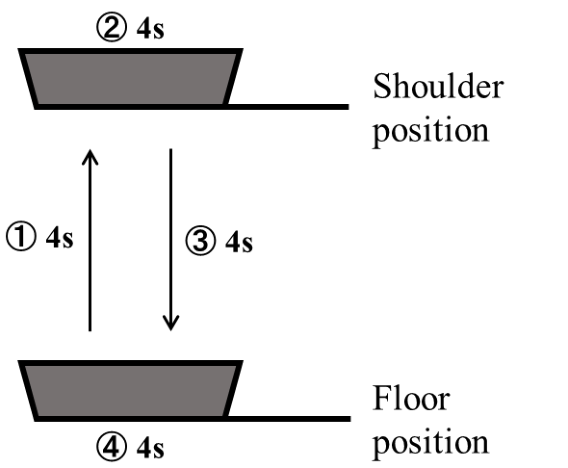
The lifting–lowering task (Fig. 3) consisted of raising a container from the floor to a shoulder height horizontal position and then lowering it back to the floor.
Each trial followed the sequence below at 4 s intervals:
1. slowly raise the container from the floor to shoulder height; 2. hold at shoulder height; 3. slowly lower the container from shoulder height to the floor; 4. place the container on the floor and stop.
The container was loaded with a 10 kg mass. We examined four conditions:
without DAS, beginning and ending in a squatting posture;
without DAS, beginning and ending in a forward bending posture;
with DAS, beginning and ending in a squatting posture;
with DAS, beginning and ending in a forward bending posture.
To mitigate order effects, the sequence of these four conditions was randomized for each participant.
RESULTS
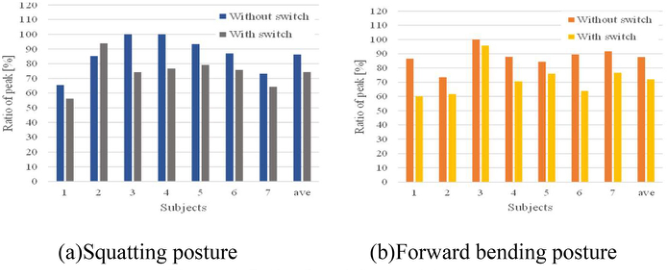
Sudden increases in operator burden during manual load transfer are hazardous; consequently, it is desirable that a power-assist device attenuates peak joint torque, which reflects the moment of highest mechanical stress. Focusing on the lowering phase, we analyzed lumbar joint torque peak values for each participant and compared with vs. without DAS across both postures.
Figure 4 presents data from seven representative participants, normalized to 100% for the baseline without a power-assist device; percentages during TPAD use are shown for each posture (“ave” denotes the mean). In both postures, normalized peak lumbar joint torque was lower—that is, the burden reduction percentage was higher—with DAS than without DAS for six of seven participants; the sole exception was Participant 2 in the squatting posture. We infer that, without DAS, many operators were unable
Enhancing Operability of Glove-Type Power-Assist Systems 5 to maintain the required assistive force until the end of lowering, leading to insufficient attenuation of peak load.
Figure 4: Ratio of peak lumbar joint torque.
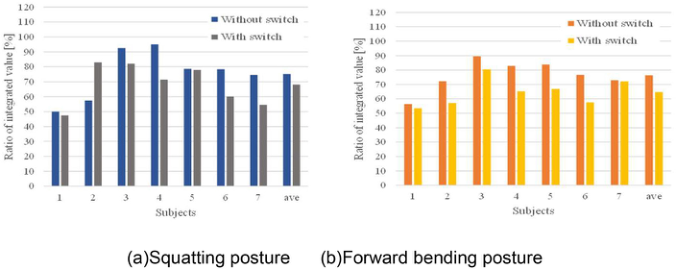
To evaluate sustained burden during transport, we computed the time integral of lumbar joint torque over the lowering phase and again compared with vs. without DAS across both postures. Figure 5 shows results for the same seven participants, normalized to 100% for the baseline without a power-assist device (“ave” denotes the mean). In both squatting and forward bending postures, integrated lumbar joint torque exhibited a greater reduction with DAS than without DAS for six of seven participants—the same exception being Participant 2 in the squatting posture.
Figure 5: Ratio of integrated lumbar joint torque.
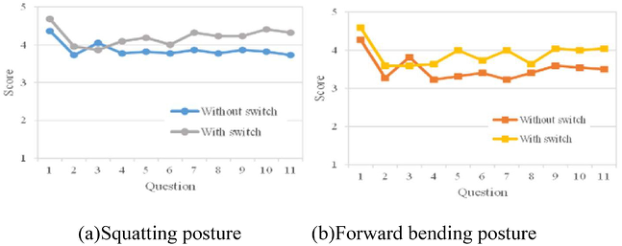
Questionnaire and Factor-Analytic Results The questionnaire items are listed in Table 1. Figure 6 (a)–(b) present the mean scores across all participants for each SD scale in the squatting and forward bending postures, respectively. Higher scores indicate more favorable evaluations. In both postures, the with DAS condition received higher evaluations than without DAS for all items except Item 3 (“operation is complex–simple”). The lower ratings for Item 3 reflect perceived increased operational complexity: in addition to tuning the right hand glove, participants needed to operate the DAS, adding an extra workflow step.
Figure 6: Result of SD method.Table 1: Questionnaire items.
Table available in the original PDF paper.
No. Subject 1 ⇔ 5 No. Subject 1 ⇔ 5 No. 1 ⇔ 5
1 Assist power
5 Operability Bad ⇔ Good 9 Uncomfortable ⇔ Comfortable
6 Device: Difficult to use ⇔ Easy to use 11 Scary ⇔ Safe
3 Operation Complex ⇔ Simple
7 Fatigue Feeling ⇔ Not feeling
4 Operation Unsettled ⇔ Calm
8 Stress Feeling ⇔ Not feeling
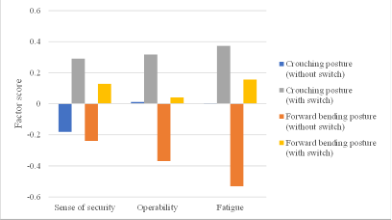
To analyze the underlying structure of these impressions, we conducted factor analysis on the questionnaire data, extracting latent judgment criteria (factors) and estimating factor scores for each participant. Table 2 lists the names assigned to the three extracted factors based on semantic interpretation: Factor 1: Sense of Security, Factor 2: Operability, and Factor 3: Fatigue. Figure 7 shows the mean factor scores. For all three factors—Sense of Security, Operability, and Fatigue—the with DAS condition achieved higher scores than the without DAS condition. For Factor 3 (Fatigue), we infer that lower evaluations in the without DAS condition were influenced by inability to maintain the required assistive force until the end of lowering.
Table 2: Factor name.
Table available in the original PDF paper.
SD Factors Adjectives Factor Interpretation
1 Secure, Safe, Comfortable Sense of Security
Operability
2 Calm, Easy to use, Stable, Easy to operate, Stress-free, Simple
3 Not fatigued Fatigue
Figure 7: Factor score.
CONCLUSION
This study quantified lumbar burden via lumbar joint torque and sought to reduce user workload while improving operability of a traction type power- assist device. To enhance operability during lowering, we integrated a descent- assist switch into the system. Physical burden was assessed objectively using a joint torque evaluation system, and operability was evaluated subjectively via an SD questionnaire. With the DAS, reductions in peak and time integral lumbar joint torque were observed, accompanied by higher questionnaire ratings across Sense of Security, Operability, and Fatigue. These results indicate that the descent-assist switch effectively reduces user burden and improves operability during lowering tasks.
ACKNOWLEDGMENT
The authors gratefully acknowledge Aikoku Alpha Co., Ltd. and Ms. Itoigawa Yuka (then a graduate student; currently with Panasonic Connect Co., Ltd.) for their valuable assistance with the experimental work.
REFERENCES
Aikoku Alpha Co., Ltd. (2026), Website:https://aikoku-rh.com/de Looze, M. P., Bosch, T., Krause, F., Stadler, K. S., O’Sullivan, L. W. (2016).
“Exoskeletons for industrial application and their potential effects on physical work load”, Ergonomics, 59(5):671–81. Lazzaroni M., Tabasi A., Toxiri S., et al. (2021), “Evaluation of an accelerationbased assistive strategy to control a back-support exoskeleton for manual material handling”, Wearable Technologies, Volume 1, e9. Osgood, C. E., & Suci, G. J. (1955),“Factor analysis of meaning”, Journal of
Experimental Psychology, 50(5), 325–338. Yamada, H., Ikeda, T., Ueki, S., Ootsubo, K., (2021), “Development of Interface for Turning Motion Assist of Power Assist System using 3D sensor” , IEEE International Conference on Mechatronics and Automation, ICMA 2021 860–864.
LISTED IN THE AHFE DIGITAL BOOKSTORE CATALOGUE
Explore the complete digital volume
Human Interaction and Emerging Technologies (IHIET-FS 2026): Future Systems and Design Applications
Read this individual research paper free through the original publisher, or explore the full digital proceedings book.
ISBN 979-8-950676-11-6
Explore this ISBN in the AHFE Bookstore ↗Listed in the July 2026 bookstore catalogue; search by ISBN to confirm current availability · Digital book purchase optional