Claudio L. Lafortunaa, José C. E. Serranob, Neil S. Coulsonc (2021). The Building of a Virtual Individual Model (VIM): Multi Domain Characterisation of Health Status in the PEGASO Project. In: Advances in Human Aspects of Healthcare. AHFE Open Access, vol. 13. https://doi.org/10.54941/ahfe100502
1 Istituto di Biommagini e Fisiologia Molecolare Consiglio Nazionale delle Ricerche 20090 Segrate Milano, IT ↗
2 NUTREN-Nutrigenomics Dept Medicinal Experimental Universidad de Lleida 25008 Lleida, ESP ↗
3 Division of Rehabilitation and Ageing, University of Nottingham, Queen's Medical Centre, Nottingham NG7 2UH, UK d Istituto di Tecnologie Industriali ed Automazione, Consiglio Nazionale delle Ricerche, 20133 Milano, IT ↗
The recent European strategies for the improvement of citizens’ health status largely rely upon the promotion of technological solutions that empower the individual as a co-producer of his/her health through the management of personal life conditions, with a user-centred approach. The efficacy of this approach is enhanced by a detailed and accurate modelling of knowledge concerning the individual's health requirements. Moreover, the adoption of a Virtual Individual Model (VIM) including biological, cognitive and social aspects in the framework for health status characterisation may lead to a stronger empowerment of the user through a more individualised strategy of health management. Purpose of this work is the presentation of a VIM structure suitable to describe obesity related phenomena in children and adolescents. The model includes physical, physiological and psychological domains which are ruled by specific behaviours and influenced by societal externalities, and ultimately concur to the concept of whole individual's health, defined as "a state of complete physical, mental, and social well-being and not merely the absence of disease or infirmity". It is assumed that health status is primarily settled on elements of physical status of body structure (comprising body size and composition attributes), physiological status (comprising metabolic parameters related to alimentary habits and functional responses to exercise) and psychological status (based on relevant characteristics of personality). Body structure and functionality are influenced by the individual's behaviours in the domains of alimentation and physical activity, which are driven by relevant aspects of motivation. Social status, social behaviour and psychological status (i.e. the psychosocial factors) are considered in the model as important determinants of behavioural skills as well as attitudes and motivation to engage in healthy lifestyle behaviours. In such a context, status and behaviours in the different domains can be defined by appropriate profiling including parameters relevant for quantitative characterisation and detection of changes, whereas motivation for healthy lifestyles can be evaluated through changes in alimentary and/or physical activity behaviours. Thus the VIM results to be built on profiles spanning from physical to psychological and social domains and include aspects of different behaviours, each component of the model being modifiable by the other components and determining dynamically the individual's health status. The so defined VIM will be suitable to be handled with ontology-driven tools allowing to outline the semantic relations between the different elements in the biological, cognitive and social domains and dynamically enabling inferences over individual-related parameters spanning through the different domains. Moreover, the use of VIM within the PEGASO project, will facilitate the creation of both the whole multi-dimensional and cross-disciplinary ICT system architecture as well as the development of dedicated reasoners for the inference of the health status and the promotion of alimentary-/exercise-related healthy behaviours, relevant for overweight and obesity prevention in the juvenile age.
The recent widespread development and diffusion of solutions for citizens' needs based on Information and Communication Technology (ICT) offers the opportunity to rethink also health scenarios specifically based on a more personalised and effective approach to medical problems in the context of more affordable healthcare systems.
The concept of the user-centred perspective at the basis of personalised services which enable individuals to become co-producers of their health and/or to maintain a good health status has inspired many EU initiatives, such as several action calls inside 7th Framework Programme or Horizon 2020, funded by European Commission, and aimed at tackling major medical problems, among which obesity is of top relevance.
PEGASO is a technological project devised to promoting healthy lifestyles among teenagers, through assistive technology fostering motivation, enhanced by a virtual model of individual's characteristics related to health (PEGASO, 2013). The adoption of a Virtual Individual Model (VIM) including functional, physical and psychosocial aspects characterizing individual’s health status and relevant behaviours, will lead to a more individualised strategy for the enhancement of motivation to engage in healthy lifestyles, with particular regard to physical exercise and dietary behaviour.
In such a context, the implementation in the system architecture of a Virtual Individual Model (VIM), including biological, cognitive and social aspects referred to the single individual, and the use of this characterisation coded in the model for system intelligence rules are expected to lead to a higher user centricity (Honka et al., 2011) producing a more individualised strategy of health management and a stronger empowerment of the user.
A BACKGROUND OF EUROPEAN EXPERIENCES The deeper understanding recently achieved about the biology of human being, introduces the idea of the individual as a unique multiple organ system, overtaking the traditional approach –in force in medical practice- of the human body as a set of independent sections. Indeed most of the major diseases affecting world population, and among these the condition of obesity, are recognized to have multi-factorial origin and involve different domains of knowledge, spanning from physical/functional to mental and social factors (World Health Organization, 1948). Thereof derives that in order to efficiently act on complex health conditions it is necessary to take into account the interaction between all factors involved in those phenomena, keeping in mind that the more information is provided, the more personalised and exact the intended actions will be.
These prerequisites prompted the initiatives which led to the development of the Virtual Physiological Human (VPH), a methodological and technological framework for integrated modelling of a living human body (Hunter, 2006). Funded by European Commission, the initiative hosted the development of several projects in the recent years, focussed on the modelling of different human body functions incorporating cross-disciplinary knowledge from biochemistry, biophysics and anatomy of cells, tissues and organs. This approach, intended to generate a framework of technology and methods for the collaborative study of human biology in a descriptive, integrative and predictive perspective (Fenner et al., 2008). The models so far realised in the context of VPH concern different functional specialisms, including projects in the cardiovascular, respiratory, neurological, immunological and oncological domains, which exploit the current knowledge about physiological and pathological mechanisms finalised to medical practice and/or tutorial simulation. The many projects stemming from the framework of VPH are substantially aimed at describing the interaction of all the physiological components of individuals - referred to as Physiome -, from molecular to apparatus level. This systemic approach inherent in VPH modelling conforms to the holistic approach in the study of body function, and supplies the view of the body as a single multi organ system.
However, such a holistic architecture, modelling physiology and pathology of the different body functions to converge into the Physiome solution, substantially describes the human being from the perspective of biological relations without accounting for the behavioural and social externalities, which may interfere with and determine the biological balance of functions in health and disease. By contrast, the PEGASO VIM aims to include in individual's characterisation, both biological specifications and relevantly related behaviour factors spanning from the physical domain of body structure to physiological description of functional interaction, and psychosocial determinants of health, specifically involved in alimentary and physical activity behaviours in young people.
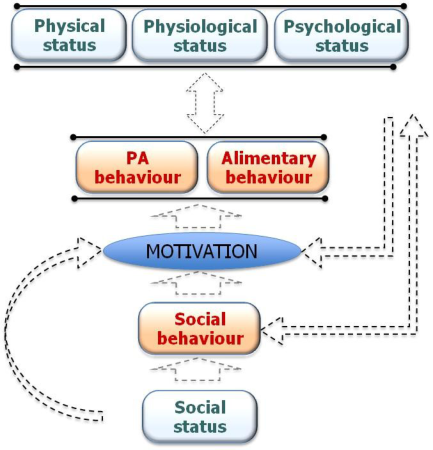
Figure 1. The PEGASO virtual individual model. Stippled arrows denote the presumptive relations among the model's element which will be defined in the project. PA: Physical Activity.
THE PEGASO VIRTUAL INDIVIDUAL MODEL As a complement of the concepts underpinning the virtual physiologic human, aiming to include all knowledge of biology and physiology of the human body, the virtual individual model points to incorporate also the knowledge required for a comprehensive representation of the human person as a whole, involving several concepts related to behavioural and psychosocial factors which are only partially covered by current vocabularies and ontologies.
PEGASO VIM intends to consider the individual's health by accounting for the factors with relevant association with phenomena involved in overweight and obesity, especially in younger people. Stemming from the concept of health as resulting from the balance between physical, mental and social well-being, health status is assumed in the model to derive from interaction between physical, functional and psychological status, as depicted in Figure 1.
Body structure and functionality are influenced by the individual's behaviours in the domains of alimentation and physical activity, which are driven by relevant aspects of motivation. Social status, social behaviour and psychological status (i.e. the psychosocial factors) are considered as important determinants of motivation to engage in healthy lifestyle behaviours. The profiling of the individual's characteristics in the different domains defined in the VIM is intended to provide a comprehensive framework of information including the reciprocal influences between biological phenomena and motivations ruling personal choices and behaviours related to alimentation and physical activity. On this basis, the VIM will be considered the source of knowledge empowering the PEGASO system whose overall aim is to promote and sustain healthy lifestyles in teenagers through personalised interaction.
Physical and Metabolic Domain The elements characterising physical status (i.e. the information concerning body structure) will be identified among the indicators of body adiposity and risk factors for the development of the disease conditions related to overweight and obesity, as interpreted on the basis of standard reference values (Dulloo et al., 2010). Among adults, although body composition is a prime quantificator of adiposity and its body distribution, body mass index (BMI), a parameter calculated from the ratio between body mass and squared height, is in first approximation utilised to set cut-off values to stratify individuals according to the concept of underweight, normal weight. overweight and different degrees of obesity (World Health Organization, 2000). By contrast, BMI in childhood changes substantially with age, and to define juvenile obesity a cut off point related to age should be used (Cole et al., 2000). Moreover a structural parameter such as waist-to-height ratio (waist circumference/height2), beside detecting central intra- abdominal fat tissue deposition, has been demonstrated to be also highly predictive of cardio metabolic risk associated with obesity in children and adolescents (Mokha et al., 2010).
Indeed severe metabolic derangements occur with obesity (such as type II diabetes and dyslipidemia) which considerably increase the risk of hypertension and cardiovascular disease. In particular, obesity plays a central role in the development of the metabolic syndrome (MetS), an important clustering of metabolic abnormalities and anthropometric characteristics also in adolescents across different countries (Lafortuna et al., 2010). MetS can be characterised also in the juvenile age according to International Diabetes Federation (Zimmet et al., 2007) diagnostic criteria (including high blood pressure, low levels of high density lipoprotein cholesterol, high triglycerides levels, high plasma glucose concentration and central obesity as assessed by waist circumference). Although not included in key diagnostic criteria, proinflammatory state (as indicated by elevated high sensitivity C-reactive protein, or inflammatory cytokines) and insulin resistance (quantifiable through homeostatic model assessment method, HOMA- IR) are functional metabolic derangements considered to be notably predictive for cardiovascular disease and/or diabetes (International Diabetes Federation, 2006).
Physical Activity Behaviour According to collective views of international groups of experts (World Health Organization, 2000; Commission of European Community, 2005), the role of lifestyles as determinants of conditions such as overweight and obesity has been thoroughly evidenced, with particular focus to juvenile age. Studies using motion sensors have shown that children who spend less time in physical activity are at higher risk of becoming obese during childhood and adolescence. Television and video games have contributed to more sedentary leisure activities and are associated with the consumption of energy-dense snacks and beverages. The findings from the 2009/2010 survey in EU countries from Health Behaviour in School-aged Children (HBSC) international report (Currie et al., 2012) indicate that young people who are overweight/obese are less physically active and watch television more, beside being more likely to exhibit unhealthy alimentary patterns. Therefore, the PEAGASO VIM will include parameters permitting the characterisation of Physical Activity Behaviours expected to have a direct influence on both Physical and Functional Status. Evaluation of sedentariness can be achieved through the monitoring of individuals' movements in their free-living context, which enables the characterisation of physical activity through the determination of its amount and intensity. By using specific recognition algorhythms, the type of activity can be assesses (e.g. walking, stepping, running, cycling), and the actual energy expenditure required to sustain that given activity can be determined. A wide body of knowledge is available about the energy cost of human activities in a large context of daily life and leisure pursuits (Ainsworth et al., 2000) and during specific sports scenarios (Glass & Dwyer, 2007). Activity intensity, sex and body mass are also important determinant of energy expenditure attained during body movements, and as such, they have to be accounted for in the evaluation of the energetic daily budget.
An important aspect of individual's profiling concerns the evaluation of the level of physical conditioning accounting for the individual's capacity to perform exercise, based on physiological responses to exercise in terms of heart and respiratory rate. The assessment of the relationship between exercise intensity and heart rate in the course of specific exercise conditions permits to appreciate the degree of the individual's involvement in that activity and estimate of his/her maximal aerobic capacity, which is a determinant of the maximal work capacity. The excess of body mass due to overweight/obesity condition has considerably negative effects on the capacity of individuals to sustain prolonged efforts associated with exercise or even everyday life activities (Lafortuna, 2013), and limits the use of physical activity as an effective tool to contrast obesity. Moreover, beside contributing to a negative energy balance and playing a relevant role in weight control, exercise has also important metabolic and cardiovascular effects. There is evidence that increased physical activity has a protective effect on the likelihood of developing type II diabetes, favourably influences the lipid profile and lowers blood pressure, also in children and adolescents, especially in those who are at high risk of cardiovascular and heart disease or have elevated blood pressure. (U.S. Department of Health and Human Services, 1996).
Thus, profiling of exercise capacity and habits provides an important aspect in VIM building as it determines individuals' physical potentialities in life activities which are modifiable in function of changes in behavioural choices towards physical activity.
Alimentary Behaviour It is agreed that inadequate or excessive nutrient intake may have important health consequences, such as nutritional deficiencies and increased risk of several metabolic diseases. During childhood and adolescence, a main goal is the prevention of nutritional deficiencies possibly observed at this age with specific requirements for normal growth (iron, calcium, protein, etc.), and the avoidance of bad dietary habits such as not eating breakfast, low fruit and vegetable intake, and high soft and alcoholic beverages intake. Skipping breakfast is somehow common among young people in European countries, and becomes more common with age. For example, around 71% of 11-year-old children takes breakfast everyday; while at the age of 15 the part of them maintaining this habit is considerably reduced (about 55%). In the context of fruit consumption, its prevalence is reduced between ages 11 and 15, and in all ages it could be considered that the percentage of adolescents that eat at least one fruit a day is worryingly low (31 to 42%). On the opposite, the consumption of sugar-sweetened beverage, including soft drinks, has risen across European countries, and it is expected to be associated to lower intakes of milk, calcium and other nutrients (Vartanian et al, 2007).
Based in this scenario, which is probably made worse by increasing the age, early and continued interventions are important since eating habits developed in youth are likely to continue into adulthood (Merten et al, 2009). In this context, two principal objectives has been identified for the nutritional assessment within the PEGASO system for monitoring and educative programs recommendation: (1) the promotion of health for the preservation of normal growth and development; and (2) the prevention of chronic diseases (such as obesity and other metabolic diseases) associated to inadequate dietary habits.
The individual dietary habits will be determined by means of food frequency questionnaires, with which the energy and nutrient intake and dietary patterns in relation to diet quality, diversity and equilibrium can be estimated. Finally, the overall assessment of dietary habits can be expressed as a diet quality index, which scores the adherence to country specific dietary guidelines. The advantage of the use of such index is that it captures the complexity of human diets in a single value, accounting for the interactions between nutrients, food preparation methods and eating patterns.
In the context of the relations considered in the VIM building, diet quality and alimentary patterns are meant to lead to the characterisation of the adolescent actual health and the possible health outcomes in the future. The effects of actual dietary behaviour on health could be interpreted in terms of changes in body weight, height and physical activity. Moreover, there is consistent evidence supporting the use of diet quality index as a predictor of several blood biomarkers of health status such as some vitamin (ascorbic acid, folate, vitamin E) and lipid profile, which could serve as a base for present recommendations and enable inferences on future health outcomes. The assessment of adolescents and paediatric diet quality is of great importance because food habits and behaviours that develop in childhood may predict diet-related diseases in adult age (Craigie et al, 2011). As an example of dietary patterns that may predispose to negative health outcomes in the future, a poor diet quality has been associated with earlier onset of puberty by 0.4 years, which, on turn, may establish a risk factor for hormone-related cancers, all-cause mortality and insulin resistance (Cheng et al., 2010). In the same way, a good diet quality has been associated with a lower prevalence of cognitive impairment in cohort studies (Huijbregts et al, 1998), while a highly varied diet was inversely associated with risk of colorectal cancer (Fernandez et al, 2000).
Finally, since the changes in dietary behaviour may not produce an immediate change in measureable health parameters (including weight and height), any adequate dietary behaviour change during the use of the PEGASO system could also be modelled to keep the user interest in maintaining a healthy eating behaviour.
Psychosocial perspective of behavioural changes Historically, a range of models of health-related behaviour have been developed to understand and predict health- related behaviours, including those related to alimentary behaviour and physical activity. However, reviewing recent evidence suggests that such models may not be useful frameworks through which to develop behaviour change interventions. Rather, a more robust approach to the design of behaviour change interventions is to conduct a systematic review of the available evidence and extract those parameters which have been shown to demonstrate a reliable casual influence on the target behaviour in the target group. The PEGASO project will embrace this evidence-based approach.
Changing health-related behaviour is not a straightforward task but rather it demands a careful analysis of both the target behaviour (e.g. alimentary behaviour or physical activity) and the target audience (e.g. teenagers). In the PEGASO project, a narrative synthesis of the extant literature will take place and be used to select those parameters which have a clear causal influence on each of the target behaviours in the VIM. However, it should be noted that each of the target behaviours (i.e. alimentary behaviour and physical activity) are themselves broad and multi- factorial concepts and therefore the VIM will consider specific aspects (e.g. eating breakfast, dietary balance) and integrate the relevant psychosocial parameters as it relates to each. To illustrate, the concept of “healthy eating” may refer to the dietary diversity and balance of a teenager’s diet but it may equally refer to eating breakfast regularly or consumption of sugary drinks. Therefore, the first step in designing a successful behaviour change intervention, such as that being piloted in the PEGASO project, is to identify the primary psychosocial determinants or parameters of that behaviour.
Successful behaviour change interventions will also require an insight into the target group. A range of ‘elicitation’ techniques can be used to gain valuable and rich insights into the thoughts, feelings and attitudes of young people. The VIM will also integrate the valuable knowledge derived from focus group work with young people across 3 European countries to explore attitudes towards health issues as well as how technology (e.g. sensory tracking, mobile phones and serious gaming) can support healthy lifestyles.
Integrating a sound evidence base, but whilst taking on board the views of young people, will be the key to success in the development of the PEGASO VIM. Through the insights obtained from this preparatory work and the VIM, mechanisms of behaviour change will be integrated and embedded into the interventions. For example, evidence- based motivational strategies which have shown to be effective will be used in the development of the health companion application as well as the game to be enjoyed by teenagers.
CONCLUSIONS
The VIM defined in the PEGASO project will be handled with ontology-driven tools allowing to outline, also in semantic terms, the relations between the different biological, cognitive and social factors which account for the whole profile of the human person in a holistic view. In the context of PEGASO system architecture, this will enable dynamical inferences concerning individual's health conditions and behaviours spanning through the different human domains, and will support the creation of the multi-dimensional and cross-disciplinary ICT individualised strategy. It can be anticipated that such an approach is liable to empower the engaging and user-centred features of PEGASO action, aiming at developing awareness and enhancing users' motivation towards healthy lifestyles, relevant for overweight and obesity prevention in the juvenile age.
ACKNOWLEDGEMENTS
The PEGASO project is co-funded by the European Commission under the 7th Framework Programme. The project is compliant with European and National legislation regarding the user safety and privacy, as granted by the PEGASO Ethical Advisory Board.
The authors of the paper wish to thank all the project partners for their contribution to the work.
REFERENCES
Ainsworth, B.E., Haskell, W.L., Whitt, M.C., Irwin, M.L., Swartz, A.M., Strath, S.J., O'Brien, W.L., Bassett, D.R. Jr., Schmitz, K.H., Emplaincourt, P.O., Jacobs, D.R. Jr., Leon, A.S. (2000), Compendium of physical activities: an update of activity codes and MET intensities. Medicine and Science in Sports and Exercise, 32(9 Suppl), S498-504. Cheng, G., Gerlach, S., Libuda, L., Kranz, S., Gunther, A.L.B., Karaolis-Danckert, N., Kroke, A. & Buyken, A.E. (2010) Diet
quality in childhood is prospectively associated with the timing of puberty but not with body composition at puberty onset. J. Nutr. 140, 95–102. Cole, T. J., Bellizzi, M.C., Flegal, K.M., Dietz, W.H. (2000), Establishing a standard definition for child overweight and obesity worldwide: international survey. British Medical Journal, 320, 1-6. Commission of European Community (2005), Green Paper - Promoting healthy diets and physical activity: a European
dimension for the prevention of overweight, obesity and chronic diseases. COM(2005) 637, Brussels, December 2005. Craigie, A.M., Lake, A.A., Kelly, S.A., Adamson, A.J. & Mathers, J.C. (2011) Tracking of obesity-related behaviours from childhood to adulthood: a systematic review. Maturitas 70, 266–284. Currie, C., Zanotti, C., Morgan, A., Currie, D., de Looze, M., Roberts, C., Samdal, O., Smith, O.R.F., Barnekow, V. (2012).
Social determinants of health and well-being among young people. Health Behaviour in School-aged Children (HBSC) study: international report from the 2009/2010 survey. Copenhagen, WHO Regional Office for Europe, (Health Policy for Children and Adolescents, No. 6). Dulloo, A.G., Jacquet, J., Solinas, G., Montani, J.P., Schutz, Y. (2010), Body composition phenotypes in pathways to obesity and the metabolic syndrome. International Journal of Obesity (Lond), 34, Suppl 2, S4-17. Fernandez E, Negri E, La Vecchia C, Franceschi S. (2000). Diet diversity and colorectal cancer. Prev Med 31, 11-14. Glass, S., & Dwyer, G. B., American College of Sports Medicine (2007). ACSM's Metabolic Calculations Handbook. Lippincott
Williams & Wilkins, Baltimore, MD. Honka, A., Kaipainen, K., Hietala, H., Saranummi N. (2011), Rethinking Health: ICT-Enabled Services to Empower People to Manage Their Health. IEEE Reviews in Biomedical Engineering, 4, 119-139. Huijbregts P, Feskens E, Rasanen L, Fidanza F, Alberti-Fidanza A, Nissinen A, Giampaoli (1998). Dietary patterns and cognitive
function in elderly men in Finland, Italy and the Netherlands. Eur J Clin Nutr 52, 826-831. Hunter, P.J. (2006), Modeling Human Physiology: The IUPS/EMBS Physiome Project. Proceedings of the IEEE, 24, 678-691. International Diabetes Federation (2006). IDF Consensus Worldwide Definition of the Metabolic Syndrome. Retrieved From the International Diabetes Federation website: http://www.idf.org/metabolic-syndrome. Lafortuna, C.L. (2013), Physiological Bases of Physical Limitations During Exercise. In: Disabling Obesity - From Determinants
to Health Care Models, Capodaglio P, Faintuch J, Liuzzi A, eds., Springer-Verlag, Heidelberg, pp. 21-38. Lafortuna, C.L., Adorni, F., Agosti, F., De Col, A., Sievert, K., Siegfried, W., Sartorio, A. (2010), Prevalence of the metabolic syndrome among extremely obese adolescents in Italy and Germany. Diabetes Research and Clinical Practice, 88, 14-21. Merten MJ, Williams AL, Shriver LH (2009), Breakfast consumption in adolescence and young adulthood: parental presence,
community context, and obesity. Journal of the American Dietetic Association, 109, 1384-1391. Mokha, J.S., Srinivasan, S.R., Dasmahapatra, P., Fernandez. C., Chen, W., Xu, J., Berenson, G.S. (2010), Utility of waist-toheight ratio in assessing the status of central obesity and related cardiometabolic risk profile among normal weight and overweight/obese children: the Bogalusa Heart Study. BMC Pediatrics, 10: 73. PEGASO (2013) - PErsonalised GuidAnce Services for Optimising lifestyle management in teenagers through awareness,
motivation and engagement, FP7-ICT-2013-10, Grant Agreement 610727. Retrieved From the European Commission - Community Research and Development Informatio Service website: http://cordis.europa.eu/projects/rcn/110906_en.html. Renjilian DA, Nezu A, Shermer RL, Perri MG, McKelvey WF, Anton SD. (2001), Individual versus group therapy for obesity: Effect of matching participants to their treatment preferences. J Consult Clin Physchol 69, 717-721. U.S. Department of Health and Human Services (1996), Physical Activity and Health: A Report of the Surgeon General. Atlanta,
GA: U.S. Department of Health and Human Services, Centers for Disease Control and Prevention, National Center for Chronic Disease Prevention and Health Promotion. Vartanian LR, Schwart MB; Brownell KD. (2007), Effect of soft drink consumption on nutrition and health: a systematic review and meta-analysis. American Journal of Public Health, 97, 667-675. World Health Organization (1948), Preamble to the Constitution of the World Health Organization as adopted by the
International Health Conference, New York, 19-22 June, 1946; signed on 22 July 1946 by the representatives of 61 States (Official Records of the World Health Organization, no. 2, p. 100) and entered into force on 7 April 1948. World Health Organization (2000), Obesity: preventing and managing the global epidemic. Report of a WHO consultation. WHO technical report series no. 894, WHO, Geneva. Zimmet, P., Alberti, K.G., Kaufman, F., Tajima, N., Silink, M., Arslanian, S., Wong, G., Bennett, P., Shaw, J., Caprio, S.; IDF
Consensus Group (2007), The metabolic syndrome in children and adolescents - an IDF consensus report. Pediatric Diabetes, 8, 299-306.
LISTED IN THE AHFE DIGITAL BOOKSTORE CATALOGUE
Explore the complete digital volume
Advances in Human Aspects of Healthcare
Read this individual research paper free through the original publisher, or explore the full digital proceedings book.
ISBN 978-1-4951-2093-0
Explore this ISBN in the AHFE Bookstore ↗Listed in the July 2026 bookstore catalogue; search by ISBN to confirm current availability · Digital book purchase optional