Kristian Karlovic, Stefan Pfeffer, Thomas Maier, Karl-Dietrich Sievert (2021). Human Factors View of the Assistant at Laparoscopic Procedures – A Pilot Study. In: Advances in Human Aspects of Healthcare. AHFE Open Access, vol. 13. https://doi.org/10.54941/ahfe100482
1 Institute for Engineering Design and Industrial Design, Research and Teaching Department Industrial Design Engineering, University of Stuttgart, Germany ↗
2 University Department of Urology, University Hospital Tuebingen (UKT), Germany ↗
This study is part of a research project with the aim of reducing physical demand and workload of surgery staff. In a first step, human factors of assistant additional to the surgeon should be analyzed. Therefore subjective and objective measurement approach was utilized. In general the subjective results show slight perceived demand. Furthermore, the assistant in urology perceived less demand than in gynecology. The objective results show slight demand for the assistant in gynecology. Life-record-data revealed similar static body, head and arm postures for the assistant and the surgeon in gynecology. Furthermore, this study shows the observation that human factors are influenced by the common working space and the significance of the common task as a team. The workflow-chart shows many parallels in the movements of the upper arm of the surgeon and the assistant during the preparation phase. In conclusion, one similar technical supporting system might be developed for the surgeon and the assistant because of many parallels in ergonomics with the aim of reducing physical demand and workload.
OBJECTIVE A pre-study of this project revealed an asymmetric physical demand of the trapezius muscle of surgeons during laparoscopic procedures in gynecology (Pfeffer et al., 2013). Other surveys among surgeons reveal physical discomfort and health effects due to suboptimal working postures, too (Miller et al., 2012). During laparoscopic procedures in gynecology and urology with regard to both space and task, the surgeon and the assistant work together closely. Thus human factors (ergonomics) of the assistant in addition to the surgeon are interesting. In order to investigate human factors of the surgery staff in a preferably holistic view, human factors of the assistant and with regard to the surgeon were observed. Based on these results, key elements for ergonomic optimization of the situation of surgery staff should be acquired. In the next step of this research project, these key elements will be utilized for the systematical development of a supporting technical system. This supporting system should reduce physical demand and workload.
In this study the assistant of two surgical laparoscopic units of the University Hospital Tuebingen (UKT) (one urological and one gynecological) were investigated. In order to analyze human factors, physical demand and musculoskeletal health status among assistants, the instruments were developed during this study. This study shows the resulting data. Based on the results, possible solutions for the development of a supporting system in laparoscopic surgery are proposed. Furthermore, the question whether the same technical supporting system can be used for the assistant as well as for the surgeon should be discussed.
SIGNIFICANCE Work enhancement among surgeons (Bohrer et al., 2011) and increasing risk of medical error (Mc Cormick et al., 2012) are shown. These facts as well as the forecast of more operations per day have been mentioned by the interviewed assistants and surgeons. Consequently, an intensification of physical demands, less concentration and a tremendous risk of errors can be expected. These things might be in direct relationship to less quality in health care and thus to higher costs for medical treatments.
Assistant and surgeon operate together as a team and both of them are in direct contact to the patient. Because of this exceptional circumstance and the importance of both of them, it is necessary to investigate human factors for the surgeon as well as for the assistant in a preferably holistic view. Thus the situation of assistants' and surgeons' healthcare as well as the quality of work of surgical units can be improved.
METHODS
In this study a multiple measurement approach including subjective and objective methods was used. Data for subjective measurement was gathered from altogether 9 surgical interventions in gynecology and urology (3 laparoscopic hysterectomies, 3 laparoscopic nephrectomies, 1 laparoscopic retroperitoneal lymphadenectomy, 1 laparoscopic partial nephrectomy, 1 laparoscopic cystectomy) lasting 30 minutes to 120 minutes. Data for objective measurement was collected from 2 surgical interventions at gynecology (2 laparoscopic hysterectomies).
Subjective method consists of the NASA TLX (Hart and Staveland, 1988). The questionnaire NASA TLX considers the six various dimensions physical demand, mental demand, temporal demand, performance, effort and frustration in order to determine the perceived workload of the assistant and the surgeon during a specific work task. As a result the Overall Weighted Workload Score (OWWS) is calculated out of the six dimensions.
The objective methods consist of the surface electromyography (sEMG) and life record data which are utilized throughout the whole surgery. The sEMG offers the opportunity to estimate muscular strain. Referring to this method, life record data offers the opportunity to explain the results of the sEMG considering the human factors. The root mean square value of the bipolar sEMG is the electrical activity (eA) of the trapezius muscle (descending part). A pre study of this project reveals the trapezius muscle as an important advice for physical demand in laparoscopic surgery (Pfeffer et al., 2013). Consequently, this muscle is considered at sEMG. Before the accomplishment of the sEMG measurement of the assistant, sEMG normalization was accomplished. This normalization is a reference measurement with an anteversion of both straight arms holding an external load of 2 kg in each hand.
The objective method life record data consists of a 3-perspective videoanalysis (3 cameras). Thus the whole body of the assistant, a part of the body of the surgeon and the coherences of both can be observed. Thereby movements, postures, positions, relations and procedures between the assistant and the surgeon can be analyzed. The camera positions were arranged to realize the left side view of the observed assistant and consequently the right side of the surgeon, the front view of the surgeon and the assistant and the right side view of the assistant. The setting of the laparoscopic surgery is shown in figure 1 as well as the positions of the cameras utilized for 3-perspective videoanalysis.
operating table
camera 1
main screen
second screen
nurse for uterus manipulation
anaesthesia workspace
patient
assistant camera 2
high-frequency unit
Figure 1. Setting of laparoscopic surgery in gynecology at the UKT with cameras for 3-perspectivevideo-analysis
Figure available in the original PDF paper.
RESULTS
Perceived demands and physical complaints
Figure 2 shows the Overall Weighted Workload Score (OWWS) as the comparison of assistants in urology and gynecology. In total, in gynecology 3 different assistants of 3 surgeries (laparoscopic hysterectomies) were used for the OWWS. In urology 3 different assistants of 6 surgical interventions (3 laparoscopic nephrectomies, 1 laparoscopic retroperitional lymphadenectomy, 1 laparoscopic partial nephrectomy, 1 laparoscopic cystectomy) were used for the OWWS.
According to figure 2, the workload of assistants was perceived little, but in general assistants from gynecology perceived higher workload than in urology.
100
80
60
OWWS
40
20
0
Equation reproduced from the original PDF.Equation reproduced from the original PDF.Figure 2. NASA TLX Overall Weighted Workload Score of the assistant for laparoscopic interventions in gynecology and urology including standard deviation
Figure available in the original PDF paper.
Muscular strain (sEMG) The analysis of muscular strain assessed by electrical activity (eA) is based on the data collected from two gynecological assistants during two gynecological interventions (gynecological hysterectomy). Assistant 1 is male and assistant 2 is female. Figure 3 shows the normalized eA of the trapezius muscle for the left and the right arm in order to give an estimation of the physical demand. The trapezius muscle was used as a significant muscle with reference to the pre-study (Pfeffer et al., 2013).
The median normalized eA (given in percent of the reference contraction) for assistant 1 was 0,31 on the right side and 0,19 on the left side. Assistant 2 showed a median normalized eA of 0,169 on the right side of the trapezius muscle and 0,15 on the left side. The right arm was the dominant arm for both investigated assistants.
Quartile 3 Median
Quartile 1
Electrical Activity (% 2kg)
0 0,1 0,2 0,3 0,4 0,5 0,6 0,7 0,8 0,9 1
Trapezius p.d. left
Trapezius p.d. right
Trapezius p.d. left
Trapezius p.d. right
(assistant 1)
(assistant 1)
(assistant 2)
(assistant 2)
Figure 3. Frequency distribution of the normalized trapezius eA of two assistants in gynecology The muscle activity of the surgeon in laparoscopic interventions (laparoscopic hysterectomy, laparoscopic ovariectomy) in gynecology at UKT was investigated in a pre-study of this project (Pfeffer et al., 2013). According to this pre-study, the muscle activity of the surgeon (0,23 for the left side; 0,45 for right side) is higher and more asymmetric than for the assistant from this study.
Figure available in the original PDF paper.
Life record data
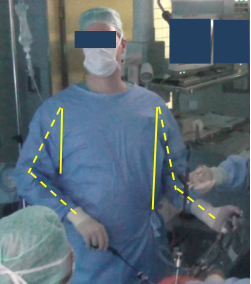
Figure 4 shows the typical static arm posture of the observed assistant in gynecology. The typical arm posture for both arms of the assistant was bent and beside the body. Normally, the left arm of the assistant was used for holding the endoscope and the right arm for holding the instrument. For static postures the upper arm was close to the body and consequently the arm abduction was slight.
arm posture body posture
Figure 4. Significant arm posture of the observed assistant in gynecology
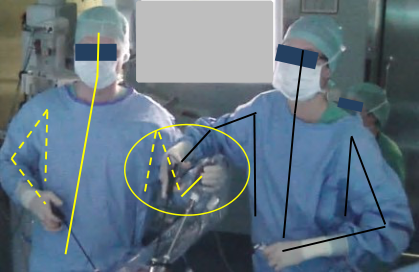
Figure 5 shows the relation of assistant and surgeon (“team assistant - surgeon”) with regard to anthropometry. The assistant and the surgeon were working together closely regarding the task as well as the working space. In the Human Aspects of Healthcare (2021) observed surgeries in gynecology, the position of the assistant was always on the right side of the surgeon in a standing position. In particular the lower arms were crossing and were closer together than the upper arms. The common working space of assistant and surgeon as a result of the task influenced the arm posture. The right picture in figure 5 shows an example, taken from the urology, of the relation between assistant and surgeon. The assistant sat on the left side of the surgeon and supported his right arm by the left arm. The arm posture was bent.
The observed assistant as well as the surgeon showed static bent arm postures. The observed arm abduction was less for the assistant than for the surgeon, which was shown in a pre-study of this project (Pfeffer et al., 2013). The arm abduction and consequently the physical demand of assistant and surgeon might depend on the body height and consequently the team composition.
Assistant and surgeon looked at the same main screen, which was consistently in one position. This influenced the head / body posture, as the position of the screen was not optimal for both users. Figure 5 shows the unnatural body / head postures for assistant and surgeon. The postures were similar. In the example from urology (figure 5 right), the body / head postures were also influenced by the gaze to the consistently positioned main screen.
gynecology urology assistant surgeon surgeon assistant arm posture body posture common working space
Figure 5. Relation of the observed assistant and surgeon (arm posture, body posture, common working space)
In dynamic situations the body / head posture of the observed assistant sometimes became extreme because of the relation between tasks for both arms, main screen position and common working space. Extreme body / head postures for dynamic tasks in gynecology are shown in figure 6. During these dynamic situations, higher arm abduction than during static situations could be observed.
arm posture body posture
Figure 6. Body / head posture of the observed assistant in gynecology
Figure available in the original PDF paper.
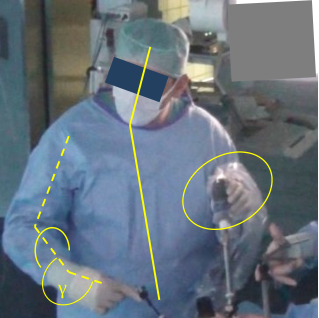
More static postures for the upper arm than for the lower arm were observed during the interventions. The lower arm was more dynamic because of the needed pushing and rotating movements of the hand and the instrument. Figure 7 shows the rotating movements of the lower arm around its pivot. Furthermore, the needed movements caused the uncomfortable hand posture which is indicated by the angle γ. The observed assistants also used different manners to grab the endoscope. The assistant in the right picture used a grasping movement of the hand and the assistant in the middle and the left picture used a clasping movement of the hand.
γ γ
γ arm posture body posture pivot rotation angle hand posture
Figure 7. Movements of the upper arm in gynecology
The workflow chart in figure 8 compares rough static and dynamic movements of the upper arm of the assistant and the surgeon in dependence on the side (left or right). It is the result of the observation of one gynecological hysterectomy and was created by the transcription of life-record-data. It is obvious that the assistant accomplished in general slightly more static postures than dynamic postures. Thereof more static postures with the left arm than with the right arm were observed. Furthermore, more static postures could be observed for the preparation period (phase 1) than for the second period of morcellation (phase 2).
The surgeon as well as the assistant accomplished more static postures with the left arm than with the right arm (dominant arm), however, the surgeon obviously revealed more dynamic postures and movements for the right arm than the assistant.
Figure 8. Workflow-chart assistant – surgeon in dependence of static and dynamic postures of the arms
Figure available in the original PDF paper.
DISCUSSION AND CONCLUSION The assistant as well as the surgeon reveal physical demand and workload. Subjective data show slightly perceived workload by the assistant. The workload was perceived higher by the assistant in gynecology than in urology. This might be explained by the possible sitting posture of the assistant in urology contrarily to the standing position of the assistant in gynecology. Furthermore, the observed assistant (figure 5) in urology often supported his active arm by the other arm. Consequently, the support of body and arm posture might be perceived as less demanding. The sEMG for the observed two assistants in gynecology shows a slight demand. The workflow-chart shows in general many static postures for the assistant, but slightly more static for the left than for the right side. Moreover, it shows more static postures for the left side of the surgeon than for the right side. In general, the surgeon as well as the assistant show many static arm postures. Life record data showed that body, head and arm postures were similar for the observed assistant and surgeon. In particular, the bent arm postures were noticeable.
Attention should be paid to the mentioned little number of investigated assistants and surgical interventions for the subjective (6 assistants, 9 surgical interventions) and the objective (2 assistants, 2 surgical interventions) measurement approach. Reasons are long duration of surgical interventions, limited personal within the urology and the gynecology and the focus on the development of the supporting system in this project. In the framework of this project further explorative investigations will be done. The observed data gives a first advice for the possible supporting system with reference to human factors.
In conclusion, the physical demand of the assistant and the surgeon can be reduced by a similar supporting technical system because of similar physical demand and human factor issues. A first attempt for the conception of the supporting system would be to provide an opportunity for the surgeon and the assistant to support the static arm postures and automatically track the dynamic tractions. Thereby a major challenge would be to consider the common working space.
ACKNOWLEDGEMENT
The “Industry on Campus” project IOC-103 (Ministerium fuer Wissenschaft, Forschung und Kunst Baden- Wuerttemberg, induced by Interuniversitaeres Zentrum fuer medizinische Technologien Stuttgart-Tuebingen) with the title „Interaktionsbasierte manipulatorgestuetzte Assistenz“ includes this study. This project is in cooperation with FESTO and TRUMPF Medizin Systeme (Pfeffer et al., 2013). SEMG data was determined and analyzed by the Institute of Occupational and Social Medicine and Health Services Research of the University Hospital Tuebingen.
REFERENCES
Bohrer, T. Koller, M. Schlitt, HJ. Bauer, H. (2011). “Quality of life of german surgeons: results of a survey of 3652 attendees of the annual meetings of the German Surgical Societies.” Deutsche Medizinische Wochenschrift 136 (42), pp: 2140 – 2144. Thieme, Stuttgart. Hart, S. Staveland, L. (1988), “Development of NASA-TLX (Task Load Index): Results of empirical and theoretical research in
Human mental workload”. Hancock, P., Meshkati, N., eds.), pp. 139-183. Amsterdam: North Holland. Mc Cormick, F. Kadzielski, J. Landrigan, CP. Evans, B. Herndon, JH. Rubash, HE: (2012), “Surgeon fatigue: A Prospective Analysis of the Incidence, Risk, and Intervals of Predicted Fatigue-Related Impairment in Residents.” Archives of Surgery 147 (5), pp. 430-435. Miller, K et al. (2012), “Ergonomics Principles Associated With Laparoscopic Surgeon Injury/Illness”, Human Factors, vol. 54,
no. 6, pp. 1087-1092 Pfeffer, S. Hoffmann, A. Maier, T. Rothmund, R. Sievert, K. Seibt, R. Rieger, M. Steinhilber, B. (2013), “Ergonomics of Selected Laparoscopic Procedures – Need for Action?”. Biomedical Engineering/Biomedizinische Technik, Band 58, Heft SI-1 Track J, Usability, Risk Management & Regularotry Affairs.
LISTED IN THE AHFE DIGITAL BOOKSTORE CATALOGUE
Explore the complete digital volume
Advances in Human Aspects of Healthcare
Read this individual research paper free through the original publisher, or explore the full digital proceedings book.
ISBN 978-1-4951-2093-0
Explore this ISBN in the AHFE Bookstore ↗Listed in the July 2026 bookstore catalogue; search by ISBN to confirm current availability · Digital book purchase optional