Laura Lange, Katharina Gleichauf, Stefan Pfeffer (2025). Identification and Empirical Investigation of Movement Strategies for Workstation Design. In: Physical Ergonomics and Human Factors. AHFE Open Access, vol. 185, pp. 59–68. https://doi.org/10.54941/ahfe1006464
This study investigates movement strategies in assembly workstations to improve ergonomic design. Movement strategies, defined as sequences of actions performed repeatedly by specific groups in specific situations, have been understudied in assembly contexts. An inductive approach was used to build a theoretical base that included knowledge, unconscious actions and hand dominance. Twenty participants performed standardized assembly tasks in standing and sitting positions, with hand and leg movements observed and qualitatively analyzed. Results revealed primary, secondary and individual movement strategies, such as right-handed participants consistently grasping objects from the right side. Future research will investigate the transferability of the identified strategies to virtual reality environments, extending their application to virtual ergonomics and simulation-based workstation design. This study contributes to the growing body of knowledge in human factors and ergonomics and provides a novel approach to optimizing human-centered manufacturing environments.
The design of assembly workstations significantly impacts worker ergonomics, efficiency, and overall productivity (Schlund et al., 2018). Traditional approaches to workstation design often consider anthropometric data, biomechanics, and physical stressors to minimize strain and prevent injuries (Daub et al., 2018). However, an aspect that has received less attention is the understanding and incorporation of movement strategies employed by workers during assembly tasks. Movement strategies are defined as sequences of actions that are repeatedly performed in a comparable way by specific groups of people in certain situations (Beyer, 2014). These strategies emerge from a combination of various factors, including individual preferences, task demands, workplace layout, and learned behaviors. Recognizing and understanding these strategies is essential because they directly influence posture, reach distances, and the frequency of specific movements, all of which contribute to ergonomic risk. A poorly designed assembly workstation can lead to fatigue, reduced productivity, musculoskeletal disorders and a higher risk of injury (Peruzzini et al., 2019;
Alipour et al., 2021). Existing literature in ergonomics provides guidelines and recommendations for workstation design, focusing on minimizing physical strain and optimizing workflow (DIN EN ISO 6385, 2016; ArbSchG, 2024; ArbStättV, 2024). Concepts such as reach zones, placement of tools and materials, and adjustability of workstations are well-established. However, these guidelines often lack a detailed understanding of the nuanced movement patterns that workers develop to accomplish tasks efficiently.
This research paper aims to address this gap by identifying and empirically investigating movement strategies in assembly workstations. The approach is based on an inductive method, beginning with observations and leading to the formulation of research questions and an exploratory study. The study involves observing behaviors at assembly workstations during predefined tasks to identify recurring movement sequences of the arms and legs. The study aims to provide initial insights into existing movement strategies at assembly workstations and to stimulate further research (Bockholt et al., 2017; Latka, 2019). The study examined a wide variety of movements for possible strategies as part of a Master’s thesis (Lange, 2024). In this paper, the following research questions (RQ) are addressed:
RQ1: Which side do people reach for objects from?
RQ2: How are backward reaching movements performed?
RQ3: How are operating actions with the foot performed if they take place directly behind the person?
METHOD
Sample Participants were recruited at Furtwangen University (HFU), Campus Tuttlingen. The study included 20 participants. One participant was identified as an outlier in terms of age. In order to be able to draw a conclusion about a specific age group, this participant was removed from the analysis. This resulted in the following sample: nine identified as female and ten as male. The mean age was 25.42 years (SD = 3.29). Regarding handedness, 15 participants were right-handed (78.95%), two were left-handed (10.53%) and two were ambidextrous (10.53%). The dominant leg was the right leg in 13 participants (68.42%), the left leg in four participants (21.05%), and both legs were equally dominant in two participants (10.53%). Regarding experience with assembly workstations, seven participants (36.84%) reported no experience, ten (52.63%) reported some experience, and two (10.53%) reported extensive experience.
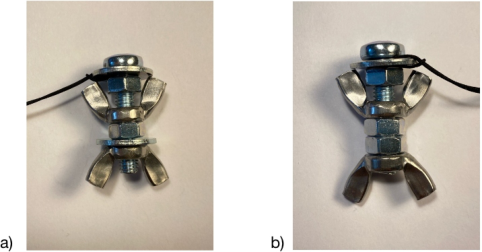
Material A standardized assembly workstation was designed and implemented for this study to facilitate the analysis of participants’ performance in both standing and seated conditions. The primary task involved the assembly of screw figures, with two variants created to accommodate the within-subjects design
Identification and Empirical Investigation of Movement Strategies for Workstation Design 61
(see Figure 1). This setup enabled the systematic observation of participants’ behaviors relevant to the research questions posed.
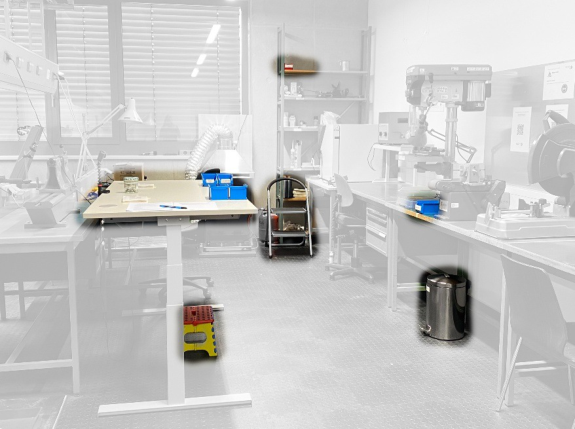
The experimental assembly workstation comprised a height-adjustable desk, a standard rotatable office chair, and a folding stool serving as a footrest. The structure of the study area is shown in Figure 2 below. The workspace was augmented with open-fronted storage containers, measuring 10cm x 16cm, which were clearly labeled to prevent confusion regarding their contents. These containers housed the necessary components for the screw figure assembly, including key rings with loops, M6 screws, M6 washers, M6 nuts, and M6 wing nuts. The table was set up so that the exact same materials were mirrored to the right and left of the work surface. To observe the direction of close gripping movements, materials were placed directly at the edge of the table, to the right and left of the participant. In addition, two pairs of pliers were provided at a distance of 60cm from the edge of the table so that the participants could choose their preferred gripping orientation further away. These tools were individually packaged in sealed paper bags. The subsequent phase involved the utilization of a pedal-operated waste receptacle, standing 40cm in height, with a foot-activated lid mechanism. The assembly process was documented using two cameras, specifically the GoPro Hero7 Black model.
Detailed instructions were given to guide the implementation, with each step designed to yield a distinct, measurable outcome. To address all pre- identified research questions within the assembly process, certain additional steps were incorporated into the “standard”screw figure assembly procedure. For instance, participants were required to open a container to retrieve materials and dispose of items in the pedal-operated waste receptacle, enabling observation of these specific actions. Upon completion of the experiment, a comprehensive questionnaire was administered to collect demographic and anthropometric data from the participants. This included information on gender, age, height, forearm length, handedness, dominant foot, and prior experience with assembly workstations.
Figure 2: Assembly work station (standing condition).
Procedure At the commencement of the study, participants were greeted and informed about safety protocols and the study’s methodology. They then provided informed consent and generated unique respondent codes to ensure confidentiality. The study began with participants setting up their individual workstations while video recording commenced. Those starting in a standing position were allowed to adjust the table height and decide whether to use a footstool. Participants beginning in a seated position could also modify the desk chair to suit their needs. It was crucial that the objects on the table remained in place during this customization process to maintain consistency across setups.
Once the workstation was configured, participants received detailed instructions for assembling screw figures. They were instructed to follow these guidelines precisely and were free to ask questions or request assistance at any point during the process. Upon completing the first assembly task, participants notified the study leader and then reconfigured their workstation for the alternate posture (standing/seated). Concurrently, the researcher restored the table layout to its original state.
This process was repeated for a second screw figure assembly. The objective of the study was to analyze intuitive actions during the assembly process. To prevent priming effects, demographic data and information about participants’ everyday movements were collected only after both assembly tasks were completed. Following the second task, participants completed a final questionnaire, after which the video recording was halted and saved. The entire procedure lasted approximately 20 to 25 minutes per participant and concluded with a debriefing session.
Identification and Empirical Investigation of Movement Strategies for Workstation Design 63
RESULTS
The video recordings were evaluated using Microsoft Excel. The observed movements were classified into strategy classes. The occurrences of each movement strategy were then analyzed. The placement of the materials and the order in which they were assembled resulted in different numbers of executions for each research question. The percentages were calculated so that the results could still be compared with each other.
The terms “clockwise” and “counterclockwise” are used in connection with turning. These are chosen from the perspective of the acting person.
The study identified main strategies, secondary strategies, and individual strategies (Bockholt et al., 2017; Latka, 2019). Table 1 shows the classification of these movement strategies. The percentages were based on the results of the study.
Table 1: Classification of movement strategies into main, secondary and individual strategies.
Table available in the original PDF paper.
Main Strategy Secondary Strategy Individual Strategy Rarely used movement strategies Movement strategies used by most people
Other movement strategies used by a smaller percentage of people Several secondary strategies possible
Several individual strategies possible
Maximum of one to two main strategies per observed task
Between 12.00% and 49.99% of executions were made using this strategy
More than 50.00% of executions were made using this strategy
Between 0.01% and 11.99% of executions were made using this strategy Research question 1 investigates which hand is chosen for gripping and from which side the material is gripped. A choice should be made between a right-hand and a left-hand positioned material container. Nearby and more distant containers were considered separately.
During the study, the close reach was performed 73 times. As shown in Table 2, 76.71% of the participants used the same strategy in the seated condition. They reached with their right hand to the right side. This strategy can be considered as the main strategy for this movement. The analysis of handedness revealed only minimal deviations for left-handed people towards the secondary strategy. The results of the seated condition correspond to the results of the standing condition.
Table 2: Evaluation of RQ1 (standing, close reach).
Table available in the original PDF paper.
& Grabbed From Left Side Grabbed From Right Side Grabbed with left hand 9 / 73 (12.33%) 4 / 73 (5.48%) Grabbed with right hand 4 / 73 (5.48%) 56 / 73 (76.71%)
If reaching direction and reaching hand are examined for objects that are further away, there are fewer individual strategies (see Table 3). The main
strategy remains the same as for the gripping process to nearby objects. An analysis of the left-handed people shows that all of them use the strategy “reach left with left hand”. The results of the seated condition correspond to the results of the standing condition.
Table 3: Evaluation of RQ1 (standing, farther reach).
Table available in the original PDF paper.
& Grabbed From Left Side Grabbed From Right Side Grabbed with left hand 4 / 19 (21.05%) 1 / 19 (5.26%) Grabbed with right hand 0 / 19 14 / 19 (73.68%)
Research question 2 investigated whether there are movement strategies for reaching movements directly backwards. It was examined which direction of rotation is preferred, which hand is used to grip and which direction of rotation backwards is subsequently preferred. The use of a chair in the sitting condition results in anatomically different movements than in the standing condition. In the standing condition, one main strategy was identified. 68.42% of the executions (26 out of 38) followed the main strategy “turn clockwise, grab with right hand, turn back counterclockwise” (see Table 4). With 26.32% (10 out of 38), the mirrored execution was recognizable as a secondary strategy. An increased number of executions of the main strategy (22 out of 30, 73.33%) was evident among right-handed people. No influence of the dominant leg was recognizable.
Table 4: Evaluation of RQ2 (standing).
Table available in the original PDF paper.
& Turn Counterclockwise Turn Clockwise Grabbed With Left Hand
Grabbed With Right Hand
Grabbed With Left Hand
Grabbed With Right Hand 0 / 38 1 / 38 (2.63%) 0 / 38 26 / 38 (68.42%)
Turn back counter- clockwise
0 / 38 0 / 38 1 / 38 (2.63%)
10 / 38 (26.32%)
Turn back clockwise
In the sitting condition, this research question showed the same main and secondary strategies as in the standing condition, but with slightly different percentages. The main strategy was used in 80.56% (29 out of 36) of executions while the secondary strategy was used in 13.89% (5 out of 36) of executions. It should be noted that only two executions where noted, where people stood up from the chair. All other people rotated with the chair while they remained seated. These stand-up executions were removed from the table as the movement sequence deviated significantly, and they can be regarded as a separate individual movement strategy.
Research question 3 considers which foot is used to operate a pedal- operated waste receptacle when it is located directly behind the person. In
Identification and Empirical Investigation of Movement Strategies for Workstation Design 65
order to answer this research question, it was examined which direction of rotation is preferred, which foot is used to interact with the waste receptacle, which hand is used for disposal and which direction of rotation backwards is subsequently preferred.
One person skipped the task and continued with the assembly without disposing of the bag in the pedal garbage can. This resulted in 18 executions for the evaluation. A main strategy with 50.00% (9 of 18 executions) was identified: “Turn clockwise, interact with right foot, dispose with right hand, turn back counterclockwise”. The secondary strategy with 33.33% (6 of 18 executions) was executed mirrored. Furthermore, the participants showed three individual strategies, each with one execution.
The handedness had no influence on the execution of the task. In contrast, the independent variable “dominant leg” shows a slight effect. People with a right-dominant leg turned clockwise in 8 out of 12 executions (66.67%) and turned back counterclockwise in 7 out of 12 executions (58.33%). No influence of the dominant leg was observed in the other groups.
The seated condition is also examined. As research question 2 shows, the participants usually turned around together with the chair, too. Two people lifted the lid by hand and therefore did not perform the task correctly. These persons were excluded in the evaluation. The same main and secondary strategies were observed as in the standing condition, but with slightly different percentages. The main strategy was used in 68.75% (11 out of 16) of executions while the secondary strategy was used in 25.00% (4 out of 16) of executions. The dominant leg also had an influence here. 81.82% (9 out of 11 executions) of people with a right-dominant leg use the main strategy “Turn clockwise, interact with right foot, dispose with right hand, turn back counterclockwise”.
SUMMARY AND DISCUSSION OF THE MAIN STRATEGIES Some of the identified main strategies are visualized in this chapter. These findings apply to the examined sample, in particular to mainly right-handed people with a dominant right leg, with an average age of 25.5 years and some experience in assembly.
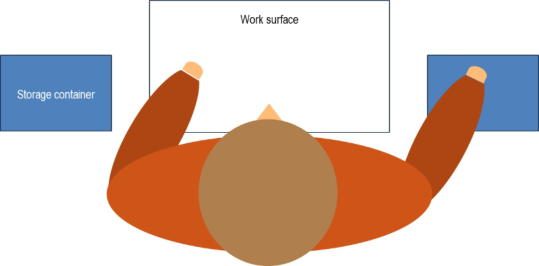
RQ1 (Direction of reaching): The main strategy is to reach with their right hand from the right side (see Figure 3), which reflects the high incidence of right-handedness in society. Left-handed people are more likely to use the secondary strategy, although the primary strategy remains the most common for them as well, probably due to learned behaviors and societal adaptations (BGHM, 2013). The choice of strategy is slightly influenced by the distance of the object, with the primary strategy being more commonly used for farther objects. This shows an influence of the object’s position, as nearby objects can be reached comfortably with either hand. Objects located further away are more easily reached with the hand on the corresponding side.
RQ2 (Backward reaching movement): The main strategy is “Turn clockwise, reach with the right hand, turn back counterclockwise”. This shows that the participants are likely to choose the shortest path for the gripping hand and the body is turned as little as possible during the turning
process. Right-handed people are most likely to turn in the right direction, then reach with the right hand. So it can be concluded that the variable “handedness” has an influence on the choice of the strategy.
Figure 3: Main strategy of RQ1 (direction of reaching).
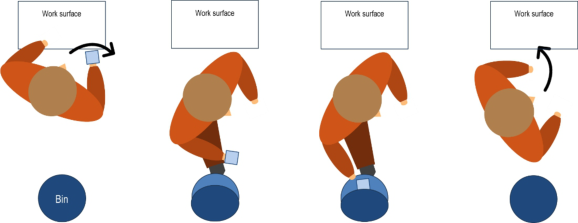
RQ3 (Backward foot operation): The main strategy observed was: “Turn clockwise, interact with right foot, dispose with right hand, turn back counterclockwise” (see Figure 4). The participants preferred to interact with the side of limbs to which one turns. E.g. if turned clockwise, the right foot and right hand was used for the operating action and vice versa. This shows that the turning movement has an influence on the execution of the operating action. The study showed that the pedal-operated waste receptacle was never opened by hand when standing, whereas this was the case twice when seated. This could be due to the fact that when seated, the hands are closer to the lid, making it easier to operate by hand, whereas when standing, the foot is preferred due to the greater distance.
Figure 4: Main strategy of RQ3 (backward foot operation).
CONCLUSION
This study provides evidence for the existence of distinct movement strategies at assembly workstations, categorized into main, secondary, and individual strategies. These findings underscore the importance of incorporating such strategies into workstation design.
Identification and Empirical Investigation of Movement Strategies for Workstation Design 67
Key outcomes of the research reveal that right-handed individuals predominantly reach with their right hand from the right side, and when reaching rearward, most participants pivot to the right, utilize their right hand, and rotate back to the left. For foot operations, participants favor the foot corresponding to their turning direction. The study emphasizes the significant influence of handedness on strategy selection, suggesting that workstations should be adaptable to individual handedness, particularly in shared environments. Furthermore, the placement of materials and tools emerged as a critical factor in determining movement strategies, with ergonomic positioning potentially reducing unnecessary movements and improving efficiency.
The present study acknowledges several limitations that require consideration. Firstly, the laboratory setting may have influenced participant behavior, potentially compromising validity. Secondly, the relatively small, homogeneous sample limits the generalizability of the results. Thirdly, the classification of strategies based on study outcomes may also impede comparisons with extant literature. Future research should address these limitations and expand the field’s scope, utilizing larger, more diverse samples to enhance transferability across populations and work contexts. Attention should be paid to examining other age groups and taking a closer look at left- handed people. Conducting studies in authentic work environments would provide invaluable insights into natural employee behaviors. Standardizing methods for data collection and analysis is crucial for improving inter-study comparability and facilitating meta-analyses. Additionally, investigating the long-term impact of movement strategies on employee health and well- being is essential. Integrating cognitive ergonomics concepts with physical ergonomics could yield novel insights and innovative solutions, leading to more holistic and effective interventions. These approaches would contribute to a significant advancement in our understanding of ergonomic workplace design and its implications for employee health and productivity.
In conclusion, the integration of movement strategies into the design of workplaces appears to hold considerable potential for enhancing ergonomics and employee well-being. A nuanced approach that takes into account individual needs is imperative. Key recommendations include the development of flexible, adaptable workspaces. However, it is essential to acknowledge the limitations of the studies, particularly with regard to sample characteristics. Future workplace design should strive to balance general principles with individual variability to create truly ergonomic, employee-centred environments.
AUTHOR’S STATEMENT Informed consent has been provided from the participant. Access to the complete research findings is available upon request.
REFERENCES
Alipoor, P., Daneshmandi, H., Fararuei, M., & Zamanian, Z. (2021). Ergonomic Design of Manual Assembly Workstation Using Digital Human Modeling. Annals of Global Health, 87(1), 55. Beyer, L. (2014). Motorische Stereotype in der manuellen Medizin: Entwicklung und
Gebrauch eines Begriffs. Manuelle Medizin, 52(4), 314–320. BGHM. (2013). Händigkeits- gerechtes Arbeiten: Hinweise in Regelwerken und arbeitswissenschaftliche Erkenntnisse. Berufsgenossenschaft Holz und Metall. Daub, U., Gawlick, S., & Blab, F. (2018). Ergonomische Arbeitsplatzgestaltung. Deutsches Institut für Normung e. V. (2016). DIN EN ISO 6385:2016-12, Grundsätze der Ergonomie für die Gestaltung von Arbeitssystemen (ISO_6385:2016); Deutsche Fassung EN_ISO_6385:2016. DIN Media GmbH. Federal Ministry of Justice. (2024a). Arbeitsschutzgesetz – ArbSchG (Federal
Ministry of Labour and Social Affairs Patent). https://www.gesetze-im-internet.de/ englisch_arbschg/englisch_arbschg.pdf Federal Ministry of Justice. (2024b). Workplace Ordinance—ArbStättV (Federal Ministry of Labour and Social Affairs Patent). https://www.gesetze-im-internet.de/ englisch_arbst_ttv/englisch_arbst_ttv.pdf Lange, L. (2024). Identifikation und empirische Untersuchung von Bewegungsstrategien für die Arbeitsplatzgestaltung [Masterthesis]. Internal Hochschule Furtwangen. Unpublished. Latka, J. (2019). Nutzerzentrierte Entwicklung von Ein- und Ausstiegskonzepten
im Nutzfahrzeugbereich unter der Betrachtung von Bewegungsstrategien [Dissertation]. Technische Universität München. Peruzzini, M., Pellicciari, M., & Gadaleta, M. (2019). A comparative study on computer-integrated set-ups to design human-centred manufacturing systems. Robotics and Computer-Integrated Manufacturing, 55, 265–278. Rigel, S. (2005). Entwicklung und Validierung einer Methode zur quantitativen
Untersuchung der Ein- und Ausstiegsbewegung in einen Pkw [Dissertation]. Technische Universität München. Schlund, S., Mayrhofer, W., & Rupprecht, P. (2018). Möglichkeiten der Gestaltung individualisierbarer Montagearbeitsplätze vor dem Hintergrund aktueller technologischer Entwicklungen. Zeitschrift für Arbeitswissenschaft, 72(4), 276–286. Schreiber, W., Zürl, K., & Zimmermann, P. (Eds.). (2017). Web-basierte Anwendungen Virtueller Techniken: Das ARVIDA-Projekt – Dienste-basierte Software-Architektur und Anwendungsszenarien für die Industrie. Springer Berlin Heidelberg. Seidu, R. K., Ofori, E. A., Eghan, B., Fobiri, G. K., Afriyie, A. O., & Acquaye, R.
(2024). A systematic review of work-related health problems of factory workers in the textile and fashion industry. Journal of Occupational Health, 66(1), uiae007. Stergiou, N., & Decker, L. M. (2011). Human movement variability, nonlinear dynamics, and pathology: Is there a connection? Human Movement Science, 30(5), 869–888.
LISTED IN THE AHFE DIGITAL BOOKSTORE CATALOGUE
Explore the complete digital volume
Physical Ergonomics and Human Factors
Read this individual research paper free through the original publisher, or explore the full digital proceedings book.
ISBN 978-1-964867-61-8
Explore this ISBN in the AHFE Bookstore ↗Listed in the July 2026 bookstore catalogue; search by ISBN to confirm current availability · Digital book purchase optional