Junya Tatsuno, Setsuo Maeda (2025). Standing Balance After Whole-Body Vibration Exposure: Differences Between Tiptoeing and Flat-foot Standing. In: Physical Ergonomics and Human Factors. AHFE Open Access, vol. 185, pp. 93–99. https://doi.org/10.54941/ahfe1006468
Slip, trip, and fall accidents are among the most significant occupational hazards in the land transportation industry. These incidents are assumed to be associated with whole-body vibration (WBV) exposure during vehicle operation. Considered the nature of work postures in this industry, it has suggested that tiptoeing postures may contribute to fall accidents. Thus, this study aimed to investigate the effects of WBV exposure on standing balance ability when assuming a tiptoeing posture or flat-foot standing posture.A laboratory experiment was conducted with five participants to investigate the impact of WBV exposure. The participants underwent a 60-minute virtual driving session using a driving simulator (DS) while being exposed to WBV. Standing balance measurements were performed at four time points: before WBV exposure, immediately after exposure, 2 minutes after exposure, and 4 minutes after exposure. The experimental conditions included two variables: (1) the presence or absence of driving tasks during WBV exposure and (2) two standing postures for balance assessment: flat-foot standing posture and tiptoeing posture. Additionally, a control condition without WBV exposure was included, resulting in a total of six experimental conditions.Following the experiment, standing balance was evaluated using three key parameters: total center of pressure trajectory length (LNG), enveloped area (ENV_AREA), and root mean square area (RMS_AREA). The results indicated that, in the tiptoeing posture, all balance parameters exhibited significantly greater values compared to the flat-foot standing posture. This finding suggests that the tiptoeing posture inherently results in reduced balance stability.Furthermore, an analysis of WBV exposure conditions revealed that standing balance was affected compared to the control condition. In particular, a notable degradation in standing balance was observed under the driving condition. A possible explanation for this finding is that prolonged driving requires continuous operation of the accelerator pedal, using the right leg. This asymmetric muscle activation may lead to differential fatigue between the right and left lower limbs, thereby contributing to increased postural instability immediately after driving.These findings suggest the critical importance of post-driving recovery time. The results show that tiptoeing immediately after prolonged driving causes a high risk of falls and should be considered a hazardous condition. Therefore, sufficient rest time should be implemented to mitigate this risk. Moreover, given that standing balance capacity is generally lower in the tiptoeing posture compared to the flat-foot standing posture, workers required to perform tasks in a tiptoeing position should exercise caution to prevent slip, trip, and fall accidents. This study provides valuable insights into occupational safety in the land transportation industry and highlights the necessity of implementing preventive measures against fall-related accidents. Future research should further explore the physiological mechanisms underlying postural instability following WBV exposure and prolonged driving, as well as the development of effective interventions to enhance worker safety.
Vehicle occupants are exposed to whole-body vibration (WBV) while riding. While WBV affects driving comfort, prolonged exposure can lead to health issues such as back pain, sciatica, digestive disorders, genitourinary problems, and hearing damage, among others. Previous studies have also raised concerns about the increased risk of traffic accidents due to fatigue caused
by WBV. As a result, numerous measures have been investigated to mitigate WBV in vehicles.
In recent years, the number of occupational accidents involving workers in the road transportation industry falling from heights during loading and unloading after driving has been increasing. In Japan, more than 10,000 work-related accidents occur annually in cargo-handling operations, accounting for approximately 10% of all occupational accidents (Land Transportation Safety and Health Association, 2018). The temporary loss of standing balance is believed to be a contributing factor in these slips, trips, and falls among land cargo workers. In response, the Ministry of Health, Labor and Welfare recommends stretching exercises and rest breaks before work, as prolonged driving may increase the risk of slip-and-fall accidents (Land Transportation Safety and Health Association, 2015). However, specific details regarding these recommendations have not yet been disclosed. To address this gap, this study aims to identify the optimal duration of rest time and investigate practical prevention strategies related to occupational environments.
Tatsuno et al. (2023) previously investigated the effects of WBV exposure on standing balance impairment and suggested that a rest period of several minutes should be implemented. Their study exposed participants to vibration at 0.5 m/s2 RMS for 60 minutes in a driving simulator (DS). Additionally, during cargo handling work in the land transportation industry, working with an unstable posture, such as standing on one leg standing on tiptoes, may increase the risk of work-related accidents, including slips, trips, and falls. Although Nolan and Kerrigan (2004) have investigated differences in postural control mechanisms between tiptoeing and flat-foot standing, this article focuses on the relationship between WBV exposure and standing balance ability. Therefore, this study conducted an experiment to examine the effects of WBV exposure on standing balance ability while tiptoeing post-exposure.
MATERIALS AND METHODS
Experimental Outline The experiment consisted of WBV exposure and static standing balance measurement. Participants’ static standing balance was first assessed prior to WBV exposure. Next, the participants were exposed to WBV for 60 minutes. Immediately after the WBV exposure, the standing balance was assessed as before. Additional assessments were conducted at 2 and 4 minutes post-exposure to evaluate balance recovery.
During the assessment, participants stood on a sensor in two postures: a flat-foot stance and a tiptoeing stance. The participants sat to rest during the non-measurement periods.
Participants The participants consisted of five healthy male university students with regular driver’s licenses. Their ages were between 20 and 21 years with a
Standing Balance After Whole-Body Vibration Exposure 95
mean of 20.4 ± 0.5 years. No participants were occupational drivers in the transportation industry. In addition, those who suffered from low back pain were excluded. The approval from the Bioethics Committee of the Faculty of Engineering, Kindai University (approval number: KUBE1404), was obtained before the experiment was designed. A gratuity was paid to each participant according to the hours spent in the experiment to provide benefit to the participants and ensure reliability of the experimental data.
Experimental Procedure The experimental procedure was as follows:
1. Before the experiment, participants were informed of purpose and outline, and their consent was obtained. Additionally, their profile information was collected. 2. Participants sat in the DS and adjusted the seat to a comfortable driving position. This instruction was also given in the non-driving condition, as the passenger seat in commercial vehicles allows for adjustments. 3. Participants practiced driving to familiarize themselves with DS operation. 4. The standing balance of the participants 30 s before WBV exposure was measured. 5. Once participants had no further questions, the experimental environment was set according to a predetermined order. Experimental driving then began at a speed of 60 km/h. In the non-driving condition, participants performed a reading task instead of driving. 6. After WBV exposure, participants’ standing balance was measured immediately, as well as at 2 and 4 minutes post-exposure. Between measurements, they sat and rested.
Whole-Body Vibration Exposure The DS with 6 DOF (SUBARU CORPORATION, Tokyo, Japan) used for the WBV exposure. The participants were subjected to WBV exposure based on the computational algorithm in the DS control software (UC-Win Road, FORUM 8 Co., Ltd, Tokyo, Japan) (Tatsuno et al., 2011). This experiment considered two scenarios: participants riding as either the driver or the passenger. To facilitate this, an external controller was connected to the DS, allowing the experimenter to operate the vehicle.
A test course was constructed in a virtual reality space based on a previous study (Tatsuno et al., 2023). The course included gentle curves to prevent participants from becoming bored during the experiment, while the vertical alignment remained flat with no slopes. WBV exposure zones were placed approximately every 500 m along the course, with five bumps positioned at 10 m intervals within each zone. The magnitude of WBV was controlled by adjusting the bump height, which was set at 1, 2, and 3 cm. Under these conditions, participants were exposed to WBV of approximately 0.2 m/s2 (Tatsuno et al., 2023).
96 Tatsuno and Maeda
Standing Balance Test In this study, the Nintendo Wii Balance Board was utilized for stabilometry measurements. Several studies have reported the application of the Nintendo Wii Balance Board in medical and rehabilitation fields (Bojanek et al., 2020; Yoshikawa et al., 2015). Participants were asked to stand on the stabilometer without a foam rubber pad and gaze at a target 2 m away for 30 s with their eyes open. As mentioned earlier, participants stood on the sensor in two postures: a flat-foot stance and a tiptoeing stance. They sat to rest during the non-measurement periods.
Experimental Condition The experiment was designed to investigate the effect of task difference (driver or passenger) during WBV exposure and participants’ standing posture during standing balance test on the participants’ standing balance. Thus, four conditions were established by multiplying task difference and standing balance. The conditions were prepared as a control in which the participants were not exposed to vibrations. While participants took assessment with flat-foot stance in the fifth condition, the sixth condition required a tiptoeing stance.
RESULTS AND DISCUSSION
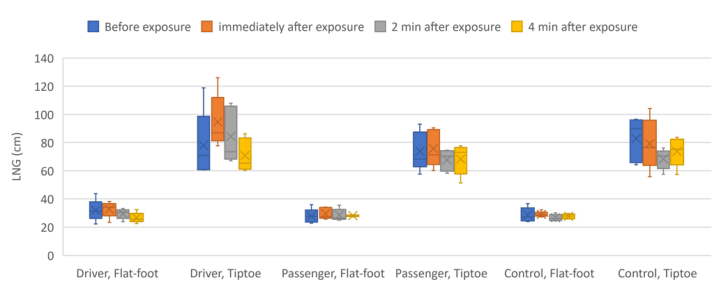
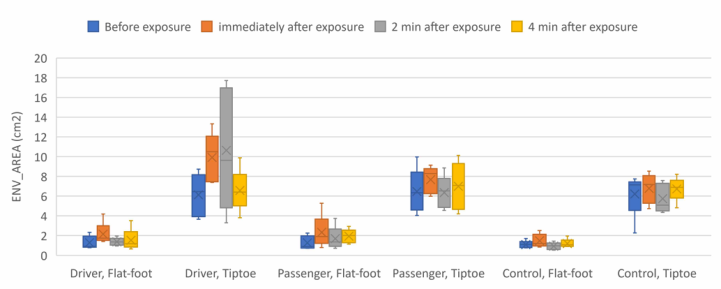
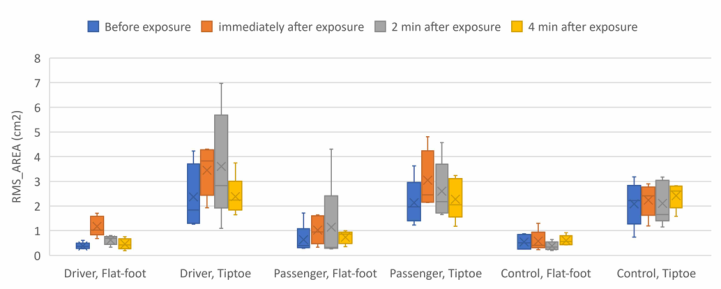
Evaluation indices can be derived from the trajectory of center-of-gravity. In this paper, total trajectory length (LNG), enveloped area (ENV_AREA), and RMS area (RMS_AREA) were calculated for evaluation metrics. Figures 1, 2 and 3 present boxplots of LNG, ENV_AREA, and RMS_AREA under six conditions before and after WBV exposure, respectively. The results indicated a significant increase in all values immediately after WBV exposure under the tiptoeing condition, with a notably slower recovery observed in the driver condition.
LNG is generally higher in the tiptoeing stance than in the flat-foot stance, confirming that tiptoeing is inherently less stable. The values observed in the flat-foot standing were consistent with those reported in previous studies. The standing balance test performed by tiptoeing after 60 minutes of driving showed that the LNG increased immediately after the WBV exposure. Additionally, LNG tends to recover to baseline levels after 4 minutes.
As shown in Fig. 2, ENV_AREA is significantly larger in the tiptoeing, particularly for the driver immediately after WBV exposure. The effect isn’t clear in passengers, indicating that driving operation may lead to greater instability after WBV exposure. In the control group, ENV_AREA remains relatively constant, reinforcing the idea that WBV has a destabilizing effect of standing balance. Similar to LNG, ENV_AREA decreases over time, suggesting partial recovery. However, in the driver-tiptoeing condition, recovering standing balance takes longer, as ENV_AREA remains relatively high even 4 minutes after exposure.
Standing Balance After Whole-Body Vibration Exposure 97
Figure 1: Boxplot of total trajectory length (LNG).Figure 2: Boxplots of enveloped area (ENV_AREA).Figure 3: Boxplots of root-mean-square area (RMS_AREA).
Similar to the other indices, while RMS_AREA values in Flat-foot standing show much smaller variations, RMS_AREA increased immediately after WBV exposure, especially in the driver-tiptoeing condition. The control condition remains stable across all time points. Drivers show a larger increase in RMS_AREA than passengers, especially in the tiptoeing stance. The
98 Tatsuno and Maeda
passenger tiptoe condition also shows an increase but not as much as the driver tiptoe condition.
It was assumed that the difference between the driving and passenger conditions was due to the accelerator pedal operation. Some studies (Michida et al., 2001; Grujicic et al., 2010) have shown that prolonged operation of the accelerator pedal causes fatigue. The results of the present study suggest that fatigue caused by the accelerator pedal operation might have influenced the disruption in the standing balance.
These findings suggest the critical importance of post-driving recovery time. The results show that tiptoeing immediately after prolonged driving causes a high risk of falls and should be considered a hazardous condition. Therefore, sufficient rest time should be implemented to mitigate this risk. Moreover, given that standing balance capacity is generally lower in the tiptoeing posture compared to the flat-foot standing posture, workers required to perform tasks in a tiptoeing position should exercise caution to prevent slip, trip, and fall accidents. This study provides valuable insights into occupational safety in the land transportation industry and highlights the necessity of implementing preventive measures against fall- related accidents. Future research should further explore the physiological mechanisms underlying postural instability following WBV exposure and prolonged driving, as well as the development of effective interventions to enhance worker safety.
CONCLUSION
This study investigated the effects of whole-body vibration (WBV) exposure on standing balance, particularly in tiptoeing and flat-foot postures, following prolonged driving. The results revealed that tiptoeing inherently reduces balance stability, and this effect was further exacerbated immediately after WBV exposure. Among the evaluated conditions, drivers who adopted a tiptoeing posture exhibited the most pronounced impairment in balance stability. This may be attributed to asymmetric fatigue caused by prolonged accelerator pedal operation, which likely affects lower limb muscle control.
Importantly, while balance metrics such as total trajectory length (LNG), enveloped area (ENV_AREA), and RMS area (RMS_AREA) showed gradual recovery within a few minutes post-exposure, tiptoeing balance impairment persisted longer in the driving condition. These findings emphasize the heightened risk of falls for individuals required to perform tasks in a tiptoeing posture immediately after driving. Employers should be encouraged to incorporate systemized recovery breaks and targeted stretching routines as part of their standard operating procedures.
To mitigate this risk, it is crucial to implement sufficient rest periods following prolonged driving. Additionally, occupational safety protocols should prioritize increased awareness among workers performing tiptoeing tasks in high-risk environments. Stretching exercises, as recommended by safety authorities, may play a role in reducing the risk of slip, trip, and fall accidents.
Standing Balance After Whole-Body Vibration Exposure 99
Future research should further investigate the physiological mechanisms underlying postural instability following WBV exposure and explore effective intervention strategies to enhance worker safety. Such efforts will contribute to improving occupational health and reducing fall-related accidents in the transportation industry.
REFERENCES
Bojanek, E. K., Wang, Z., White, S. P., Mosconi, M. W. (2020). Postural control processes during standing and step initiation in autism spectrum disorder. J Neurodevelop Disord 12, 1 (2020). https://doi.org/10.1186/s11689-019-9305-x Grujicic, M., P., Pandurangan, B., Xie, X., Gramopadhye, A. K., Wagner, D.,
Ozen, M. (2010). Musculoskeletal computational analysis of the influence of car- seat design/adjustments on long-distance driving fatigue. Int. J. Ind. Ergon. 40, 345–355. Land Transportation Safety and Health Association. (2015). Stop, Fall Disaster. http://rikusai.or.jp/wp-content/uploads/pdfs/tentou-leaf.pdf (accessed on 18 March 2025) (In Japanese). Land Transportation Safety and Health Association. (2018). Explanation of Safety Guidelines for Cargo Handling Operations. http://rikusai.or.jp/wp-content/ uploads/pdfs/niyaku-guideline_kaisetsu_H30.pdf (accessed on 18 March 2025). (In Japanese). Michida, N., Okiyama, H., Nishikawa, K., Nouzawa, T. (2001). A Study of Drivers’ Fatigue Mechanisms During Long Hour Driving. SAE Trans., 110, 284–292. Nolan, L., Kerrigan, D. C., (2004), Postural control: Toe-standing versus heel-
toe standing, Gait & Posture, 19(1), pp. 11–15, https://doi.org/10.1016/S0966- 6362(03)00007-9. Tatsuno, J. Tsuchiya, K. Yonehara, M. Nakamura, H. Takehara, S. Ishimatsu, K.
Maeda, S. (2011). Driving Simulator for Subjective Scaling Validation of the ISO 2631–1 standard. Proceedings of the 40th International Congress and Exposition on Noise Control Engineering (Inter-Noise 2011), Osaka, Japan. Tatsuno, J. Maeda, S. (2023). Effect of Whole-Body Vibration Exposure in Vehicles on Static Standing Balance after Riding. Vibration 2023, 6, 343–358. https:// doi.org/10.3390/vibration6020021 Yoshikawa, K., Kojima, T., Sugiura, A., Miyao, M. (2015). Possibility of Using the
Wii Balance Board in Stabilometry, FORMA, 30(1), 1–4, https://doi.org/10.5047/ forma.2015.001.
LISTED IN THE AHFE DIGITAL BOOKSTORE CATALOGUE
Explore the complete digital volume
Physical Ergonomics and Human Factors
Read this individual research paper free through the original publisher, or explore the full digital proceedings book.
ISBN 978-1-964867-61-8
Explore this ISBN in the AHFE Bookstore ↗Listed in the July 2026 bookstore catalogue; search by ISBN to confirm current availability · Digital book purchase optional