Junya Tatsuno, Tamaki Tsuchioka, Kazuma Ishimatsu, Setsuo Maeda (2026). Effects of Multimodal Whole-Body Vibration Exposure in Automobiles on Occupants’ Tactile Perception. In: Advances in Human Factors of Transportation. AHFE Open Access, vol. 224, pp. 258–264. https://doi.org/10.54941/ahfe1007853
As automated vehicles develop, occupants will shift from drivers to passengers. They will use touch interfaces, mobile devices, and other systems inside vehicles. In these situations, tactile perception becomes important. At the same time, occupants are exposed to whole-body vibration (WBV) generated by vehicle motion. Thus, the effects of vibration on ride comfort have been studied. While there are some reports on the effects of whole-body vibration on human perception, such as visual and acoustic perception, its influence on tactile perception remains insufficiently understood. Participants performed a pairwise comparison task of tactile roughness under different vibration conditions and visual display conditions using a driving simulator. Three vibration conditions (large, small, and none), two visual display conditions (single-screen and triple-screen), and three time points (0, 30, and 60 min) were examined. Psychological scale values were calculated using Thurstone’s method of paired comparisons, and time-course changes in perceptual distance relative to baseline were analyzed. The results indicated that vibration exposure did not reduce tactile discrimination as initially hypothesized. Instead, perceptual distance tended to increase under small vibration conditions, while large vibration caused a slight decrease. A repeated-measures ANOVA revealed a marginal tendency for the main effect of vibration (p = 0.067), whereas no significant effects of visual condition or exposure time were observed. As the number of participants in the experiment is only 10, we will continue the experiment with more participants to develop a guideline for designing the interior of the fully automated vehicle in the future.
In this study, automated vehicles refer to vehicles with high levels of driving automation (SAE Level 4 or higher). This includes fully autonomous and driverless vehicles, as well as electric vehicles in which occupants do not need to perform driving tasks.
Effects of Multimodal Whole-Body Vibration Exposure in Automobiles 259 WBV generated by road surface irregularities and vehicle dynamics affects ride comfort. It also influences sensory and cognitive functions. A quantitative meta-analysis by Conway et al. (2007) demonstrated that WBV can degrade human performance through both mechanical interference and increased cognitive load, affecting perceptual-motor tasks and reaction-based behaviors. In addition, visual degradation under WBV has been reported to peak around 12.5 Hz, attributed to the eyeball’s resonance frequency (Ishitake et al., 1998). Moreover, experimental findings have shown that WBV exposure also reduces postural stability immediately after vibration (Tatsuno et al., 2025).
As fully autonomous vehicles become more common, in-vehicle design will differ from that of conventional vehicles. In particular, the handling of visual and auditory information will change. In such environments, interactions among different sensory modalities may result in perceptual characteristics that differ from those induced by single-sensory stimuli. In other words, fully autonomous vehicles, in which various tasks are performed while traveling, should adopt in-vehicle designs that account for perceptual characteristics to enhance task performance. Previous studies have demonstrated that visual stimuli significantly influence subjective evaluations of ride comfort and motion sickness (Tatsuno et al., 2024).
Although it is clear that a deeper understanding of the effects of whole- body vibration on human sensory and cognitive functions is needed, discussions regarding product standardization have only just begun in various international standards.
The objective of this study is to investigate how multimodal WBV exposure influences tactile perception in an automotive environment. Specifically, an experimental environment combining vibration conditions and visual information presentation conditions was constructed. Then, changes in tactile perceptual characteristics across conditions were quantitatively evaluated.
Through this approach, this study aims to deepen the understanding of sensory integration mechanisms in multimodal environments and to provide fundamental knowledge that will contribute to future in-vehicle design and human–machine interface design for autonomous vehicles.
MATERIALS AND METHODS
Apparatus
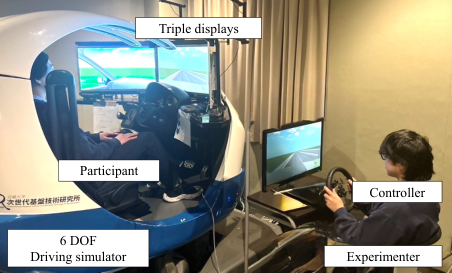
Figure 1 shows the configuration of the experimental apparatus. A six- degree-of-freedom driving simulator (Fuji Heavy Industries, Japan) with three displays was used to expose participants to WBV. Since participants were exposed to WBV as passengers in this experiment, the experimenter operated the driving simulator at 60 km/h with the external controller.
Triple displays
Participant
Controller Experimenter 6 DOF Driving simulator
Figure 1: Experimental environment.
Experimental Conditions The course was 30 km long and configured as a closed loop by virtually connecting the start and end points. Along the course, vibration exposure zones were placed at specific sections, each consisting of five bumps spaced at 10-meter intervals. Based on previous research, vibration exposure levels in each vibration exposure zone are approximately measured as shown in Table 1. Within these zones, accelerations from a few hertz to 100 Hz, caused by the bumps, as well as accelerations below 1 Hz due to the road’s longitudinal alignment, were measured (Tatsuno et al., 2024). By adjusting the bump height, two distinct vibration exposure levels were created. The RMS vibration acceleration values were 0.16 and 0.12 m/s² for the high and low vibration courses, respectively. In addition, a control condition with no fixed vibration zones was included, where only background vibration of approximately 0.03 m/s² was present throughout the course. These vibration levels correspond to mild WBV exposure levels commonly observed in passenger vehicles.
Table 1: Vibration acceleration to which occupants are exposed during the vibration exposure section.
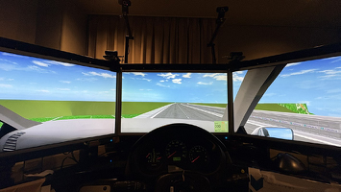
In the experiments, two foreground scenery conditions were established as shown in Figure 2. The first was a triple-display condition in which all displays showed images of the outside scenery. This configuration is designed so that participants can view the outside scenery through the front window, as in a conventional automobile. The second was a single-display condition in which only the center displays supplied images. Some futuristic renderings of fully automated vehicles use the front window as an information presenter. This configuration mimics such situations.
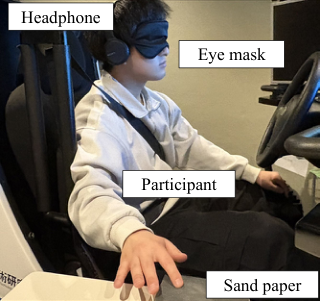
Tactile Perception Evaluation In this experiment, to investigate the effects of multimodal vibration on tactile perception, three grit sizes of the sandpaper (#400, #600, and #800) were used as presentation stimuli. Figure 3 shows the setup for the tactile perception evaluation.
Headphone Eye mask
Participant
Sand paper
Figure 3: A participant during the tactile perception experiment.
In the test, all pairwise combinations of the three grits were presented six times, excluding identical pairs. Participants performed reciprocal movements with their right index finger on sandpaper for 10 seconds using a pressure of 40 ± 10 gf. Before the experiment, the participants were asked to practice moving their fingers while observing the readings of a digital weight scale placed under the sandpaper. For the evaluation, participants were asked to rate the texture of the sandpaper presented later in one of three categories (coarser, the same, or smoother) compared to the sandpaper presented earlier. During this test, participants wore eye masks and headphones playing white noise. This task was performed three times: before riding the DS, 30 minutes after riding, and 60 minutes after riding.
PARTICIPANTS The trial participants included 10 male students with no specific medical conditions affecting their roughness perception and with valid driving licenses. Before the experiment, permission was obtained from the bioethics
committee of the Faculty of Engineering, Kindai University. All participants provided informed consent prior to participation.
RESULTS AND DISCUSSION
Results
The paired-comparison data were analyzed using Thurstone’s law of comparative judgment (Case V) (Thurstone, 1927; Torgerson, 1958). The proportion of preference was calculated as w/n, where w denotes the number of times stimulus i was judged rougher than stimulus j, with ties counted as 0.5, and n denotes the total number of comparisons between stimuli i and j. To avoid extreme proportions (0 or 1), the corrected proportion was applied as P* = (w+0.5)/(n+1) (Guilford, 1954). Then, the corrected proportions were transformed into normal deviates, and the scale values were obtained as the mean of the corresponding Z-scores.
To evaluate the effects of vibration and visual conditions on tactile perception, time-course changes in the perceived roughness difference were analyzed relative to the baseline (0 min).
SP600-SP800 SP400-SP600 SP400-SP800
SP600-SP800 SP400-SP600 SP400-SP800
1
1
0
0
-1
-1
0 min 30 min 60 min
0 min 30 min 60 min
(a) Triple-display setting under large WBV (b) Single-display setting under large WBV SP600-SP800 SP400-SP600 SP400-SP800 SP600-SP800 SP400-SP600 SP400-SP800
1
1
0
0
-1
-1
0 min 30 min 60 min
0 min 30 min 60 min
(c) Triple-display setting under small WBV (d) Single-display setting under small WBV SP600-SP800 SP400-SP600 SP400-SP800 SP600-SP800 SP400-SP600 SP400-SP800
1
1
0
0
-1
-1
0 min 30 min 60 min
0 min 30 min 60 min
(e) Triple-display setting under no WBV (f) Single-display setting under no WBV
Figure 4: Time-course changes in the differences between Thurstone scale values under each condition.
Figure available in the original PDF paper.
Figure 4 shows the changes in the perceived roughness difference for each condition, calculated as the difference from the initial state. For the SP400– SP800 pair, which represents the overall roughness classification range, the perceived roughness difference increased over time under the small-vibration condition. Particularly in the triple-display condition, perceptual sensitivity increased. In contrast, under the large-vibration condition, the perceived roughness difference remained nearly unchanged or slightly decreased. This suggests a compression or stabilization of perceptual sensitivity. In the no-vibration condition, roughness perception increased moderately over time, suggesting learning effects.
For the SP400–SP600 and SP600–SP800 pairs, condition-dependent changes were observed, indicating that the perceptual position of the intermediate stimulus (SP600) shifted over time. These results suggest that vibration exposure affects the magnitude of the perceived roughness difference.
Discussion
A three-way repeated-measures ANOVA was conducted on the roughness range, defined as the difference between the Thurstone scale values of SP400 and SP800, which represents the perceived roughness difference range of surface roughness, to examine the effects of vibration, screen condition, and time.
The results revealed no statistically significant main effects or interaction effects (p > 0.05), although a marginal effect of vibration was observed (F(2,18) = 3.15, p = 0.067).
These results indicate that vibration exposure does not simply shift perceived roughness uniformly. In particular, weak vibration may increase the perceived roughness difference, whereas strong vibration may reduce it. These findings provide insights into multisensory interactions between tactile and vibration inputs and may contribute to the design of vehicle environments and haptic interfaces.
These findings are limited to the vibration levels examined in this study. The observed tendencies, such as the enhancement of perceived roughness difference under small vibration and the compression under large vibration, may depend on vibration magnitude.
Future studies should increase the sample size to improve statistical power and employ model-based approaches, such as linear mixed-effects models, to examine individual differences and interaction effects.
CONCLUSION
This study examined the effects of multimodal whole-body vibration (WBV) exposure on tactile roughness perception in an automobile environment. The main findings are summarized as follows:
1. This study shows that whole-body vibration (WBV) in automotive environments does not substantially alter tactile roughness perception.
2. Our findings indicate that the ordinal hierarchy of tactile stimuli remained unchanged under all experimental conditions. In addition, a marginal effect of vibration was observed (p = 0.067). 3. This, perceptual tendency was maintained regardless of visual condition or exposure duration. These results suggest that ambient vehicle vibration may influence the perceived roughness difference without degrading overall tactile roughness perception.
REFERENCES
Conway, G.E., Szalma, J.L., Hancock, P.A., (2007). A quantitative meta-analytic examination of whole-body vibration effects on human performance. Ergonomics, 50(2), 228–245. Guilford, J.P., (1954). Psychometric Methods. McGraw-Hill. Ishitake, T., Ando, H., Miyazaki, Y., Matoba, F., (1998). Changes of visual
performance induced by exposure to whole-body vibration. Kurume Medical Journal, 45, 59–62. Tatsuno, J., Hisada, I., Ishimatsu, K., Nakamura, H., Maeda, S. (2024). Considerations of Interior Design in Fully Automated Vehicles: Influence of Front Window Scenery on Ride Comfort and Motion Sickness, Proceedings of the AHFE 2024 International Conference on Advances in Human Factors of Transportation, Vol. 148, pp.234–243, Nice, France Tatsuno, J., Maeda, S. (2025). Standing Balance After Whole-Body Vibration
Exposure: Differences Between Tiptoeing and Flat-foot Standing, Proceedings of the AHFE 2025, Physical Ergonomics and Human Factors, Vol. 185, pp.93–99 Orlando, USA Thurstone, L.L., (1927). A law of comparative judgment. Psychological Review 34 (4), 273–286. Torgerson, W.S., (1958). Theory and Methods of Scaling. Wiley, New York.
LISTED IN THE AHFE DIGITAL BOOKSTORE CATALOGUE
Explore the complete digital volume
Advances in Human Factors of Transportation
Read this individual research paper free through the original publisher, or explore the full digital proceedings book.
ISBN 979-8-950676-00-0
Explore this ISBN in the AHFE Bookstore ↗Listed in the July 2026 bookstore catalogue; search by ISBN to confirm current availability · Digital book purchase optional