Tzuno Tseng, Tung-Ming Lee (2026). Refining Research Questions for AI-Assisted Knowledge Retrieval in Interior Design: An Exploratory Study of Expert Judgment. In: Human-Computer Interaction & Emerging Technologies. AHFE Open Access, vol. 233, pp. 64–71. https://doi.org/10.54941/ahfe1007504
AI-assisted knowledge retrieval is increasingly used to support interior designers during early-stage exploration; however, current “single-shot” and keyword-driven paradigms fail to align with the iterative, interpretive, and responsibility-laden nature of expert design reasoning, requiring designers to articulate ill-defined needs precisely and offering limited support for multi-criteria comparison and accountable decision-making. This exploratory qualitative study investigates how senior interior designers structure judgment across three phases of material selection—searching, comparing, and deciding—and where AI-assisted tools support or fail to support expert reasoning. Semi-structured interviews were conducted with three senior professionals who each have 15–20 years of experience. Verbatim transcripts were analyzed using inductive thematic coding using open, axial, and thematic clustering, yielding ten codes organized into three higher-level themes: comparison-stage difficulties, expert judgment logic, and perceived roles of AI. Findings show that experts value AI for accelerating visual exploration and broadening references, but experience breakdowns during comparison due to nomenclature confusion, persistent gaps between online information and local supply-chain realities, and the lack of structured failure-based evidence. Expert judgment is anchored in constructability reasoning, tactile and physical verification, psychological matching with client intent, and reliance on trusted human networks. Based on these structures, we derive interface design implications that emphasize uncertainty awareness through time-stamped availability and risk flags, evaluation transparency through inspectable criteria and trade-offs, responsibility boundary clarification, and professional agency preservation through adjustable comparison frameworks. This human-centered framing positions AI-assisted knowledge retrieval as a collaborative decision-support system that augments—rather than replaces—expert judgment in high-stakes material decision-making.
AI-assisted knowledge retrieval aims to reduce designers’ cognitive burden in search-as-learning processes, where conventional keyword-based search often imposes excessive load during exploratory tasks (Kaushik and Jones 2023; Soufan 2023). Recent advances have leveraged Fuzzy Set Theory, knowledge-based Received February 5, 2026; Revised April 3, 2026; Accepted April 18, 2026; Available online July 20, 2026
Refining Research Questions for AI-Assisted Knowledge Retrieval in Interior 65 decision support systems (Zhang et al., 2023), and large language models to support material recommendation and early-stage decision-making (Saka et al., 2024). However, prevailing search and interaction paradigms still require designers to precisely articulate evolving and often ill-defined information needs through “single-shot” queries (White, 2024), which inadequately support the iterative and interpretive nature of design reasoning.
Prior empirical studies have identified key criteria shaping material evaluation in interior design. For example, Altay and Salcı (2024) found that architects and interior designers tend to prioritize sensorial properties and project-related constraints over ecological considerations when selecting finishing materials for residential interiors. While such findings provide valuable insight into designers’ evaluative preferences, this line of research primarily examines decision outcomes rather than the underlying knowledge retrieval and comparison processes— particularly how experts negotiate between standardized information and tacit experiential knowledge in AI-assisted contexts.
This gap becomes especially critical during the comparison stage of material decision-making, where multiple criteria—such as physical properties, constructability, and supply chain risks—must be reconciled under conditions of uncertainty. Existing research on AI-assisted design has largely emphasized system performance, algorithmic capabilities, or interface usability, leaving the internal structures of expert judgment and reasoning strategies underexplored. In response to this gap, the present study adopts an exploratory qualitative approach to examine how senior interior designers search for, compare, and decide on materials in real-world project contexts, with the aim of grounding future human-centered AI-assisted knowledge retrieval systems in authentic expert reasoning practices.
Accordingly, this study is guided by the following research questions: RQ1: What are the key judgment structures employed by expert designers across the searching, comparing, and deciding stages of material selection? RQ2: How do AI-assisted knowledge retrieval tools support—or fail
to support—expert reasoning at each stage, particularly during material comparison? RQ3: Based on expert judgment, which evaluative dimensions should future AI-assisted interfaces make explicit and inspectable?
METHODOLOGY
This study employs an exploratory qualitative approach to elicit the tacit knowledge of senior interior designers during material selection. Because material decision-making requires multi-dimensional judgments, including aesthetics, regulatory compliance, technical feasibility, and cost, semi- structured interviews were conducted to capture expert reasoning across three phases: searching, comparing, and deciding.
As an exploratory pilot study, the focus is on depth of expert insight rather than statistical representativeness. Purposive sampling was used to recruit three senior professionals, coded as P01, P02, and P03, each with 15 to 20 years of professional experience. All participants have extensive experience in large design organizations and hold either managerial responsibilities or advanced academic training. Their project portfolios span residential, commercial, and complex public-sector projects.
Table 1: Participant profiles.
Table available in the original PDF paper.
Participant Experience Primary Role Project Scope P01 15 years Senior Interior Designer Residential, Commercial
P02 17 years Senior Interior Designer Commercial Large-scale Projects P03 20 years Senior Interior Designer &Project Manager
Interview Design and Procedure The semi-structured interview guide was designed to probe experts’ cognitive processes in real-world project scenarios. Open-ended questions examined how participants initiate workflows and source initial material options, how they narrow down alternatives and organize emerging ideas, which evaluative criteria they apply during comparison, and when uncertainty or heightened cognitive load occurs. The interviews also explored participants’ experiences with AI and digital design tools, as well as their expectations for future AI-assisted knowledge retrieval.
Data Analysis All interviews were audio-recorded and transcribed verbatim. Data were analyzed using inductive thematic coding through a three-stage process. First, open coding decomposed transcripts into minimal semantic units and assigned preliminary codes. Second, axial coding organized these codes into 10 core categories based on conceptual relationships, as documented in the codebook. Finally, thematic clustering synthesized higher-level themes to represent the structural framework of expert judgment. Throughout analysis, the coding scheme was iteratively refined through constant comparison and analytic memoing to ensure conceptual coherence. All interviews lasted between 40 and 60 minutes and were conducted by a single researcher. All participant data were anonymized to protect confidentiality.
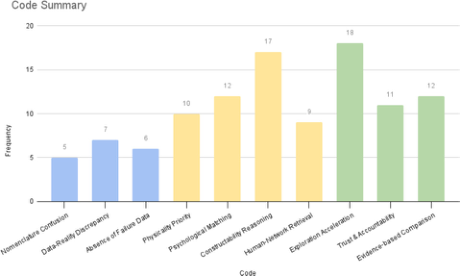
Figure 1: Code frequency distribution grouped by three thematic categories. Frequencies indicate recurrence in expert narratives rather than statistical importance; interpretive significance is derived from cross-case structural analysis (Table 3).
Refining Research Questions for AI-Assisted Knowledge Retrieval in Interior 67 As shown in Figure 1, the ten codes derived from inductive thematic analysis were organized into three higher-level themes: difficulties in the comparison stage, expert judgment logic, and the perceived role of AI. Rather than indicating statistical importance, the frequency distribution reflects the relative salience of recurring issues articulated by experts during material-related decision-making. The mapping between individual codes and thematic categories is summarized in Table 2.
Table 2: Mapping of thematic categories and corresponding codes.
Table available in the original PDF paper.
Theme Category Codes Difficulties in the comparison stage
Nomenclature Confusion; Data–Reality Discrepancy; Absence of Failure Data Expert judgment logic Physicality Priority; Psychological Matching; Constructability Reasoning; Human-Network Retrieval
The role of AI Exploration Acceleration; Trust and Accountability; Evidence- Based Comparison
Cross-Case Matrix of Expert Judgment Structures To further delineate both shared heuristics and individual nuances among participants, a cross-case matrix was developed (Table 3). This matrix distinguishes between shared expert structures—foundational reasoning patterns common to all participants—and role-specific concerns, which reflect variations driven by specific project contexts and professional responsibilities.
Table 3: Cross-case matrix of expert judgment structures (P01–P03).
Table available in the original PDF paper.
Theme/Code P01 P02 P03 Structural Interpretation Difficulties in the comparison stage
Nomenclature Confusion
✗ ✓ ✗ Role-specific concern: P02 expressed strong frustration with misleading marketing- oriented material names.
Data-Reality Discrepancy
✓ (lead time)
✓ (logistics/ schedule)
✓ (out of stock)
Shared core structure: persistent gaps between online information and local supply chain realities.
Absence of Failure Data
✗ ✓ ✓ Shared trend: strong desire for access to failure cases rather than promotional success stories.
Expert judgment logic Physicality Priority ✓ ✓ ✓ Shared core structure: tactile sensing and physical sample verification viewed as irreplaceable.
Shared core structure: materials are interpreted in relation to clients’ personality and psychological states.
Constructability Reasoning
✓ ✓ ✓ Shared core structure: decisions hinge on constructability, detailing feasibility, and material loss.
✓ (suppliers)
✓ (craftsmen)
Human- Network Retrieval
✓ (senior colleagues)
Shared core structure: trusting human expertise over search engines or AI outputs.
The role of AI Exploration Acceleration ✓ ✓ ✓ Shared core structure: AI valued for improving efficiency in early-stage visual exploration and ideation.
Trust & Accountability
✓ (copyright)
✓ (misleading content)
✓ (AI may fabricate)
Shared core structure: experts emphasized personal accountability for final decisions and outcomes.
Evidence-Based Comparison
✓ ✓ ✓ Shared core structure: strong expectations for AI to provide sources, references, and real- world examples.
DISCUSSION
Critical Information Gaps in Material Decision-Making Based on the empirical findings, this study identifies three recurring information gaps that current AI-assisted tools do not adequately address. These gaps reflect key points of friction in expert material decision-making and highlight opportunities for future human–AI collaborative interfaces.
Spatial-Material Context and Geometry-Aware Reasoning Experts noted that AI systems are unable to anticipate how material patterns fragment or deform under specific detailing conditions, such as sink basins or corner junctions, indicating a need to move beyond image-based retrieval toward geometry-aware reasoning that accounts for material behaviour and constructability.
Transparency in the Supply Chain “Black Box” Lead time and logistics stability constitute critical dimensions in expert material comparison. However, most AI design tools operate without real- time or context-sensitive supply chain data. Participants highlighted that
Refining Research Questions for AI-Assisted Knowledge Retrieval in Interior 69 recommending materials without indicating procurement risks can severely disrupt project schedules. This “supply chain black box” suggests that for AI to function as a reliable decision-support tool rather than a purely visual inspiration engine, it must integrate time-stamped metadata regarding availability and logistical feasibility.
Information Vacuum of Failure-Based Evidence Existing digital platforms and generative AI systems predominantly emphasize marketing-oriented information. The absence of structured failure-based evidence often compels experts to rely on informal human networks for risk verification, underscoring the need for AI-assisted systems that systematically surface and contextualize failure cases to support risk-aware evaluation. Taken together, these information gaps have direct implications for the design of AI-assisted knowledge retrieval interfaces in material decision- making contexts.
Table 4: Mapping information gaps to interface design implications.
Table available in the original PDF paper.
Information Gap Human Factors Dimension Interface Implication Supply chain black box Uncertainty awareness Time-stamped availability indicators and risk flags
Geometry-blind retrieval
Geometry-aware previews and constraint annotations
Evaluation transparency; Professional agency preservation Absence of failure data Responsibility allocation; Uncertainty awareness
Explicit separation of AI suggestions, failure case surfacing, and human decisions
CONCLUSION
The results of this study highlight a fundamental mismatch between current AI-assisted knowledge retrieval systems and the multi-criteria nature of expert decision-making in interior design. Experts do not evaluate materials based on isolated attributes; instead, they integrate physical constraints, aesthetic coherence, supply chain reliability, and execution risk into a single, situated judgment. These findings suggest that future AI-assisted design tools should be framed as multi-criteria decision support systems capable of structuring and mediating trade-offs, rather than merely delivering recommendations.
To support expert judgment without diminishing professional agency, AI interfaces should move beyond surface-level usability considerations and explicitly operationalize key human factors dimensions. Specifically, from a human factors perspective, future AI-assisted knowledge retrieval interfaces should incorporate: (1) uncertainty awareness, by making data gaps, contextual dependencies, and missing or unstable information perceptible rather than concealed; (2) cognitive responsibility allocation, by clearly delineating the boundary between AI-supported exploration and human accountability for final decisions; (3) evaluation structure transparency, by revealing how comparison criteria and trade-offs are constructed rather than presenting
70 Tseng and Lee opaque, pre-optimized outputs; and (4) professional agency preservation, by allowing experts to adjust evaluative criteria, reweight priorities, and reinterpret evidence across different project stages. Importantly, these human factors dimensions do not map one-to-one to specific information gaps; rather, individual gaps often implicate multiple dimensions simultaneously, as illustrated in Table 4.
By embedding these human factors dimensions, AI-assisted knowledge retrieval can evolve from isolated recommendation delivery to collaborative decision support—augmenting rather than supplanting professional reasoning in complex, high-stakes design contexts. This human-centered framing offers a principled direction for designing AI systems that more closely reflect how experts think, compare, and assume responsibility in real-world practice.
Based on these findings, future research can further operationalize expert judgment into testable research questions and hypotheses. For example, AI-assisted comparison interfaces that explicitly surface uncertainty and data gaps may reduce cognitive load during material evaluation. Clear delineation of responsibility boundaries between AI suggestions and human judgment may increase trust without undermining professional agency. Similarly, transparent presentation of comparison criteria and trade-offs may improve experts’ ability to critically reflect on AI-generated recommendations. These directions provide a foundation for empirically testing how AI interfaces can better support multi-criteria decision-making in design practice.
With respect to RQ1, the findings indicate that expert material decision- making is grounded in a set of shared core judgment structures across cases, including constructability reasoning, physicality-oriented validation, psychological matching with client intent, and reliance on trusted human networks (Table 3). These structures form a stable backbone of expert reasoning that persists across different project types and professional roles.
Addressing RQ2, the analysis shows that AI-assisted tools are perceived as effective during early-stage exploration, particularly for accelerating visual ideation and broadening design references. However, their support breaks down during the comparison stage, where experts encounter gaps related to physical applicability, supply chain uncertainty, and the absence of failure- based evidence.
In response to RQ3, the study suggests that future AI-assisted interfaces must make key evaluative dimensions explicit and inspectable, rather than implicit or opaque. As synthesized from the identified information gaps and human factors dimensions (Table 4), these include uncertainty awareness, responsibility allocation, evaluation structure transparency, and preservation of professional agency, all of which are essential for supporting multi-criteria expert judgment in high-stakes design decisions.
ACKNOWLEDGMENT
The authors thank the participating senior interior design professionals for their time and expertise, as well as academic colleagues for their valuable feedback during the development of this research.
REFERENCES
Altay, B and Salcı, E 2024, ‘Exploring designers’ finishing materials selection for residential interior spaces’, Architectural Engineering and Design Management, vol. 20, no. 2, pp. 269–286. Available from: https://doi.org/10.1080/17452007. 2023.2181753. Kaushik, A and Jones, GJF 2023, ‘Comparing conventional and conversational
search interaction using implicit evaluation methods’, in Proceedings of the 18th International Joint Conference on Computer Vision, Imaging and Computer Graphics Theory and Applications - Volume 2: HUCAPP, pp. 292–304. Available from: https://doi.org/10.5220/0011798500003417. Saka, A, Taiwo, R, Saka, N, Salami, BA, Ajayi, S, Akande, K and Kazemi, H 2024, ‘GPT models in construction industry: Opportunities, limitations, and a use case validation’, Developments in the Built Environment, vol. 17, p. 100300. Available from: https://doi.org/10.1016/j.dibe.2023.100300. Soufan, A 2023, ‘Towards understanding and supporting exploratory searches’, in Proceedings of the 2023 Conference on Human Information Interaction and Retrieval (CHIIR ‘23), pp. 453–457. Available from: https://doi.org/10.1145/3576840.3578304. White, RW 2024, ‘Advancing the search frontier with AI agents’, Communications
of the ACM, vol. 67, no. 9, pp. 54–65. Available from: https://doi. org/10.1145/3655615 Zhang, Y, Chen, Y and Li, X 2023, ‘Integrated framework of knowledge-based decision support system for user-centered residential design’, Expert Systems with Applications, vol. 216, p. 119412. Available from: https://doi.org/10.1016/j. eswa.2022.119412.
Read this individual research paper free through the original publisher, or explore the full digital proceedings book.
ISBN 979-8-950676-09-3
Explore this ISBN in the AHFE Bookstore ↗Listed in the July 2026 bookstore catalogue; search by ISBN to confirm current availability · Digital book purchase optional