Qihan Sun, Lu Chen, Minshi Fu, Linzi Chang (2025). Influence of Footstep Sounds Induced by Varying Shoe Types and Gait Frequencies on Initial Impressions. In: Physical Ergonomics and Human Factors. AHFE Open Access, vol. 185, pp. 8–18. https://doi.org/10.54941/ahfe1006459
With the rapid development of multimedia industries such as film, television, and gaming, the role of sound in shaping environmental atmosphere and character imagery has garnered increasing attention. Particularly, footsteps have been the focus of interest due to their unique role in identity recognition and emotional expression. Although existing research has concentrated on simulating realistic footstep sounds and analysed their acoustic characteristics, there is a relative scarcity of studies on how footstep sounds influence initial impressions on others. This study aims to fill this gap by exploring the impact of different footstep sounds on personality impressions. We designed a total of eight footstep sounds based on four types of footwear (heels, work boots, sneakers, and leather shoes) and two walking frequencies (0.75 seconds and 1 second between steps), and invited 60 subjects with normal hearing to evaluate these footstep sounds across 15 impression dimensions. The results indicate that heels footsteps convey a sense of charm but lack stability; work boot footsteps give a lower sense of charm and a stronger impression of dominance; sneakers produce a similar effect to work boots but with a weaker impact; and leather shoes convey a certain level of charm. This study not only provides new perspectives and data for the field of psychoacoustics but also has guiding significance for character imagery and environmental design in film production, game design, and virtual reality.
When individuals engage with movies, games, and other forms of media, auditory experiences play an indispensable role in shaping their enjoyment and overall experience. The effective integration of audio-visual elements can enhance the alignment between audience or player perceptions and behaviours within a virtual environment, thereby intensifying the sense of “immersion”. In film and video games, the appropriate use of sound effects plays a crucial role in making character portrayals more vivid and realistic. Among these, a character’s footsteps constitute a significant category of sound design that contributes to character development. Footstep sounds that align with a character’s traits can create a more multidimensional representation, leaving a lasting impression on the audience. Researches have shown that human footsteps convey rich and detailed social information. The
Influence of Footstep Sounds Induced by Varying Shoe Types 9
sound of footsteps alone can reveal perceptions of an individual’s gender, body weight, personality traits, emotional states, and even health conditions (Mirshekari et al., 2018; Tajadura-Jiménez et al., 2015).
The sound of footsteps is typically sourced from a sound library or created by professional “Foley artists”. These artists employ various techniques to produce sounds that align with the characters’ actions, enhancing the viewer’s “sense of representation”and “sense of reality.” Remarkably, this process can be executed without the actual use of shoes or floor materials (Wright, 2014).
Additionally, algorithmic simulation of footstep sounds is becoming increasingly prevalent. Cook introduced the first footstep sound synthesis system, utilizing a sound wave granularity parameter estimation algorithm to generate synthesized footstep sounds that replicate walking on various surfaces (Cook, 2002). Farnell further developed a programmatic approach to footstep sound synthesis, which replicates the acoustic characteristics of footsteps by simulating key biomechanical parameters of movement.
People quickly form first impressions of one another based on facial appearance during initial encounters. Similarly, sound also plays a significant role in shaping the perceiver’s perceptions. Impressions of personality traits from voices are formed swiftly, within a 400-millisecond exposure (Mileva & Lavan, 2023). People construct “auditory faces” in their minds through sound, which serves as a vital source of social information, including trustworthiness, dominance, and attractiveness as main potential evaluation dimensions (Mileva & Lavan, 2023). Jiang et al. compared the first impressions between people formed under face-based cue and voice-based cue and found that stable first impressions can be formed by these two cues (Jiang et al., 2024).
As demonstrated above, extensive research has been conducted on footstep synthesis and speech-based impressions; however, relatively little attention has been given to the first impressions of personality elicited by different footstep sounds. To address this research gap in the auditory perception of footsteps, we conducted experiments using synthesized footstep sounds generated by four types of shoes and two footstep frequencies. These experiments aimed to explore the variations in first impressions of personality associated with different footstep sound characteristics. Our research provides valuable insights for sound designers in the fields of film and gaming, enabling them to craft desired atmospheres or develop more multidimensional characters through sound design. Furthermore, it offers a theoretical foundation for personal image building, helping individuals present themselves more effectively in speeches, professional settings, and other contexts.
METHOD
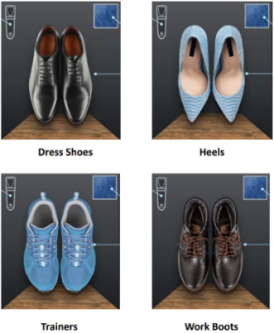
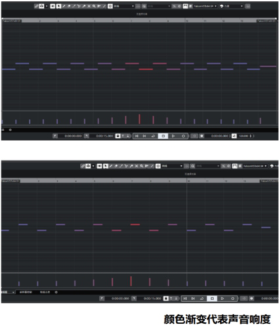
Footstep Sounds Design Professional footstep production software, Falcon (Figure 1), and arrangement software, Cubase (Figure 2), were utilized to create eight footstep sound samples for the experiment. The shoe types were categorized into four groups: heels, work boots, trainers, and dress shoes. Each shoe
type was paired with two walking frequencies: “fast” (step interval of 0.75 seconds) and “slow” (step interval of 1 second). A “wood floor”was selected as the flooring material, resulting in the generation of eight distinct footstep sounds. Subsequent experiments will be conducted based on these eight footstep variations.
Figure 1: Schematic of four shoe types provided by Falcon.Figure 2: Cubase arranging software interface diagram.
Scale and Questionnaire Design To investigate users’ first personality impressions of walkers based on their footsteps, we utilized 15 personality impression characteristics identified and summarized by Wu as the evaluation criteria (Wu et al., 2021): Including intelligence, aggressiveness, tenacity, responsibility, trustworthiness, masculinity, femininity, emotional stability, sociability, competence, likability, warmth, attractiveness, dominance, confidence. A 7-point Likert scale was developed based on these 15 characteristics, with responses ranging from 1 to 7: very weak, weak, relatively weak, neutral, relatively strong, strong, and very strong. The online survey platform So Jump
Influence of Footstep Sounds Induced by Varying Shoe Types 11
was used to create and distribute the questionnaire, allowing participants to complete it by scanning a QR code on their mobile devices. In addition, the first page of the questionnaire is the basic information of the subjects, including subject serial number, gender and randomly generated voice order, as shown in Table 1.
Table 1: Content of the scale and questionnaire.
Table available in the original PDF paper.
Questionnaire Item Personal information
1. Serial number 2. Gender 3. Voice order Impression words
1. Dominance(refer to the personality trait indicating that walkers hold a dominant position in inter-personal relationships) 2. Aggressiveness 3. Attractiveness(refer to the mass appeal of walkers) 4. Trustworthiness 5. Likability 6. Confidence 7. Intelligence 8. Responsibility 9. Sociability 10. Emotional stability 11. Femininity 12. Masculinity 13. Competence 14. Warmth 15. Tenacity
Participant Recruitment Sixty healthy college student (30 males, 30 females) aged between 17 and 25 years old were selected to participate in this study. All subjects were in good health, with normal hearing and no mental illness. Before the experiment, the subjects did not know the specific matters of the experiment, and had a relatively unified cognition of the experiment expectation.
Experimental Procedures The experimental site was the study room of South China University of Technology (8×10×4m3), and the main experimental equipment was two pairs of headsets of the same model (SONY-MDR-ZX110AP) and two iPads (iPad pro A1673 and iPad Air3 A2152, respectively). To ensure that the subjects are not disturbed by environmental noise while listening to footsteps, we have kept the environment quiet during the experiment and use a headset to play the sound. The headphones connected to the iPad via a wired connection to ensure clarity and consistency of sound. The experimenter used
the RAND and RANK functions in Excel to generate a non-repetitive random sequence of numbers 1 to 8 for each subject, which was used as the playing order, and played 8 footstep sound sources for the subject through the iPad in turn. At the same time, to minimize the impact of volume differences on participants’ auditory perception, the devices were set to a consistent volume level of 60%.
Prior to the experiment, participants used their personal mobile phones to scan a QR code and complete the basic demographic section of the online questionnaire. The experimenter provided instructions and highlighted matters need attention for the study to the participants. Then participants put on headphones and listened to each footstep sound presented on a continuous loop. Simultaneously, they completed a 7-point Likert scale questionnaire evaluating 15 dimensions of personality impressions for each sound. The experiment involved a total of eight footstep samples, each lasting 15 seconds. The sound intensity of each sample was set to simulate the auditory experience of a walker approaching and then moving away. Playback continued until participants completed their evaluations of the 15 personality dimensions for each sample. To minimize errors in participants’ judgment and ensure more stable and consistent impression results, the experiment was conducted in two rounds. Between the two rounds, participants were given a two-minute break during which they could either listen to soothing music or engage in light movement. This break was designed to reduce potential interference between the rounds and alleviate auditory fatigue. The final impression judgment score for each participant was calculated as the average of their responses from the twice questionnaires.
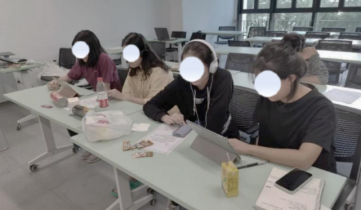
As shown in Figure 3, the subjects were seated in the study room, wore headsets and listened to the footsteps sounds. During this process, they completed the impression scale questionnaire online.
Figure 3: Experimental site.
Statistical Analysis In this study, SPSS 26.0 and a two-factor analysis of variance (ANOVA) were employed to examine the main effects of shoe type and step frequency on personality impression disposition judgments, as well as their interaction. Post-hoc analysis was conducted to identify the relationship between shoe type and impression characteristics. Additionally, an independent sample
Influence of Footstep Sounds Induced by Varying Shoe Types 13
t-test was used to explore the relationship between step frequency and impression features, with a significance level set at 0.05.
RESULTS
ANOVA of Shoe Type and Step Frequency on Personality Impression Judgments The two-factor ANOVA (see Table 2) revealed that shoe type exerted a significant main effect on the perception of 12 personality traits: responsibility (F = 7.520, p < .001), emotional stability (F = 5.036, p < .05), tenacity (F = 4.832, p < .05), intelligence (F = 4.313, p < .05), social ability (F = 3.878, p < .05), warmth (F = 7.824, p < .001), likability (F = 32.230, p < .001), femininity (F = 169.874, p < .001), attractiveness (F = 19.976, p < .001), dominance (F = 11.448, p < .001), aggressiveness (F = 12.633, p < .001), and masculinity (F = 183.296, p <.001). The footstep sounds associated with different shoe types notably influenced participants’ ratings of these personality traits. For example, the footstep sounds of heels were associated with higher ratings of femininity and attractiveness, whereas the footstep sounds of work boots were linked to higher ratings of tenacity and dominance.
Walking frequencies also demonstrated a significant main effect on the perception of four personality traits: intelligence (F = 7.250, p < .05), warmth (F = 35.428, p < .001), femininity (F = 24.980, p < .001), and masculinity (F = 23.491, p < .001). The footstep sounds of varying walking frequencies led to significant differences in participants’ ratings of these personality traits. For instance, high-frequency step sounds were associated with higher ratings of intelligence and warmth, while low-frequency step sounds were associated with higher ratings of masculinity.
However, for the judgments of the three personality traits, trustworthiness, confidence, and competence, the main effects of shoe type and walking frequencies were not significant, indicating that footstep sounds did not significantly influence participants’ judgments on these traits. Participants’ ratings for these traits were relatively stable and unaffected by variations in shoe type and walking frequencies.
Additionally, there was no significant interaction effect between shoe type and walking frequencies. Under different combinations of shoe type and walking frequencies, participants’ ratings of the 15 personality traits did not exhibit significant interaction effects. This suggests that the impact of shoe type and walking frequencies on personality impression judgments is independent, and their combination does not produce additional interactive effects.
Table 2: Result of two-factor ANOVA.
Table available in the original PDF paper.
Dependent Variable F p Partial η2 Shoe type Responsibility 7.520 0.000 0.046 emotional stability 5.036 0.002 0.031 tenacity 4.832 0.003 0.030
Note: significance level set at 0.05 Post-Hoc Multiple Comparison Analysis of Shoe Type
The judgments of the walker’s responsibility, emotional stability, tenacity, dominance, aggressiveness, and masculinity revealed that the average scores for the heels group were significantly lower than those of other shoe types. Conversely, in the judgments of intelligence, social ability, warmth, likability, femininity, and attractiveness, the heels group received significantly higher average scores compared to other shoe types.
For the work boots group, the average scores in likability, femininity, and attractiveness were significantly lower than those of other shoe types. However, in the judgments of tenacity, dominance, aggressiveness, and masculinity, the work boots group achieved significantly higher average scores.
Similarly, the dress shoes group received significantly lower average scores in likability, femininity, and attractiveness compared to other shoe types. In contrast, their average scores for dominance, aggressiveness, and masculinity were significantly higher than those of other shoe types. As shown in Table 3 and Table 4.
Table 4: Final result of post-hoc multiple comparisons of shoe type.
Table available in the original PDF paper.
Heels Work Boots Dress Shoes Trainers Responsibility N —— —— —— Emotional stability N —— —— —— Trustworthiness —— —— —— —— Tenacity N P —— —— Confidence —— —— —— —— Intelligence P —— —— —— Sociability P —— —— —— Competence —— —— —— —— Warmth P —— —— —— Likability P N —— N Femininity P N —— N Attractiveness P N —— N Dominance N P —— P Aggressiveness N P —— P Masculinity N P —— P
Note: P: positive; N: negative; ——: not significant
Independent-Samples T Test of Footstep Frequency Significant differences were observed in the average scores for judgments of intelligence, warmth, femininity, and masculinity based on footstep frequency. For intelligence, warmth, and femininity, the average scores were significantly higher at high walking frequencies compared to low walking frequencies. In contrast, for masculinity, the average scores were significantly higher at low walking frequencies than at high walking frequencies. As shown in Table 5.
Table 5: Result of independent-samples T test of footstep frequency.
Previous literature mainly focused on the production of virtual footsteps or the first impression of a person’s speaking voice, researches on the impact of footstep sounds on human impression perception is limited. In this study, we utilized the Falcon footstep sound synthesis software to generate footstep sounds for four types of shoes and two walking frequencies, totalling eight
Influence of Footstep Sounds Induced by Varying Shoe Types 17
types of footstep sounds. These sounds were evaluated by 60 participants using a 7-point Likert scale to assess 15 personality impression words. Our findings revealed that shoe type and walking frequency independently influenced initial judgments, with no interaction effects observed between them.
In terms of shoe type, the footstep sounds produced by heels were more likely to evoke positive impressions of the walker’s intelligence, social ability, warmth, likability, femininity, and attractiveness; but were associated with negative impressions of responsibility, emotional stability, tenacity, dominance, aggressiveness, and masculinity. The footstep sounds generated by work boots were more likely to elicit positive impressions of the walker’s tenacity, dominance, aggressiveness, and masculinity; but negative impressions in likability, femininity, and attractiveness. Similarly, footstep sounds from trainers were more likely to elicit positive impressions of the walker’s dominance, aggressiveness, and masculinity; but negative impressions of likability, femininity, and attractiveness. In contrast, footstep sounds from dress shoes did not significantly affect impression judgments. Regarding walking frequencies, we found that high-frequency footstep sounds were associated with more positive impressions of the walker as being warm, intelligent, and possessing greater femininity. Low-frequency footstep sounds were linked to impressions of the walker as exhibiting greater masculinity.
In prior study, Gillath et al. (2012) reported the first impression from shoe photos. Their findings suggest that shoe photos can provide some reliable information for forming impressions, but these judgments are often influenced by stereotypes and may not always be accurate, this may also exist in audio-judgement. Besides, their results show that sounds with predominantly high-frequency components were associated with females, while males were linked to sounds with dominant low-frequency components (Gillath et al., 2012), which consistent with our finding.
Nevertheless, this study still has certain limitations. The generation of footsteps stems from the interaction between the feet and the floor, and is therefore affected by various factors, such as the type of shoes, the surface material, the dynamics and timing of the contact between the shoes and the ground, as well as the individual’s physical characteristics (height, weight, and foot length) (Turchet, 2016). This study only took four types of shoes and wooden floor material as the research subjects. Future studies can further increase and control variables to explore the differences in the impressions given by footsteps under the variations of other factors.
CONCLUSION
In conclusion, our findings can be summarized as follows: Footstep sounds generated by heels create the most distinct impressions compared to other shoe types and they are perceived as more attractive but less tenacious. Work boots produce the second most distinctive impressions, characterized by lower perceived attractiveness and greater dominance. Footstep sounds from trainers convey a similar impression to work boots, though to a lesser extent.
In contrast, dress shoes produce less distinctive impressions, suggesting a moderate level of attractiveness in the walker.
Our findings provide valuable insights and practical guidance for designers involved in character design for films and video games. Additionally, this study can serve as a useful reference for individuals aiming to enhance their personal image in daily life.
REFERENCES
Cook, P. R. (2002). Modeling Bill’s gait: Analysis and parametric synthesis of walking sounds. Audio engineering society conference: 22nd international conference: Virtual, synthetic, and entertainment audio. Gillath, O., Bahns, A. J., Ge, F., & Crandall, C. S. (2012). Shoes as a source of first
impressions. Journal of Research in Personality, 46(4), 423–430. Jiang, Z., Li, D., Li, Z., Yang, Y., Liu, Y., Yue, X., Wu, Q., Yang, H., Cui, X., & Xue, P. (2024). Comparison of face-based and voice-based first impressions in a Chinese sample. British Journal of Psychology, 115(1), 20–39. Mileva, M., & Lavan, N. (2023). Trait impressions from voices are formed rapidly
within 400 ms of exposure. Journal of Experimental Psychology: General, 152(6), 1539. Mirshekari, M., Pan, S., Fagert, J., Schooler, E. M., Zhang, P., & Noh, H. Y. (2018).
Occupant localization using footstep-induced structural vibration. Mechanical Systems and Signal Processing, 112, 77–97. Tajadura-Jiménez, A., Basia, M., Deroy, O., Fairhurst, M., Marquardt, N., & Bianchi-Berthouze, N. (2015). As light as your footsteps: Altering walking sounds to change perceived body weight, emotional state and gait. Proceedings of the 33rd annual ACM conference on human factors in computing systems, Turchet, L. (2016). Footstep sounds synthesis: Design, implementation, and
evaluation of foot–floor interactions, surface materials, shoe types, and walkers’ features. Applied Acoustics, 107, 46–68. Wright, B. (2014). Footsteps with character: The art and craft of Foley. Screen, 55(2), 204–220. Wu, Q., Liu, Y., Li, D., Leng, H., Iqbal, Z., & Jiang, Z. (2021). Understanding one’s
character through the voice: Dimensions of personality perception from Chinese greeting word “Ni Hao”. The Journal of Social Psychology, 161(6), 653–663.
LISTED IN THE AHFE DIGITAL BOOKSTORE CATALOGUE
Explore the complete digital volume
Physical Ergonomics and Human Factors
Read this individual research paper free through the original publisher, or explore the full digital proceedings book.
ISBN 978-1-964867-61-8
Explore this ISBN in the AHFE Bookstore ↗Listed in the July 2026 bookstore catalogue; search by ISBN to confirm current availability · Digital book purchase optional