Scott Ledgerwood, Erika Gallegos, Marie Vans (2024). Measuring Detection and Habituation of Olfactory Stimuli in Virtual Reality for Improved Immersion. In: Human Factors in Virtual Environments and Game Design. AHFE Open Access, vol. 137, pp. 186–196. https://doi.org/10.54941/ahfe1005001
Virtual reality (VR) is a powerful tool that allows humans to interact with systems at scale, often with more feasibility and/or accessibility. However, the usefulness of these digital counterparts can be limited by the immersiveness of the experience, especially when the human-system interaction is integral for the use case (e.g., VR for training or gaming). Therefore, increasing a users’ sense of presence can improve the utility of VR. Previous literature suggests that integrating olfactory may be beneficial towards this. However, gaps exist in formalizing the integration and deployment of olfactory in VR. The objective of this study is to investigate the effectiveness of a wearable odor device for detecting scent stimuli in VR. Our primary goal is to determine the optimal parameters under which a participant can accurately detect a scent stimulus. We seek to answer the following objectives: 1) how do various levels of scent intensity and duration effect scent detection, and 2) does habituation of intensity and pleasantness of scent occur after prolonged exposure.A 20-minute VR study (N=34) using an Oculus Quest 2 and odor attachment was conducted; during which participants were exposed to two scents across various scent intensities and delays. The study used a 5 (intensity: 105, 150, 225, 300, 600 ms; within-subject) x 3 (delay: 15, 30, 60 seconds; within-subject) x 2 (scent: pleasant (smoke), unpleasant (body odor); within-subject) factorial design. Pleasant and unpleasant scents were selected using a pilot study. Participants clicked a button using the Oculus controller when they detected a scent and rated the scent intensity and pleasantness each on a 7-point Likert scale.A binary logistic mixed model was used to predict scent detection (hit/miss). There was a significant effect (p < .05) on detection based on intensity, age, and interaction of scent with intensity. Detection for 600 ms intensity was 4.41 times more likely than intensity at 105 ms. There was a decreased likelihood of detecting the pleasant scent at 600 ms, suggesting that the unpleasant scent was even more detectable at this high intensity. Individuals ≤ 35 years were 2.17 times more likely to detect a scent than those over 35.ANOVAs were performed to assess Likert scale ratings of scent intensity and pleasantness, as a measure of habituation. Results indicate no effect of order or delay, but within-subject effects of scent and intensity. Where unpleasant was rated more intense (p < .001) and more unpleasant (p < .001) compared to pleasant. Additionally, higher intensity dispersions were self-reported as more intensity (p = .003).Our framework and associated conclusions can guide olfactory integration into VR environments for improved human interaction. The results suggest that the effectiveness of a scent may vary depending on the strength of the intensity and the user's age. Certain scents may be more potent at lower intensities, while others may require higher intensities to produce a significant [detectable] effect. The use of multiple sensory integration into virtual training and/or gaming simulations could have a positive effect on knowledge outcomes, skill acquisition, and enjoyment.
Virtual reality (VR) is a powerful tool that allows humans to interact with systems at scale, often with more feasibility and/or accessibility. This can be useful during requirements, design, evaluation, and training stages of a system’s lifecycle. However, the usefulness of these digital counterparts can be limited by the immersiveness of the experience, especially when the human- system interaction is of focus (e.g., VR for training). Therefore, increasing the sense of presence felt by users can improve the utility of these VR tools.
VR simulation requires effective integration of senses beyond just the user’s hearing and vision to increase their sense of presence (Slater et al., 1997). For example, odor displays (i.e., scent dispersion) have been integrated with VR
Measuring Detection and Habituation of Olfactory Stimuli in Virtual Reality 187
applications to supplement training experiences (Richard et al., 2006) and have been successfully used to promote behavioral reactions (Flavian et al., 2021), reduce VR motion sickness (Ranasinghe et al., 2020) and for stress relief (Pizzoli et al., 2021; Serrano et al., 2016).
Integrating scent stimuli can improve a trainee’s sense of presence and immersion, thus increasing the fidelity of the VR experience (Baus et al., 2019). For example, incorporating a smoke-like scent into a VR firefighter training program can create a realistic smoke-filled dwelling scenario. The use of scent coupled with the 3D displays and interactions of VR can better replicate the stressors of the actual situation in ways traditional 2D train- ing cannot (Moore et al., 2015). Moreover, the inclusion of odor in VR has been associated with achieving intended training outcomes and improved knowledge/skill capture (Whitlock et al., 2022).
While literature suggests that the inclusion of scent can be beneficial in VR, gaps still exist in formalizing the integration and deployment of olfactory in VR modules. This is in large part because of the variability across delivery methods for odor displays, which can include airflow, vortex ring, natural diffusion, or direct injection (Yanagida, 2012). There are tradeoffs between these approaches, where ambient dispersion offers a less intrusive approach, while direct injection can provide more controlled and precise perception. An odor display connected to a VR head-mounted display (HMD) is likely more user friendly and easier to deploy, hence this design was selected for use in this study. Previous research has explored the use of odor displays in VR HMDs but has not considered the intensity associated with these displays (Covarrubias et al., 2015).
In addition to the delivery mechanism, temporal effects are also relevant considerations. Previous research has used direct injection olfactometers to assess adaptation and habituation for human subject responses (Wang et al., 2002; Croy et al., 2013). These have found that continuous olfactory stimu- lation creates a phenomenon where sensory activity decreases and prohibits cognitive perception of the scents (Wang et al., 2002). Although habitua- tion across scent types can vary, where users have shown to habituate to an unpleasant scent (hydrogen sulfide) after repeated exposure, but not so for pleasant scents (phenethyl alcohol and peach) (Croy et al., 2013). Minimizing this adaptation by determining the smallest amounts of scent disbursement can mitigate scents lingering in the air and presenting conflicting information (Noguchi et al., 2011).
Previous research has laid a foundation for olfactory integration into VR for improved immersion. Our study aims to build on this by investigating the effectiveness of a wearable odor display for detecting scent stimuli in a VR simulation, considering variations in scent type, intensity, and delay. Our primary goal is to determine the optimal parameters under which a partici- pant can accurately detect a scent stimulus using the wearable odor display in VR. In this paper, we seek to answer the following objectives: 1) how do various levels of scent intensity and duration effect detection of scent, and 2) does habituation towards a neutral scent occur after prolonged exposure to different scents.
METHODS
A VR study was conducted to evaluate factors that affect reliable detec- tion and habituation of olfactory stimulation. Participants experienced a 20-minute virtual simulation, during which they were exposed to two dif- ferent scents across various scent intensities and delays (i.e., interstimulus intensity, ISI). The study had Institutional Review Board (IRB) approval and informed consent was obtained from each participant prior to data collection.
Participants There were 34 participants included in this study (12 females, 22 males). Based on previous literature of homogenous olfactory perception groups (Noguchi et al., 2011), participants were binned into two age groups: 35 and under (N = 20) and over 35 (N = 14).
Data collection occurred near the end of the COVID-19 pandemic (November – December of 2022), which has been associated with loss of smell. As seen in Table 1, a total of 22 participants shared that they had COVID-19 with recoveries ranging from 1 to greater than 6 months prior to study involvement. Moreover, five participants reported that they had lost their scent at one point due to COVID-19. However, these individuals performed similar to other individuals and thus we did not consider it as a concern for our study.
Table 1. Participant recovery time since last testing positive for COVID-19.
Participants were recruited through flyers and emails at Colorado State University. Exclusion criteria for the study excluded participants under 18, over 55 due to diminished ability to detect odor stimuli (Doty et al., 1984), and pregnant women due to potential heighted sense of smell. During recruit- ment, participants were also shown the odor display and given bursts of a scent, if they could not detect the scent, they were excused from the study.
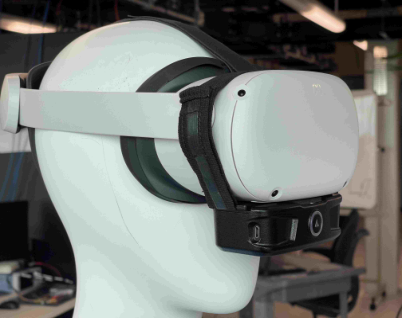
Equipment An Oculus Quest 2 was used for the VR HMD. A commercial odor display from OVR Technology was fit to the VR HMD, approximately 1-inch from the users’ nose, see Figure 1. The display integrates into the VR experiment over Bluetooth, such that scent is dispersed based on the VR environment using temporal or spatial cues; in this study we dispersed scent at specific time intervals.
Measuring Detection and Habituation of Olfactory Stimuli in Virtual Reality 189
Figure 1: VR HMD with odor display attached.
The wearable odor display provided preconfigured scent kits, which con- tained relaxation or trauma-related odors. The scent cartridge, comprised of nine capsules, each contained a water-based scent solution with up to 5% fragrance, 1% of Benzisothiazolinone, and a surfactant. New cartridges were provided prior to the study as the lifetime of the scents is two months before it begins to degrade.
Two scents were used in this study: pleasant (smoke) and unpleasant (body odor). A pilot test with eight participants and six scents was conducted to determine the pleasantness ratings of various odors on a 7-point scale. The odor with the highest pleasantness rating and the odor with the lowest pleasantness rating were selected for inclusion in this study.
In addition, a water-based solution with no scent was dispersed every 5-seconds throughout the experiment. This neutral [water] scent was used to mitigate prior scents from lingering, as well as to minimize the likelihood of a participant initiating their detection each time they felt a water burst or heard a tiny click.
The physical room that the study was carried out in was an enclosed lab space, such that the participant sat at a table using the VR alone in the room with a closed door. The room was quiet, with a slight white noise generator, and good ventilation. The researcher sat right outside, next to a window into the room.
VR Environment Within the VR space, participants were in an enclosed room with a large screen on one wall. The screen played a 20-minute video of the Great Bar- rier Reef, see Figure 2. This video was selected based on prior research that showed similar footage did not evoke an emotional state (Han et al., 2012). Audio was disabled for the video to remove a potential confounding factor. A questionnaire was used to collect consent, demographics, and detection of the scents; this was incorporated into the VR environment and users interacted with it using the VR controller.
Figure 2: Clip of the great barrier reef video in the VR environment.
Questionnaire In addition to demographics, the questionnaire was used to capture scent detection and ratings of intensity and pleasantness. Participants were instructed to click a button on the VR controller when they detected a scent. This would create a pop-up window asking them to rate the intensity (7-point Likert scale, from weak to strong) and pleasantness (7-point Likert scale, from unpleasant to pleasant) of the scent. Participants could click “submit” after selecting their ratings or “cancel” if they accidentally clicked the button to bring up the questionnaire.
Procedure The study was first piloted on four participants to assess study procedures and data logging; data from these participants were not used in analysis. Then, 34 participants successfully completed the study. Participants were first shown the wearable odor display and provided a sample scent not used in the study to understand how the device functioned. They were instructed on the VR controls and the task of detecting and rating a scent when detected. Then, users donned the headset, completed a questionnaire on demographics, and then the video of the Great Barrier Reef began. They would continue watching the video, waiting for the next scent to be detected, and repeat the process of rating the intensity and pleasantness. This continued until all scents were dispersed (15 pleasant and 15 unpleasant; 30 in total). The study took approximately 25-minutes per participant.
The study used a 5 (intensity: 105, 150, 225, 300, 600 ms; within-subject) x 3 (delay: 15, 30, 60 seconds; within-subject) x 2 (scent: pleasant, unpleas- ant; within-subject) factorial design. Hence, all participants experienced all levels of intensity and delay for each scent. The order of intensity x delay x scent was randomized across participants. These levels of intensity and delay were selected based on previous research (Wang et al., 2002), which indicated that stimulus strength of 35 ms to 200 ms at 5, 10, and 60 second delay levels, based on a direct injection odor display, had significant effects at p < 0.01. Larger delay and intensity values were selected for our study based on the open-air design of our unit compared to their direct injection olfactometer (Lorig et al., 1999).
Measuring Detection and Habituation of Olfactory Stimuli in Virtual Reality 191 Data Analysis
The R statistical software program (version 4.2.2) was used for data cleaning and analysis. Statistical significance was assessed at α < 0.05.
Scent detection (hit/miss) was modeled using a binary logistic mixed model. Random effects on the participant level were controlled for in the model, to account for the repeated observations within subjects. Post-hoc analysis was used to analyze marginal effects.
Measures of scent habituation (self-reported intensity and pleasantness) were evaluated using repeated measures analysis of variance (ANOVA), where data was blocked on the participant level. Tukey honest significant difference post hoc tests were used to further evaluate significant factors.
Dependent Variables Scent detection, coded as a hit or a miss, was based on the participant response to the scent stimuli. A hit was defined as the participant pressing the controller button to initiate the intensity and pleasantness questionnaire within 2 to 17 seconds after the scent was dispersed. A miss was defined as no button press, a button press earlier than 2 seconds, or a button press longer than 17 seconds after a scent was dispersed.
Scent habituation was based on the responses over time to the intensity and pleasantness questionnaire that appeared after the participant recorded a hit. After each detection, participants reported their rating of intensity and rating of pleasantness, both on a 7-point Likert scale.
Independent Variables There were five fixed effects considered in the models:
Scent: smoke or body odor.
Intensity: duration that the scent was dispensed for, where a longer inten- sity corresponded to a stronger scent, with levels of 105 ms, 150 ms, 225 ms, 300 ms, and 600 ms.
Delay: time between scent dispersion, with levels of 15 seconds, 30 sec- onds, or 60 seconds.
Order: sequence of the combinations of scent x intensity x delay pre- sented to the user over the 30 disbursements. Order was used to assess if there were any habituation effects to the subjects’ perceived intensity or pleasantness of the two scents.
Age: categorized as ≤35 years old or > 35 years old.
Gender: categorized as male or female.
RESULTS
Scent Detection A generalized linear mixed model was used to predict scent detection (hit/miss), see Table 2. There was a significant effect for intensity at 600 ms, age, and the interaction of smoke x intensity at 600 ms. Specifically, that detection for a 600 ms intensity was 4.41 (i.e., e1.483) times more likely than
for an intensity of 105 ms, but there was no differentiation in the probabil- ity of detection between the other intensities. Similarly, individuals 35 years old and under were 2.17 times more likely to detect a scent compared to individuals over 35 years old. There was also an additional decreased likeli- hood of detecting smoke at 600 ms, suggesting that body odor was even more detectable at this high intensity. Interestingly, there was no effect of delay or gender on detection.
Table 2. Main effects from model predicting scent detection.
Table available in the original PDF paper.
Variable Coeff SE z-value p-Value Intercept −1.488 0.346 −4.31 <0.001 Smoke (ref. Body Odor) −0.627 0.396 −1.59 0.113 (ns) Intensity 150 (ref. 105 ms) 0.254 0.337 0.75 0.452 (ns) Intensity 225 (ref. 105 ms) 0.033 0.314 0.11 0.916 (ns) Intensity 300 (ref. 105 ms) 0.494 0.296 1.67 0.095 (ns) Intensity 600 (ref. 105 ms) 1.483 0.298 4.98 <0.001 Delay 30 (ref. 15 sec) −0.095 0.249 −0.38 0.701 (ns) Delay 60 (ref. 15 sec) 0.177 0.243 0.73 0.466 (ns) Age ≤35 (ref. > 35 y.o) 0.777 0.251 3.09 0.002 Male (ref. female) −0.023 0.254 −0.09 0.927 (ns) Smoke x Intensity 150 ms −0.262 0.498 −0.53 0.599 (ns) Smoke x Intensity 225 ms −0.003 0.481 −0.01 0.996 (ns) Smoke x Intensity 300 ms −0.357 0.466 −0.77 0.444 (ns) Smoke x Intensity 600 ms −1.201 0.463 −2.59 0.010 Smoke x Delay 30 sec 0.368 0.381 0.97 0.335 (ns) Smoke x Delay 60 sec 0.130 0.380 0.34 0.733 (ns) Model Fit AIC LL LRatio p-value Model 1130.2 −548.1 75.8 <0.001 Null 1176.0 −586.0
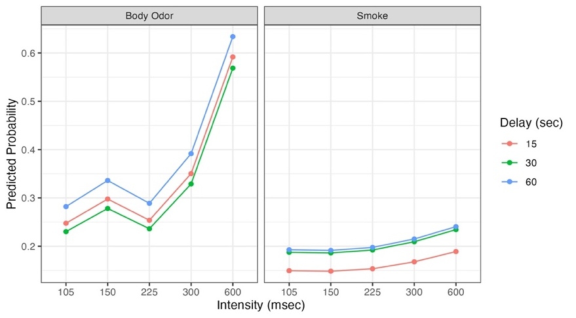
To further understand the differences of scent and intensity levels, an inter- action plot of the estimated marginal means was created, see Fig. 3. The plot on the left shows the differences between intensities for the body odor scent and for smoke on the right. Specifically, the left plot shows that for the body odor scent, we can see a significant effect for the difference between an inten- sity of 600 ms and all other intensities, as denoted by the spike in predicted probability at 600 ms. The differences amongst the lower intensities had no significant effects. The plot for smoke shows similar trends, however not as pronounced.
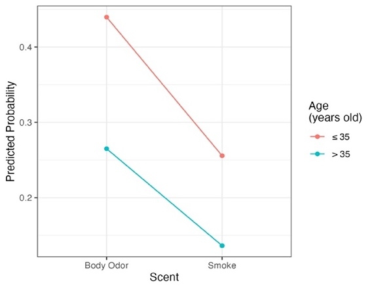
Since older age has been associated with decreased scent detection, we further investigated the effects of age in our study, as shown in Fig. 4. Partic- ipants aged 35 and under had a probability of 43% (CI: 36% to 52%) for detecting the body odor scent and 26% (CI: 21% to 34%) for detecting the smoke scent across all conditions. In contrast, the over 35 years old group had a lower likelihood of detecting both scents, with a probability of 28% (CI: 21% to 37%) for body odor and 15% (CI:11% to 22%) for smoke.
Measuring Detection and Habituation of Olfactory Stimuli in Virtual Reality 193
Figure 3: Estimated marginal means of each scent across levels of intensity and delay.Figure 4: Estimated marginal means of each scent across age groups.
Scent Habituation Two ANOVAs were performed to assess if habituation towards the scent intensity and pleasantness within subjects occurred as the study progressed. That is, if self-reported ratings of intensity and/or pleasantness trended neu- tral by the end of the study. In both ANOVAs, the independent variables were order, scent, intensity, and delay, with random effects at the participant level.
The ANOVA on self-reported intensity indicated no effect of order or delay, but there was a within-subject effect of scent (F(1, 253) = 29.49, p < 0.001) and intensity (F(4, 253) = 4.11, p = 0.003). Tukey post hoc tests showed that body odor was rated as more intense (mean = 3.8, SD = 1.7) compared to smoke (mean = 3.1, SD = 1.4). Similarly, higher intensities were reported as more intense for both scents.
The ANOVA on self-reported pleasantness also showed no significant effect of order or delay, and in addition, intensity. However, there was a within-subject significant effect of scent (F(1, 253) = 29.3, p < 0.001); where smoke was rated as more pleasant (mean = 4.1) compared to body odor (mean = 3.4).
DISCUSSION
In this study, we examined the impact of odor intensity and delay on 34 par- ticipants using a water-based, wearable odor display attached to a VR HMD. The study employed a 5×3 x 2 within-subject factorial design with repeated measures. We saw no difference in participants ability to detect scents based on prior COVID-19 infection and gender.
Our results showed significant main effects on detection for intensity, scent, and age. Specifically, the unpleasant odor was detected at higher rates, which aligns with previous research that threats are more readily detected by the human olfactory system (Wang et al., 2002). There was also an effect on age, with subjects 35 years and under having a higher probability of a successful detection. This is consistent with research showing anosmia occurring after peak age of odor detection (30s and 40s) (Doty et al., 1984). Further, research has suggested interactions between age and gender with better performance for women aged 16–55 (Hummel et al., 2007), however, we did not see this effect in our results.
Our results suggests that the effectiveness of a scent may vary depending on the intensity, specific scent, and age of the user. It is possible that certain scents are more potent at lower intensities, while others may require higher intensi- ties to produce a significant effect. The lower odds of smoke being detected at the fullest strength presented in this study indicate a possible high noise floor for the odor display. The smoke scent seems to be less distinguishable.
The results suggest that the ability to detect a scent across users does not appear to be affected by delays ranging from 15 to 60 seconds. It may be that the sense of smell is relatively quick to perceive and retain the informa- tion about the scent. The delay may not have been short enough to have a just noticeable difference (JND) for the wearable odor display. Prior research indicated 2.5 seconds as a JND, where users were not able to detect scents due to habituation but were successful at and above 10 second delay. The lack of effect for the 15, 30 and 60 second delays for the wearable odor dis- play warrants additional research, which would be recommended in the 2.5 to 15 second delay range.
Croy et al. (2013) had found a trend for unpleasant scents to become more neutral after repeated exposure. Our study did not find that result based on the scents administered. It could be that the delays and intensities were different or that the unpleasant nature is scent dependent. Future research could seek to more closely mirror the levels and scents used in Croy et al. (2013) with a wearable odor display.
Limitations The use of a water-based capsule and open cartridge design resulted in back- ground noise when trying to detect a particular scent from the cartridge full of nine capsules. This can make it difficult to accurately measure or perceive a given scent. To reduce the noise floor and improve the accuracy of the odor display, steps should be taken to address the source of the noise and ensure that the conditions for displaying the scent are as controlled and consistent as possible.
Measuring Detection and Habituation of Olfactory Stimuli in Virtual Reality 195
While a general formula is provided for each scent in the cartridge, the exact formulation is not publicly available. Users of odor displays that refer- ence and provide scents by name are advised to trial different intensity levels to ensure they are obtaining the desired response. A similar framework as presented in this paper could be used by these future studies.
The nature of this study focused on a psychometric signal detection task which relied on sequential bursts rather than spatial interactions. Humans traditionally engage with scents based on physically proximity to the source, i.e., where the intensity maximizes at the origin and dissipates as a user moves away. The results of this study provide a reference point for testing scent intensity levels and reveals that multiple scents can be disbursed at delays of 15 seconds with minimal effect.
Future Work
The use of multiple sensory integration into virtual training simulations could have a positive effect on knowledge outcomes and skill acquisition. This study highlighted considerations for deploying scents when using a wearable odor display with VR. Future research should apply these findings to odor integra- tion in immersive simulations for evaluating training effectiveness compared to audio and visual only training. Additional findings may emerge on the user’s sense of presence or willingness to adopt a technology with integrated scent (e.g., Net Promoter Score) (Witmer and Singer, 1998).
CONCLUSION
The use of VR as a tool for digital twins has become increasingly popular, as it offers a safe and feasible modality for training; where more immersive VR experiences can improve training effectiveness and the overall human-system interaction. One such solution to increasing fidelity is incorporating multi- sensory integration in the VR experience. This study explored the effects of incorporating olfactory into a VR simulation. We identified thresholds of scent intensities and temporal delays that can be reliably detected, as well as evaluated demographic factors, such as age and gender. The framework and associated conclusions presented in this paper can guide olfactory integra- tion into VR environments, for improved human interaction with VR digital twins.
REFERENCES
Baus O., Bouchard S., Nolet K.(2019). Exposure to a pleasant odour may increase the sense of reality, but not the sense of presence or realism. Behaviour & Information Technology, 38(12): 1369–1378. Covarrubias M., Bordegoni M., Rosini M., Guanziroli E., Cugini U., Molteni F.
(2015). VR system for rehabilitation based on hand gestural and olfactory inter- action. In Proceedings of the ACM Symposium on Virtual Reality Software and Technology (VRST), 117–120. Croy I., Maboshe W., Hummel T. (2013). Habituation effects of pleasant and unpleasant odors. International Journal of Psychophysiology, 88(1): 104–108.
Doty R. L., Shaman P., Applebaum S. L., Giberson R., Siksorski L., Rosenberg L. (1984). Smell identification ability: Changes with age. Science, 226(4681): 1441–1443. Flavian C., Ibáñez-Sánchez S., Orús C. (2021). The influence of scent on virtual
reality experiences: The role of aroma-content congruence. Journal of Business Research, 123: 289–301. Han S., Lerner J. S., Zeckhauser, R. (2012). The disgust-promotes-disposal effect.
Journal of Risk and Uncertainty, 44: 101–113. Hummel T., Kobal G., Gudziol H., Mackay-Sim A. (2007). Normative data for the “Sniffin’ Sticks” including tests of odor identification, odor discrimination, and olfactory thresholds: an upgrade based on a group of more than 3, 000 subjects. European Archives of Oto-Rhino-Laryngology, 264: 237–243. Lorig T. S., Elmes D. G., Zald D. H., Pardo J. V. (1999). A computer-controlled olfac-
tometer for fMRI and electrophysiological studies of olfaction. Behavior Research Methods, Instruments, Computers, 31(2): 370–375. Moore A., Herrera N., Hurst T., McMahan R., Poeschl S. (2015). The effects of olfaction on training transfer for an assembly task. In Proceedings of the 2015 IEEE Virtual Reality (VR), 237–238. Noguchi D., Sugimoto S., Bannai Y., Okada K. (2011). Time characteristics of olfac-
tion in a single breath. In Proceedings of the SIGCHI Conference on Human Factors in Computing Systems (CHI’11), 83–92. Pizzoli S. F. M., Monzani D., Mazzocco K., Maggioni E., Pravettoni G. (2021). The power of odor persuasion: The incorporation of olfactory cues in virtual environ- ments for personalized relaxation. Perspectives on Psychological Science, 17(3): 652–661. Ranasinghe N., Jain P., Tolley D., Tailan S. K., Yen C. C., Do E. Y.-L. (2020). Explor-
ing the use of olfactory stimuli towards reducing visually induced motion sickness in virtual reality. In: Proceedings of the 2020 ACM Symposium on Spatial User Interaction, 12: 1–9. Richard E., Tijou A., Richard P., Ferrier J.-L. (2006). Multi-modal virtual environments for education with haptic and olfactory feedback. Virtual Reality, 10(3–4): 207–225. Serrano B., Baños R., Botella C. (2016). Virtual reality and stimulation of touch
and smell for inducing relaxation: A randomized controlled trial. Computers in Human Behavior, 55(Part A): 1–8. Slater M., Wilbur S. (1997). A framework for immersive virtual environments (FIVE): Speculations on the role of presence in virtual environments. Presence: Teleoperators and Virtual Environments, 6(6): 603–616. Wang L., Walker V. E., Sardi H., Fraser C., Jacob T. J. C. (2002). The correlation
between physiological and psychological responses to odour stimulation in human subjects. Clinical Neurophysiology, 113(4): 542–551. Whitlock M., Chelen J., Ledgerwood S. (2022). Toward VR-based training modules for public safety scenarios. In ACM CHI’22 – VR [we are] Training Workshop 2022. Witmer B. G., Singer M. J. Measuring presence in virtual environments: A presence
questionnaire. (1998). Presence: Teleoperators and Virtual Environments, 7(3): 225–240. Yanagida Y. (2012). A survey of olfactory displays: Making and delivering scents. In Proceedings of IEEE SENSORS, 1–4.
LISTED IN THE AHFE DIGITAL BOOKSTORE CATALOGUE
Explore the complete digital volume
Human Factors in Virtual Environments and Game Design
Read this individual research paper free through the original publisher, or explore the full digital proceedings book.
ISBN 978-1-964867-13-7
Explore this ISBN in the AHFE Bookstore ↗Listed in the July 2026 bookstore catalogue; search by ISBN to confirm current availability · Digital book purchase optional