Natsumi Wada, Silvia Maria Gramegna (2026). Living with Time: Designing Olfactory Rhythms and Adaptive Homemaking in Dementia Care. In: Human Factors in Aging and Special Needs. AHFE Open Access, vol. 214, pp. 55–65. https://doi.org/10.54941/ahfe1007573
Changes in the perception and experience of time are widely observed among people living with dementia. Rather than being perceived as a linear sequence, time may be experienced as fragmented sensory moments shaped by bodily states, routines, and environmental cues. Phenomena such as increased disorientation during late-afternoon transitions—commonly described as sundowning—illustrate how temporal orientation is closely intertwined with sensory and contextual conditions. Consequently, environmental adaptation in dementia care must be understood not only in spatial terms, but as a multisensory and relational process that mediates memory, activity, and perception in everyday life. While design research has explored supportive domestic environments through concepts such as safe space, small world, and connection within the broader framework of the sense of home, limited attention has been paid to how temporal rhythms themselves can be intentionally designed. This study addresses this gap by investigating how temporal, spatial, and sensory dimensions of home can be co-designed with people living with dementia through olfactory and multisensory rhythm interventions. The research began with a literature-informed primary mapping of olfactory interventions in dementia care, focusing on reported effects, temporal patterns of use, and everyday sensory practices. Insights from this mapping informed the development of the Chrono-Olfactory Home Map, a participatory design tool that supports the articulation of daily rhythms by mapping activities, perceived energy, and sensory cues across time. Workshops were conducted with five residents with mild to moderate dementia and care staff in a dementia care setting in Milan, combining sensory elicitation, narrative interviews, and collaborative mapping. Findings indicate that scent-based micro-interventions, when embedded within everyday homemaking practices rather than delivered as isolated therapies, can support temporal orientation, emotional regulation, and a sustained sense of home. The study highlights temporal–sensory design as a critical yet underexplored dimension within human factors approaches to dementia care.
Dementia affects approximately 55 million people worldwide, a number expected to rise as populations age (Gauthier et al., 2021). Beyond cognitive decline, dementia involves a fundamental transformation in how time is perceived and lived, shaping everyday experience and the ongoing
56 Wada and Gramegna construction of a sense of home (Van Hoof et al., 2016). The transition from private homes to institutional care environments often intensifies this transformation, producing not only spatial but also temporal disorientation. In response, dementia care design has increasingly focused on creating home-like environments, demonstrating that environmental interventions can reduce distress and support remaining cognitive and perceptual abilities (Fleming and Purandare, 2010; Zeisel et al., 2003). How people with dementia perceive, structure, and adapt to time within everyday living environments has received limited attention.
Temporal Disorientation and Sundowning Altered temporal experience is widely observed in dementia, where time may be perceived not as a linear continuum but as fragmented, sensory moments shaped by bodily and environmental cues (Nygård, 2006; Öhman et al., 2001). Sundowning—characterized by increased confusion, agitation, and anxiety in the late afternoon and evening—represents a particularly salient manifestation of this disruption (Khachiyants et al., 2011; Volicer et al., 2001). Importantly, temporal disorientation extends beyond circadian rhythms to encompass daily routines, seasonal cycles, and autobiographical time—the narrative continuity linking past, present, and anticipated future (Nygård, 2006).
Home as Temporal-Sensory Architecture The concept of “home” is multifaceted, extending beyond physical structure to encompass emotional, spatial, and symbolic dimensions deeply intertwined with personal history, social relationships, and cultural norms (Coolen and Meesters, 2011). While existing frameworks emphasize safety, small world, and connection, time plays a foundational role in how home is practiced and experienced (Wada et al., 2025; Rijnaard et al., 2016; Van Steenwinkel et al., 2014). Daily routines—morning rituals, shared meals, periods of rest—constitute a temporal structure through which home gains coherence and meaning (Bachelard, 1994; Bollnow, 2011). For people with dementia, homemaking thus becomes an ongoing, adaptive process through which identity and preference are expressed despite changing cognitive conditions. Time and memory are deeply intertwined through sensory experience. Embodied cues such as touch, taste, and especially smell can evoke autobiographical memories and emotional states, even when verbal memory is impaired (Herz, 2016; Willander and Larsson, 2006). Olfactory memory is relatively preserved in moderate stages of dementia, making scent a particularly powerful medium for supporting identity continuity and emotional connection (Djordjevic et al., 2008).
Living With Time: Designing Olfactory Rhythms and Adaptive Homemaking 57 Olfactory Approaches in Dementia Care
Previous research has demonstrated that specific scents can alleviate behavioral and psychological symptoms of dementia. Aromatherapy studies report reduced agitation and improved sleep through calming scents such as lavender, and enhanced alertness through stimulating scents such as rosemary and peppermint, particularly when aligned with daily rhythms (Ballard et al., 2002; Jimbo et al., 2009; Moss et al., 2003). Parallel research highlights the importance of personally meaningful scents—such as coffee, baking bread, or garden flowers—in evoking autobiographical memories and reinforcing a sense of self.
Despite these findings, olfactory research has rarely examined scent as a temporal design element embedded in everyday life. How scent might function as a temporal structuring device—marking transitions, supporting rhythms, and shaping domestic atmospheres—remains insufficiently explored.
Research Gap and Study Aims This study investigates how temporal, spatial, and sensory dimensions of home can be co-designed with people living with dementia through olfactory and multisensory rhythm interventions. Rather than framing altered time perception as a deficit requiring correction, the study positions it as a different mode of temporal being that calls for supportive design approaches. The research asks: How do people living with dementia experience and adapt to altered temporal rhythms in everyday living spaces? How can olfactory and multisensory interventions support temporal orientation and emotional regulation? How can domestic routines be reconceptualized as adaptive configurations of time, space, and atmosphere?
By positioning people with dementia as active participants in shaping their temporal–sensory environments, this research contributes to human factors and design research by foregrounding time perception as a critical dimension of supportive care environments.
Methodology
This study examines how dementia patients experiencing daily cognitive changes can participate in homemaking and organize and design time for themselves. We explore the methodology through the following process, examining how scent engages with the rhythms, bodily sensations, and time design of individuals with dementia, serving as a means for them to design their own time: 1. Preliminary mapping, 2. Design kit and interviews, 3. Observation, 4. Designing tools for scent and time, 5. Conducting workshops, 6. Data analysis.
Preliminary Mapping A literature review was conducted to map existing evidence on the use of scent in dementia care, focusing on reported effects and temporal patterns of application. Prior studies consistently examined essential oils such as lavender, lemon balm, rosemary, and peppermint, reporting effects including reduced agitation, improved sleep quality, enhanced alertness, and support
58 Wada and Gramegna for engagement (Ballard et al., 2002; Jimbo et al., 2009; Moss et al., 2003; Snow et al., 2004). Several studies emphasized time-specific use—stimulating scents in the morning and calming scents in the evening—highlighting scent’s potential role in supporting daily rhythms. These findings informed the development of the scent categories summarized in Table 1.
Table 1: Literature-based mapping of scent application and effects in dementia care.
Table available in the original PDF paper.
Proposed Mechanisms Key References
Scent (Essential Oil)
Reported Effects in Dementia Care Lavender Reduced agitation, improved sleep quality, decreased anxiety
GABAergic modulation, sedative and calming properties
Snow et al., 2004; Jimbo et al., 2009 Cholinergic modulation, anxiolytic effects Ballard et al., 2002
Lemon Balm Reduced agitation, improved quality of life in severe dementia Rosemary Enhanced alertness and cognitive performance
Acetylcholinesterase inhibition
Moss et al., 2003 Central nervous system stimulation Moss et al., 2008
Peppermint Increased attention and stimulation, support for activity engagement Multi-essential oil blends
Jimbo et al., 2009
Improved cognitive function and circadian rhythm regulation through time-specific use
Combined stimulating and calming effects aligned with daily rhythms
Participants and Research Setting The study was conducted within an experimental living lab located in a dementia day-care facility in Northern Italy. Nine participants were involved: five residents with mild to moderate dementia (aged 75–84), two experienced care staff, and two design researchers. Recruitment was carried out in collaboration with care staff, who supported eligibility assessment and participation. All participants received explanations of the study and provided informed consent directly or through supported processes. The study was approved by the Ethics Committee of the Politecnico di Milano, and all data were anonymized.
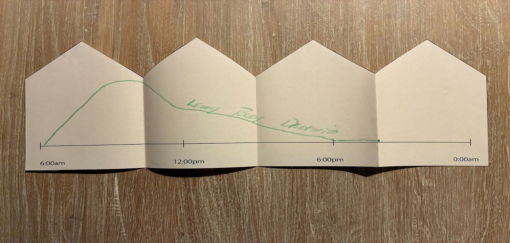
Semi-Structured Interviews and Temporal Mapping Data collection took place in familiar environments and consisted of 20–30 minute semi-structured interviews supported by custom-designed timeline mapping tools. Participants were invited to visualize perceived energy fluctuations across the day using a timeline with time on the horizontal axis and energy level on the vertical axis, which served as prompts for discussion. Interviews explored daily rhythms, preferred activities, and moments of comfort or fatigue, like “At what time of day do you feel most relaxed?” “Which moments of the day do you enjoy the most, and why?”. These
Living With Time: Designing Olfactory Rhythms and Adaptive Homemaking 59 mappings revealed recurring patterns, often characterized by higher morning energy and gradual decline toward evening (Figure 1).
One resident articulated this experience with particular clarity: “My energy peaks in the morning and declines as evening approaches. Between nine and ten in the morning is when I feel most energetic and active. After eating lunch, I feel my vitality gradually diminishing. So I try to place enjoyable activities in the morning hours.”
Figure 1: Timeline mapping produced by a male participant during the interview. The vertical axis represents perceived energy level, while the horizontal axis represents time across the day. The drawn line and annotations reflect the participant’s self- reported fluctuations in energy and associated experiences, which were referenced during the interview excerpt presented in the text.
Observational Studies A two-week observational study was conducted to examine how daily routines in the care home were structured in relation to residents’ energy levels and late-afternoon vulnerability. Observations showed that mornings were prioritized for higher-energy activities, while afternoons and evenings shifted toward quieter, supportive routines, informing the subsequent integration of scent into existing temporal structures rather than introducing separate interventions.
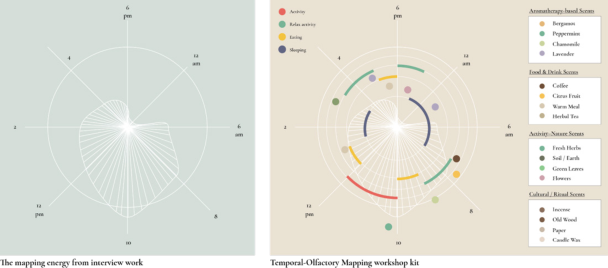
Design Tool Development: Temporal-Olfactory Mapping Building on chronotope-based temporal mapping approaches (Barbara & Gramegna, 2022), the research team developed circular temporal–olfactory mapping tools integrating daily activities, perceived energy levels, and scent categories (Figure 2). These tools were used in participatory workshops where participants worked with physical scent kits and color-coded pencils to map preferred scents onto their daily rhythms. Care staff and researchers provided supportive assistance when needed, without directing participants’ choices.
Figure 2: Chronotope-based temporal–olfactory mapping tools were developed to integrate daily energy rhythms, activities, and scent-based design. The left diagram represents a participant’s perceived energy fluctuations across the day using a circular time format derived from Figure 1. The right worksheet builds on this framework by linking daily activities to energy levels and color-coded scent categories (aromatherapy, food and drink, activity–nature, and cultural or ritual scents). The tools support participants in exploring how preferred scents can be embedded within their own daily rhythms, enabling flexible and personalized temporal–sensory design.
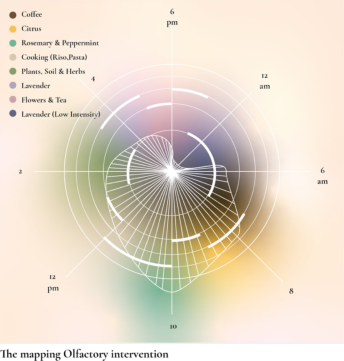
Workshops also included care staff and activity instructors as co-designers, contributing practical knowledge about routines and feasibility. Together, participants explored how scent could be embedded into everyday practices— such as coffee preparation, cooking, gardening, and craft activities—rather than delivered as isolated therapeutic sessions (Figure 3).
Figure 3: Diagrammatic synthesis of participant-generated scent–time maps developed during the workshops. The figure abstracts individual mappings into a circular temporal diagram, visualizing participants’ preferences for specific scents—such as coffee and citrus in the morning—and the layering of multiple scent categories in relation to daily activities. Rather than representing fixed interventions, the diagram illustrates how combinations of scents were associated with movement, mood, and imagined atmospheres across the day, making participants’ subjective temporal and affective experiences visible.
Living With Time: Designing Olfactory Rhythms and Adaptive Homemaking 61 Data Analysis: Interpreting Temporal-Sensory Experience
Data analysis was conducted through an iterative, interpretive process informed by reflexive thematic analysis, drawing on interview transcripts, observational field notes, workshop materials, and participant-produced artifacts. Rather than applying predefined coding schemes, the analysis focused on identifying meaningful patterns in how participants described temporal experience, energy fluctuations, and the integration of scent into everyday homemaking practices. Narrative attention was given to how participants articulated daily rhythms across time, while design-oriented analysis examined how mappings, activities, and crafted objects functioned as expressions of agency and sense-making. Themes were developed through repeated comparison across data sources, emphasizing experiential knowledge and participant-led meanings.
Findings: Olfactory Rhythms and the Design of Daily Life Through a month-long olfactory design intervention, incorporating scent into everyday practices was shown to reshape daily experience. Rather than functioning as a discrete intervention, scent became part of the creative work of making home—supporting the design of personal rhythms, atmospheres, and ways of being across the day.
In the morning, when participants felt most energetic and alert, olfactory cues supported the “beginning.” Freshly brewed coffee served as a central temporal marker; its aroma signaled the transition from sleep to wakefulness, anchoring the start of the day within daily rituals. Similarly, citrus scents were valued for their mood-lifting and refreshing effects and were frequently incorporated into everyday actions like peeling oranges. Stimulating aromatherapy scents (e.g., rosemary, peppermint) were incorporated into morning hand care or massage to support awakening and readiness for activity.
After lunch, participants’ energy levels typically shifted, making midday and evening periods important moments of transition rather than fixed phases of activity or rest. Some participants chose to rest, while others preferred low-effort engagement such as card games or watching films. Gardening- related activities offered a flexible intermediate option: watering plants, tending herbs, or resting near fragrant flowers provided sensory richness without requiring high physical or cognitive effort. As the day progressed toward evening, calming scents—most notably lavender—were introduced through low-intensity environmental cues (e.g., sachets, plants) and relational practices such as hand massage. These olfactory cues supported emotional settling and were often associated with feelings of security and familiarity, reflecting both their sensory qualities and personal resonance. Nighttime practices emphasized calmness rather than sleep induction, with gentle scents (e.g., lavender, chamomile, warm post-meal aromas) embedded within familiar routines and personal space preparation. Across these later- day transitions, the design implication was not a fixed scent schedule, but an adaptable palette responsive to fluctuating energy, mood, and individual preference, experienced as care and homemaking rather than therapeutic intervention.
A central finding was that scent design was most effective when understood as an ongoing homemaking practice rather than a discrete intervention. Participants demonstrated agency by selecting scents, determining when and how to use them, and evaluating whether scent–activity combinations supported their desired states throughout the day. Craft-based and everyday practices—such as making lavender sachets, highlighting the aroma of coffee, or choosing flowers for personal spaces—enabled sensory continuity and supported a sustained sense of home within the care environment.
Discussion
This study contributes to dementia care by demonstrating that temporal and olfactory design can support not only orientation and emotional regulation but also sustained daily activities and identity construction. Rather than positioning temporal disorientation as a defect to be corrected, it frames altered time perception as a distinct mode of temporal existence requiring new environmental and sensory support.
Time Experiences Participants demonstrated subtle awareness of their own temporal rhythms and actively structured their daily lives based on these rhythms. Rather than reflecting a lack of time perception, temporal disorientation in dementia can be understood as a transformed mode of temporal awareness in which the present gains heightened significance, calling for design responses that support lived rhythms rather than restoring linear temporality (Öhman et al., 2001; Hedman et al., 2013).
Olfactory Design Research findings indicate that scent can function as a temporal structure that constructs daily rhythms and marks transitions without requiring explicit cognitive awareness. Crucially, olfactory interventions proved most effective when integrated into meaningful activities or domestic practices rather than offered as isolated treatments. Scent functioned not only through pharmacological properties but also via biographical resonance, ritualized practices, and atmospheric continuity. It subtly and persistently shaped temporal and spatial perception, supporting comfort not through explicit signals but via the body and emotions. This research highlights the temporal dimension as central to dwelling. The home emerges not only as a spatial configuration but as a temporal structure formed by daily rhythms, transitions, and biographical continuity. Small acts of temporal design— selecting flowers, making lavender sachets, paying attention to the scent of morning coffee—enabled participants to express agency and aesthetic preferences. These practices transformed the institutional environment into personally meaningful places, converting uniform clock time into lived rhythms.
Living With Time: Designing Olfactory Rhythms and Adaptive Homemaking 63 Limitations
This study is constrained by its small sample size and single-site implementation. Future research should validate the effectiveness of the time- olfactory design across diverse cultural backgrounds, care models, and stages of dementia progression, while also examining its long-term sustainability. Sustaining such practices requires organizational commitment to the sensory and aesthetic aspects of care, alongside clinical priorities.
CONCLUSION
This research demonstrates that people living with dementia can actively participate in designing their own temporal–sensory worlds, crafting meaningful rhythms that honor altered relationships with time. Rather than treating temporal disorientation as a deficit to be corrected, the study frames it as a different mode of temporal being that calls for new forms of environmental and sensory support. When integrated into everyday homemaking practices, olfactory design can support temporal orientation, emotional regulation, and the ongoing construction of home.
Scent structures daily experience without requiring explicit cognitive recognition: morning coffee marks beginnings, lavender eases evening transitions, and garden flowers connect the present to biographical memory. Operating through the body and emotion, olfactory cues offer a gentle yet powerful means of supporting people whose relationship with linear, clock- based time has become uncertain. Crucially, the effectiveness of scent lies not only in its neurological effects but in its embedding within meaningful activities and social practices. Coffee matters as ritual, lavender through caring touch, and plants through seasonal continuity. These practices reveal people with dementia not as passive recipients of care, but as creative agents shaping their own temporal atmospheres. Supporting this agency requires tools and collaborative processes that enable individuals to articulate and design their own sensory–temporal preferences.
Ultimately, the study suggests that sustaining a sense of home in dementia care begins not with architecture alone, but with memories, gestures, and sensations—time made tangible through scent, rhythm, and atmosphere, and through small acts of intentional beauty carried out day by day.
ACKNOWLEDGMENT
This research was conducted within the framework of the HOMEDEM project and was funded by the European Union’s Horizon 2020 research and innovation programme under the Marie Skłodowska-Curie Actions Doctoral Network (Grant Agreement No. 101072827).
REFERENCES
Alzheimer’s Association. (2023). 2023 Alzheimer’s disease facts and figures.
Alzheimer’s & Dementia, 19(4), 1598–1695. Bachelard, G. (1994). The poetics of space. Beacon Press. Ballard, C. G., O’Brien, J. T., Reichelt, K., & Perry, E. K. (2002). Aromatherapy as a safe and effective treatment for the management of agitation in severe dementia: The results of a double-blind, placebo-controlled trial with Melissa. Journal of Clinical Psychiatry, 63(7), 553–558. Bollnow, O. F. (2011). Human space. Hyphen Press. Böhme, G. (2017). The aesthetics of atmospheres. Routledge. Coolen, H., & Meesters, J. (2011). Private and public green spaces: Meaningful but
different settings. Journal of Housing and the Built Environment, 27(1), 49–67. Djordjevic, J., Jones-Gotman, M., De Sousa, K., & Chertkow, H. (2008). Olfaction in patients with mild cognitive impairment and Alzheimer’s disease. Neurobiology of Aging, 29(5), 693–706. Fleming, R., & Purandare, N. (2010). Long-term care for people with dementia:
Environmental design guidelines. International Psychogeriatrics, 22(7), 1084– 1096. Gauthier, S., Rosa-Neto, P., Morais, J. A., & Webster, C. (2021). World Alzheimer Report 2021: Journey through the diagnosis of dementia. Alzheimer’s Disease International. Hedman, R., Hansebo, G., Ternestedt, B. M., Hellström, I., & Norberg, A. (2013).
How people with Alzheimer’s disease express their sense of self: Analysis using Rom Harré’s theory of selfhood. Dementia, 12(6), 713–733. Hendriks, N., Truyen, F., & Duval, E. (2014). Designing with dementia: Guidelines for participatory design together with persons with dementia. In IFIP Conference on Human-Computer Interaction (pp. 649–666). Springer. Herz, R. S. (2016). The role of odor-evoked memory in psychological and
physiological health. Brain Sciences, 6(3), 22. Jimbo, D., Kimura, Y., Taniguchi, M., Inoue, M., & Urakami, K. (2009). Effect of aromatherapy on patients with Alzheimer’s disease. Psychogeriatrics, 9(4), 173–179. Khachiyants, N., Trinkle, D., Son, S. J., & Kim, K. Y. (2011). Sundown syndrome in
persons with dementia: An update. Psychiatry Investigation, 8(4), 275–287. Moss, M., Cook, J., Wesnes, K., & Duckett, P. (2003). Aromas of rosemary and lavender essential oils differentially affect cognition and mood in healthy adults. International Journal of Neuroscience, 113(1), 15–38. Moss, M., Hewitt, S., Moss, L., & Wesnes, K. (2008). Modulation of cognitive
performance and mood by aromas of peppermint and ylang-ylang. International Journal of Neuroscience, 118(1), 59–77. Musiek, E. S., Bhimasani, M., Zangrilli, M. A., Morris, J. C., Holtzman, D. M., & Ju, Y. E. S. (2018). Circadian rest-activity pattern changes in aging and preclinical Alzheimer disease. JAMA Neurology, 75(5), 582–590. Nygård, L. (2006). How can we get access to the experiences of people with
dementia? Suggestions and reflections. Scandinavian Journal of Occupational Therapy, 13(2), 101–112. Öhman, A., Josephsson, S., & Nygård, L. (2001). Awareness through interaction in everyday occupations: Experiences of people with Alzheimer’s disease. Scandinavian Journal of Occupational Therapy, 8(3), 157–166. Pallasmaa, J. (2012). The eyes of the skin: Architecture and the senses. Wiley. Petratou, D., Spence, C., & Ristic, J. (2013). Nostalgic scents and the perception of
time. Chemical Senses, 38(6), 513–521.
Living With Time: Designing Olfactory Rhythms and Adaptive Homemaking 65 Rijnaard, M. D., van Hoof, J., Janssen, B. M., Verbeek, H., Pocornie, W., Eijkelenboom,
A., ... & Wouters, E. J. (2016). The factors influencing the sense of home in nursing homes: A systematic review from the perspective of residents. Journal of Aging Research, 2016, 6143645. Rodgers, P. A. (2018). Co-designing with people living with dementia. CoDesign, 14(3), 188–202. Snow, L. A., Hovanec, L., & Brandt, J. (2004). A controlled trial of aromatherapy
for agitation in nursing home patients with dementia. Journal of Alternative and Complementary Medicine, 10(3), 431–437. Van Hoof, J., Verbeek, H., Janssen, B. M., Eijkelenboom, A., Molony, S. L., Felix, E., ... & Wouters, E. J. (2016). A three perspective study of the sense of home of nursing home residents: The views of residents, care professionals and relatives. BMC Geriatrics, 16(1), 169. Van Steenwinkel, I., Van Audenhove, C., & Heylighen, A. (2012). Home in later life:
A framework for the architecture of home environments. Home Cultures, 9(2), 195–217. Volicer, L., Harper, D. G., Manning, B. C., Goldstein, R., & Satlin, A. (2001).
Sundowning and circadian rhythms in Alzheimer’s disease. American Journal of Psychiatry, 158(5), 704–711. Willander, J., & Larsson, M. (2006). Smell your way back to childhood: Autobiographical odor memory. Psychonomic Bulletin & Review, 13(2), 240–244. Zeisel, J., Silverstein, N. M., Hyde, J., Levkoff, S., Lawton, M. P., & Holmes, W.
(2003). Environmental correlates to behavioral health outcomes in Alzheimer’s special care units. The Gerontologist, 43(5), 697–711.
LISTED IN THE AHFE DIGITAL BOOKSTORE CATALOGUE
Explore the complete digital volume
Human Factors in Aging and Special Needs
Read this individual research paper free through the original publisher, or explore the full digital proceedings book.
ISBN 978-1-964867-90-8
Explore this ISBN in the AHFE Bookstore ↗Listed in the July 2026 bookstore catalogue; search by ISBN to confirm current availability · Digital book purchase optional