Arnaldo Costeira (2026). Designing Immersive Reading: Augmented Reality, Printed Books, and the Future of Natural AR Interfaces. In: Metaverse, Virtual Environments and Game Design. AHFE Open Access, vol. 217, pp. 193–203. https://doi.org/10.54941/ahfe1007666
This article examines the evolving landscape of augmented reality (AR) applied to printed books, focusing on narrative fiction, technological evolution, human–computer interaction (HCI), and design strategies for immersive reading. It builds on previous work in immersive book design, where AR and dramaturgical techniques extend the sensory and cognitive dimensions of printed novels. While current AR books, typically mediated by smartphones or tablets, can enhance comprehension and engagement, they also impose cognitive and attentional costs by forcing readers to divide focus between page and screen. Studies on AR storybooks show that tightly aligned augmentations improve recall and understanding, yet often fail to support a fluid, embodied reading experience, underscoring the need for more natural, integrated interfaces. A key shift is toward lightweight AR glasses and interfaces based on gaze, gesture, and spatial computing, which reduce cognitive load and enable hands-free, context-aware augmentations within the reader’s perceptual field. In narrative fiction, subtle AR layers—spatial visualizations, ambient soundscapes, dramaturgical annotations—can deepen immersion while preserving the material qualities and cultural significance of printed books. Building on the author’s prior work on “immersive books,” this paper proposes a reader-centered, HCI-informed framework that uses AR glasses to transform printed novels into hybrid experiences, positioning AR as a sustainable, enriching complement rather than a replacement for print.
Augmented reality (AR) applied to printed books has evolved from early, devicecentric demonstrations into a more mature design space where print and digital media can coexist in a complementary way. Rather than positioning AR as a rival to the printed book, current research increasingly frames it as a tool that can preserve the tactile, cognitive, and cultural qualities of print while enriching narrative engagement through additional sensory layers. This article examines that evolving landscape with a particular focus on narrative fiction, printed novels, technological evolution, human–computer interaction (HCI), and design strategies that support immersive reading.
194 Costeira The work builds on the author’s previous research in immersive book design, in which AR and dramaturgical techniques are integrated into printed novels to extend the sensory, spatial, and cognitive experience of reading. In that earlier work, the printed novel was treated as a performative object: a stage where text, layout, and AR-driven dramaturgy co-construct a hybrid reading environment. While most existing AR book implementations in the field have relied on smartphones and tablets to deliver augmentations— often introducing cognitive and attentional costs by forcing readers to divide focus between the physical page and a handheld screen and to repeatedly operate the digital interface, thereby undermining the fluidity of longform narrative reading—the author’s research instead uses these platforms only as provisional carriers, aiming ultimately at AR glasses as the medium best suited to support a truly fluid, immersive reading experience. In this sense, the work explicitly seeks to move beyond the prevailing smartphone/tablet paradigm and to prepare narrative, editorial, and dramaturgical foundations for future AR-glasses-based reading.
At the same time, studies in AR storybooks—especially in educational and children’s contexts—have shown that augmented content can improve recall, comprehension, and engagement when the digital elements are closely aligned with the printed material (Alhamad, Manches, & McGeown, 2024; Şimşek, 2024).
However, because these systems are typically delivered via handheld devices and often emphasize screenbased interaction and test outcomes over the embodied experience of reading, early AR book approaches frequently fail to produce a truly fluid, continuous engagement with the story. This highlights the need for more natural, integrated interfaces that can support immersion without displacing the centrality of the printed book.
A key development in AR design is the emergence of lightweight, wearable AR glasses, which can deliver digital augmentations directly within the reader’s perceptual field, reducing the need to hold and manage additional devices. HCI research indicates that interaction techniques based on gaze, gesture, and spatial computing can help manage cognitive load and support more seamless engagement with content, suggesting that handsfree, contextually aware augmentations may better align with the temporal and bodily rhythms of narrative reading. This evolution opens the possibility of interfaces that preserve both the materiality and cultural significance of printed books while extending their sensory and spatial affordances through AR.
In the specific context of narrative fiction, subtle AR augmentations—such as spatially aligned visualizations, ambient soundscapes, and dramaturgical annotations—can deepen immersion without disrupting the act of reading. Costeira and Lameiro (2025) conceptualize “immersive books” as printed novels augmented through design and AR-driven dramaturgy, arguing that digital layers should enhance narrative depth without compromising the physical book. Their approach demonstrates how print and digital elements can coexist symbiotically, offering designers a framework for expanding storytelling possibilities while maintaining the reader’s tactile and cognitive connection to the book.
Designing Immersive Reading: Augmented Reality, Printed Books, and the Future 195 Building on this trajectory, the present article synthesizes AR, dramaturgical strategies, and HCI-informed design principles to propose a reader-centred framework that leverages lightweight, wearable AR glasses for immersive reading. It reframes AR not as a replacement for print but as a design tool that complements and enriches the traditional book experience, in contrast to earlier multimedia interventions, such as CD-ROMs, that often positioned digital content in competition with print. Lightweight, wearable AR glasses and immersive design strategies are presented as an opportunity to transform printed novels into hybrid experiences that combine the cognitive, cultural, and sensory advantages of print with context-aware digital augmentation.
BACKGROUND AND RELATED WORK AR and Printed Books
AR has long been used to overlay digital content onto physical artefacts, including books. Early AR books often centered on the novelty of 3D models and animations floating above the page, treating the printed surface primarily as a tracking target. As the field matured, research shifted towards pedagogical and experiential benefits: AR storybooks for children, science education materials, and language learning resources demonstrated that properly aligned augmentations can improve conceptual understanding, narrative recall, and motivation.
In particular, studies such as Alhamad, Manches, and McGeown (2024) showed that augmented content aligned with printed text and illustrations enhances comprehension and engagement. However, these systems typically relied on handheld devices and emphasized content rather than interaction naturalness. The physical book, while still present, was often overshadowed by the digital screen, and the reading experience risked becoming a series of short AR episodes rather than a continuous narrative journey.
The Cultural and Material Value of Printed Books From a cultural and mediatheoretical perspective, printed books carry a dense set of practices, rituals, and meanings: underlining, bookmarking, shelf display, and the specific haptics of paper are part of how readers construct longterm relationships with texts. Historical attempts to “upgrade” the book with digital media—CDROMs, enhanced ebooks, multimedia encyclopedias—frequently framed print as obsolete, positioning digital content as a successor technology. As Borsuk and Bouse (2012) note, these interventions often placed print and digital in competition, with the digital layer claiming to replace the static page.
AR introduces a different possibility: digital content can inhabit the same physical space as the book without requiring the book to disappear. This invites design approaches that recognize the book as a stable cognitive and cultural anchor and use AR to extend, rather than overwrite, its capacities. The challenge is to do so in a way that preserves the embodied, often introspective, nature of reading—especially in narrative fiction.
The author’s prior work on immersive books positions the printed novel as a core, nonnegotiable component of the reading experience, while AR functions as a dramaturgical extension of the text and design. In this framework, the book is conceived as a stage, and AR elements act as lighting cues, sound design, spatial scenography, or offstage voices that enrich the narrative atmosphere.
An important aspect of this research is the mapping between narrative structures and AR functionalities:
Spatial settings are extended into the reader’s environment through ambient visuals and soundscapes.
Characters’ internal states can be subtly externalized via sound textures, visual metaphors, or whispered voiceover.
Symbolic motifs can reappear as visual or auditory echoes that haunt the margins of the reader’s perception.
Paratextual features—such as chapter openings, typographic shifts, marginal icons, or blank pages—can operate as dramaturgical thresholds where AR transitions occur.
This dramaturgical perspective treats AR not as mere decoration but as a carefully choreographed layer that supports narrative pacing, emotional intensity, and spatial imagination. However, its original implementations still depended on handheld devices, inheriting their cognitive and ergonomic limitations.
Limitations of Handheld AR Interfaces for Reading Most AR book systems to date rely on smartphones or tablets. While these devices are ubiquitous and powerful, they introduce problems for immersive reading:
Divided attention: Readers must constantly alternate between the printed page and the device screen, fragmenting focus and increasing cognitive load.
Operational overhead: Launching apps, aligning the camera, managing tracking errors, and navigating onscreen controls all demand attention that competes with the narrative.
Ergonomic strain: Holding both a book and a device can be uncomfortable, especially for extended reading sessions, leading to awkward postures and fatigue.
Temporal fragmentation: Technical interruptions and the need to reengage the AR application disrupt the temporal continuity that is central to narrative immersion.
These limitations are particularly acute for long-form narrative fiction, where immersion requires sustained attention, bodily comfort, and seamless narrative flow. Handheld AR’s constraints motivate interaction modalities better aligned with embodied reading practices.
RESEARCH AIM AND QUESTIONS This article aims to extend the immersive book framework by focusing on the naturalness of AR interfaces, with emphasis on wearable AR glasses and HCIinformed interaction design. The central premise is that immersion in ARenhanced reading is not only a matter of content quality or narrative alignment but also of how the interface integrates—or fails to integrate— with readers’ perceptual, cognitive, and bodily routines.
The research is guided by the following questions:
1. How can wearable AR glasses, combined with printed books, mitigate the cognitive and attentional costs associated with handheld AR interfaces in narrative reading? 2. Which HCI/dramaturgy principles enable natural, embodied AR reading? 3. How can the material and graphic design of printed novels—format, pagination, typography, and paratextual elements—be coordinated with spatial, auditory, and interactive augmentations without compromising reading flow or the cultural and tactile value of the book?
METHODOLOGY
Design Research Trajectory The study adopts a design research methodology (Zimmerman, Forlizzi, & Evenson, 2007), combining theoretical synthesis, prototype analysis, and AR reading scenario design. This aligns with Research through Design (RtD) practices in HCI (Frayling, 1993; Dombrowski, Harmon, & Fox, 2016), where knowledge emerges through designed artefacts. The process involves three iterative phases:
Literature synthesis: AR storybooks (Alhamad et al., 2024), HCI interaction paradigms (Danaei et al., 2023), and dramaturgical theory applied to interactive media
Critical prototype analysis: Evaluation of existing immersive book implementations against naturalness criteria
Conceptual scenario development: Markerless AR glasses prototype extending the dramaturgical framework (Costeira & Lameiro, 2025) This RtD trajectory positions the work at the intersection of HCI, design research, and literary studies, generating both practical design knowledge and theoretical insights into immersive reading.
Prototype Scenario: AR-Enhanced Printed Novel The prototype scenario centres on existing printed novels in familiar formats (e.g., trade paperback), demonstrating that AR augmentations can be applied retrospectively to conventionally printed books without requiring specially designed markers or reimpression.
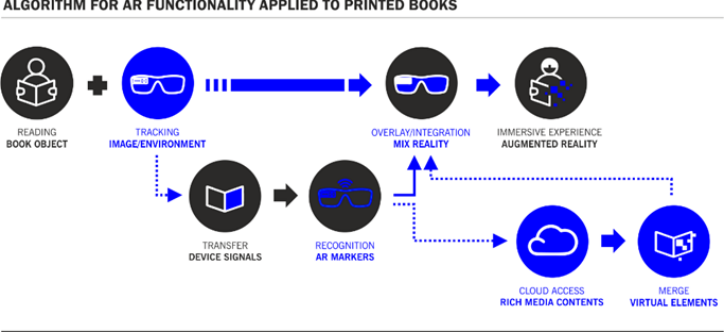
Figure 1: Algorithm for AR functionality applied to printed books. Maps narrative elements (space, time, characters, emotion) to AR outputs (visuals, soundscapes, spatial overlays) via markerless typographic recognition. Source: Author (Costeira & Lameiro, 2025).
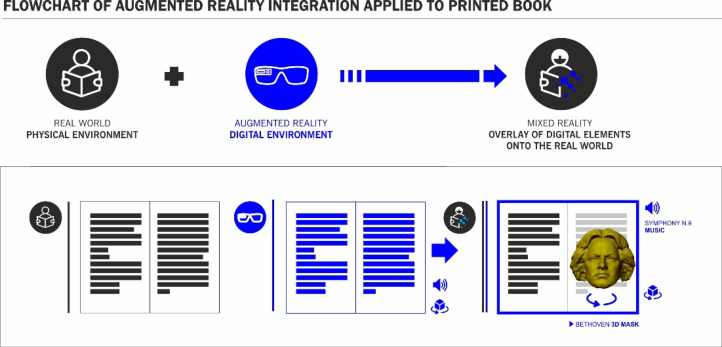
Costeira (2025) demonstrates this strategic potential through the ‘Clarabóia’ prototype, which uses markerless page recognition on existing printed novels to create immersive learning experiences. Current computer vision technologies enable robust page recognition through the unique typographic layout, pagination patterns, text block geometry, and compositional structure of each spread. This approach aligns with the principles established in Immersive Books: Reimagining Printed Novels through Design, Augmented Reality and Dramaturgy (Costeira & Lameiro, 2025), which demonstrates that immersive AR experiences are achievable with the global corpus of existing printed literature rather than requiring purpose-built AR editions.
Figure 2: AR Integration pipeline applied to printed books. (a) Flowchart showing the process from optical marker detection to immersive embodied reading; (b) Marker identification sequence demonstrating typographic recognition and AR overlay activation on printed novel pages. Source: Author.
Designing Immersive Reading: Augmented Reality, Printed Books, and the Future 199 Key characteristics include:
Material preservation: The approach respects high-contrast typography, comfortable line lengths, and paper stocks already optimized for long reading sessions, maintaining the physical and tactile expectations of conventional novel reading.
Natural page anchors: Page identification relies entirely on the intrinsic visual complexity of existing typographic layouts—text block shape, line spacing, marginalia, running headers/footers, and pagination—which serve as unique “fingerprints” for precise AR alignment without visual intrusion.
Layered dramaturgy: Narrative scenes are classified according to their atmospheric and dramaturgical requirements (e.g., high tension, calm reflection, spatial disorientation), mapped to specific AR behaviours (light shifts, soundscapes, spatial overlays) that activate automatically upon page recognition.
When read with AR glasses, these existing novels activate ambient visual and auditory layers that are context-aware (sensitive to page, chapter position, and reader context) and responsive to minimal input (gaze dwell, subtle gestures).
Exploratory User Study To validate the experiential plausibility of markerless, glasses-based AR reading, this ongoing research includes a multi-phase user study extending the author’s current investigation in immersive book design. Building on the prototype’s capacity to augment existing printed novels, the study currently adopts a mixed-methods, within-subjects design comparing three reading conditions across the same narrative excerpt:
Study Conditions:
1. Print-only baseline: Conventional reading without AR 2. Handheld AR (smartphone): Markerless page recognition via existing apps 3. AR glasses simulation and current capabilities: High-fidelity simulation (projector/screens/simulator) demonstrating the full proposed immersive experience, compared with real AR glasses testing their current capacity for natural page recognition and gaze/gesture interaction.
Table 1: Multi-dimensional evaluation framework for markerless AR reading (Costeira, 2026).
Qualitative Semi-structured interviews on dramaturgical perception; thematic analysis of “moments of rupture” vs “seamless immersion” Expected Contributions Beyond Comparison: Rather than merely validating AR glasses superiority, the study aims to:
1. Quantify thresholds of AR naturalness (when technology “disappears”?) 2. Map dramaturgical moments to optimal augmentation strategies 3. Establish design guidelines for markerless AR applied to printed books 4. Define success metrics for immersive reading research This rigorous evaluation framework positions the work as foundational for the transition from handheld AR books to the glasses-based paradigm anticipated in the original Immersive Books research trajectory.
DESIGN PRINCIPLES FOR NATURAL AR INTERFACES IN READING Naturalness in HCI and Reading
Naturalness refers to the degree to which an interface allows users to maintain habitual behaviours—posture, rhythm, focus—without conscious system operation (Norman, 2013; McCarthy & Wright, 2004). In HCI, this aligns with “invisible computing” (Weiser, 1991) and “calm technology” (Weiser & Brown, 1996), where interfaces leverage existing skills, reduce explicit controls, and recede from foreground awareness (Dourish, 2001). For immersive reading, naturalness specifically requires:
Allowing readers to hold/manipulate books in familiar postures
Positioning augmentations peripherally to preserve text legibility
Minimising explicit device management via context-aware triggers Naturalness emerges from the co-adaptation of hardware (AR glasses), software (markerless tracking), and content design (dramaturgy), echoing “situated interaction” principles (Suchman, 1987; Dourish, 2001).
Interaction Model With AR Glasses The model builds on established gaze + gesture paradigms and ambient information design in HCI:
Page recognition: Textural analysis of typographic layout
From Device-Centred AR to Reader-Centred Immersion The shift from smartphones to AR glasses enables a fundamental reorientation from device-centred AR (Billinghurst et al., 2015) to reader-centred immersion. Handheld setups treat the device as a foreground object requiring constant attention and manipulation (Hutchins, 1995), competing with the book for cognitive and physical resources. AR glasses support environmental interfaces where the book remains central while augmentations operate peripherally, aligning with “ubiquitous computing” principles (Weiser, 1991).
This evolution extends the immersive books framework (Costeira & Lameiro, 2025), transforming the interaction substrate from screen-centric apps to embodied spatial interaction (Dourish, 2001) better suited to reading rhythms.
Risks and Constraints AR glasses introduce ecological validity challenges (Bowers & Dix, 2019):
Notification interference: Ambient computing risks greater distraction than single-purpose devices
Sensory overload: Rich media affordances tempt “spectacle-driven design” (Laurel, 1993) that undermines narrative focus
Ergonomic barriers: Prolonged wear limitations mirror early wearable constraints Sustainable AR reading demands “reading modes” and platform-level interventions.
The framework impacts multiple domains:
Narrative design: Authors gain procedural authorship tools (Murray, 1997) for spatial storytelling
Editorial practice: Publishers can create dual-purpose artefacts supporting print and AR affordances (Borsuk, 2016)
Platform development: AR ecosystems need domain-specific interaction paradigms (Norman, 2013) This positions AR as a complementary medium rather than print competitor (Borsuk & Bouse, 2012).
CONCLUSION AND FUTURE WORK This article examined the evolving landscape of AR applied to printed books, with a focus on narrative fiction, technological evolution, HCI, and design strategies that support immersive reading. Building on previous work on immersive books and ARdriven dramaturgy, it argued that the main barrier to truly embodied, fluid AR reading is not the lack of compelling content but the limitations of current interfaces, especially handheld devices that fragment attention and disrupt reading posture.
By turning to lightweight AR glasses and natural interaction techniques based on gaze, gesture, and spatial computing, the article proposed a readercentred design framework in which AR becomes a subtle, contextaware layer around the printed novel. In this model, digital augmentations—spatially aligned visualizations, ambient soundscapes, dramaturgical annotations—aim to deepen immersion while preserving the material, cognitive, and cultural advantages of print. AR is thus reframed not as a successor technology but as a design tool that complements and enriches the traditional book experience.
Future work will involve implementing a functional prototype based on the described principles, conducting comparative studies between handheld and glassesbased AR conditions, and refining measures of immersion and naturalness. In the longer term, the goal is to articulate a shared design vocabulary—bridging literature, dramaturgy, editorial design, and HCI— that can guide the creation of ARenhanced printed novels whose interfaces are as natural and transparent as the act of reading itself.
ACKNOWLEDGEMENT
The author gratefully acknowledges discussions with Mónica Lameiro on immersive book design and dramaturgical frameworks.
Aarseth, E., 1997. Cybertext: Perspectives on Ergodic Literature. Johns Hopkins University Press. Alhamad, A., Manches, A. and McGeown, S., 2024. Comparing reading
comprehension between children reading augmented reality and print storybooks. Computers & Education, 152, p. 104274. Billinghurst, M., Clark, A. and Lee, G., 2015. A survey of augmented reality.
Foundations and Trends in HCI, 8(2-3), pp. 73–272. Borsuk, M., 2016. The Book. MIT Press. Borsuk, M. and Bouse, E., 2012. Between Page and Screen. Siglio Press. Bowers, J. and Dix, A., 2019. The challenge of ecological validity in HCI. Interacting with Computers, 31(2), pp. 123–136. Costeira, A., 2025. Augmented Reality and Strategic Organizational Learning: A
Design-Based Prototype Applied to a Printed Novel Book. International Journal of Strategy and Organizational Learning. The Science Publishing House, USA. Costeira, A. and Lameiro, M., 2025. Immersive Books: Reimagining Printed Novels through Design, Augmented Reality and Dramaturgy. In: Communications in Computer and Information Science, HCI International 2025 Posters Proceedings. Springer. Danaei, D., Nasongkhla, E.N. and Sujiva, S., 2023. Digital storytelling with
augmented reality and cognition: A systematic literature review. Educational Technology & Society, 26(1), pp. 221–236. Dombrowski, L., Harmon, E. and Fox, S., 2016. Social justice-oriented interaction design. Proceedings of the 2016 ACM Conference on Designing Interactive Systems, pp. 656–671. Dourish, P., 2001. Where the Action Is: The Foundations of Embodied Interaction.
MIT Press. Frayling, C., 1993. Research in art and design. Royal College of Art Research Papers, 1(1), pp. 1–5. Hutchins, E., 1995. Cognition in the Wild. MIT Press. Laurel, B., 1993. Computers as Theatre. Addison-Wesley. McCarthy, J. and Wright, P., 2004. Technology as Experience. MIT Press. Murray, J.H., 1997. Hamlet on the Holodeck: The Future of Narrative in Cyberspace.
MIT Press. Norman, D.A., 2013. The Design of Everyday Things. Basic Books. Rayner, K. et al., 2016. So much to read, so little time: How do we read, and can speed reading help? Psychological Science in the Public Interest, 17(1), pp. 4–79. Şimşek, M., 2024. Augmented reality books: In-depth insights into children›s reading
engagement. Frontiers in Psychology, 15, p. 1423163. Suchman, L.A., 1987. Plans and Situated Actions: The Problem of Human-Machine Communication. Cambridge University Press. Weiser, M., 1991. The computer for the 21st century. Scientific American, 265(3),
pp. 94–104. Weiser, M. & Brown, J.S., 1996. Designing calm technology. PowerGrid Journal, 1(1). Zimmerman, J., Forlizzi, J. and Evenson, S., 2007. Research through design as a
method for interaction design research in HCI. Proceedings of the SIGCHI Conference on Human Factors in Computing Systems, pp. 493–502.
LISTED IN THE AHFE DIGITAL BOOKSTORE CATALOGUE
Explore the complete digital volume
Metaverse, Virtual Environments and Game Design
Read this individual research paper free through the original publisher, or explore the full digital proceedings book.
ISBN 978-1-964867-93-9
Explore this ISBN in the AHFE Bookstore ↗Listed in the July 2026 bookstore catalogue; search by ISBN to confirm current availability · Digital book purchase optional