Wesley Woelfel (2026). Retreat Redesign: A Case Study Using the IIPL Approach. In: The Human Side of Service Engineering. AHFE Open Access, vol. 221, pp. 115–121. https://doi.org/10.54941/ahfe1007715
Academic faculty retreats are routinely geared towards professional development, team building, and strategic planning. They encourage focused discussions and often employ collaborative exercises and activities. However, the intricacies of how these events are built and facilitated can be the difference between meaningful outcomes and results that may be considered impersonal or merely procedural. This case study examines the strategic implementation and facilitation of a prototype faculty retreat event developed to support meaningful collaborative ideation utilizing the IIPL Approach. The IIPL Approach fuses Personal Leadership Philosophy practices with Design Thinking and Creative Problem Solving (CPS) methods to support introspective, value-based outcomes in creative activities. It is guided by four criteria for success (introspective, inclusive, personal, local) along with a series of mindsets. This creative methodology was selected to provide the structure for a recent design faculty and staff retreat event held on the campus of California State University, Long Beach. The event topics addressed the changing landscape of building academic and professional communities and subsequently expanded into related areas including design technologies, artificial intelligence, and design education. In following the IIPL Approach, these topics were structurally driven by Personal Leadership Philosophy. The event format, exercises, facilitation strategies, observed outcomes, and reflections on participant engagement are discussed, along with comparisons to a prior application of the IIPL Approach.
A recent faculty retreat event in the Department of Design at California State University, Long Beach, was strategically planned around the question, “How might we build community?” The goal was to find meaningful, inclusive, and value-based answers and suggestions from faculty and staff. The IIPL Approach, a methodology that drives creative thinking and problem- solving frameworks through Personal Leadership Philosophy structures, was selected as the strategic foundation for a two-hour event. In what ways might we develop and facilitate exercises using this methodology to capture a group’s collective intelligence within the context of a retreat? Held in the form of a workshop, a structure built using the IIPL Approach framework
116 Woelfel was leveraged to drive creative thinking exercises with personal values and purpose. This paper outlines the adapted structure, execution, and outcomes of this faculty retreat event case study.
METHODOLOGY
The faculty retreat workshop event was structured through the IIPL Approach’s four success criteria and two mindsets (Woelfel, 2024). Its success criteria are as follows: (1) introspective – what is important to you; (2) inclusive – honor the identities of others; (3) personal – channel what is important; and (4) local – use local space as a living lab. These criteria are strongly associated with the designed implementation of activities within this methodological framework and build to emphasize Personal Leadership Philosophy and its influence on creative thinking. The mindsets key to the facilitation of the IIPL Approach methodology are (A) elevate ideas via inclusivity and diversity; and (B) make it meaningful by making it personal.
IMPLEMENTATION A previous implementation of the IIPL Approach methodology was applied to a short, one-hour event that led a room filled with college design students of various levels through value-driven exercises and into inclusive divergent thinking. Food was used as the subject matter and collaborative driver. It established several executions of the success criteria and mindsets that are central to the IIPL Approach methodology.
This Design Department Faculty Retreat event presented different circumstances. First, the audience was composed of primarily faculty and staff rather than students. As seasoned design experts in their respective fields, they already possessed an exemplary wealth of creative experiences and trained approaches to solving problems. It was likely that this audience held their own established, preconceived, and resilient opinions about what a design community in higher education should be. Another significant difference was a longer assigned two-hour time slot, providing twice as much time as a previous case study. Finally, instead of integrating food into the event as a thematic driver, a meal was served during a scheduled break. Thus, food was not woven into the event’s activities as a central theme, as it had been in a prior implementation.
The Duncan Anderson Design Gallery, located on campus within the Department of Design at California State University, Long Beach, was selected as the workshop location. The site supports a “Campus as a Living Lab” approach to education (Whitcraft et al., 2014) and served as the primary implementation of the “local” criterion of the IIPL Approach. Because the location was on “home turf,” it also promoted the “make it meaningful by making it personal” mindset. For this event, the space was reformatted to promote a collaborative environment by arranging eight tables with four to six chairs each. Each table was outfitted with a selection of fine-point Sharpies, sticky notes, one flip chart, and six participant worksheets. These materials supported the individual and collaborative activities that embody the success criteria and mindsets of this event methodology.
Retreat Redesign: A Case Study Using the IIPL Approach 117 Facilitation and Energy Modulation
Throughout the retreat event, several exercises were designed and facilitated in a strategic sequence with the intent of transitioning Personal Leadership Philosophy into creative outcomes through Design Thinking and Creative Problem Solving (CPS) systems. Each exercise was timed and introduced by the facilitator. As the event unfolded, additional exercises and techniques were incorporated to support the success criteria and mindsets of the IIPL Approach.
The retreat posed two questions to be addressed using creative thinking techniques. The first prompt asked, “How might we foster a thriving community within our faculty and staff?” The second prompt, whose topic was decided independently by each table, asked, “What are your hopes and fears related to your table’s topic?” Both questions were grounded in the event’s initial Personal Leadership Philosophy exercises.
Modulating the mood and energy of the room at critical moments throughout the retreat event was essential to foster contemplative reflection, playful banter involving ideas, and paced purposeful discussion related to community and the future of design education. These shifts elevated the exercises and reinforced the two mindsets of the IIPL Approach integrated throughout the workshop. Energizers, exercise mindset guidelines, and music selection were instrumental in activating these shifts in engagement.
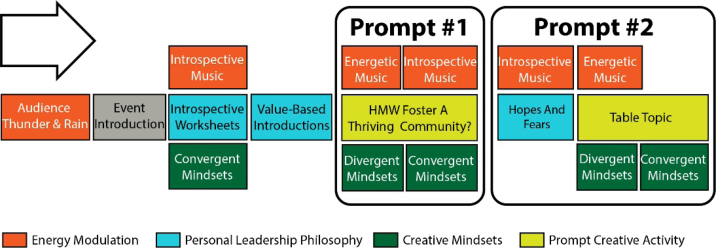
To crack the shell of seasoned educators, a playful audience “rain energizer” opened the event. The facilitator guided the sounds and rhythms of rain and thunder throughout the room, which were generated collectively through the audience’s sounds and movements. Following a subsequent workshop introduction, the room’s energy was intentionally modulated toward paced introspective thought using mindset guidelines and contemplative music. Participants then journeyed through worksheet exercises focused on forging a penned commitment to their own value-based Personal Leadership Philosophy. This mood, energy, and exercise combination was designed to promote the “make it meaningful by making it personal” mindset that would drive the creative exercises to follow.
Figure 1: Sequence of activities and exercises.
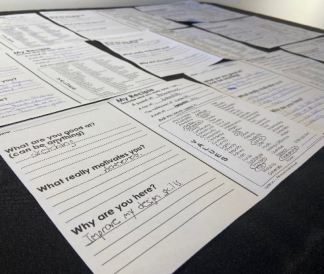
The “introspective” and “personal” criteria of the IIPL Approach were supported and implemented through a series of exercises in the form of individually completed worksheets that combined value-based commitments with core identity questions. These exercises identified authentic self- awareness (Cashman, 2017), and the process provided time and space to define and honor the values and identities of each participant. The materials included questions related to skill, motivation, and purpose. Next, participants completed a “Mad Libs”-style “My Recipe” form inspired by the value-based leadership assessment Recipe of Me (Hairston, 2021). In this activity, participants selected from a foundational set of emotional words to build a prioritized list of values. Each worksheet established an introspective and personal lens through which divergent and convergent creative systems framed by Creative Problem Solving (Osborn, 1953) and Design Thinking (Brown, 2009) were applied. This content was advanced by a structured exercise designed for groups to honor the identities of all participants through peer introductions. In this exercise, participants, grouped by tables, passed their written worksheets to the person next to them. They then introduced each other using the content from their value-based reflections. This activity allowed teams of faculty and staff at each table to shed preconceptions and see and hear one another through a values-centered lens, promoting the “elevate ideas via inclusivity and diversity” mindset of the methodology.
Figure 2: Personal leadership philosophy worksheets.
Leveraging Creative Systems Once the value-based Personal Leadership Philosophy foundations were established and shared through the aforementioned activities, the facilitator transitioned to two creative thinking prompts. The important transition to this phase of the event was leveraged in three ways: modulating energy, utilizing creative thinking guidelines, and applying IIPL Approach mindsets. The first prompt asked, “How might we foster a thriving community within our faculty and staff?” The facilitator then prepared the audience with divergent thinking guidelines and modulated the mood of the room with high-energy creative music. Teams of participants proceeded to feverishly
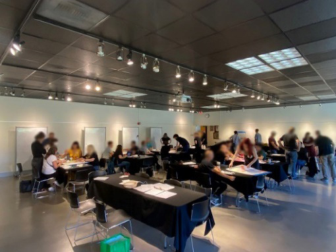
Retreat Redesign: A Case Study Using the IIPL Approach 119 pile sticky notes of divergent ideas onto flip charts in a vibrant atmosphere of collaboration. The divergent guidelines inherently supported inclusive ideas, which were reinforced by the “yes, and” divergent methods (Creative Education Foundation, 2015), aligning with the “elevate ideas via inclusivity and diversity” IIPL Approach mindset. Following this timed exercise, the pace slowed to allow for thoughtful discussion and the grouping of sticky note ideas guided by convergent thinking guidelines. Introspective music was played to further modulate the energy in the room during this activity. Each group then selected its top three ideas and presented them to the entire audience.
Figure 3: Prompt #1 collaborative teams and creative thinking outcomes.
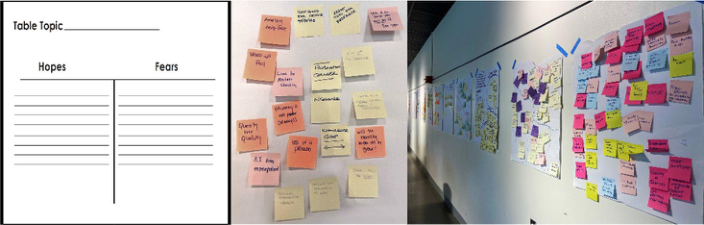
After a break, each table was asked to select an important topic pertaining to the future of design education. A second prompt was then revealed, asking, “What are your hopes and fears related to your table’s topic?” The activity began with an individually completed “write-out” using a “hopes and fears” creative thinking tool. This introspective exercise was followed by a typical divergent-convergent pattern, in which the divergent element consisted of teams collaboratively adding these responses to a flip chart using sticky notes and Sharpies. Each team then participated in a convergent activity to identify the top ideas. These activities were supported by appropriate creative thinking guidelines, music for energy modulation, and IIPL Approach mindsets. Following a share-out by each team, the flip charts were posted on the gallery walls.
Figure 4: Prompt #2 outcome example and gallery display of work.
DISCUSSION
In future implementations, a reserve set of modular exercises and supportive modulation tools may be useful in amplifying a guided experience such as this and curating specific activities as needed. In this case study, the order in which teams lined up for the food break was determined by the number of ideas generated during the first prompt. Further gamification of exercises may also be beneficial in modulating the energy and engagement of participants and facilitators alike.
The familiar gallery location reinforced the “Campus as a Living Lab” strategic decision; however, it may have conflicted with a change-of-scenery strategy often associated with retreat events. An unfamiliar site on campus or within the city of Long Beach may have yielded different outcomes while still aligning with the “local” success criterion of the IIPL Approach. Changing environments while ensuring a meaningful connection to place may provide new perspectives and promote equity.
The introduction of others through values was a unique ingredient used to reinforce inclusivity and diversity through the value-based honoring of identities. However, placing this activity directly after a deeply personal and introspective commitment to values may have been uncomfortable for some participants, particularly those who penned their values for the first time.
The pairing of Personal Leadership Philosophy with creative exercises generated heartfelt discussions and a wealth of diverse ideas. Transitioning between Personal Leadership Philosophy and creative exercises through a three-pronged implementation using energy modulation, thinking guidelines, and IIPL Approach mindsets provided rich multisensory navigation and value-based ideas. In subsequent implementations, the music used for energy modulation may be more effective and inclusive for neurodivergent participants by incorporating sounds that target concentration such as alpha waves or 90 Hz/106 Hz beta-wave stereo splits during introspective activities. Throughout the event, some planned exercises were omitted due to time constraints and perceived redundancy. This included lunchtime discussion prompts and a change-of-seats energizer exercise. In a two- hour event, decisions to add or subtract elements can significantly affect participant concentration, energy, and the effectiveness of the IIPL Approach methodology, particularly given the extended time frame. A substantial amount was accomplished within this two-hour period, and by the conclusion of the event, participants appeared both exhausted and proud.
CONCLUSION
This case study has presented a wealth of information that can be applied to future implementations of this methodology in similar contexts. The IIPL Approach is a powerful tool for providing meaningful, value-based creative thinking through the planning and facilitation of events. It has reliably produced a large volume of Personal Leadership Philosophy-driven creative ideas through various implementations. The scheduling, implementation, and facilitation of exercises are critical to the success of these events, as each requires different navigation within the success criteria and mindsets of the IIPL Approach. The development of a toolkit may be useful in addressing
Retreat Redesign: A Case Study Using the IIPL Approach 121 the strategies and nuances of varying events, workshop topics, goals, and audiences.
REFERENCES
Barker, H., Martin, I., Martin, W., Toossi, R., Whitcraft, C., Woelfel, W. (2014).
Sustainability: Our Community as a Living Lab. (Sustainability White Paper) Brown, T. (2009). Change by Design, How Design Thinking Transforms Organizations and Inspires Innovation. New York: Harper Business. Cashman, K. (2017). Leadership from the Inside Out: Becoming a Leader for Life.
Massachusetts: Creative Education Foundation. Dawson, K., Cawthon, S. (n.d.). Recipe for Me. Drama-Based Instruction Activating Learning Through the Arts! Website: https://dbp.theatredance.utexas.edu/ teaching-strategies/recipe-me Hairston, L. (January 22, 2021). The Recipe of Me: Developing Your Personal
Mission Statement. (Presentation) Kelley, D., Kelley T. (2013). Creative Confidence: Unleashing the Creative Potential Within Us All. New York: Crown Business. Osborn, A. (1953). Applied Imagination: Principles and Procedures of Creative
Thinking. New York: Charles Scribner’s Sons. Ruggero, E., Haley, D. (2005). The Leader’s Compass: A Personal Leadership Philosophy Is Your Key to Success. Pennsylvania: Academy Leadership Publishing. Woelfel, W. (2024). ““Introspective Creativity” Leveraging Inclusive Leadership
Philosophy with Design Thinking Methodologies” In: The Human Side of Service Engineering, Vol 143, pp. 235–242.
LISTED IN THE AHFE DIGITAL BOOKSTORE CATALOGUE
Explore the complete digital volume
The Human Side of Service Engineering
Read this individual research paper free through the original publisher, or explore the full digital proceedings book.
ISBN 978-1-964867-97-7
Explore this ISBN in the AHFE Bookstore ↗Listed in the July 2026 bookstore catalogue; search by ISBN to confirm current availability · Digital book purchase optional