Nabil Badr, Claude Lawrence II, Luca Carrubbo (2026). Bridging Translational Gaps in Learning Healthcare Systems. In: The Human Side of Service Engineering. AHFE Open Access, vol. 221, pp. 95–105. https://doi.org/10.54941/ahfe1007713
Persistent translational gaps continue to limit the impact of scientific discoveries, digital innovations, and evidence-based practices in healthcare, despite major advances in artificial intelligence, data interoperability, and digital health infrastructure. Learning Health Systems (LHS) offer a compelling vision for continuous, data driven improvement, yet most remain aspirational because they lack the sociotechnical mechanisms needed to embed learning into routine practice. Drawing on service science, design science, sociotechnical systems theory, and implementation science, this paper proposes an integrated conceptual framework that combines Translational Service Design (TSD) with LHS principles to address these longstanding barriers. The resulting synthesis clarifies how innovations can move from discovery to implementation to sustained learning, overcoming the “valleys of death” that typically impede adoption. By positioning TSD as the methodological and architectural foundation of LHS, this work offers a coherent pathway for transforming continuous learning from an aspirational ideal into an operational reality, laying the foundation for future empirical validation and technical specification.
Healthcare is undergoing rapid digital transformation, yet the movement of evidence into practice remains slow, inconsistent, and highly variable across settings. Despite advances in digital health and data-driven decision support, many innovations fail when deployed in real-world environments. Decades of research show that it can take 15–17 years for evidence-based interventions to become standard care (Proctor et al., 2022). Delays are not solely technological; they stem from human factors, workflow misalignment, organizational inertia, and regulatory barriers that impede adoption and sustained use (Testa et al., 2025). Conventional research-to-practice pipelines, with slow feedback loops and fragmented data flows, are poorly suited to the complexity of modern healthcare (Platt et al., 2020). Without mechanisms for adoption, scaling, and governance, LHS remain conceptual. They require sociotechnical integration across actors, infrastructures, and governance structures to function effectively.
Effective Learning Health System (LHS) implementation therefore requires transforming the full-service cycle through close stakeholder collaboration, Received January 27, 2026; Revised April 15, 2026; Accepted May 1, 2026; Available online July 20, 2026
96 Badr purposeful technology deployment, and value co-creation. Translational Service Design (TSD) could fill this gap by providing a structured, codesigned, and governance-aware methodology that spans the full pathway from discovery to sustained learning, embedding feasibility, safety, interoperability, and accountability into the design process itself.
This paper proposes a sociotechnical framework that informs TSD to address persistent translational gaps in LHS. As a conceptual contribution, the paper lays groundwork for future technical specifications and empirical validation. A hypothetical regional diabetes network illustrates its use, followed by implications and future research directions.
BACKGROUND
Service Science (Maglio et al., 2009) provides the ecosystems lens for mapping actors collaboration, contextual interdependencies and value exchanges (Polese et al., 2017). Building on this foundation, design science contributes the methodological rigor needed to create purposeful, reproducible, and evaluable service interventions that address real-world problems within these ecosystems (Seckler et al., 2025). Fueled by design thinking practices, design science takes those early concepts and turns them into rigorous, testable, and evaluable artifacts, methods, workflows, architectures, governance models, etc. (Brown & Wyatt, 2015). At the early stage, Design Thinking and Participatory Design (Lyng et al., 2021) support empathic inquiry and problem reframing. Later, in the implementation stages, Sociotechnical Systems Theory (Carayon et al., 2011) frames alignment of social and technical subsystems and Implementation Science (Proctor et al., 2022) provides constructs for feasibility, acceptability, and integration. Conceptually, TSD is at the intersection of Service science; design thinking; implementation science with a sociotechnical adaptation. TSD can be explained therefore as a seven-stage pathway that moves innovations from discovery to sustained learning.
Ensures ongoing adaptation through real-time data, evaluation, and governed feedback.
Bridging Translational Gaps in Learning Healthcare Systems 97 It begins with framing problems and contexts to surface translational gaps (Brown & Wyatt, 2015; Maglio et al., 2009), followed by co-design processes that build shared intentionality among stakeholders (Lyng et al., 2021; Carlini et al., 2024). TSD then defines the sociotechnical architecture needed for implementation, including service blueprints, data flows, and governance requirements (Palazzo et al., 2024; Roberts et al., 2016). Subsequent stages involve iterative prototyping and workflow integration, adaptive pilot deployment, and the institutionalization and scaling of validated services (Proctor et al., 2022; Vaz & Araujo, 2024). Finally, continuous learning mechanisms, real-time data capture, participatory evaluation, and governed feedback loops, ensure that services evolve with changing contexts and needs (Menear et al., 2019). Governed feedback loops ensure that LHS are accountable, transparent, and safe (Komashie et al., 2021).
Sociotechnical Systems (STS) Foundation Sociotechnical Systems (STS) theory provides a foundational lens for understanding why healthcare innovations succeed or fail in complex, multi-actor environments (Norman & Stappers, 2015). STS explains why innovations succeed or fail by highlighting the need for alignment between social structures, technical architectures, and institutional arrangements. TSD further activates this alignment by coordinating social and technical subsystems across the service lifecycle, providing a unified service language, translational architecture, and reusable design patterns that structure how actors coordinate, how resources flow, and how governance mechanisms operate in practice (Menear et al., 2019). When these subsystems are misaligned, translational failures occur even when technologies are technically robust.
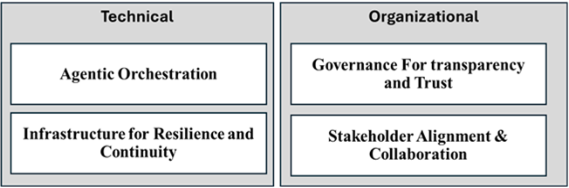
CONCEPTUAL FRAMEWORK Our proposed framework treats continuous learning within LHS as a sociotechnical capability that depends on coordinated action across stakeholders, infrastructures, and governance structures. Conceptually, we represent four interdependent components (Stakeholder Collaboration, Infrastructure Resilience, Agentic Orchestration, and Governance and Trust) each aligning social structures with technical functions to sustain LHS.
Stakeholder Collaboration The stakeholder component anchors our framework by aligning social and technical commitments through actor mapping, shared objectives, service-level agreements, co-design workshops, and feedback channels, with these commitments encoded into governance policies and agent behaviors. Actors first take defined roles that enhance system function, then build relationships through ongoing interactions guided by shared objectives (Polese et al., 2017). Design thinking informs early actor discovery, journey mapping, and problem reframing, while TSD codifies these insights into institutional workflows, agent behaviors, and governance structures (Brown & Wyatt, 2015). Cycles of shared intentionality, cognitive alignment, and resource integration support collective action and system viability in complex
98 Badr healthcare networks (Vargo et al., 2010). In a Learning Health System, these mechanisms embed collective commitments, trustworthy data practices, and coordinated action. When stakeholders (providers, patients, regulators, technologists, and others) align resources with continuous learning goals, their repeated interactions generate feedback loops that drive sustained, emergent improvement across the ecosystem (Badr et al., 2022). Resource integration binds these elements by positioning stakeholders as owners of data, knowledge, and capabilities, creating virtuous cycles of efficiency, trust, and institutional memory that enable continuous adaptation and value co-creation.
Infrastructure Resilience and Continuity The infrastructure component provides the resilient, interoperable technical backbone that enables continuous learning in a Learning Health System (LHS). Its core function is to ensure reliable, scalable operations across heterogeneous environments through redundant data pipelines, secure APIs, failover mechanisms, and comprehensive observability (Moses et al., 2013). As the foundational component of the LHS architecture, it supports all higher-order learning, orchestration, and governance capabilities by exposing public-health and clinical functions as modular, composable services (Lessard et al., 2017). Redundant pipelines minimize single-point failures and maintain uninterrupted surveillance, reporting, and analytic workflows, while secure APIs enable standardized, policy-constrained data exchange across EHRs, laboratories, registries, and edge devices, reinforced by robust identity and access management (Papastergiou et al., 2021). To sustain continuity in dynamic and resource-variable settings, the infrastructure incorporates gracefuldegradation and traffic-rerouting mechanisms during outages or cyber incidents. Real-time logging and observability provide visibility into system performance and anomalies, enabling rapid detection and remediation (Adepoju et al., 2022).
Agentic Orchestration Agentic orchestration provides the adaptive, automated intelligence needed to operationalize LHS, enabling continuous data-to-knowledge-to-action cycles. Agentic orchestration strengthens LHS by enabling continuous, automated, and context-aware learning cycles across clinical, operational, and population-health environments (Banerjie et al., 2025). Unlike static artificial Intelligence (AI) models, agentic systems coordinate multiple specialized agents that ingest data, generate insights, and trigger actions in real time, thereby reducing the fragmentation that has historically limited LHS implementation (Tallam, 2025). Emerging analyses argue that agentic AI is essential for transforming healthcare from episodic automation to collaborative, continuously learning operations, aligning with the LHS vision of rapid evidence generation and practice refinement (Karunanayake, 2025). This orchestration layer supports dynamic workflow adaptation, model monitoring, and human-in-the-loop oversight, creating the conditions for a self-improving sociotechnical ecosystem (Herrmann & Pfeiffer, 2023).
Bridging Translational Gaps in Learning Healthcare Systems 99 Governance and Trust
The governance component represents provenance and consent foundations required for continuous learning in a Learning Health System (LHS), ensuring that that improvement cycles do not compromise quality, privacy, accountability, or institutional legitimacy. While infrastructure and orchestration layers deliver reliability and adaptive automation, governance defines the rules, assurances, and oversight mechanisms that make such automation acceptable in real-world public health contexts (Platt et al., 2020). Federated learning enables healthcare organizations to collaboratively train models without sharing raw patient data, forming a core privacy-preserving architecture for LHS (Antunes et al., 2022). Other techniques such as secure aggregation, differential privacy, and encrypted provenance tracking further support system-wide learning while maintaining strict protections around consent and confidentiality (Bala et al., 2024). Tamper-evident audit trails further provide verifiable records of data access, model updates, and decision-support actions, strengthening retrospective review and cross-jurisdictional trust (Ashrafuzzaman, 2025). A hybrid on-chain/off-chain ledger can record metadata, hashes, and consent artifacts in a tamper-evident manner while keeping sensitive clinical data local, balancing transparency with privacy by preserving provenance without centralizing raw data (Frempong et al., 2024). For example, technology driven smart contracts operationalize governance by encoding provenance, consent lifecycles, data-use permissions, and automated compliance checks, enabling machine-readable enforcement of regulatory and ethical constraints (Mustafa et al., 2025).
Sociotechnical Implementation Framework for LHS (SIF-LHS) The proposed conceptual framework (Figure 1) brings these elements together by defining the sociotechnical architecture needed for continuous learning and specifying how stakeholders, infrastructures, orchestration mechanisms, and governance structures must align to support an operational Learning Health System.
Figure 1: Sociotechnical implementation framework for LHS (SIF-LHS).
Yet a framework alone does not explain how these components function cohesively in real-world settings.
TSD and the proposed SIF-LHS framework function as a tightly coupled implementation architecture pair. TSD provides the dynamic process that moves innovations from discovery through implementation and into continuous learning, while proposed SIF-LHS supplies the structural conditions that make each stage viable in real-world environments. This synthesis highlights the complementary roles of collaboration, resilient infrastructure, adaptive automation, and trustworthy governance in overcoming translational gaps and sustaining learning.
Table 2 shows an example of how each stage activates social, technical, agentic, and governance capacities, informed by the framework and demonstrating that effective LHS implementation requires coordinated progress across all four dimensions.
Table 2: Example of how each stage TSD is informed by the SIF-LHS framework.
Table available in the original PDF paper.
TSD Stage Guidance from SIF-LHS Framework Components Stakeholder Collaboration (SC); Infrastructure Resilience (IR); Agentic Orchestration (AO); Governance and Trust Stage 1. Problem Framing & Contextual Inquiry SC: Co-design and shared intentionality align actors with real needs. IR: Interoperable data flows embed new knowledge into operations. AO: Adaptive agents turn insights into context-sensitive workflows. GT: Consent, provenance, and auditability maintain legitimacy.
Stage 2. CoDesign & Shared Intentionality
SC: Aligns incentives across research and practice. IR: Reduces technical friction to support scaling. AO: Creates pathways for embedding innovations in routine work. GT: Ensures cross-institutional compliance and trust.
Stage 3. Translational Architecture & Service Blueprinting
SC: Aligns roles, norms, and incentives. IR: Aligns data architectures and workflows. AO: Aligns human–machine interaction via policy-aware automation. GT: Aligns policies, consent, and oversight.
SC: Shared service dictionaries and co-design artifacts. IR: Standardized APIs and data patterns. AO: Modular agent templates. GT: Machine-readable policies and smart-contract governance.
Stage 5. Pilot Deployment & Adaptive Implementation
SC: Clear roles and shared objectives. IR: Composable service components. AO: Executable workflows. GT: Enforceable rules for sustained implementation.
Stage 6. Institutionalization & Scaling
SC: Feedback loops and participatory evaluation. IR: Real-time capture and monitoring. AO: Drift detection and adaptive workflows. GT: Governed triggers and accountable adaptation.
SC: Shared intentionality and relational alignment. IR: Transparent data practices. AO: Human-in-the-loop mechanisms. GT: Participatory governance for cross-sector legitimacy.
Bridging Translational Gaps in Learning Healthcare Systems 101 Stakeholder Collaboration grounds discoveries in real-world needs through co-design and aligned incentives, while Infrastructure Resilience supplies interoperable data flows and composable services that embed new knowledge into operations. Agentic Orchestration converts insights into executable, context-sensitive workflows through modular agents and adaptive automation. Governance and Trust ensure legitimacy and accountability through consent, provenance, auditability, and machine- readable policies. Operational fidelity depends on detecting “learning triggers” (clinical, operational, behavioral, or data-quality anomalies such as model drift, unexpected outcomes, or workflow bottlenecks) and routing them through governed learning cycles. Once detected, Stakeholder Collaboration interprets the trigger, Infrastructure Resilience captures and routes it, Agentic Orchestration adapts workflows, and Governance and Trust validate compliance and authorize changes, turning disruptions into opportunities for shared understanding and resilient system improvement.
Hypothetical Use Case: Regional Hypertension Support LHS Network Use Case: A regional health authority seeks to reduce uncontrolled hypertension across a diverse, fragmented set of clinical environments, namely urban clinics, rural primary-care practices, community pharmacies, and mobile health units. Despite strong evidence for effective hypertension management, outcomes vary widely due to inconsistent workflows, siloed data, limited patient engagement, and uneven adoption of digital tools. Previous pilots have produced promising results but failed to scale due to misaligned incentives, governance uncertainty, and technical fragmentation.
To address this, the region’s public health commissioner has decided to implement a Learning Health System (LHS) using TSD as implementation architecture (Figure 2).
7. Continuous Learning: Drift
5. Adaptive Pilot: Thresholds,
3. Architecture & Blueprinting: Standardized BP data, APIs, workflows, consent
1. Problem Framing: Gaps exposed: siloed data, misaligned workflows, unclear
detection, dashboards, governed updates,
workflows, and device variability refined iteratively.
model defined.
consent.
periodic review.
2. Co-Design: Shared goal set;
4. Prototyping: Alerts, tasks, and
6. Scaling: Reusable modules
roles clarified;
nudges tested;
deployed across
data flows
diverse clinical
validated.
settings.
common vocabulary established.
Figure 2: Use case for SIF-LHS in a regional hypertension LHS network.
Figure available in the original PDF paper.
The region’s public health commissioner performed a structured assessment showing extant systemic issues. Clinics used incompatible EHRs, pharmacies held isolated adherence data, community workers relied on paper forms, and patients submitted readings through disparate applications. Regulatory constraints further complicated data sharing, rendering the implementation of LHS impossible. (S1 - Discovery). The implementation team convened clinicians, pharmacists, patients, community organizations, vendors, and
102 Badr regulators to establish a shared objective: reducing uncontrolled hypertension by 20% in 18 months. Co-design sessions aligned expectations, clarified roles, and created a common vocabulary, activating stakeholder alignment and collaboration (S2: Co-Design). Following guidance from the SIF-LHS framework and the TSD approach, stakeholders produced a unified blood- pressure data dictionary, cross-sector workflows, interoperable APIs, and a regulator-approved consent model (S3: Architecture and Blueprinting). These activities established the foundation for scalable LHS. At the next stage (S4: Prototyping), a controlled prototype deployed a LHS instance with a modular hypertension-monitoring agent, automated pharmacist prompts, community-worker task lists, and patient notifications, through policy-aware, human-supervised automation (Agentic Orchestration). Clinicians validated alert relevance; regulators confirmed compliance. Early pilots could reasonably demonstrate a reduction in alert fatigue as agentic orchestration filters low-value notifications and routes only clinically meaningful signals to clinicians. Data harmonization across clinics, pharmacies, and community programs would likely produce a measurable increase in adherence-related data completeness, enabling more accurate risk stratification and follow-up. Automated triage and governed workflow adaptation could also yield a reduction in time to intervention, allowing high-risk patients to receive medication adjustments, counseling, or community outreach more quickly. These hypothetical outcomes illustrate how sociotechnical alignment translates into tangible improvements in care quality and system performance. As the pilot expanded (S5: Adaptive Pilot), variability in device accuracy and workflow responsiveness required iterative adjustments. Weekly learning cycles supported refinement, while governance mechanisms ensured transparency and compliance enabling accountable system evolution (Governance and Trust). Next (S6: Institutionalization and Scaling), the implementation teams, formalized the validated components into reusable modules, monitoring agents, standardized APIs, consent contracts, and workflow templates and deployed across diverse clinical environments. Scaling became systematic rather than site-specific. Finally, the region transitioned into a functioning LHS. Real-time dashboards, drift detection, governed retraining, and quarterly review cycles institutionalized continuous learning. The system identified emerging patterns, such as transportationrelated adherence barriers, and adapted accordingly (S7: Continuous Learning, Monitoring, and Evolution).
CONCLUSION
The paper argues that closing persistent translational gaps in healthcare requires more than new technologies; it demands a coherent sociotechnical architecture activated by an appropriate methodological rigor. The paper offers an integrated SIF-LHS framework drawing on service science, design science, sociotechnical systems theory, and implementation science to specify conditions for translation of LHS from evidence into practice. The SIF-LHS framework outlines the fundamental need of alignment across stakeholders, infrastructures, orchestration, and governance in a structure approach through TSD for successful LHS implementations.
Bridging Translational Gaps in Learning Healthcare Systems 103 Several limitations shape the scope of this conceptual work. The framework is theoretical and has not yet been empirically validated in operational healthcare environments, leaving questions about its performance under real-world constraints. Contextual variability across healthcare systems. particularly differences in regulatory maturity, digital infrastructure, and institutional culture, may require adaptation of the framework. Additionally, the governance mechanisms proposed, such as smart contracts and provenance ledgers, introduce legal and operational complexities that warrant further investigation. Finally, the feasibility of policy-aware agents and adaptive orchestration depends on data quality, model robustness, and human-automation trust, all of which require empirical study.
Future work should translate this framework into operational prototypes and empirical evaluations by specifying the agentic orchestration layer, testing governance across jurisdictions, and assessing adaptability in low-resource or variable environments. Pilot implementations in diverse clinical settings would enable measurement of learning cycles, workflow integration, and governance performance.
REFERENCES
Adepoju, A. H., Austin-Gabriel, B., Hamza, O., & Collins, A. (2022). Advancing monitoring and alert systems: A proactive approach to improving reliability in complex data ecosystems. IRE Journals, 5(11), 281–282. Antunes, R. S., André da Costa, C., Küderle, A., Yari, I. A., & Eskofier, B. (2022).
Federated learning for healthcare: Systematic review and architecture proposal. ACM Transactions on Intelligent Systems and Technology (TIST), 13(4), 1–23. Ashrafuzzaman, M. (2025). Blockchain-Enabled Audit Trails for Public MIS: Enhancing Transparency in Government IT Systems. Available at SSRN 5286689. Badr, N. G. (2022). Learning Healthcare Ecosystems for Equity in Health Service
Provisioning and Delivery: Smart Cities and the Quintuple Aim. The Proceedings of the International Conference on Smart City Applications, 237–251. Badr, N. G., Carrubbo, L., & Mohtar, L. (2022). How to reach the goal of quadruple aim today in healthcare service ecosystem: Nudges from the A4A approach. ITM Web of Conferences, 41, 01001. Bala, I., Pindoo, I., Mijwil, M. M., Abotaleb, M., & Yundong, W. (2024). Ensuring
security and privacy in Healthcare Systems: A Review Exploring challenges, solutions, Future trends, and the practical applications of Artificial Intelligence. Jordan Medical Journal, 58(3). Banerjie, S., Zhu, Y., Freeman, I., Machado, J. V., Ahmed, A., Sarker, A., & Al-Garadi, M. (2025). Agentic AI in Healthcare: A Comprehensive Survey of Foundations, Taxonomy, and Applications. Authorea Preprints. Brown, T., & Wyatt, J. (2015). Design thinking for social innovation. Annual Review
of Policy Design, 3(1), 1–10. Carayon, P., Bass, E. J., Bellandi, T., Gurses, A. P., Hallbeck, M. S., & Mollo, V.
(2011). Sociotechnical systems analysis in health care: A research agenda. IIE Transactions on Healthcare Systems Engineering, 1(3), 145–160. https://doi.org/1 0.1080/19488300.2011.619158 Carlini, J., Muir, R., McLaren-Kennedy, A., & Grealish, L. (2024). Transforming health-care service through consumer co-creation: Directions for service design. Journal of Services Marketing, 38(3), 326–343.
Consent Management in Healthcare: A Framework for Enforcing Privacy Preferences and Regulatory Compliance. Health, 3(4), 5. Herrmann, T., & Pfeiffer, S. (2023). Keeping the organization in the loop: A sociotechnical extension of human-centered artificial intelligence. Ai & Society, 38(4), 1523–1542. Karunanayake, N. (2025). Next-generation agentic AI for transforming healthcare.
Informatics and Health, 2(2), 73–83. Komashie, A., Ward, J., Bashford, T., Dickerson, T., Kaya, G. K., Liu, Y., Kuhn, I., Günay, A., Kohler, K., Boddy, N., & others. (2021). Systems approach to health service design, delivery and improvement: A systematic review and meta-analysis. BMJ Open, 11(1), e037667. Lessard, L., Michalowski, W., Fung-Kee-Fung, M., Jones, L., & Grudniewicz, A.
(2017). Architectural frameworks: Defining the structures for implementing learning health systems. Implementation Science, 12(1), 78. Lyng, H. B., Macrae, C., Guise, V., Haraldseid-Driftland, C., Fagerdal, B., Schibevaag, L., Alsvik, J. G., & Wiig, S. (2021). Balancing adaptation and innovation for resilience in healthcare–a metasynthesis of narratives. BMC Health Services Research, 21(1), 759. Maglio, P. P., Vargo, S. L., Caswell, N., & Spohrer, J. (2009). The service system
is the basic abstraction of service science. Information Systems and E-Business Management, 7(4), 395–406. Menear, M., Blanchette, M.-A., Demers-Payette, O., & Roy, D. (2019). A framework for value-creating learning health systems. Health Research Policy and Systems, 17, 1–13. Moses, H., Matheson, D. H., Dorsey, E. R., George, B. P., Sadoff, D., & Yoshimura, S.
(2013). The anatomy of health care in the United States. Jama, 310(18), 1947–1964. Munro, C. L., & Savel, R. H. (2016). Narrowing the 17-year research to practice gap.
In American Journal of Critical Care (Vol. 25, Issue 3, pp. 194–196). American Association of Critical Care Nurses. Mustafa, G., Rafiq, W., Jhamat, N., Arshad, Z., & Rana, F. A. (2025). Blockchainbased governance models in e-government: A comprehensive framework for legal, technical, ethical and security considerations. International Journal of Law and Management, 67(1), 37–55. Norman, D. A., & Stappers, P. J. (2015). DesignX: Complex Sociotechnical Systems.
She Ji: The Journal of Design, Economics, and Innovation, 1(2), 83–106. https:// doi.org/10.1016/j.sheji.2016.01.002 Palazzo, A. C., Bertelli, M., & Gaspari, J. (2024). A Systemic Review on the Adoption of Service Design Practices to Improve the Quality of User Experience and Organization in the Healthcare Environment. Sustainability, 16(13), 5595. Papastergiou, S., Mouratidis, H., & Kalogeraki, E.-M. (2021). Handling of advanced
persistent threats and complex incidents in healthcare, transportation and energy ICT infrastructures. Evolving Systems, 12(1), 91–108. Platt, J. E., Raj, M., & Wienroth, M. (2020). An analysis of the learning health system in its first decade in practice: Scoping review. Journal of Medical Internet Research, 22(3), e17026. Polese, F., Pels, J., Tronvoll, B., Bruni, R., & Carrubbo, L. (2017). Journal of Service
Theory and Practice. Practice, 27(5), 1040–1056. Proctor, E., Ramsey, A. T., Saldana, L., Maddox, T. M., Chambers, D. A., & Brownson, R. C. (2022). FAST: a framework to assess speed of translation of health innovations to practice and policy. Global Implementation Research and Applications, 2(2), 107–119.
Bridging Translational Gaps in Learning Healthcare Systems 105 Roberts, J. P., Fisher, T. R., Trowbridge, M. J., & Bent, C. (2016). A design thinking
framework for healthcare management and innovation. Healthcare, 4(1), 11–14. https://doi.org/10.1016/j.hjdsi.2015.12.002 Seckler, C., Mauer, R., Vom Brocke, J., Hanisch, M., Schrage, S., Terzidis, O., & Weißenberger, B. E. (2025). Design Science Across Disciplines: Building Bridges for Advancing Impactful Business Research. Schmalenbach Journal of Business Research. https://doi.org/10.1007/s41471-025-00233-6 Tallam, K. (2025). From autonomous agents to integrated systems, a new paradigm:
Orchestrated distributed intelligence. arXiv Preprint arXiv:2503.13754. Testa, S., Forsman, H., Mattarelli, E., & Petruzzelli, A. M. (2025). Innovation failure: What we know and what is missing. Technovation, 140, 103140. https://doi. org/10.1016/j.technovation.2024.103140 Vargo, S. L., Lusch, R. F., & Akaka, M. A. (2010). Advancing service science with
service-dominant logic: Clarifications and conceptual development. Handbook of Service Science, 133–156. Vaz, N., & Araujo, C. A. S. (2024). Service design for the transformation of healthcare systems: A systematic review of literature. Health Services Management Research, 37(3), 174–188.
LISTED IN THE AHFE DIGITAL BOOKSTORE CATALOGUE
Explore the complete digital volume
The Human Side of Service Engineering
Read this individual research paper free through the original publisher, or explore the full digital proceedings book.
ISBN 978-1-964867-97-7
Explore this ISBN in the AHFE Bookstore ↗Listed in the July 2026 bookstore catalogue; search by ISBN to confirm current availability · Digital book purchase optional