Johannes Hogg (2026). The mimetic Power for the Diffusion of Innovation. In: The Human Side of Service Engineering. AHFE Open Access, vol. 221, pp. 106–114. https://doi.org/10.54941/ahfe1007714
Scientific research creates knowledge, theories, or models that might lead to innovation of products, processes, or institutions (e.g., e-markets) offering practical value propositions to improve human well-being. This paper aims to reflect the translational process of scientific knowledge gaining, practical innovations, and their diffusion in the market. Mimetic reciprocity contributes to the evolution of complex social, cultural, and representational capabilities. The research question here is how mimesis, a strategy of empowerment through imitation, enables the diffusion of innovation. This paper approaches the effect of imitation on the diffusion of innovations through the memetic theory and the frame of SDL. The power of mimesis is relevant to understand the dynamics in a service ecosystem in three respects: (1) Imitation for innovation, as foundation for the acquisition of actor´s capabilities (e. g. language, knowledge, or culture). (2) Imitation for actor´s identity formation and institutionalization, as actor´s shape themselves, by orienting towards others and the acquisition of the principles that underlie the imitated actions. (3) Imitation for diffusion and market shaping, understanding imitation as a driver for the diffusion of innovation – imitation becomes a market shaping capability to initiate a fashion or a trend. The theoretical implication is to introduce mimesis as a source of power into service ecosystems. Furthermore, the understanding of the innovation diffusion process and its phases is improved.
Innovation only becomes impact- and powerful if its diffusion becomes successful. Firms shape existing markets or create new markets through the diffusion of innovation. The approach here is to research on mimesis – the study of imitation as a source of power – to transform the service ecosystem.
The study of power within service-dominated logic is a juvenile field of research. This conceptual and exploratory article builds on propositions regarding the conceptualization of power strategies in a service ecosystem (Hogg, 2024). Power, here, is the transformative capability to influence the behaviour of actors directly or indirectly, to intervene a given set of events and in some way alter them (Giddens, 1979, 1987; Hogg, 2024). The aim of this article is to introduce imitation and the power of mimesis next to asymmetric interdependencies (Hogg, 2024) as an additional source of power.
The idea of the power of mimesis is central to the philosophy of e.g. Aristotle (Woodruff, 2015), as art and representation of reality. The work
The mimetic Power for the Diffusion of Innovation 107 of art has always been manually reproducible (Benjamin, 2018): “Replicas were made by pupils in practice of their craft, by masters for diffusing their works, and, finally, by third parties in the pursuit of gain” (Benjamin, 1969, p. 218). The ability of the technological reproduction of the work of art or artificial intelligence gives the mimetic power intensity. The development, where the diffusion of the copy - thanks to technological (r)evolution - is more important than the original has led to what some researchers call an “age of technological reproducibility” (Benjamin, 2018) or a “culture of the copy” (Schwartz, 2014). In practice we see industries like (social) media or software where the service is designed to be copied.
René Girard (1978) coins the term “mimetic reciprocity” for the evolution of more complex social, cultural, and representational capabilities. Human actors have the advanced cognitive capability to imitate, which has propelled them forward in their evolution. (Blackmore et al., 2000). Thus, mimetic reciprocity is a powerful force shaping the economic—and not only biological—evolution (Blackmore et al., 2000). The research question is how mimesis, the strategy of empowerment through imitation, enables the successful diffusion of innovation.
A literature review in S-D logic literature about imitation research makes obvious that aspects of imitation exist in the literature body. Imitation, there, is mainly seen as a threat for firm´s competitive advantage gained through innovation. The intention of this article is to extend this threat-focused view by looking at the positive side of imitation – the mimetic power for the diffusion of an innovation. Thereafter, the findings are considered together with the sociological literature of mimesis and synthesized to achieve conceptual integration (Jaakkola, 2020).
The power of mimesis is relevant to understand the dynamics in a service ecosystem in three respects: (1) Imitation for innovation, as foundation for the acquisition of actor´s capabilities (e.g. language, knowledge, or culture) (Blackmore et al., 2000). (2) Imitation for actor´s identity formation and institutionalization, as actor´s shape themselves, by orienting toward others and the acquisition of the principles that underlie the imitated actions (Bourdieu, 1992; Sieweke, 2014). (3) Imitation for diffusion and market shaping, imitation as a driver for the diffusion of innovation – as a market shaping capability to initiate a fashion or a trend. The paper theoretically contributes to the conceptualization of power in service ecosystems and improves the understanding of transformations of service ecosystems.
THE S-D LOGIC THEORETICAL FRAMEWORK Service dominant logic provides a framework to explore the role of exchange, value, and institutions on different levels. Central concepts within S-D Logic are manifested in the logic´s axioms as e.g., service-for-service exchange, the view on actors as resource integrators, and that value cocreation is coordinated through actor-generated institutions and institutional arrangements (Vargo and Lusch, 2016). The study of power within service- dominated logic is a juvenile field of research. In line with the axiom of the actor as a resource integrator asymmetrical interdependence between actors
108 Hogg is identified as source of power well documented in the S-D logic body of literature (Hogg, 2024).
Perception of Imitation and Innovation in S-D Logic S-D logic literature addresses the topic of imitation in the field of innovation but is limited (1) to aspects of resources that may generate sustained competitive advantage (Arnould, 2008; Chester Goduscheit and Faullant, 2018), (2) to competitors attempting to neutralize or leapfrog the advantaged firm (Hunt and Madhavaram, 2006), or (3) to distinct invention from innovation (Kaartemo et al., 2018). Imitation, in the S-D logic body of literature, is mainly seen as a threat for firm´s competitive advantage gained through innovation.
In line with resources–advantage theory the firm´s resources should be “inimitable and non-substitutable” (2006, p. 2). The basic distinction between innovation and imitation is well described by Schmookler (1966, p. 2): “The first enterprise to make a given technical change is an innovator. Its action is innovation. Another enterprise making the same technical change later is presumably an imitator, and its action, imitation”. Therefore firm´s might establish different barriers against successful imitations of their potential imitators like e.g., withhold information about profitability, deter imitators by signal promise of retaliation, preventively secure access to resources, or exploit time lags (Jelassi and Martínez-López, 2020).
The intention of this article is to extend this threat-focused view by looking at the positive side of imitation. Of course, the release of imitative service offers trigger a negative force for the service provider - a substitution effect decreasing the demand of the original. On the other hand, the same release triggers a positive force for the service provider – a topic not deeply described in the body of S-D Logic literature – the discovery effect that creates higher awareness and demand for the original (Yilmaz et al., 2023). The article supports the fundamental distinction that imitation is not innovation but focuses on the question of when imitation accelerates the diffusion of innovation. This motivates us to conceptually integrate core ideas of imitation: mimetic desires and mimetic reciprocity.
MIMETIC DESIRE AND MIMETICE RECIPROCITY AS CONCEPTS OF IMITATION Mimetic Desire
The core concept of mimetic desire is that human actors form their desires on the desires of the actors within their service ecosystem, who they follow or spend time with. In Girard (1993)´s view, human actors have the compulsive tendency to imitate others’ desires, in the sense that what is really desired is whatever is desired out by others (Gallese, 2011). This assumption of desire transmission shatters the common perception of autonomy and uniqueness because by having mimetic desires, even when bad, it’s the opening out of oneself (Girard, 1993). This approach gives explanation to the power of jealousy, that in certain contexts dominates the actor´s mind. To imitate
The mimetic Power for the Diffusion of Innovation 109 another actor’s desire, to become the object of another actor’s desire, means to gain social recognition (Gallese, 2011). The foundation of the development of (social) cognition is the “like me” analogy between infant and caregiver. Whenever a human actor meets someone, he/she is implicitly aware of his/her similarity to the other, because they literally embody it. “Self” and “other” are originally co-constituted. The I-You relation is shaped by bidirectional exchange processes (Meltzoff, 2011). The constitutive openness to other actors, of which mimesis is one of the main expressions, can be manifest both in social violence and social cooperation – a phenomenon referred to as mimetic ambivalence (Gallese, 2011).
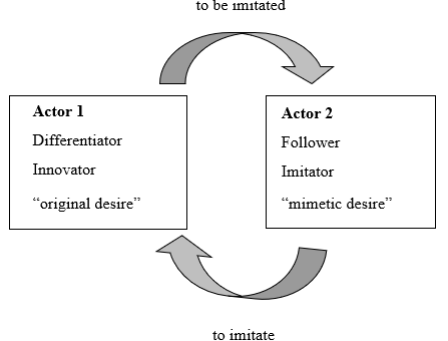
Mimetic Reciprocity Mimetic reciprocity is the reciprocity of imitating and being imitated, which promotes the process of emotional attachments and the development of self- other differentiation (see Figure 1). Imitation is advantageous for acquiring novel behaviours and cultural skills, the facilitation of self-other recognition and differentiation. Mimetic reciprocity is considered as a foundation for human relational motivations and attachments (Garrels, 2011). Imitations are considered as powerful learning tools for human actors because they are supposed to be more efficient than trial-and-error learning (Wohlschläger and Bekkering, 2002).
Figure 1: Mimetic reciprocity.
PROPOSITIONS OF MIMETIC POWER A set of three propositions is presented for the conceptualization of mimetic power in a service ecosystem.
Proposition (1): Mimetic Power Through Imitation for Innovating Imitation for innovation, is a foundation for the acquisition of actors´ capabilities (e.g. language, knowledge, or culture) (Blackmore et al., 2000). The actor who is being imitated has a transformative capability to influence
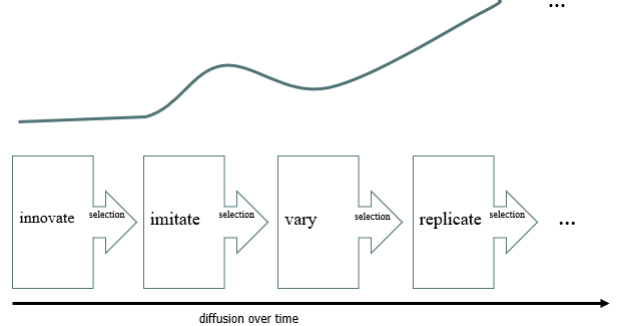
110 Hogg the behaviour of the imitating actor directly or indirectly. The imitated actor intervenes the imitating actor´s e.g., language, knowledge, or culture. The evolutionary process has three stages (Dawkins, 2016): (1) copy again and again, (2) vary and select some variants over others, and (3) replicate the selected ones. Through numerous iterations of this cycle, the population of selected - and consequently surviving - copies will gradually acquire new properties that tend to make them better suited to succeeding in the ongoing competition. During this process of coping, varying, and replicated, the given set of events is altered. Power is exercised (Giddens, 1979, 1987; Hogg, 2024). A reason for variation is that in social practice the human actors in their practical activities embody and enact, yet these constituent components are never perfectly replicated. Giddens considers the discursive formulation of a rule to be “already an interpretation of it that may in and of itself alter the form of its application” (Giddens, 1984, p. 23). Figure 2 illustrates the process of diffusion of a successful innovation.
Figure 2: Process of diffusion of innovation.
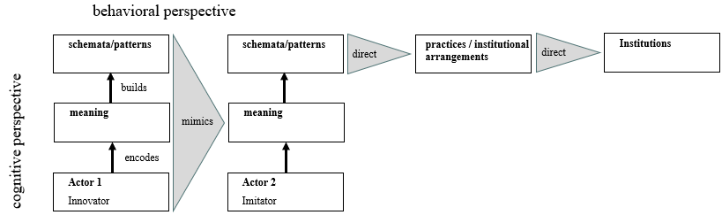
Proposition (2): Mimetic Power for Actor´s Identity Formation and Institutionalization Actors do shape their own identities, by orienting towards others and the acquisition of the principles that underlie the imitated actions and actors (Bourdieu, 1992; Sieweke, 2014). Bourdieu (2010) defines “mimesis”, as the process in which one actor imitates other actors’ actions. Related to Bourdieu´s practice theory mimesis is understood as transmission in practice, meaning cognitive schemata can be directly transferred from one actor to another (Sieweke, 2014) but also the acquisition of the principles that underlie the actions (see Figure 3, next page). The distinction between behavioral and cognitive perspective is essential for differentiating between two distinct perspectives of mimesis: On the behavioral perspective in the sense that humans mimic other actors’ actions and on the cognitive perspective mimesis in the sense that also influences human cognition. By doing the mimics in the cognitive perspective, meanings, perceptions and schemata are formed.
The mimetic Power for the Diffusion of Innovation 111 This cognitive mimesis directs the co-creation of actors’ future practices and institutional arrangements.
Figure 3: Two perspectives on mimetic power for institutionalization. (Adapted from Sieweke (2014)).
Proposition (3): Mimetic Power for The Diffusion of Innovation and Market Shaping Diffusion of innovation, imitation and mimesis have the same conceptual roots in common: The study of diffusion of innovations originated with Tarde’s (1903/2022) seminal work The Laws of Imitation (Wejnert, 2002). Diffusion of innovations describes the process by which abstract ideas and concepts, technical information, and actual practices spread within a social system, involving the transfer from an originator to an adopter, typically via communication and influence (Rogers, 1976). It is the communication and social influence that alters an actor’s probability of adopting an innovation.
Imitation is a key driver for the diffusion of innovation. Thus, imitation is a market shaping capability that initiates a fashion or a trend. There are increasingly many instances where firms offer opensource strategies and architecture to increase the diffusion of innovation by facilitating imitation.
Competitive imitation may lead to a “discovery effect” (Yilmaz et al., 2023). There, awareness and subsequently demand for a product may be enhanced by the release of an imitative product. Specifically, in contexts where actors can readily identify the original product upon encountering an imitative version, the presence of the imitative version of the product serves to enhance the awareness of the original (Yilmaz et al., 2023). While imitation in certain markets is defined temporally - where imitators are those who enter after the initial entrant or later in the diffusion process (Naumovska et al., 2021) - it can also be characterized as more derivational and traceable, particularly when a reference-like mechanism is present. In this case the imitative product explicitly references the original. This referencing of the original source occurs in contexts, like here, academic writing, or e.g., software, audio, scientific research, patents, and designs.
In these marketplaces, when creators imitate or build on an original product, it is observable that they often provide a link back to that original product, even when such link is not legally required. In many innovation communities, such citations are of course legally required. Moreover, explicit
112 Hogg links can also be made between an imitation and an original, especially when two products are highly similar. In this case product recommendations may nudge the customer to prefer an imitating product (Yilmaz et al., 2023).
CONCLUSION
The dynamics of markets can only be fully understood by integrating the elementary concept of power of mimesis to deepen the understanding of market-dynamics. The paper suggests focusing more on the opportunities than the threats of imitation as former approaches did. The mimetic power of imitation is unfolded in three areas: Firstly, the paper describes mimetic power for innovation, the foundation for the acquisition of actors´ capabilities. The stages of the process of the diffusion of innovation are illustrated: the iterative cycle of (1) copy, (2) vary, and (3) replicate. With the surviving copies, that acquire new properties making them better suited to succeeding in the ongoing competition (Figure 2). Secondly, the effects of mimesis are distinguished, offering a behavioral and cognitive perspective: not only actors’ actions are mimicked. On the cognitive perspective, mimesis also influences human cognition, by building schemata of actor´s perception and identity, which directs the co-creation of actors’ institutional arrangements and institutions (Figure 3). Lastly, imitation is a driver for the diffusion of innovation. Hence, imitating is a market shaping capability to initiate fashions or trends. Imitation is presented as an additional market shaping capability and should complement Nenonen et al. (2019) triggering capabilities. The article enhances the juvenile research field of power within service-dominant logic by displaying the translational process of innovation, and its diffusion in the market.
REFERENCES
Arnould, Eric J. (2008): Service-dominant logic and resource theory. In J. of the Acad. Mark. Sci. 36 (1), pp. 21–24. DOI: 10.1007/s11747-007-0072-y. Benjamin, Walter (Ed.) (1969): Illuminations. Essays and Reflections. With assistance
of Hannah Arendt. New York: Schocken. Benjamin, Walter (2018): The work of art in the age of mechanical reproduction.
In Sheila Watson, Amy Jane Barnes, Katy Bunning (Eds.): A Museum Studies Approach to Heritage. Abingdon, Oxon, New York, NY : Routledge, 2018. | Series: Leicester readers in museum studies: Routledge, pp. 226–243. Blackmore, Susan; Dugatkin, Lee Alain; Boyd, Robert; Richerson, Peter J.; Plotkin, Henry (2000): The Power of Memes. In Scientific American (283 (4)), pp. 64–73. Available online at http://www.jstor.org/stable/26058899, checked on 1/19/2026. Bourdieu, Pierre (1992): The logic of practice. [Repr.]. Stanford, Calif.: Stanford
Univ. Press. Bourdieu, Pierre (2010): Outline of a theory of practice. [Nachdr.]. Cambridge: Cambridge Univ. Press (Cambridge studies in social and cultural anthropology, 16). Chester Goduscheit, René; Faullant, Rita (2018): Paths Toward Radical Service
Innovation in Manufacturing Companies—A Service-Dominant Logic Perspective. In J of Product Innov Manag 35 (5), pp. 701–719. DOI: 10.1111/jpim.12461.
The mimetic Power for the Diffusion of Innovation 113 Dawkins, Richard (2016): The selfish gene. 40th anniversary edition. Oxford,
United Kingdom: Oxford University Press (Oxford landmark science). Available online at https://search.ebscohost.com/login.aspx?direct=true&scope= site&db=nlebk&db=nlabk&AN=1243961. Gallese, Vittorio (2011): The Two Sides of Mimesis. In Scott R. Garrels (Ed.): Mimesis and science. Empirical research on imitation and the mimetic theory of culture and religion. East Lansing, MI: Michigan State University Press (Studies in Violence, Mimesis, & Culture), pp. 87–108. Garrels, Scott R. (2011): Mimesis and science. Empirical research on imitation and
the mimetic theory of culture and religion. East Lansing, MI: Michigan State University Press (Studies in Violence, Mimesis, & Culture). Giddens, Anthony (1984): The constitution of society. Outline of the theory of structuration. 1st paperback ed., repr. Cambridge: Polity Press. Giddens, Anthony (1987): The nation-state and violence. Berkeley, Calif.: Univ. of
California Press (A contemporary critique of historical materialism / Anthony Giddens, Vol. 2). Giddens, Anthony (1979): Central problems in social theory. Action, structure and contradiction in social analysis. 1. publ. Berkeley, Calif.: Univ. of Calif. Press. Available online at http://www.loc.gov/catdir/enhancements/fy0745/79064667-b. html. Girard, René (1978): To double business bound. Essays on literature, mimesis, and
anthropology. Baltimore: Johns Hopkins University Press. Girard, René (1993): Violence, Difference, Sacrifice: A Conversation with René Girard. In Religion and Literature (25), pp. 9–33. Available online at https://www. jstor.org/stable/pdf/40059554. Hogg, Johannes (2024): Exploring power strategies for transformation in a service-
ecosystem. In JSTP 34 (3), pp. 399–419. DOI: 10.1108/JSTP-01-2023-0023. Hunt, Shelby D.; Madhavaram, Sreedhar (2006): The Service-Dominant Logic of Marketing: Theoretical Foundations, Pedagogy, and Resource-Advantage Theory. In Robert F. Lusch (Ed.): The service-dominant logic of marketing. Dialog, debate, and directions. Armonk, N.Y.: Sharpe, pp. 67–84. Jaakkola, Elina (2020): Designing conceptual articles: Four approaches. In AMS Rev
10 (1-2), pp. 18–26. DOI: 10.1007/s13162-020-00161-0. Jelassi, Tawfik; Martínez-López, Francisco J. (2020): Creating and Sustaining a Competitive Advantage over Time. In Tawfik Jelassi, Francisco J. Martínez- López (Eds.): Strategies for e-Business. Cham: Springer International Publishing (Classroom Companion: Business), pp. 173–203. Kaartemo, Valtteri; Kowalkowski, Christian; Edvardsson, Bo (2018): Enhancing the
Understanding of Processes and Outcomes of Innovation: The Contribution of Effectuation to S-D Logic. In Stephen Vargo, Robert Lusch (Eds.): The SAGE Handbook of Service-Dominant Logic. 1 Oliver’s Yard, 55 City Road London EC1Y 1SP: SAGE Publications Ltd, pp. 522–535. Meltzoff, Andrew N. (2011): Out of the Mouths of Babes. In Scott R. Garrels (Ed.): Mimesis and science. Empirical research on imitation and the mimetic theory of culture and religion. East Lansing, MI: Michigan State University Press (Studies in Violence, Mimesis, & Culture), pp. 55–74. Naumovska, Ivana; Gaba, Vibha; Greve, Henrich R. (2021): The Diffusion of
Differences: A Review and Reorientation of 20 Years of Diffusion Research. In ANNALS 15 (2), pp. 377–405. DOI: 10.5465/annals.2019.0102. Nenonen, Suvi; Storbacka, Kaj; Windahl, Charlotta (2019): Capabilities for marketshaping: Triggering and facilitating increased value creation. In J. of the Acad. Mark. Sci. 47 (4), pp. 617–639. DOI: 10.1007/s11747-019-00643-z.
Consumer Research 2 (4), pp. 290–301. Available online at http://www.jstor.org/ stable/2488658. Schmookler, Jacob (1966): Invention and Economic Growth. s.l.: Harvard University Press. Available online at https://www.degruyterbrill.com/isbn/9780674432833. Schwartz, Hillel (2014): The culture of the copy. Striking likenesses, unreasonable
facsimiles. 2., rev. and updated ed. New York: Zone Books. Sieweke, Jost (2014): Imitation and Processes of Institutionalization — Insights from Bourdieu’s Theory of Practice. In Schmalenbach Bus Rev 66 (1), pp. 24–42. DOI: 10.1007/BF03396868. Trade de, Gabriel (1903/2022): Laws of Imitation. [S.l.]: LEGARE STREET PRESS. Vargo, Stephen L.; Lusch, Robert F. (2016): Institutions and axioms: An extension
and update of service-dominant logic. In J. of the Acad. Mark. Sci. 44 (1), pp. 5–23. DOI: 10.1007/s11747-015-0456-3. Wejnert, Barbara (2002): Integrating Models of Diffusion of Innovations: A Conceptual Framework. In Annu. Rev. Sociol. 28 (1), pp. 297–326. DOI: 10.1146/ annurev.soc.28.110601.141051. Wohlschläger, Andreas; Bekkering, Harold (2002): Is human imitation based on
a mirror-neurone system? Some behavioural evidence. In Experimental brain research 143 (3), pp. 335–341. DOI: 10.1007/s00221-001-0993-5. Woodruff, Paul (2015): Mimesis. In Pierre Destrée, Penelope Murray (Eds.): A Companion to Ancient Aesthetics: Wiley, pp. 327–340. Yilmaz, Erdem Dogukan; Naumovska, Ivana; Miric, Milan (2023): Does imitation
increase or decrease demand for an original product? Understanding the opposing effects of discovery and substitution. In Strategic Management Journal 44 (3), pp. 639–671. DOI: 10.1002/smj.3467.
LISTED IN THE AHFE DIGITAL BOOKSTORE CATALOGUE
Explore the complete digital volume
The Human Side of Service Engineering
Read this individual research paper free through the original publisher, or explore the full digital proceedings book.
ISBN 978-1-964867-97-7
Explore this ISBN in the AHFE Bookstore ↗Listed in the July 2026 bookstore catalogue; search by ISBN to confirm current availability · Digital book purchase optional