Markus Warg, James Clinton Spohrer, Tilo Böhmann, Christine Leitner, Luca Carrubbo, Peter Weiss, Jens Neuhüttler, Volker Gruhn, Marc Alexander Burmeister (2026). Translational Service Research And Design Methodology: What it is, What it is not, What it might be. In: The Human Side of Service Engineering. AHFE Open Access, vol. 221, pp. 1–11. https://doi.org/10.54941/ahfe1007703
Translational Service Research and Design Methodology (TSRDM, (Warg et al., 2025)) addresses persistent translational gaps between rapidly growing scientific discoveries and their delayed, partial, or failed implementation in practice (Sung et al., 2003, Woolf, 2008). Although knowledge creation accelerates, implementation often lags behind, as observed across domains such as medicine, digital transformation, and sustainability (Jones, 2009, Vial, 2019). Grounded in the centrality of service (Spohrer et al., 2022), TSRDM advances a "unifying service language" that provides a higher-order, domain agnostic grammar for aligning research, design, engineering, and implementation. It reconceives the path from scientific discovery to real-world use as a service-based and ecosystemic journey rather than a linear handover between disciplines, and structures this journey as an eight-step process built around three pillars. TSRDM provides a robust translational framework for configuring steps, decisions, roles, services, flows, and relationships, thereby making translational gaps, frictions, linkages, and transitions visible as explicit design dimensions. This, in turn, aims to accelerate the overcoming of translational gaps and the implementation of service innovations that support sustainable human well-becoming.
MOTIVATION AND PURPOSE Translational gaps denote the disconnects between rapidly growing knowledge and its delayed, partial, or failed implementation in practice. They address the gaps between what is known and what is actually done - between scientific discovery, design, engineering, and implementation. Translational
gaps can be observed across all knowledge domains. In the medical field, for example, it is estimated that an average of 17 years elapses before only 14% of new scientific discoveries are integrated into everyday clinical practice (Westfall et al., 2007). In advancing the Sustainable Development Goals (SDGs), despite agreed targets and established solution knowledge, progress remains slow: only around 18% of the SDG targets are currently on track and 17 per cent are making moderate progress, (Leal Filho et al., 2025; United Nations, 2025). In the realm of digital transformation, translational gaps appear as discrepancies between abundant digital concepts and technologies and their fragmented or failed implementation, often resulting in stalled pilots, “islands of digitalization,” and implementation failure rates exceeding 70% (Koczerga, 2024; Forth et al., 2020). This leads to three guiding research questions of this paper (Gamo et al., 2017; Moser et al., 2023): First, how can research activities be systematically organized to cultivate a translational space that serves as a fertile interface between research, design, engineering, and implementation? Second, which conceptual and operational characteristics must such a translational space exhibit in order to enable the bridging of translational gaps in a systematic, general and domain agnostic way? Third, which strategies and mechanisms can increase market willingness to invest in innovations grounded in this translational space?
The purpose of this paper is to respond to the social and economic challenges resulting from translational gaps. The work contributes to the building of knowledge and its application for accelerating the translation of scientific knowledge into service innovations that enhance human well-becoming. It introduces the Translational Service Research and Design Methodology (TSRDM) that constitutes a translational framework for systematically overcoming translational gaps by linking research, design, engineering and implementation. TSRDM integrates a “unifying service language” with a structured translational space of services, patterns, and architectures, organized into three pillars and an eight-step process. After outlining the methodology and theoretical background, TSRDM is introduced and it is derived what it is, what it is not, and what it might become.
METHODOLOGY
This paper adopts a conceptual research design in the sense outlined by Jaakkola (Jaakkola, 2020) to develop Translational Service Research and Design Methodology (TSRDM) as an integrative translational framework. Conceptual papers are particularly suitable for bridging existing theories in novel ways, linking work across disciplines, and broadening the scope of inquiry (Gilson and Goldberg, 2015). The model type of conceptual paper is chosen because the objective is to develop a bounded set of constructs and specify their relationships within a coherent framework, rather than merely synthesizing or adapting existing theories (MacInnis, 2011; Jaakkola, 2020). This employs a formal analytical approach to organize knowledge and to examine and detail the causal linkages and mechanisms at play (Delbridge and Fiss, 2013). Following this orientation, the paper extends insights from established domain and method theories seeking previously unexplored
Translational Service Research and Design Methodology 3 connections between constructs and thus to explain how translational gaps can be systematically addressed by linking research, design, engineering, and implementation. Domain theories delineate key elements of translational gaps as the focal phenomena to be explained, while method theories elucidate the relationships between the studied constructs (Jaakkola, 2020).
THEORETICAL BACKGROUND This section starts laying out translational research, translational medicine, Design Science Research Methodology (DSRM) and software engineering as domain theories. As method theories Service-Dominant Logic (S-D Logic), Service Science and the related theoretical foundations Viable Systems Approach (VSA), many-to-many-marketing, Service Dominant Architecture (SDA) are picked.
Translational Approaches as Domain Theories Translational research emerged in medicine to bridge the gap between basic science and improved patient care through a bidirectional “bench-to-bedside- and-back” process. Early work framed translation as crossing two key gaps from discovery to clinical application and routine practice. Foundational contributions by Sung, Westfall, Woolf, and Khoury formalized these models and continue to shape contemporary translational approaches (Sung et al., 2003, Westfall et al., 2007; Woolf, 2008; Khoury et al., 2007). Design Science Research Methodology (DSRM) is a problem-solving approach that creates and evaluates innovative IT artifacts (constructs, models, methods, or instantiations) to address organizational problems.
It is translational because it systematically connects theoretical knowledge with practical solutions through a build - evaluate cycle embedded in real business environments. The process is characterized by iterative search, rigorous evaluation, and explicit contribution to the knowledge base (Hevner et al., 2004). Software engineering systematically develops, operates, and maintains software systems using defined processes, tools, and quality management. It is translational because it turns often vague, changing requirements and domain knowledge into executable code through process models, simulations, and continuous improvement cycles (Gruhn and Striemer, 2018). These translational approaches inform the definition of translational gaps and the eight-step process in TSRDM.
Service Theories as Foundations The grand theories (Gregory et al. 2011; Mills, 1959) of Service-Dominant Logic (Vargo and Lusch, 2004) and Service Science (Spohrer and Maglio, 2008) explain the foundational concepts and mechanisms of service, understood as the application of resources (e.g. knowledge) for the benefit of another. Service is the basis of social and economic exchange and value cocreation. S-D Logic states that along the process of value cocreation, actors fundamentally do the same: they integrate resources and engage in service exchange, generating shared understanding and worldview, habitual patterns,
and institutions through repetition, which in turn guide and reproduce future actions. Value is co-created by multiple actors always including the beneficiary (Vargo and Lusch, 2016; Vargo et al., 2022). Service Science extends this actor and process logic by formalizing dynamic structures of responsible actors as “service systems”. Service Systems as open, interacting entities co-improve their states through voluntary and reciprocal resource exchange (Spohrer and Maglio, 2008; Spohrer et al., 2017).
Related theories and concepts deepen aspects of these foundations out of different perspectives. Many-to-many marketing emphasizes the dynamic networks of relationships and interactions and shifts the focus to services by emphasizing that “activities render services, goods render services” (Gummesson, 2004; Gummesson, 1995). VSA examines organizational viability within dynamic ecosystems. Considering organizations as open systems, sustain viability by aligning resource integration, goal orientation, and relationship governance with changing environments (Barile and Polese, 2010; Polese et al., 2018).
SDA operationalizes these service foundations by representing the structure of value co-creation through design patterns spanning five interrelated systems: interaction, data, participation, institutions, and operant resources. As structure, SDA simultaneously serves as medium (plan) and outcome (result) for the processes and services it recursively organizes (Giddens, 1984). As plan, SDA enables the design of value-creation constellations, including actors, roles, and processes along the five purposed systems; engineered and instantiated by responsible actors, the plan becomes a tangible outcome (Warg et al., 2016; Warg, 2022; Weiss, 2023; Spohrer et al., 2022).
FRAMEWORK DEVELOPMENT This section seeks to develop a translational framework that defines a bounded set of constructs and specifies their relationships to better link research, design, engineering, and implementation. Its core constructs are the centrality of service and a “unifying service language”, an eight-step process, explicit attention to frictions, linkages, and transitions and the three TSRDM pillars (service research, translational space, service design and engineering.
Centrality of Service and a Unifying Service Language Service is treated as the fundamental basis of social and economic exchange and value cocreation, transcending traditional goods-activities-services distinctions and shifting attention from production to utilization and beneficiary perspectives. This grounding enables a higher-order view of research, design, engineering, and implementation, all interconnected by rendering services that are coordinated through a shared, ubiquitous service language to address translational gaps as misalignments in resource integration and institutional linkages. Within this unifying language, service provides the overarching grammar and syntax, while services are the letters whose coherent combination articulate domain-independent configurations as words and sentences. The “unifying service language” provides a generalizable way to describe and recombine services across domains (e.g. health, digital transformation, sustainability).
Translational Service Research and Design Methodology 5 An Eight-Step Process
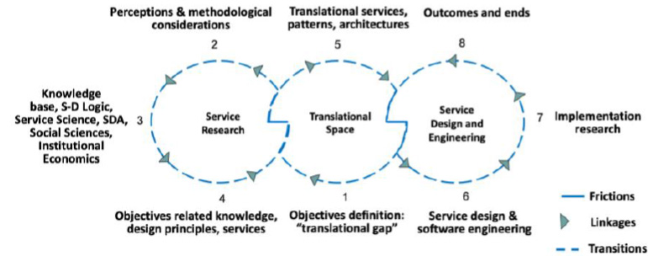
The iterative, eight-step TSRDM process that starts from 1) a clearly defined translational gap, proceeds to 2) conceptual approaches and the elaboration of a 3) knowledge base as the foundation for 4) objective related knowledge building. From this knowledge, the 5) translational space composed of translational services, patterns of interactions and relationships, structures and architectures is created. 6) service design and service and software engineering guide the 7) definite design and its implementation, followed by 8) outcome evaluation and associated knowledge building.
Frictions, Linkages and Transitions Frictions, linkages, and transitions constitute central components of the TSRDM process. Frictions denote obstacles that impede progress, dissipate energy, or consume time unnecessarily, such as poorly designed procedures, inefficient communication, or ambiguous roles and responsibilities (Sutton and Rao, 2024). Linkages refer to the material, institutional, and social connections among actors, systems, and events that facilitate coordination and cumulative advancement; examples include infrastructures and policies. Transitions capture gradual yet profound configuration changes within complex systems, often societal in nature, that unfold across multiple domains and actor constellations. They describe how an overall configuration evolves from one stabilised state to another (Wittmayer et al., 2024).
Figure 1: The eight-step TSRDM process and dynamic frictions, linkages and transitions, Warg et al., 2026.
All change of the form of translation of knowledge to practice - whether in hierarchy, market, or commons (Atkins et al., 2019) - has choices and decisions made in stages. The choices and decisions that have to be made in the course of the eight-step TSRDM process could look like this:
1. Who gets to decide what societal, business, and individual problems are worth working on? 2. Who gets to decide which existing theories are most relevant for tackling the challenge?
3. Who gets to decide which research groups are most worthy (expert) for investment in working on the challenge? 4. Who gets to decide the pilot audience for the initial trials and deployment? 5. Who gets to decide site selection - deployment site organizational capacity to change? 6. Who gets to decide who works with those who have to change? 7. Who gets to decide the metrics for evaluating success of the pilot trials? 8. Who gets to decide if scaling up investment to a larger population is worth it?
Three Pillars
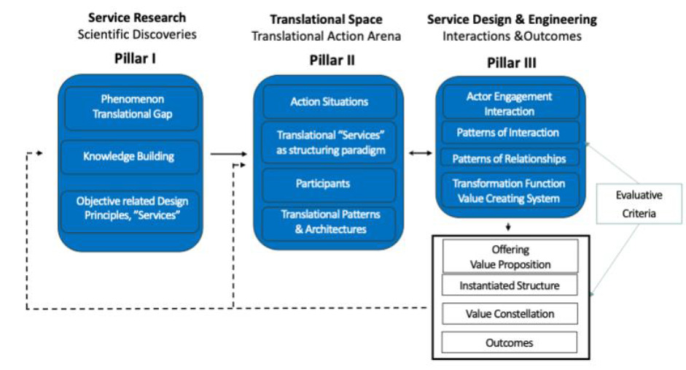
Figure 2 depicts the three TSRDM pillars. The pillars structure translational work. Pillar I is about objective related knowledge building. Service research is always part of the knowledge base, while other theories and concepts are added depending on the phenomenon – the translational gap – under investigation.
Pillar II, the “translational space” serves as action arena in which services are offered and exchanged between actors from different domains. By interacting actors become participants in action situations. By repeatedly interacting actors build shared understanding and gradually stabilize habitual patterns and architectures of interaction, relationships (participation), and learning (Koskinen, 2020; Ostrom, 2005; Ostrom et al., 1994; Aligica, 2006; Vargo et al., 2022). Pillar III is about service design and engineering, including software engineering as means of implementation. Service design and engineering therefore work backwards (Bryar and Carr, 2021; Böhmann, 2004; Gruhn, 2002) by decomposing designed value propositions, value creating systems and their processes into implementable services; e.g. by assigning them to the five SDA systems. In doing so implementation is supported in a technology-agnostic manner.
Figure 2: The three TSRDM pillars,Warg et al., (2026), inspired by Kiser and Ostrom 1982, Ostrom, Gardner et al., 1994, Ostrom 2009 and by Vargo, S., Peters, L., Kjellberg, H., Koskela-Huotari, K., Nenonen, S., Polese, F., Sarno, D. & Vaughan, C. 2022.
Translational Service Research and Design Methodology 7 TSRDM: What it is, What it is not, What it might be
Table 1: TSRDM: What it is, What it is not, What it might be.
Table available in the original PDF paper.
What it is - a translational framework as medium and output of the journey from scientific discovery to implemented service innovation TSRDM recursively organizes - an eight-step process structured around the three pillars: service research,
translational space, service design and engineering - an evolving “unifying service language” to unite efforts cross boundaries: services as letters; service as grammar and syntax; patterns as words; architecture as sentences; translational space as communication area - a methodology that renders translational gaps visible and actionable
- a general-purpose or stand-alone research methodology, nor a purely
What it is not
theoretical or discipline-bounded framework - a methodology for abstract model-building - a set of fixed procedural norms
- medium and output for translational services, patterns and architectures it
What it might be
recursively organizes - an action arena for researchers, designers and engineers - a process for the continuous development of proven translational services, patterns, and architectures produced and reproduced through recurring interactions - an incubator for service innovations by continually increasing service(s)
density and combinatorial evolution - patterns of interaction and relationships that guide the configuration of value constellations in health, digital transformation, sustainability, and beyond - a community of scholars, educators, and practitioners addressing major
societal and economic problems in a unified way
Schematic Example (Inventing the Printing Press) TSRDM can be illustrated by the invention of the printing press as a translational journey in which the eight-step process and the three pillars jointly form both medium and output of innovation.
First (Steps 1-4, Pillar I), a translational gap becomes visible: hand- copied manuscripts limit knowledge diffusion, literacy, and institutional coordination across Europe. Service research assembles conceptual and objective related knowledge on scribal workflows, religious and commercial demand, available materials, and emerging urban trade networks. From this, objective related knowledge about promising mechanisms for reproducing texts at scale is built.
On this basis, a translational space (Step 5, Pillar II) is configured: translational services and patterns such as type-cutting, ink formulation, page composition, proofreading, distribution, and financing are specified, along with recurrent interaction patterns between craftsmen, scholars, merchants, and authorities. These patterns stabilize into patterns like print shops, trade guilds, and censorship practices, which are themselves outputs of the process.
Service design and engineering (Steps 6-8, Pillar III) then work backwards from value propositions - cheaper, more reliable, and faster access to
texts - to design presses, workflows, and governance arrangements, turning patterns and architectures into implementable services. Across the eight steps, TSRDM’s eight-steps and pillars recursively organize roles, decisions, and structures, while simultaneously evolving the translational space as action arena for actors from different domains - all “speaking” the “unifying service language” for subsequent printing-related innovations and derivative services such as newspapers, pamphlets, and scientific journals.
FINDINGS TSRDM structures translational activities by starting from clearly defined translational gaps, building conceptual and objective related knowledge, and configuring a translational space of services, patterns, and architectures that links and guides design, engineering, implementation, and outcome evaluation. This process architecture integrates the three pillars into a coherent methodology that links knowledge creation with practical realization and treats valleys of death and frictions as explicit design dimensions.
Regarding the second research question, the findings specify the translational space as a shared lexicon of translational services, interaction patterns, relationships, and corresponding structures and architectures, articulated within a “unifying service language”. Within this space, these constructs act as combinable building blocks and value propositions that connect scientific insights to concrete design and engineering activities, making the bridging of translational gaps systematic, general, and domain-agnostic across fields such as health, digital transformation, and sustainability.
With respect to the third research question, the findings indicate that TSRDM can reduce translational risks and enhance stakeholders’ willingness to invest by building and reusing proven translational services, patterns, and structures that increase service density over time. Treating these as combinable constructs in a generative translational space supports the combinatorial evolution (Arthur, 2009) of services and improves the predictability, scalability, and perceived reliability of service innovations as they traverse bottlenecks between science and engineering and between innovation and market adoption
CONCLUSION AND OUTLOOK TSRDM reconceives the path from scientific discovery to real-world use as a service-based and ecosystemic journey rather than a linear handover between disciplines. It provides a “unifying service language” that is independent of any one domain and can describe research, design, engineering, and implementation as interconnected services, enabling their exchange and reuse across fields such as sustainability, health, and digital transformation. Built around an iterative eight-step process and three pillars, TSRDM makes translational gaps, frictions, linkages, and transitions visible as explicit design dimensions instead of leaving them as hidden failure points.
Translational Service Research and Design Methodology 9 The translational space (pillar II) serves as an action arena in which services are offered and exchanged between actors from different domains. By repeatedly interacting within this translational space, actors build shared understanding and gradually stabilize habitual patterns and architectures of interaction, participation, and learning (Atkins et al., 2019). Over time, the accumulation and recombination of proven translational services, patterns and architectures increases service density and fosters service innovation, reducing translational risk and cycle time and thereby strengthening the willingness to invest. In this way, TSRDM evolves into a generative translational framework that supports sustainable innovation and human well-becoming across complex service ecosystems.
REFERENCES
Aligica, P. D. 2006. Institutional and stakeholder mapping: frameworks for policy analysis and institutional change. Public Organization Review, 6, 79–90. Arthur, W. B. 2009. The nature of technology: What it is and how it evolves, Simon
and Schuster. Atkins, P. W., Wilson, D. S. & Hayes, S. C. 2019. Prosocial: Using evolutionary science to build productive, equitable, and collaborative groups, New Harbinger Publications. Barile, S. & Polese, F. 2010. Linking the viable system and many-to-many network
approaches to service-dominant logic and service science. International Journal of Quality and Service Sciences, 2, 23–42. Böhmann, T. 2004. Modularisierung von IT-Dienstleistungen: Eine Methode für das Service Engineering, Wiesbaden, Deutscher Universitäts-Verlag. Bryar, C. & Carr, B. 2021. Working Backwards: Insights, Stories, and Secrets from
Inside Amazon, Pan Macmillan. Delbridge, R. & Fiss, P. C. 2013. Editors’ comments: Styles of theorizing and the social organization of knowledge. Academy of Management Briarcliff Manor, NY. Forth, P., Reichert, T., De Laubier, R. & Chakraborty, S. 2020. Flipping the odds of
digital transformation success. Boston Consulting Group, 1, 35. Gamo, N. J., et al. 2017. Valley of death: a proposal to build a “translational bridge” for next generation. Neuroscience research,115, 1–4. Giddens, A. 1984. The constitution of society: Outline of the theory of structuration,
Univ of California Press. Gilson, L. L. & Goldberg, C. B. 2015. Editors’ comment: So, what is a conceptual paper? : SAGE Publications Sage CA: Los Angeles, CA. Gregory, D., Johnston, R., Pratt, G., Watts, M. & Whatmore, S. 2011. The dictionary
of human geography, John Wiley & Sons. Gruhn, V. 2002. Process-centered software engineering environments, a brief history and future challenges. Annals of Software Engineering, 14, 363–382. Gruhn, V. & Striemer, R. 2018. The Essence of Software Engineering, Springer. Gummesson, E. 1995. Relationship Marketing: its Role in the Service Economy. In:
GLYNN, W. J. & BARNES, J. G. (eds.) Understanding Services Management. Gummesson, E. From one-to-one to many-to-many marketing. Service Excellence in Management: Interdisciplinary Contributions, Proceedings from the QUIS 9 Symposium, Karlstad University Karlstad, Sweden, 2004. Citeseer, 16–25. Hevner, A. R., March, S. T., Park, J. & Ram, S. 2004. Design science in information
systems research. MIS Quarterly, 75–105.
Jaakkola, E. 2020. Designing conceptual articles: four approaches. AMS Review, 1–9. Jones, B. F. 2009. The burden of knowledge and the “death of the renaissance
man”: Is innovation getting harder? The Review of Economic Studies, 76, 283–317. Khoury, M. J., Gwinn, M., Yoon, P. W., Dowling, N., Moore, C. A. & Bradley, L.
2007. The continuum of translation research in genomic medicine: how can we accelerate the appropriate integration of human genome discoveries into health care and disease prevention? Genetics in Medicine, 9, 665–674. Koczerga, M. 2024. Navigating the Digital Chasm: An Analysis of Digital Transformation Failures, Organizational Readiness Assessment Methods, and Their Limitations. Scientific Journal of Bielsko-Biala School of Finance and Law, 28. Koskinen, K. 2020. Translatorial linguistic ethnography in organizations. Managing
Multilingual Workplaces. Routledge. Leal Filho, W., et al. 2025. Mapping the Implementation of the United Nations Sustainable Development Goals. Sustainable Development. Macinnis, D. J. 2011. A framework for conceptual contributions in marketing.
Journal of Marketing, 75, 136–154. Mills, C. W. 1959. The sociological imagination, Oxford University Press. Moser, L. B., et al. 2023. Herausforderungen der Translation von innovativen Produkten und Technologien in die klinische Praxis. Arthroskopie, 36, 187–193. Ostrom, E. 2005. Understanding institutional diversity, Princeton university press. Ostrom, E., Gardner, R., Walker, J., Walker, J. M. & Walker, J. 1994. Rules, games,
and common-pool resources, University of Michigan Press. Polese, F., Barile, S., Loia, V. & Carrubbo, L. 2018. The demolition of service scientists’ cultural-boundaries. In: MAGLIO, P. P., KIELISZEWSKI, C. A., SPOHRER, J. C., LYONS, K., PATRíCIO, L. & SAWATANI, Y. (eds.) Handbook of Service Science, Volume II. Cham: Springer. Spohrer, J. & Maglio, P. P. 2008. The emergence of service science: Toward systematic
service innovations to accelerate co-creation of value. Production and operations management, 17, 238–246. Spohrer, J., Maglio, P. P., Vargo, S. L. & Warg, M. 2022. Service in the AI era: Science, logic, and architecture perspectives, Business Expert Press. Spohrer, J., Siddike, M. A. K. & Kohda, Y. 2017. Rebuilding evolution: a service
science perspective. Sung, N. S., et al. 2003. Central challenges facing the national clinical research.
Jama, 289, 1278–1287. Sutton, R. I. & Rao, H. 2024. The friction project: How smart leaders make the right things easier and the wrong things harder, Random House. UNITED NATIONS 2025. The Sustainable Development Goals Report 2025. In:
DEPARTMENT OF ECONOMIC AND SOCIAL AFFAIRS (ed.). New York. Vargo, S. & Lusch, R. 2016. Institutions and axioms: an extension and update of service-dominant logic. Journal of the Academy of Marketing Science, 44, 5–23. Vargo, S. L. & Lusch, R. F. 2004. Evolving to a New Dominant Logic for Marketing.
Journal of Marketing, 68, 1–17. Vargo, S. L., Peters, L., Kjellberg, H., Koskela-huotari, K., Nenonen, S., Polese, F., Sarno, D. & Vaughan, C. 2022. Emergence in marketing: an institutional and ecosystem framework. Journal of the Academy of Marketing Science, 1–21. Vial, G. 2019. Understanding digital transformation: A review and a research agenda.
The Journal of Strategic Information Systems, 28, 118–144. Warg, M. 2022. Fostering Actor Engagement Through Human Centered Service Design (HCSD): Lessons Learned from the Cross Domain Examples of Service Dominant Architecture.
Translational Service Research and Design Methodology 11 Warg, M., Spohrer, J., Böhmann, T., Leitner, C., Carrubbo, L., Gruhn, V., Neuhüttler,
J., Weiss, P. & Burmeister, M.-A. 2025. Translational Service Research And Design Methodology (TSRDM) - Whitepaper, Online Available: https://www. ifsd.hamburg/TRANSLATIONAL-SERVICE-RESEARCH-AND-DESIGN- METHODOLOGY-TSRDM/ [Accessed 20251101]. Warg, M., Weiß, P., Engel, R. & Zolnowski, A. 2016. Service Dominant Architecture based on S-D logic for Mastering Digital Transformation. In: RUSSO-SPENA, T. & MELE, C. (eds.) 26th Annual RESER Conference. Naples, Italy. Weiss, P. W., Markus; Zolnowski, Andreas 2023. Service Design Patterns for
Transforming Business with Service Dominant Architecture (SDA): Insights from a Longitudinal Case Study. XXXIII. International RESER Conference. Switzerland. Westfall, J. M., Mold, J. & Fagnan, L. 2007. Practice-based research—“Blue Highways” on the NIH roadmap. Jama, 297, 403–406. Wittmayer, J. M., et al. 2024. Advancing the understanding of social innovation in
sustainability transitions. Elsevier. Woolf, S. H. 2008. The meaning of translational research and why it matters. Jama, 299, 211–213.
LISTED IN THE AHFE DIGITAL BOOKSTORE CATALOGUE
Explore the complete digital volume
The Human Side of Service Engineering
Read this individual research paper free through the original publisher, or explore the full digital proceedings book.
ISBN 978-1-964867-97-7
Explore this ISBN in the AHFE Bookstore ↗Listed in the July 2026 bookstore catalogue; search by ISBN to confirm current availability · Digital book purchase optional