Kazuyoshi Shimada, Christine Leitner, Michele Carroll (2025). Key Findings of the ISSIP White Paper on "AI Challenges to Global Democracy". In: The Human Side of Service Engineering. AHFE Open Access, vol. 182, pp. 96–106. https://doi.org/10.54941/ahfe1006410
This contribution draws attention to the findings of a dedicated ISSIP* Ambassador Series on artifi-cial intelligence (AI) and democracy, which took place in the latter half of 2024.The contribution presents the key findings of this event series, based on the ISSIP White Paper "AI Challenges to Global Democracy", which was published in Spring 2025. The White Paper synthesises insights from a collaborative international community seeking to navigate these complex issues in a series of virtual panel discussions. Experts from diverse fields, representing different regions and jurisdic-tions of the world, explored the complex intersection between AI and democratic governance, with a focus on service innovation. They highlighted the incumbent risks and opportunities of AI and, in particular, how AI might reshape communicating, thinking, deliberation, policy-making, and en-gagement and public trust in democratic institutions. The White Paper also considers the findings from an online survey and position statements gathered from various stakeholders during the Am-bassador Series. Finally, the White Paper highlights key questions for future service science re-search, serving as initial inspiration for improving service research. Given AI’s dual role as both a benefit and a risk to democracy, it advocates for a sandbox environment to explore collective intel-ligence and new democratic models— a key issue in applied ergonomics.*The International Society for Service Innovation Professionals, https://issip.org/
In 2024, when more than half of the world’s population were entitled to vote in elections at different levels of government, the International Society of Service Innovation Professionals (ISSIP)1 initiated an Ambassador Discovery 1ISSIP is a global community that advances service innovation to benefit people, business and society. ISSIP’s 2000+ global participants represent 600+ organizations (companies, non-profits, NGOs and government entities), and more than 200 educational institutions in 76 countries. ISSIP has 120 active
Key Findings of the ISSIP White Paper on “AI Challenges to Global Democracy” 97
Series to explore “Artificial Intelligence (AI) Impacts on Global Democracy”. The objective was to identify the potential threats and opportunities that AI poses to democracy on a global scale, and to explore what role service science could play in international research efforts, and policy dialogue.
The co-leads of this Discovery Series authored an ISSIP White Paper, “AI Challenges to Global Democracy, from a perspective centered on service innovation,” published in April 2025 (ISSIP, 2025), summarizing insights gleaned in the series and survey, outlining key issues and presenting guiding questions for exploration by the service science community. The guiding questions are based on the following three interrelated considerations which are in line with frameworks and proposals made, among others, by the G7 leaders (Hiroshima AI Process, 2023), UNESCO (UNESCO, 2024), OECD (OECD, 2024 and 2022), and the European Parliamentary Technology Assessment Network (EPTA, 2024): (1) Aspects that need to be considered: Key dimensions include societal impact, transparency, fairness, bias mitigation, and the protection of rights and privacy. (2) What must be created: Frameworks, guidelines, and tools for ethical AI design, monitoring systems, and educational programs to raise awareness of AI ethics, etc. (3) What must be implemented: Practical measures such as embedding ethics into AI development, enforcing accountability through policies, and establishing oversight mechanisms, building trusts and collaborations among stakeholders etc.
METHODOLOGY
Following traditional methodology for discovery summits, ISSIP conducted an online survey among its global community (see Table 1), asking whether participants view AI impacts on global democracy as largely positive, largely negative or both. The survey invited identification of key threats and opportunities and optional provision of position statements on the topic. The survey was conducted from May through September of 2024, and promoted via the ISSIP newsletter and the ISSIP LinkedIn community. A total of 67 responses were received. Respondents were invited to provide more comprehensive position statements, which were analysed by students at California State University, Long Beach using a grounded theory process (Glaser and Strauss, 1967). To explore issues raised, ISSIP hosted three virtual panel discussions in June, August and September, 2024, as shown in Table 2. To ensure coverage of different views and perspectives, 11 distinguished speakers from the US, Europe and Japan were invited as expert panellists, representing the perspectives of AI service providers, users, policy makers, academics, and practitioners.
Ambassadors, who serve as liaison to an organization, initiative, or conference they support. ISSIP Ambassadors may propose and organize a topic for exploration, secure speakers, typically for a virtual hour panel discussion, featured and promoted on the ISSIP platform. See also https://issip.org/.
Table 1: Online survey questions fielded by ISSIP in 2024 (ISSIP 2025).
Table available in the original PDF paper.
Questions Options
More opportunity
Thinking globally, do you think AI presents more
More threat
opportunity or more threat for Democracy?
Both in equal measure
Threat to decision-making
Which of the following present the most AI
Threat to recognition
threat to democracy?
Bad actor manipulation
Other cognitive threats
Other Which of the following present the most AI
Enhanced access and election participation
opportunity for democracy?
Process Automation
Visualization for better understanding
Search capability
Other operational (Free-text entry)
Please provide your own ‘position statement’ on the Threats and Opportunity of AI for Global Democracy (optional)
Yes May we include your position statement in the
No
ISSIP White Paper?
Include but without company/organization
Table 2: Overview of online panels hosted by ISSIP in 2024 (ISSIP 2025).
Table available in the original PDF paper.
Session Title & Date Discussion Theme
The state of play of AI utilization in and
Session 1 Current State of Play June 21st 2024
Opportunities that AI could present for
its impact on democracy across different regions. Session 2 The Opportunity & Progress Toward Inclusion August 21st, 2024
Recommendations for future actions for
democracy, “balancing” the potential risks and benefits. Session 3 Defining Next Steps: Research, Development, Funding Priorities September 25th, 2024 service science and the broader “transdisciplinary” community to guide future research, development, funding priorities and policy responses.
To ensure clarity and consistency, the discussions and survey questions were framed around the following definitions:
AI: is understood as an information system that automatically generates both verbal and non-verbal data, influencing human cognitive processes.
Key Findings of the ISSIP White Paper on “AI Challenges to Global Democracy” 99
It is a powerful artifact that intervenes in the exchange of information and cognitive processes — both essential for decision-making in human communities — potentially leading to either positive or negative outcomes.
Democracy: is understood as the fundamental way of human communal life that should ethically or morally pervade society in general. Democracy is not just a way of doing politics. It is rooted in the spirit of treating every individual with dignified value (Japanese Ministry of Education, 1948).
Service: ISSIP defines “service” as “the application of a resource (e.g., knowledge, goods, or technology) for the benefit of others”. While these services can generate significant benefits, they may also result in unintended harms. According to ISSIP, service innovation takes place when harms are mitigated and new business and operations models emerge to guide development and systems toward benefit creation.
AI services: refer to the use of AI technology by a service provider to a service recipient.
KEY FINDINGS ISSIP’s definitions of service and service innovation, we argue, aligns closely with the principles of democracy. However, artificial intelligence (AI) does not inherently embody the spirit of democracy. When designing AI systems and delivering services that utilize AI, it is essential to consider how these technologies can respect the dignity of all individuals. Service science could play a crucial role in ensuring the ethical and democratic use of AI services by providing frameworks and methodologies that prioritize human values and societal well-being in the development and deployment of such technologies.
We observed that AI utilization and its impact on democracy vary by region due to various contextual factors. In a number of jurisdictions, perspectives are more influenced by the negative impacts and fears around dis/misin- formation by political parties and other influencers, including foreign state actors. Some regions face challenges such as depopulation, natural disasters, and limited local government capabilities, while in some areas, primary concern is that the value for a minority group is often overlooked. By aggregating these issues across different contexts, we captured a broad and shared perspective on AI-related democratic challenges. From this perspective, we present our “Key Findings” below.
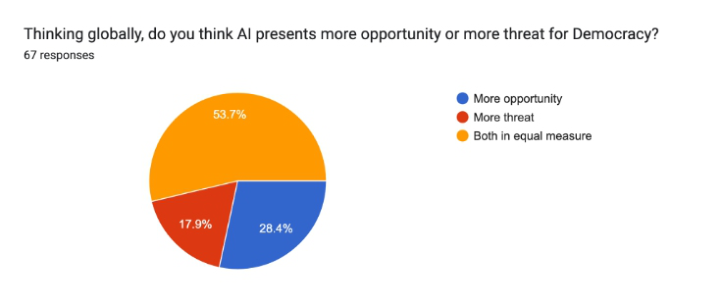
AI’s Impact on Democracy Falls Into Four Quadrants AI should be viewed as a double-edged sword, offering both profound opportunities and serious risks. Figure 1 shows a distribution of the responses to the question, “Thinking globally, do you think AI presents more opportunity or more threat for Democracy?” In fact, more than half of the online survey contributors (53.7%) saw AI impact on global democracy as equal in measure between threat and opportunity.
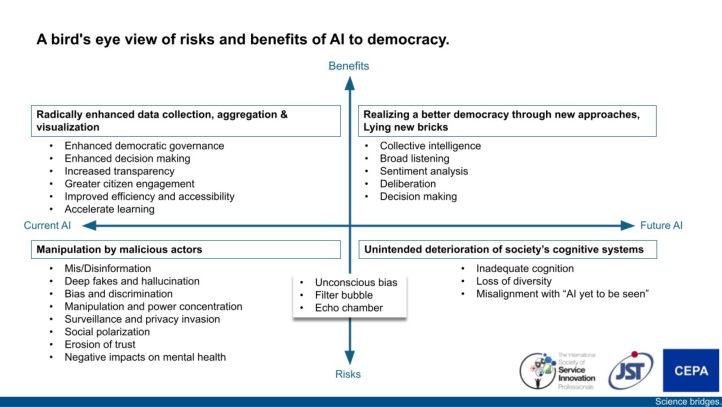
The challenges of AI fall into four quadrants: risks (threats) and benefits, both for current AI and future AI. This conceptual framework was introduced by Ryuichi Maruyama, a panellist in the inaugural online discussion.
Ongoing international efforts aim to mitigate the risks while enhancing the benefits of existing AI technologies, thereby influencing the trajectory of future advancements. One such initiative is the Hiroshima AI Process, which exemplifies these global endeavours. Additionally, the European Union’s AI Act (European Commission, 2024) represents a comprehensive legislative framework that classifies AI applications according to their associated risk levels.
Figure 1: Distribution of the responses to the question, “Thinking globally, do you think AI presents more opportunity or more threat for Democracy?” (adapted from ISSIP, 2025).
Figure 2 presents a quadrant framework of AI-related issues. This framework highlights different dynamics and provides clear examples of current and future AI utilisation and impacts.
Figure 2: Benefits and risks of AI to democracy (adapted from ISSIP, 2025).
Key Findings of the ISSIP White Paper on “AI Challenges to Global Democracy” 101
Among the benefits of current AI applications, panellists highlighted the enhanced ability to collect, aggregate, and visualize data. AI has the potential to enhance democratic governance and decision making, increase transparency, facilitate broader citizen engagement, improve efficiency and accessibility, and to accelerate learning. For instance, artificial intelligence contributes to the interpretation of complex legislation and the drafting of policy proposals by evaluating relevance, contextual factors, and potential mutual benefits. Furthermore, AI has the potential to enhance the efficiency of government services and foster greater public engagement. Conversely, manipulation by malicious actors remains a major concern. Key issues include misinformation or disinformation, deep fakes, AI hallucinations, bias, concentration of power, surveillance and invasion of privacy, social polarisation, erosion of trust, and negative mental health effects. In many jurisdictions, the manipulation of elections and referendums through AI remains a significant challenge.
Regarding the future development and deployment of AI, experts expressed prevailing optimism, symbolized by the notion of “laying new bricks,” which reflects its transformative potential for global democracy. Innovations in collective intelligence, including broad listening, sentiment analysis, deliberation, and decision-making, promise a better-informed citizenry, greater representation of marginalized groups, more responsive societies, and demand-driven innovation. Nonetheless, experts were concerned about potential unintended consequences, particularly the overall decline of society’s cognitive systems. It depends on the change in people’s ways of thinking, being and doing as they adapt to the age of AI (Anderson and Rainie, 2025). It is essential to mitigate ongoing risks including unconscious bias, filter bubbles and echo chambers, as well as inadequate cognition. It is imperative that safeguards are in place to ensure the preservation of diversity, and that the development of AI is aligned with the vision of the “AI yet to be seen”. These remain critical priorities.
New Narratives for a Better Democracy With Future AI are Expected to Emerge As seen in the upper right quadrant of Figure 2, the experts concurred that a new narrative is needed–one that envisions both an evolving role of the state and its relations with citizens as well as opportunities for businesses. When examining AI’s capacity to strengthen democratic processes, the emphasis should extend beyond harm prevention to the exploration of new democratic models. Shaping this future requires the establishment of novel objectives, an awareness of unforeseen risks, and innovative approaches that promote democratic advancement while adhering to a set of established fundamental principles. Such principles have already been codified at the national or international/regional level, for example the OECD AI principles (OECD, 2024)2 or the European Declaration on Digital Rights and Principles (European Commission, 2022), which reflects the commitment to promote
2The OECD Principles have been incorporated in a number of national and international frameworks, e.g. the EU AI Act. https://www.oecd.org/en/topics/sub-issues/ai-principles.html
and apply digital rights of EU citizens and principles based on EU values across all EU policy domains (Leitner and Stiefmueller, 2025, forthcoming).
Inclusiveness should be recognized as a fundamental factor in maximizing AI’s potential across both the public and the private sectors. For example, AI-driven recommendations, such as identifying make-up shades based through precise skin-tone recognition illustrate how inclusive design can enhance user experiences. This perspective clearly opens new business opportunities. Similarly, embedding cultural context into AI systems helps ensure that technology accurately reflects diverse user needs, with insights applicable across demographics.
Responsible Experimentation is Needed to Explore Novel Solutions and to Enhance Democratic Engagement As technology continues to evolve, an iterative approach of trial and error while learning is essential to envisioning a new narrative for democracy in the digital age. It is essentially about good service design and attention to ethical principles. A critical examination of the societal implications of AI implementation is essential, particularly its impact on fundamental rights, i.e. we need to develop a (minimum) set of shared standards to ensure everyone is treated with dignity. An ongoing dialogue on the ethical dimensions of AI is necessary, particularly to promote and uphold shared values and principles.
More specifically, the experts emphasized the need for new approaches that leverage AI to enhance public participation in research and policymaking. They further highlighted the role of experimentation and the effectiveness of the sandbox model. Regardless of technological advancements, in their view trust remains critical and must be built through community efforts, and learning from open-source development. Furthermore, effective tools for deliberative democracy must mitigate participation fatigue and disengagement. Policymakers, technologists, and civil society must work together to create inclusive, transparent, and equitable AI systems. Sustained efforts to establish a fair and inclusive society should be informed by open- source development practices. Experts stressed the potential of open-source AI to prevent monopolies, enhance transparency, and drive innovation, while recognizing the need to address sustainability and security challenges. In this context, initiatives educating the public about AI’s role in democracy and society will have to play a crucial role in fostering an informed citizenry capable of engaging with AI-related developments in a meaningful and responsible manner.
Finally, international cooperation was considered paramount in this endeavour. Shared frameworks must be developed for the discussion of rule formulation and the establishment of global standards for AI governance, such as, for example, the Hiroshima AI process, in order to address current and future risks to democracy related to the development and deployment of AI. While the establishment of international governance frameworks for strategic technologies such as nuclear power has been challenging, there are a number of successful models from which we can learn – such as the Internet, open software developments, and global health initiatives.
Key Findings of the ISSIP White Paper on “AI Challenges to Global Democracy” 103
CONCLUSION
The insights derived from the Discovery Series advocate for initiatives that would involve the entire spectrum of the global service innovation professionals community. Successful initiatives must extend beyond a focus solely on governmental funding and regulation, to encompass a transdisciplinary and cross-sectoral approach. To this end, the study formulated some guiding questions for ISSIP and the broader service science community for future research and development, policy dialogue and funding priorities. As illustrated in Table 3, these guiding questions will help define targeted future actions. Addressing these questions should be reciprocal and parallel due to the interconnected nature of outcomes.
Table 3: Guiding questions for future action (ISSIP, 2025).
Table available in the original PDF paper.
Guiding Question Explanation
This is a question at the conceptual and
What kind of ‘Future Democracy’ can AI enable?
This is a question at the service system
societal level. Today’s democracies are far from perfect, and we must revisit the factors that have hindered their success. How can AI-assisted inclusive intelligence enhance democratic governance?
This is a question relevant at the lab,
level. AI technologies have the potential to reshape decision-making processes, promoting deeper deliberation and fostering collective intelligence. How can we implement ‘sandboxes’ to explore AI impact in democracy?
community and social infrastructure level, including temporary and limited exemption from existing legislation / regulation for specific contexts.
What Kind of ‘Future Democracy’ Can AI Enable?
A renewed vision of democracy warrants further study. We must address fundamental questions at both the conceptual and societal level. The need to mitigate negative impacts of AI are urgent, even existential for democracy which relies on a productively informed and engaged citizenry. There is a need, even as immediate efforts focus on mitigating harm and establishing responsive structures to regulate and guide ethical practice, to rethink democracy, and consider how AI might contribute to making it more inclusive and resilient. By transcending traditional governance boundaries, emerging communities and innovative models could help shape more ideal democratic systems. Diverse interpretations/concepts of democracy present a challenge to the universal application of democratic principles. Reaching a consensus definition of a desired form of democracy and charting a course to achieve it will also be an iterative process, involving trial and error. In this context, the perspective of how AI-supported collective intelligence (Clark and Shannon, 2024) can enhance democratic governance is of particular
relevance. Advancements in AI allow us to revisit previously unfeasible ideas. Ken Suzuki’s “Nameraka (Smooth) Society” envisions technology uniting rather than dividing people (Suzuki, 2013). AI may help improve electoral systems and processes, or enable alternative systems of social value creation and exchange. Similarly, concepts like “plurality” (Weyl, Tang et al., 2024) suggest governance can evolve beyond existing social infrastructures.
How Can AI-Assisted Inclusive Intelligence Enhance Democratic Governance?
This is a question at the service system level. AI technologies have the potential to reshape decision-making processes, facilitating deeper deliberation and fostering collective intelligence, which should be at the core of a renewed model for democracy. The guiding principle in this endeavour should be inclusion, as it can drive the transformation of both the public and private sector services. By incorporating more “voices” and perspectives, AI-assisted tools could help create new systems that enhance the way decisions are made and how services are delivered. Such service systems could significantly contribute to enhancing democratic governance by making them more responsive and adaptive to the needs of all citizens/in- dividuals. The social experiment conducted in Afghanistan (Sahab, 2024) on the use of AI as an assistant to make discussions more inclusive is instructive (Ito, 2022) in this regard. Similarly, the Taiwanese Minister for Digitalisation, Audrey Tang championed democracy initiatives, introducing tools such as “Polis”3 to foster diversity in political engagement (Tang, 2024). Emerging data cooperatives formed by economic actors could serve as a model for democracies to create data training sets that reinforce democratic ideas, principles, and policies.
How Can We Implement ‘Sandboxes’ to Explore AI Impact in Democracy?
This is a question relevant at the lab and community as well as the social infrastructure level. The expectations and risks AI poses to democracy in service design should be explored through experiments in controlled environments, known as “sandboxes”, which can be a research foundation to examine novel societal models and mechanisms. They can include temporary, limited exemption from existing legislation/regulation for a specific purpose (e.g. testing social robots, autonomous vehicle etc.) or to test innovative products or services that challenge existing legal frameworks. Participating firms obtain a waiver from specific legal provisions or compliance processes to innovate (OECD, 2022). These spaces allow for both constrained and unconstrained testing. The first type involves protected environments where discretion is key, while the second focuses on rapid prototyping. Both approaches are essential for the evaluation of risk levels, justifying AI decisions in real-time, validating algorithms, and balancing anonymity with accountability. A strong, trusted network of stakeholders from industry,
3https://pol.is/home
Key Findings of the ISSIP White Paper on “AI Challenges to Global Democracy” 105
government, and academia will be necessary to ensure that the results of these experiments lead to meaningful social implementation. Development sandboxes protect production systems before release from R&D, prevent security vulnerabilities, allow for prototyping and testing in isolation, and provide an environment for contained user testing and the pre-release of training and observational research.
The consensus among experts was that a new narrative for global democracy will emerge through critical examination of AI opportunities as well as threats, followed by iterative experimentation and learning in sandbox environments leveraging AI as it matures, and balanced by considerations of the human side of service engineering. Those sandbox experiments should involve international collaboration to test new and innovative approaches to harm mitigation and exploration of fresh, new governance models, in ways considered impractical before AI’s maturation. And the evolution of democratic governance will need to keep pace as both AI and humans learn and adapt.
As business, society, and policy makers come to terms with this disruptive technology, ISSIP and the broader service science community will continue to engage and foster global dialogue, learning and innovation to mitigate risks of AI, and guide development toward democracy’s promise for our interconnected world.
ACKNOWLEDGMENT
The authors would like to acknowledge the insights shared by all panellists and speakers involved across the three virtual panel sessions: Hiroaki Hamada, Ryuichi Maruyama, Kevin Clark, Ivar Tallo, Giselle Mota, Lee Rainie, Jeffrey Borek, Ignacio Criado, Takayuki Ito, Lee Nackman, Paul Timmers. We would like to cordially thank Professor Debra Satterfield of California State University Long Beach and her students for their invaluable assistance in analysing the survey responses and position statements.
REFERENCES
Anderson, Janna and Rainie Lee. (2025). Experts Predict Significant Change in People’s Ways of Thinking, Being and Doing as They Adapt to the Age of AI. https://imaginingthedigitalfuture.org/reports-and-publications/being-human- in-2035/ Clark, Kevin and Shannon, Kyle. (2024). Collective Intelligence in the Age of AI.
ISBN: 9798343574234. EPTA. (2024). Artificial Intelligence and Democracy. https://eptanetwork.org/news/ epta-news/24-publication/140-epta-report-2024 European Commission. (2022). European Declaration on Digital Rights and
Principles. https://digital-strategy.ec.europa.eu/en/library/european-declaration- digital-rights-and-principles European Commission. (2024). AI Act. https://digital-strategy.ec.europa.eu/en/ policies/regulatory-framework-ai Glaser, B., & Strauss, A. (1967). The discovery of grounded theory: Strategies for
qualitative research. Chicago: Aldine.
Glen Weyl, Audrey Tang and Community. (2024). 數位Plurality: The Future of Collaborative Technology and Democracy. https://www.plurality.net/ Hiroshima AI Process. (2023). Launched at G7 Hiroshima Summitt. https://
www.soumu.go.jp/hiroshimaaiprocess/en/index.html ISSIP. (2025). White Paper on AI Challenges to Global Democracy: From the perspective of service innovation. https://issip.org/ai-impacts-on-global- democracy Ito, Takayuki., Hadfi, Rafik., Suzuki, Shota. (2022), An Agent that Facilitates Crowd Discussion. Group Decis Negot 31, 621–647. Leitner, C. and Stiefmueller M. C. (2025), Digital Technologies and Legal and
Regulatory Frameworks. In: Public Administration in the New Reality, eds. Baimenov, A. and Liverakos, P., Palgrave Macmillan (forthcoming). Ministry of Education (Government of Japan). (1948). Democracy [in Japanese]. OECD. (2022). Building Trust to Reinforce Democracy. https://doi.org/10.1787/ b407f99c-en OECD. (2023). Regulatory sandboxes in artificial intelligence. OECD Digital
Economy Papers, No. 356, OECD Publishing, Paris. OECD. (2024). Recommendation of the Council on Artificial Intelligence, OECD/ LEGAL/0449, https://legalinstruments.oecd.org/en/instruments/OECD-LEGAL- 0449 (update on the OECD AI Princiles 2019). Sahab, Sofia., Haqbeen, Jawad., Hadfi, Rafik., Ito, Takayuki., Richard Eke
Imade, Susumu Ohnuma & Takuya Hasegawa (2024). E-contact facilitated by conversational agents reduces interethnic prejudice and anxiety in Afghanistan. Commun Psychol 2, 22. Suzuki, Ken. (2013). The Nameraka (Smooth) Society and Its Enemies. https://nameteki.kensuzuki.org/book-summary-enjazh-tw Tang, Audrey. (2024). Democracy in play. RSA Journal, Issue 2. 10–15. https://www.thersa.org/wp-content/uploads/2024/06/rsajournal_issue2_2024.pdf UNESCO. (2024). Artificial intelligence and democracy. https://unesdoc.unesco.org/ ark:/48223/pf0000389736
LISTED IN THE AHFE DIGITAL BOOKSTORE CATALOGUE
Explore the complete digital volume
The Human Side of Service Engineering
Read this individual research paper free through the original publisher, or explore the full digital proceedings book.
ISBN 978-1-964867-58-8
Explore this ISBN in the AHFE Bookstore ↗Listed in the July 2026 bookstore catalogue; search by ISBN to confirm current availability · Digital book purchase optional