Nabil Badr (2026). Sociotechnical Challenges in Remote Patient Monitoring: A Multi Stakeholder Analysis. In: Human Interaction and Emerging Technologies (IHIET 2026). AHFE Open Access, vol. 236, pp. 324–334. https://doi.org/10.54941/ahfe1008107
Remote patient monitoring (RPM) is now central to hybrid and distributed care, yet its scalability remains limited by persistent sociotechnical misalignments. Despite evidence of improved deterioration detection, reduced readmissions, and better chronic disease control, adoption is uneven and many programs stall at the pilot stage. This study uses ontology informed analysis, drawing on sociotechnical systems theory, cognitive ergonomics, digital health governance, and a review of more than 200 vendors, to identify eight recurring archetypes with distinct workflows, incentives, and regulatory exposures. Across these models, interoperability gaps, cognitive load, workflow fragmentation, and incentive misalignment emerge as dominant barriers, shaping patient trust and engagement, clinician workload, and organizational integration and compliance costs. Overall, RPM effectiveness is strongly dependent on alignment across human, technical, organizational, and policy actors, making resolution of these sociotechnical constraints essential for scalable, equitable, person centered remote care.
Remote patient monitoring (RPM) has evolved from a peripheral telehealth tool into a core component of modern digital health ecosystems. As health systems transition toward hybrid, distributed, and value-based models of care, RPM now anchors chronic disease management, post-acute recovery, and hospital-at-home programs at scale. Industry analysts estimate that more than 50 million Americans use connected health devices, signalling a structural shift from episodic encounters to continuous, data-driven care1. A growing evidence base reinforces this trajectory: RPM has been associated with improved early detection of clinical deterioration (Taylor et al., 2021), reduced readmissions(Bashi et al., 2020), improved hypertension (Lyle, 2025) and diabetes control (Salehi et al., 2020). This aligns with a broader evaluation that strengthened continuity, engagement, and population-level risk management (Tan et al., 2024). Despite this momentum, RPM adoption
1https://www.health.harvard.edu/healthy-aging-and-longevity/whats-the-future-of-remote-patient- monitoring Received May 25, 2026; Revised June 29, 2026; Accepted July 18, 2026; Available online August 25, 2026
Sociotechnical Challenges in Remote Patient Monitoring: A Multi Stakeholder Analysis 325 remains uneven and difficult to sustain. Many programs stall after pilot phases, and longterm patient engagement is inconsistent. RPM is often constrained by fragmented infrastructures, workflow misalignment, and sociotechnical barriers distributed across stakeholders and institutions (Hailu et al., 2024). Addressing these constraints requires an integrated understanding of how human factors, organizational processes, interoperability standards, regulatory frameworks, and economic incentives interact (Carayon et al., 2011). This paper responds to that need by presenting a multi-stakeholder, ontology-informed analysis of RPM challenges, synthesizing insights from human–technology interaction, cognitive ergonomics, digital health governance, and ecosystem architecture. Building on this synthesis, we outline a set of design and policy directions to support the evolution of RPM into a resilient, equitable, and scalable pillar of person-centered healthcare.
BACKGROUND
The literature depicts a clear evolution in RPM. Early RPM relied on device- centric telemetry (single-function biometric tools transmitting isolated readings, which, despite proprietary protocols and manual review, improved hypertension, diabetes, and chronic disease outcomes and d reduced readmissions. RPM has progressed to a complex, platform-based, AI-enabled ecosystem (Tomar et al., 2025). This evolution reflects advances in sensing and connectivity but also deeper shifts in interoperability, workflow integration, and sociotechnical alignment. To situate the systematic review that follows, this section provides a condensed overview of the RPM technology landscape using eight archetypes derived from the ontology and synthesizes how these categories have evolved over two decades of research and industry practice.
The RPM ecosystem is a multilayered sociotechnical environment shaped by diverse care models, data architectures, regulatory classes, and incentive structures. Devices can be designed as devicecentric, platformcentric, payer- facing, each serving distinct workflows and customer segments. Reimbursement models and value-based arrangements, further differentiate vendor behavior. This heterogeneity produces fragmented interoperability, uneven scalability, and misalignment between technologies and clinical or organizational requirements (Sharma et al., 2025). Intersections with telehealth, virtual primary care, hospital-at-home, and payer care-management programs create dependencies that complicate coordination. Literature consistently identifies these structural and incentive-driven misalignments as central barriers to RPM scalability, sustainability, and equitable deployment (Gates et al., 2026; Hailu et al., 2024). Evidence shows that alignment across incentives, workflows, and governance— rather than technology alone, ultimately determines implementation success and shapes ecosystem-level scalability (Tan et al., 2024).
Viewed through a sociotechnical systems (STS) lens (Carayon et al., 2011), RPM performance depends on the human, organizational, and institutional contexts in which it is embedded. At the patient–system interface, adherence hinges on motivation, trust, and perceived value; engagement declines when feedback is generic or data practices are opaque (Kruse, 2020). Within clinical workflows, RPM introduces monitoring, triage, and documentation
326 Badr tasks that elevate workload and trigger alert fatigue when not aligned with staffing, automation, and decision-support capacity (Taylor et al., 2021). Organizationally, interoperability gaps, governance constraints, and inconsistent adoption of custom integration APIs limit scalability, reflecting persistent barriers to digital integration. RPM growth therefore represents a reconfiguration of roles, workflows, and infrastructures rather than a purely technical evolution.
METHODS
This study applies a multi-stakeholder analytical framework grounded in sociotechnical systems theory (Bostrom et al., 2009), cognitive ergonomics (Cegarra & Morgado, 2009), and digital health governance. Because RPM functions within a distributed, multi-actor ecosystem, the analysis explicitly considers the divergent goals, constraints, and interdependencies of patients, clinicians, and healthcare organizations. Sociotechnical theory provides the structural lens for examining interactions across human, technical, and organizational subsystems; cognitive ergonomics explains how workload, interface design, and information structure shape performance and error; and digital health governance introduces principles of data stewardship, standards maturity, accountability, and regulatory alignment (Badr, 2025).
We draw on a literature review and thematic analysis using a triangulated, multisource strategy consistent with qualitative research guidance emphasizing heterogeneous evidence for credibility and transferability (Braun & Clarke, 2006). Three data sources informed the analysis: (1) a PRISMA-aligned academic corpus spanning usability, workflow integration, interoperability, and sociotechnical dynamics; (2) grey literature from standards and governance bodies (ONC2, WHO3, OECD4, NQF5); (3) and a structured dataset of 200+ RPM vendors across 22 countries that we coded using a custom ontology to identify ecosystem-level patterns. This triangulation ensured that conceptual insights were grounded in empirical evidence, policy realities, and market-level implementation data.
Thematic analysis followed Braun and Clarke’s (2006) phases, using deductive codes from sociotechnical theory and inductive codes from empirical and policy evidence (Braun & Clarke, 2006). Triangulating academic studies with policy reports, industry analyses, and ontology-based vendor data strengthened analytic validity and ensured themes reflected both empirical rigor and real-world implementation contexts. Seven sociotechnical themes were identified: Interoperability and Data Fragmentation; Trust, Privacy, and Patient Motivation; Regulatory and Compliance Complexity;
2Office of the National Coordinator for Health Information Technology. (2022). Health IT Playbook: Interoperability Standards and Implementation. www.healthit.gov/playbook 3World Health Organization. (2022). Global strategy on digital health 2020–2025. https://www.who.int/ publications/i/item/9789240020924.
4Organisation for Economic Cooperation and Development. (2023). Health in the 21st century: Digital transformation of health systems. https://www.oecd.org/health/digital-health/ 5National Quality Forum. (2022). Patient generated health data (PGHD) framework and action plan. https://www.qualityforum.org/Publications/2022/PGHD_Framework.aspx
Sociotechnical Challenges in Remote Patient Monitoring: A Multi Stakeholder Analysis 327 Reimbursement and Incentive Alignment; Equity and Accessibility; Usability and Cognitive Load; and Workflow Integration and Clinician Burden.
Finally, mapping each theme to its sociotechnical dimension clarifies the origins of observed challenges and the locus of required interventions. Technical themes highlight the need for robust standards and interoperable infrastructure; behavioral themes underscore trust-building, motivational design, and cognitive load reduction; institutional themes point to governance, compliance, and reimbursement reform; population-level themes require equity-oriented policy; and crosscutting sociotechnical themes demand joint optimization of human and technical systems to prevent misalignment and implementation failure.
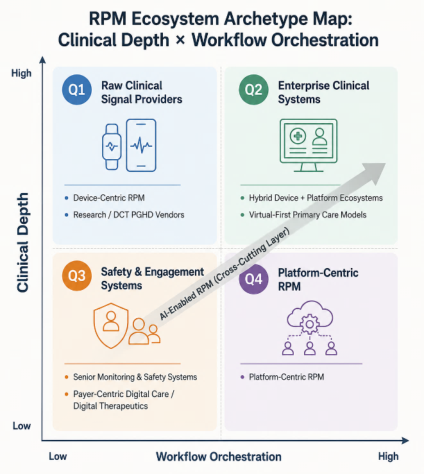
FINDINGS & DISCUSSION Our 200+-vendor review identifies a concise set of eight RPM archetypes (Figure 1). These span raw biosensing devices, workflow-rich platforms, interoperability infrastructures, payer-driven engagement models, enterprise virtual-care ecosystems, research-grade and PGHD-oriented tools (Patient- Generated Health Data tools), senior safety systems, and virtual-first primary care. Patient-Generated Health Data (PGHD) refers to health-related data created, recorded, or collected directly by patients outside traditional clinical settings. The archetypes map the ecosystem along two defining dimensions (clinical depth and workflow orchestration) signalling that RPM vendors operate in structurally distinct sub-markets rather than a single unified domain. Each archetype represents different care pathways, customer segments, regulatory exposures, and operational dependencies, which in turn shape how value is created, how workflows are supported, and how scalability constraints manifest across the ecosystem.
Figure 1: RPM vendor analysis (by author).
328 Badr Ontology analysis further shows that interoperability barriers manifest differently across solution types, shaping uneven scalability and regulatory exposure. Device-centric models struggle with inconsistent FHIR/HL7 v26 adoption and proprietary biosensor protocols that complicate normalization, while platform-centric models face high integration costs and dependence on EHR middleware to support triage, documentation, and escalation workflows.
Engagement- and payer-oriented models rely on billing-optimized custom APIs that limit interoperability with biosensors and clinical systems, and research or interoperability infrastructures contend with fragmented PGHD pipelines, variable provenance, and uneven standards maturity. These patterns align with broader evidence that heterogeneous data formats, proprietary APIs, and uneven standards adoption remain bottlenecks to data exchange and workflow integration (Wang, 2022), with EHR middleware dependence, uneven orchestration, and weak clinical linkage creating workflow friction and clinician burden (Taylor et al., 2021).
Fragmentation persists despite mitigation efforts, Integration costs remain high, downstream dependencies endure, and standards adoption is inconsistent (Hailu et al., 2024). These structural barriers cascade across stakeholders: vendors must close technical gaps, improve usability (Ding et al., 2019), and meet evolving software and AI regulatory expectations (Tabassi, 2023), while payers depend on standardized, interoperable data to assess outcomes, validate ROI, shape reimbursement, and monitor equity impacts (Badr, 2025).
Sociotechnical Burden and Complexities Our analysis indicates that, when cognitive and organizational alignment breaks down, patient engagement and clinician sustainability decline; when aligned, RPM becomes clinically meaningful. Poorly structured information, multi-step onboarding, and nonintuitive navigation elevate mental workload and erode comprehension, adherence, and trust (Ding et al., 2019). Global guidance echoes these patterns, citing high-friction onboarding, device complexity, limited real-time support, and weak error recovery as systemic usability failures7,8. Empirical studies show that community-based co-development reduces cognitive effort (Falcão et al., 2023), high workload and poorly structured interfaces impair accuracy (Cegarra & Morgado, 2009), and these issues reflect deeper cognitive-ergonomics problems rather than simple user interface flaws (Darejeh et al., 2024). Clinicians face concentrated pressures from interoperability overload (Wang, 2022), elevated cognitive demands, and workflow disruption caused by alert volume and unstructured data (Shah, 2021), compounded by regulatory and
6Clinical messaging and API-driven interoperability standards. https://build.fhir.org/ig/HL7/v2-to-fhir/ 7World Health Organization. (2022). Global strategy on digital health 2020–2025. https://www.who.int/ publications/i/item/9789240020924.
8Organisation for Economic Cooperation and Development. (2023). Health in the 21st century: Digital transformation of health systems. https://www.oecd.org/health/digital-health/
Sociotechnical Challenges in Remote Patient Monitoring: A Multi Stakeholder Analysis 329 documentation burdens. Workflow integration is equally critical. Solutions embedded in clinical workflows face the highest workflow burden because EHR middleware, uneven orchestration, and weak clinical linkage disrupt coordination. Data-oriented solutions instead carry heavier data burdens, limiting portability and downstream utility. RPM generates value only when data is actionable and embedded into care pathways. Evidence shows that structured escalation protocols and staffing models reduce emergency visits and readmissions (Taylor et al., 2021), while fragmented triage workflows and documentation demands remain persistent barriers. Emerging AI-enabled triage research reinforces this dynamic: unfiltered data increases workload, whereas AI-based prioritization reduces overload by surfacing clinically meaningful signals (Nandini, 2025).
Multi-Level Sociological Impact The social impact of RPM is prevalent across behavioural, institutional, and population levels, each shaped by distinct sociotechnical pressures.
Individual impact in RPM is driven by trust, privacy clarity, and motivational design, all of which depend on transparent data practices and reliable provenance. Grey-literature frameworks, including the ONC Trusted Exchange Framework9, NQF Telehealth Quality Framework10, identify low trust in data sharing, anxiety about secondary use, and weak behavioral reinforcement as major causes of motivation drop-off, showing that motivation is co-produced by governance, usability, and workflow design. Patients experience fragmentation as reduced continuity and diminished perceived value, with scattered data lowering trust and making monitoring feel disjointed. Empirical studies document pressures tied to device complexity and digital literacy, privacy and data-use concerns (Badr et al., 2019), and persistent digital-divide barriers (Mohtar & Badr, 2022). Early disengagement often stems from weak feedback loops (Badr et al., 2019), while opaque data practices and unclear consent reduce willingness to engage with AI-enabled monitoring (Williamson & Prybutok, 2024).
At the institutional level, reimbursement and incentive alignment largely determine whether organizations can sustain RPM, with value-based models consistently outperforming fee-for-service (Inglis et al., 2020). Outcomes- aligned reimbursement improves hypertension and diabetes results, whereas fee-for-service limits and inconsistent coverage undermine longterm viability (Salehi et al., 2020). However, misaligned incentives across providers, payers, and patients reinforce the primary customer divide (Keesara et al., 2020).
Provider organizations simultaneously face structural barriers that raise integration costs and mirror the ecosystem’s architectural heterogeneity. Studies document the operational burden of integrating heterogeneous systems, redesigning workflows for continuous monitoring (Taylor et al.,
9Office of the National Coordinator for Health Information Technology. (2022). Health IT Playbook: Interoperability Standards and Implementation. www.healthit.gov/playbook 10National Quality Forum. (2022). Patient generated health data (PGHD) framework and action plan. https://www.qualityforum.org/Publications/2022/PGHD_Framework.aspx
330 Badr 2021), and managing regulatory exposure across devices, platforms, and AI components (Tian, 2021). Financial analyses consistently show that reimbursement stability ultimately determines whether organizations can resource and sustain RPM programs.
Regulatory and compliance complexity creates uneven exposure across RPM vendors, shaping liability (Tian, 2021). Adoption is further limited by regulatory ambiguity, compliance burden, and jurisdictional variability, including unclear oversight for AI-enabled decision support (Kuttan, 2025) and documentation requirements (Hailu et al., 2024). Broader uncertainty around vague cybersecurity, auditability, and documentation expectations from FDA and NIST (Tabassi, 2023), heightens burden and erodes trust. Regulators respond with interoperability mandates, privacy and consent frameworks, and device/AI safety oversight, while vendors bear the technical load of implementing standards, middleware, and integration infrastructure.
At the population level, RPM intersects with structural determinants of health. Participatory design improves accessibility (Falcão et al., 2023), yet disparities in broadband, affordability, and literacy persist (Badr, 2022). Equity and accessibility hinge on whether interoperability supports inclusive, low-burden participation, given persistent digital-divide barriers. Systematic reviews show uneven benefits across literacy and access levels warns that without intentional design, RPM risks widening disparities.
CONCLUSION
The RPM ecosystem is constrained less by clinical efficacy and more by technology architecture and sociotechnical alignment. Innovation is shifting beyond devices toward AI-enabled analytics, interoperable data infrastructures, and workflow-integrated platforms that blur boundaries between clinical, consumer, and payer environments.
Our corpus reveals a consistent narrative: RPM effectiveness is shaped by the interaction of human factors, organizational workflows, data ecosystems, governance structures, and social determinants. Its success depends on aligning these contextual dimensions. Evidence across academic and grey literature shows a sector transitioning from basic monitoring to intelligent, predictive, and distributed care delivery. Triangulated findings highlight how innovations in RPM, digital biomarkers, workflow-aligned reimbursement, and standards-based interoperability are redefining RPM’s disruptive potential and positioning data liquidity, care-model redesign, and cross-ecosystem integration as foundational elements of the next generation of remote care. Case studies from health systems, virtual-first care models, and payer-aligned digital therapeutics were examined to ground theoretical insights in real operational experience, highlighting challenges such as alert fatigue, patient disengagement, and integration failures. Policy reports, technical standards, and industry analyses were incorporated to capture implementation realities and regulatory context.
Table 1 illustrates how patients, clinicians, provider organizations, vendors, payers, and regulators interact with the major forces shaping RPM across three domains: Technological (interoperability, data fragmentation,
Sociotechnical Challenges in Remote Patient Monitoring: A Multi Stakeholder Analysis 331 standards), Sociotechnical Burden (usability, cognitive load, workflow alignment), and Individual/Institutional/Population Factors (trust, incentives, regulatory exposure, equity).
Interoperability and workflow alignment function as the system’s load- bearing elements: when they weaken, cognitive burden rises, engagement declines, and organizational sustainability erodes; when they align, RPM becomes clinically meaningful and scalable. Equity, trust, and regulatory clarity determine who benefits, with structural determinants (e.g. literacy, broadband, affordability, and oversight) ultimately shaping population-level outcomes and longterm ecosystem viability. Each stakeholder experiences these pressures differently; in summary, patients through trust and literacy, clinicians through workflow and data overload, organizations through integration and reimbursement, vendors through compliance and standards, payers through financial feasibility and equity, and regulators through policy and structural determinants. The table makes visible that all actors operate within a layered sociotechnical system where technical constraints, human factors, institutional incentives, and population inequities interact to shape RPM’s overall performance.
RPM can only become a resilient, equitable component of person-centered care when design, policy, and organizational strategies align with these sociotechnical realities. This requires coordinated action across interface design, workflow engineering, governance, and infrastructure modernization. Human-centered interfaces, behavioural-science-based engagement, and standards-driven interoperability are essential for reducing cognitive load, strengthening trust, and enabling seamless data exchange. Automated compliance tools can ease administrative burden, while AI-enabled triage can reduce alert fatigue and surface clinically meaningful signals.
332 Badr Equity-first design focused on multilingual, low-literacy, and broadband- independent modalities, must anchor all interventions. These directions carry implications for policymakers, organizations, and vendors: policymakers can reinforce progress through interoperability mandates and reimbursement alignment; provider organizations can redesign workflows and triage pathways for safe, sustainable monitoring; and vendors can advance transparency, standards adoption, and SaMD-aligned governance.
A coordinated, multi-stakeholder approach, combining human-centered interfaces, behavioural reinforcement, standards-based interoperability, automated compliance, AI-enabled triage, and equity-first principles, offers a coherent path to reducing cognitive burden, improving workflow fit, and enabling scalable, person-centered RPM.
This analysis has limitations. RPM’s sociotechnical complexity exceeds any single framework, and interactions among interoperability, workflow design, incentives, and equity vary across settings and regulatory environments. Evidence remains uneven, with many studies reflecting earlystage or vendorspecific deployments, and limited comparative data on AI-enabled triage, long-term engagement, or equity impacts. The technical and regulatory landscape is also rapidly evolving, meaning current conclusions may not fully anticipate future configurations of infrastructure or governance.
Future research should advance AI-augmented RPM, including adaptive interfaces tailored to user behavior and clinical context; cross-ecosystem interoperability frameworks linking devices, platforms, and EHRs; and evaluation models that examine how sociotechnical alignment shapes long-term engagement, safety, and equity.
REFERENCES
Badr, N. (2022). Technology for Quintuple Aim: Evidence of Technology Innovations in Reaching the Aim of Health Equity. Badr, N. (2025). Towards a Dynamic Cross-Sector Alignment for Sustainability
in Healthcare Ecosystems. Medical Research Archives, 13(6). https://doi. org/10.18103/mra.v13i6.6630 Badr, N. G., Sorrentino, M., De Marco, M., & Fugini, M. (2019). Improving interaction in integrated chronic care management. 2019 IEEE 28th International Conference on Enabling Technologies: Infrastructure for Collaborative Enterprises (WETICE), 265–270. Bashi, N., Karunanithi, M., Fatehi, F., Ding, H., & Walters, D. (2020). Remote
monitoring of patients with heart failure: An overview of systematic reviews. Journal of Medical Internet Research, 22(1), e16673. https://doi.org/10.2196/16673 Bostrom, R. P., Gupta, S., & Thomas, D. (2009). A meta-theory for understanding information systems within sociotechnical systems. Journal of Management Information Systems, 26(1), 17–48. Braun, V., & Clarke, V. (2006). Using thematic analysis in psychology. Qualitative
Research in Psychology, 3(2), 77–101. Carayon, P., Bass, E. J., Bellandi, T., Gurses, A. P., Hallbeck, M. S., & Mollo, V.
(2011). Sociotechnical systems analysis in health care: A research agenda. IIE Transactions on Healthcare Systems Engineering, 1(3), 145–160. https://doi.org/1 0.1080/19488300.2011.619158
Sociotechnical Challenges in Remote Patient Monitoring: A Multi Stakeholder Analysis 333 Cegarra, J., & Morgado, N. (2009). A cognitive approach to human-system
interaction in complex environments. Applied Ergonomics, 40(5), 753–761. https://doi.org/10.1016/j.apergo.2008.07.004 Darejeh, A., Marcusa, N., Mohammadi, G., & Sweller, J. (2024). A critical analysis of cognitive load measurement methods for evaluating the usability of different types of interfaces: Guidelines and framework for Human-Computer Interaction. arXiv Preprint arXiv:2402.11820. Ding, H., Karunanithi, M., Kanagasingam, Y., & Varnfield, M. (2019). User
experience factors in telehealth systems. JMIR Human Factors, 6(2), e13204. https://doi.org/10.2196/13204 Falcão, M., Allocca, M., Rodrigues, A. S., Granjo, P., Francisco, R., Pascoal, C., Rossi, M. G., Marques-da-Silva, D., Magrinho, S. C., Jaeken, J., & others. (2023). A community-based participatory framework to co-develop Patient Education Materials (PEMs) for rare diseases: A model transferable across diseases. International Journal of Environmental Research and Public Health, 20(2), 968. Gates, A., Ali, A., Conard, S., & Dunn, P. (2026). Exploring an AI-First Healthcare
System. Bioengineering, 13(1), 112. Hailu, R., Sousa, J., Tang, M., Mehrotra, A., & Uscher-Pines, L. (2024). Challenges and Facilitators in Implementing Remote Patient Monitoring Programs in Primary Care. Journal of General Internal Medicine, 39(13), 2471–2477. https:// doi.org/10.1007/s11606-023-08557-x Inglis, S. C., Clark, R. A., Dierckx, R., Prieto-Merino, D., & Cleland, J. G. (2020).
Structured telephone support or telemonitoring for heart failure. Cochrane Database of Systematic Reviews, (4), CD007228. https://doi.org/10.1002/14651858. CD007228.pub4 Keesara, S., Jonas, A., & Schulman, K. (2020). Covid-19 and health care’s digital revolution. New England Journal of Medicine, 382(23), e82. https://doi. org/10.1056/NEJMp2005835 Kruse, C. S. (2020). Factors influencing patient engagement in telehealth. JMIR
Medical Informatics, 8(4), e18822. https://doi.org/10.2196/18822 Kuttan, R. (2025). Regulatory ambiguity in AI-enabled clinical decision support. Npj Digital Medicine, 8, 12. Lyle, D. (2025). Effect of Remote Patient Monitoring on Stage 2 Hypertension. The
American Journal of Managed Care, 31. Mohtar, L. N., & Badr, N. G. (2022). Digital bridge or tradeoff: Telehealth adoption and healthcare service quality. A scoping review. Sustainable Digital Transformation: Paving the Way Towards Smart Organizations and Societies, 253–268. Nandini, A. (2025). AI-Powered RPM Data Platform for Nurse Time Optimization:
Reducing Alert Fatigue and Enhancing Efficiency. Journal of Computer Science and Technology Studies, 7(2), 228–239. Salehi, S., Olyaeemanesh, A., Mobinizadeh, M., Nasli-Esfahani, E., & Riazi, H.
(2020). Assessment of remote patient monitoring (RPM) systems for patients with type 2 diabetes: A systematic review and meta-analysis. Journal of Diabetes & Metabolic Disorders, 19(1), 115–127. Shah, S. (2021). Alert fatigue and data overload in remote monitoring. Journal of the American Medical Informatics Association, 28(9), 1984–1993. https://doi. org/10.1093/jamia/ocab123 Sharma, S., Sharma, A., Fuloria, S., & Singh, A. (Eds.). (2025). Machine and Human
Together: Innovating Healthcare with Technology. BENTHAM SCIENCE PUBLISHERS. https://doi.org/10.2174/97988988116241250101
Institute of Standards and Technology. Tan, S. Y., Sumner, J., Wang, Y., & Wenjun Yip, A. (2024). A systematic review of the impacts of remote patient monitoring (RPM) interventions on safety, adherence, quality-of-life and cost-related outcomes. Npj Digital Medicine, 7(1), 192. https:// doi.org/10.1038/s41746-024-01182-w Taylor, M. L., Thomas, E. E., Snoswell, C. L., Smith, A. C., & Caffery, L. J. (2021).
Does remote patient monitoring reduce acute care use? A systematic review. BMJ Open, 11(3), e040232. Tian, M. (2021). Regulatory challenges for software as a medical device. Npj Digital Medicine, 4, 12. https://doi.org/10.1038/s41746-021-00410-w Tomar, D. S., Sharma, S., Sharma, A., Dinesh, G., & Sharma, A. (2025). Remote
Patient Monitoring: A Paradigm Shift. In The Digital Pillbox: Integrating AI, IoT, and Pharma Solutions (Part 1) (pp. 107–139). Bentham Science Publishers. Wang, Y. (2022). Interoperability burden in clinical practice. Journal of Biomedical Informatics, 130, 104082. https://doi.org/10.1016/j.jbi.2022.104082 Williamson, S. M., & Prybutok, V. (2024). Balancing privacy and progress: A review
of privacy challenges, systemic oversight, and patient perceptions in AI-driven healthcare. Applied Sciences, 14(2), 675.
SEARCH THE AHFE DIGITAL BOOKSTORE BY ISBN
Explore the complete digital volume
Human Interaction and Emerging Technologies (IHIET 2026)
Read this individual research paper free through the original publisher, or explore the full digital proceedings book.