Sebastian Stegmüller, Antonio Ardilio, Franziska Braun (2023). Value oriented design of vehicles along emotional personality structures and character traits of customers. In: Creativity, Innovation and Entrepreneurship. AHFE Open Access, vol. 74, pp. 37–45. https://doi.org/10.54941/ahfe1003303
Buying a vehicle is a highly emotional decision process. In addition to functional requirements, elements that reflect emotional and personal values are crucial for the buying decision. Due to constantly upcoming technological inventions, trends and the increasing smartification of products, it’s becoming increasingly challenging to identify a specific target user group and transfer their requirements successful into a vehicle design. The containment of the target group usually based on demographic data like age, income, place of residence etc. But the psychographic characterization is often only based on subjective assessment of the user information. For example, a lot of product developer define emotional characteristics of the target group in the form of personas or mood boards based on experiential knowledge. This leads to a bias in the soft factors of a target group conditioned by the individual perception of each product developer and is therefore prone to error. Currently there is a lack of methodical procedures for translating customer values into vehicle elements. Therefore, the questions arise, how the value profile of target groups can be defined on a data basis and how vehicle characteristics can be derived from it.MethodologyTo determine the values and character traits of a target group, the emotion-cluster "Limbic Types" invented by the psychologist Hans Georg Häusel are combined with demographic information. Limbic Types are a condensation of the complex emotional personality structures and consist out of four different types: Dominance, Harmony, Stimulance and Balance. Parallel to this, the “Elements of Value Pyramid” as described by from Bain & Company – which consists of four levels: “Functional”, “Emotional,” “Life Changing” and “Social Impact” – is being transferred to vehicle features. Applied to automotive products, this results in functional values such as "Driver Assistance Systems”, emotional values like “stress reducing elements”, personal values like “Motivation” and social added values like “sharing the vehicle”. Correlations between the limbic types and the vehicles values provide insights on which vehicle characteristics are related to which personal character traits. To further specify the target groups, information about personalization preferences, sustainability requirements, technology affinity and trends sensitivity were also considered. ApplicationTo avoid neglecting cultural differences, a quantitative online survey is conducted with more than 5.000 respondents five intercontinentally distributed countries (Germany, Italy, America, China and South Korea). The individual Limbic type of each participant was determined by using a Limbic Quick Test at the beginning of the survey, consisting of eight questions tied into a story. The entire questionnaire consists out of 30 questions and takes an average of 12 minutes to complete. In order to receive only representative answers, incomplete questionnaires or questionnaires of participants who were 70% faster or 150% slower than scheduled were sorted out. Results and DiscussionPreliminary results already show significant differences between countries and between Limbic types. Within the countries, general trends have been identified. For example, all Limbic types in Germany prefer significantly more often functionalities to reduce costs. Compared to that, all Chinese Limbic types tend to choose functions that reflect the quality of the product. Examining only the differences between the Limbic types, it becomes apparent that 62.7% of the German Dominance types prefer stress-reducing elements in the vehicle. In turn, Italian Dominance types chose with a frequency of 45.6% most often trend-oriented elements. From the data it can also be concluded, which combinations of elements are chosen significantly often. For example, Italian Harmony types who choose elements to reduce risks are also very likely to choose stress-reducing elements. Whereas Chinese Harmony types will most likely choose elements that reflect quality in combination with fun and entertainment features. Furthermore, correlations were made for the different Limbic types and culture-specific-preferences In addition, “personalization”, “importance of sustainability” and “attitudes toward new technologies” will be surveyed.
Buying a vehicle is a highly emotional process (Helander et al., 2013). Within this buying process the customers have to handle various issues, such as the purpose of buying a car, the fundamental relationship to cars, relevant functionalities, their financial frameworks, vehicle features with which they personally identify, values they want to communicate (or not communicate), influencers like family members, social and aesthetical trends and the overall trust/loyalty into a car brand.
Vehicles reflects in a strong manner the personality of the customer and thus becomes a highly emotional artifact. Design is an important strategic instrument for emotional value creation (Charles H. Edle, 2008). Designers face the challenge to design vehicles in a way that the customer’s personal values are addressed under the above mentioned circumstances. However, the design process has become a challenge due to the variety of influences that affect the user and the product and the dynamic changes of those influences. Dynamically changing social and aestethic trends, technical innovations, and
the increasing smartification of products make it difficult to clearly define a target group and make design decisions. The high number of influencers makes it necessary to extract relevant data and condense them into relevant information before making design decisions. Today, predominantly demo- graphic data is used for this purpose. Anyhow, this data source just indicates target groups (“who”) and does not give user context (“why”).
At this point, psychographic data becomes relevant. However, the psych- ographic characterization is often only based on subjective assessment of the user information. For example, a lot of product developers define the emotional characteristics of the target group using personas or mood boards based on experiential knowledge. This leads to a bias in the soft factors of a target group conditioned by the individual perception of each product deve- loper and is therefore prone to error. Currently, there is a lack of methodical procedures for translating customer values into vehicle elements.
Therefore, the questions arise, how value profiles of target groups can be extracted from data sources, and how vehicle characteristics can be derived from it.
LITERATURE REVIEW
For value-oriented design, personas are a commonly used method among designers. The Goal of this method is to extract value profiles and needs of the expected target groups at the vanguard of the design process. On the one hand, Personas support to better empathize with target groups and iden- tify their needs, and on the other hand, this method communicates a unified understanding of the target segment and its requirements within the team. To be able to explore the usage framework from the target group’s point of view, psychologists refer to as “perspective taking” (Epley et al., 2004).
The way people adopt customers perspectives in personas is an iterative process. It starts with the assumption that the user has similar motivations and behaviors as oneself. Personas help to adapt this view step by step until it matches to the expectation and observed behavior of the target group. This requires an understanding of the direction in which the target group model is to be altered and experiencing the actual behavior of the formed person model to test the iterated model against it (Peter Bagnall et al., 2005).
However, since a persona is fictional, customer behavior requires an obse- rvation of real people in the usage context and the quality of results therefore relies on the experience of the designer. In the best case, a high number of moments with very similar types of people is needed to recognize relevant pat- terns. But in terms of efficiency, it is not possible for designers to go through the personas process for a larger amount of target groups (even more if it comes to Niches or very specific target groups).
In addition, there is a bias, as user of the personas method usually start from their own motives and values which will be transferred to the target group(s). There is yet less research through field studies in ethno- graphic science in order to prove a bias-free usage of persona method (Friess, 2012).
Value-Oriented Design of Vehicles 39
METHODOLOGY
The methodological structure is divided into three sections: 1) Identification of the emotional personality structure, 2) Specification of the personality stru- ctures by interests, attitude and values, and 3) specification of preferences towards vehicle features.
1) Identification of the emotional personality structure For the determination of the personality structures and character traits and emotional types of a target group, an international tool was sought. Early approaches are Digmans “five-factor model” (Digman, 1990) and Gol- dmanns “big five” (Neyer and Asendorpf, 2018) which describe personality in five main dimensions: Neuroticism, Extraversion, Openness, Agreeable- ness and Conscientiousness. The mentioned characteristics can be described in different intensities. The combination of the intensities of the characteri- stics finally describes the personality. Extensive questionnaires such as the NEO-PI-R with 205 pages can be used to determine the personality type (Berth and Goldschmidt, 2006). The big advantage of the big five is the heri- tability of 50%. This means, half of the personality can be explained by the influence of genes. 40-45% are environmental factors and 5-10% are fault points. This can be particularly interesting when it comes to the development of products in the distant future when assumptions must be made about potential target groups. For the application in this study, a more compact model was used which, however, has its origins in the Big Five.
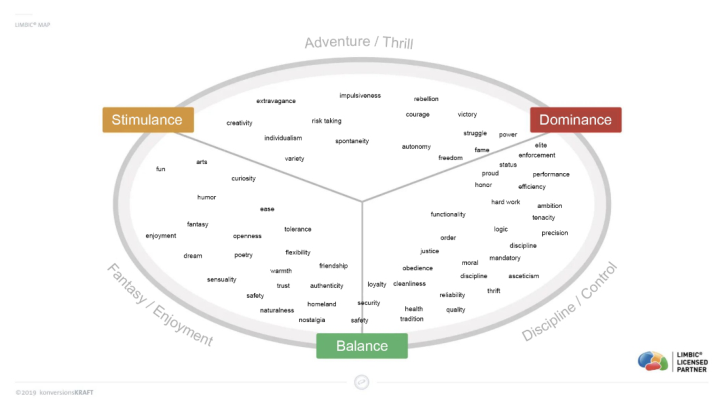
A recently developed approach which fits to the methodological require- ments of this study is the “Limbic Map” (see Figure 1). This model originate from the field of neuropsychology and was developed by Dr. Hans Georg Häusel (Häusel, 2019). The method is based on the basic motives and emoti- ons of people which are deeply anchored in the subconscious. On the Limbic Map, all values, motives, and desires can be depicted and placed in relation
Figure 1: Limbic map (Häusel, 2019).
to each other. These are decisive for consumer and purchasing behaviour as well as brand preferences.
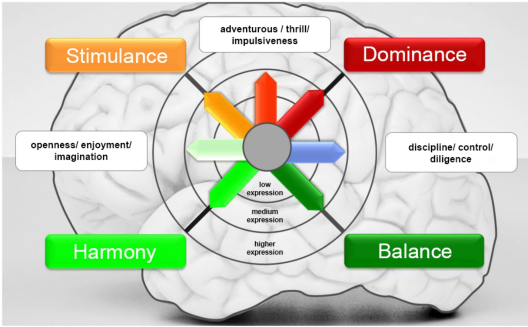
Different types, so-called limbic types, can be located on the map. Limbic types are based on the motivational and personality system of the human and condense complex emotional personality structures into superordinated dimensions. The model is similar to DISG (Dauth, 2017) or Insights MDI, but has the advantage that with just a few questions a tendency can already be derived whether the person is more likely to be assigned to the dimension of “Dominance”, “Stimulance”, “Harmony” or “Balance” (see Figure 2).
Dimensions Overview Dominant personality groups strive for recognition, power, success, victory, and prestige. The proportion of men within this group is often very high. They have a high affinity for status products and are very often interested in the latest technology.
Stimulance types are constantly searching for something new. This unste- adiness runs through the whole life. Hedonists, open-minded or adventurous people can be found here. They love modern and extravagant products and have a positive attitude. Indulgence, enjoyment, and being different are concisely in the foreground here.
Harmony personality is characterized by caring and bonding. The basic attitude is very optimistic and factors such as family, social harmony, home, and hearth play a predominant role. They are often cautious but very open to other people.
Balance types overlap with Harmonizers. Traditionalists make up a large proportion of this personality group. They tend to be conservative, examine things very meticulously, and can be described as rather cautious, sceptical, and preserving. Their thinking is oriented toward the past and the status quo.
2) Specification of the personality structures by interests and values
Figure 2: Overview of the four main fields of emotion (Häusel, 2016).
Value-Oriented Design of Vehicles 41
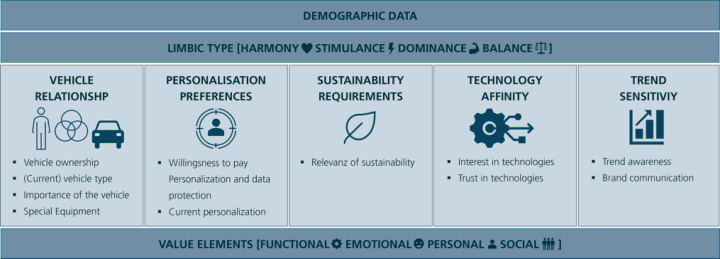
Figure 3: Overview of the collected target group information.
To specify the target group types in terms of their interests and to include global trends such as sustainability, personalization, and interest in technology, the following variables were added (see Figure 3):
Current ownership of vehicles
Vehicle body type preferences
Importance of the vehicle in life
Willingness to pay for special equipment, personalization
Data protection
Personalization options that are currently in use
Interest and Trust in (new) technologies
Trend Awareness
Brand trust
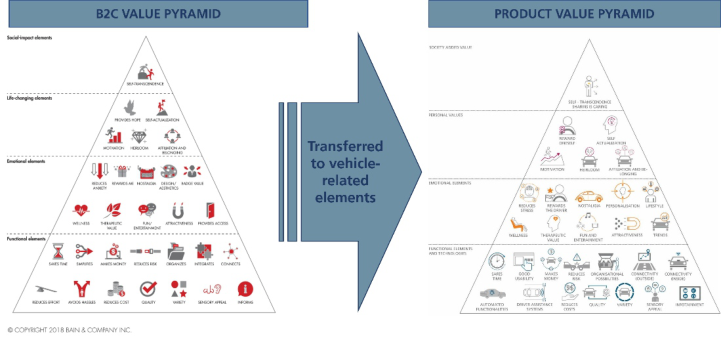
3) Specification of vehicle features regarding personality structures and character traits The above collected target group information defines the profile for deter- mining a target group. To compare these with specific vehicle characteristics, the product “car” must be broken down into individual elements. For this purpose, the Bain & Company’s B2C Pyramid was transferred into a Product Value Pyramid with specific vehicle features (see Figure 4). This approach was developed within a joint applied cooperation project with Hyundai Motor Company and Kia Corp.
Bain & Company’s value pyramid is based on the principle of Maslow’s pyramid of needs and hierarchizes functional, emotional, personal, and socially relevant values.
Adapted to the use case “car”, elements from the above mentioned Pyra- mid have been adopted (for example like “Reduces Effort”became in the Pro- duct Value Pyramid the element “Automated Functionalities” or “Provides Access” becomes “Trends”).
In the next step, an online survey was prepared and conducted. To take intercultural differences into account, a total of 5000 respondent were surveyed (1000 people each from China, South Korea, America, Italy, and Germany). To prevent gender bias, attention was paid to ensure a balanced ratio of men to women in this survey. Demographic questions formed at
Figure 4: B2C value pyramid from Bain & Company Inc. and product value pyramid developed by Fraunhofer IAO and Hyundai Motor Company and Kia Corp.
the beginning, followed by a Limbic Quick Test to determine the emotion type, followed by questions on sustainability, technology affinity, trends, and expectations towards the brand. The respondents were asked to select three functional, two emotional and one personal element of the Product Value Pyramid. For a better understanding, the abstractly formulated elements were provided with practical examples. Finally, the test persons could decide for or against a socially added value. Social added value can mean, for example, that you make your vehicle available to other people when it is not in use.
The results were examined according to different criteria and the selected elements from the Product Value Pyramid were correlated with character traits.
RESULTS
It is noticeable, that in all conducted countries the harmony type is the most common type with a share of over 22%. Closely followed by stimulant types, accounting for at least 19%. Dominance types come in third place with 5.6 - 8.69% and finally stimulus types with a share of less than 4.7%. If we corre- late the limbic types with different vehicle types, we identify that most sports cars are owned by dominance and stimulus types. In addition, dominance types own SUVs significantly more often than harmony types. Dominance types have also a very high affinity for technology, followed by stimulance types. Stimulance types place the highest value on sustainability closely fol- lowed by dominance types. When we look at Trend sensitivity, balance and harmony types are less interested in following the newest trends. In contrast, dominant types are very interested in trends and even prefer to set trends themselves. Regarding personal data balance types prefer to personalize their products themselves instead of automated personalization, followed by har- mony types. In contrast, dominance and stimulance types are more willing to provide their personal data for automated personalization. What’s noticeable is that Harmony types are the second most likely to personalize products on
Value-Oriented Design of Vehicles 43
their own but the least likely when it’s about personalizing their vehicle. In the following, exemplary results of the country-specific particularities with regard to the limbic types are shown (predominantly for China and USA).
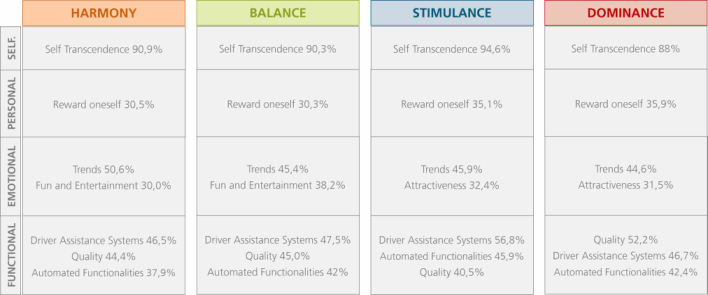
Limbic Types in China If we look at the limbic types within China (see Figure 5), we see that the same functionalities are decisive for all of them: Driver Assistance Systems, Quality, and Automated Functionalities. Looking at the emotional elements, harmony, and balance types prefer trends, fun, and entertainment elements in their vehicles. Stimulance and Dominance types are also trend-oriented but prefer in second place elements that are attractive, for example, a special streamlined shape or exclusive rims. When it comes to personal elements, all emotion types choose vehicle features that are related to their own reward. This is often special equipment that has to do with strong individualization, such as exclusive materials in the interior or a limited-edition sport steering wheel. Germans also prefer self-rewarding elements.
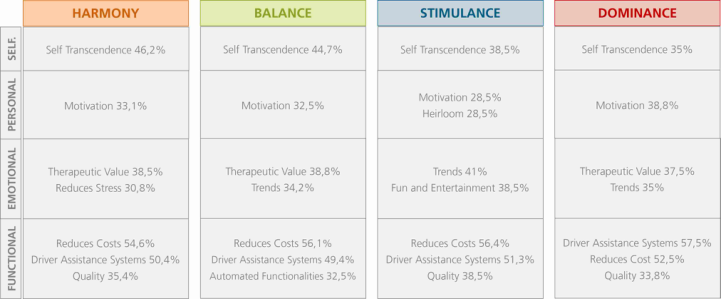
Limbic Types in North America The situation is different for American limbic types (see Figure 6). Harmony, balance and dominance types prefer features that support the driver in ach- ieving his goals. For example, features and functions that help them drive more energy-efficiently to be more sustainable. Stimulance types also prefer Heirloom elements. That means when those types invest into the vehicle the concern the resale value or is willing to share the car with family members. Therefore, vehicle characteristics are interesting, like a high resale value or special quality.
It is noticeable that in China, Korea and the USA dominance types are least likely to choose willingness to self-transcendence. Self-Transcendence means that features and functions of the vehicle add value to the society. Cross- cultural tendencies within the Limbic Types can be derived via the frequency distribution of the preferred elements. With the help of a lift analysis, it was
Figure 5: Overview of the preferred product values of the individual limbic types in China.Figure 6: Overview of the preferred product values of the individual limbic types in USA.
also possible to determine which element combination has a particularly high probability of being selected. For example, for the German balance type the lift for the functional element “Driver assistance systems” and the emotional element “Reduces Stress”is marked with 1.14. This means that if one element is chosen, there is a high probability that a German balance type will also choose the other.
This has the advantage that elements can be derived based on probabilities if there is a lack of information. This has the advantage that elements can be derived based on probabilities if there is a lack of information.
DISCUSSION
By comparing psychographic data and design elements of vehicles, overriding characteristics can be integrated into the design process at early stages. This creates a valid basis for making and justifying design decisions.
In the data evaluation process, it became apparent, that the sample of 5000 participants could have been larger. A larger sample would be helpful, especially when looking at marginalized groups.
CONCLUSION
With our study we could prove that the usage of limbic types is an efficient way to incorporate emotional characteristics of target groups into product design and development and therefore can be considered as successful.
However, in order to integrate character expressions more specifically rese- arch should be conducted to use complexer model than the limbic map – for example a modified form of Goldmann’s “Big Five”.
Furthermore, additional research should be carried out to adapt the car value pyramid to other products such as consumer products and/or medical devices as well as in terms of researching the influence of cultural differences in design decision making.
Value-Oriented Design of Vehicles 45
REFERENCES
Berth, H. and Goldschmidt, S. (2006) ‘Testinformation’, Diagnostica, vol. 52, no. 2, pp. 95–99. Charles H. Edle (2008) Using product design strategically to create deeper consumer
connections [Online] (Accessed 30 January 2023). Dauth, G. (2017) Führen mit dem DISG-Persönlichkeitsprofil: DISG-Wissen Mitarbeiterführung, 4th edn, Offenbach, GABAL. Digman, J. M. (1990) ‘Personality Structure: Emergence of the Five-Factor Model’,
Annual Review of Psychology, vol. 41, no. 1, pp. 417–440. Epley, N., Keysar, B., van Boven, L. and Gilovich, T. (2004) ‘Perspective taking as egocentric anchoring and adjustment’, Journal of personality and social psychology, vol. 87, no. 3, pp. 327–339. Friess, E. (2012) ‘Personas and decision making in the design process’, Proceedings of
the SIGCHI Conference on Human Factors in Computing Systems. Austin Texas USA, 05 05 2012 10 05 2012. New York, NY, ACM, pp. 1209–1218. Häusel, H.-G. (2016) Brain View: Warum Kunden kaufen [Online], 4th edn, Stuttgart, Haufe. Available at http://nbn-resolving.org/urn: nbn: de: bsz: 31-epflicht- 1245592. Häusel, H.-G. (2019) Think Limbic! - inkl. Arbeitshilfen online: Die Macht des
Unbewussten nutzen für Management und Verkauf [Online], 6th edn, Stutt- gart, Haufe. Available at http://nbn-resolving.org/urn: nbn: de: bsz: 31-epflicht- 1234778. Helander, M. G., Khalid, H. M., Lim, T. Y., Peng, H. and Yang, X. (2013) ‘Emotional needs of car buyers and emotional intent of car designers’, Theoretical Issues in Ergonomics Science, vol. 14, no. 5, pp. 455–474. Neyer, F. J. and Asendorpf, J. (2018) Psychologie der Persönlichkeit, 6th edn, Berlin,
Heidelberg, Springer. Peter Bagnall, Guy Dewsbury and Ian Sommerville (2005) The Limits of Personas [Online]. Available at https://www.researchgate.net/profile/guy- dewsbury/publication/255621349_the_limits_of_personas.
LISTED IN THE AHFE DIGITAL BOOKSTORE CATALOGUE
Explore the complete digital volume
Creativity, Innovation and Entrepreneurship
Read this individual research paper free through the original publisher, or explore the full digital proceedings book.
ISBN 978-1-958651-50-6
Explore this ISBN in the AHFE Bookstore ↗Listed in the July 2026 bookstore catalogue; search by ISBN to confirm current availability · Digital book purchase optional