Wesley Woelfel (2024). “Introspective Creativity” Leveraging Inclusive Leadership Philosophy with Design Thinking Methodologies. In: The Human Side of Service Engineering. AHFE Open Access, vol. 143, pp. 235–242. https://doi.org/10.54941/ahfe1005103
The IIPL Approach is a creative methodology developed specifically to understand how inclusive and introspective leadership tools may strengthen and empower creative process outcomes. Run in the form of a design charrette, it challenges teams of participants by fusing Personal Leadership Philosophy techniques with Design Thinking methods to discover meaningful design outcomes. The IIPL Approach outlines four criteria for success: 1) introspective – what is your formula and what is important to you today and tomorrow, 2) inclusive – honor identities and stories of others, 3) personal – channel what is important, 4) local – utilize local space as a living lab. It also leverages Creative Problem Solving (CPS) tools with the following IIPL Approach mindsets: A) elevate ideas through inclusivity and diversity, B) make it meaningful by making it personal. The IIPL Approach creative methodology was developed as a design charrette module for a Voices of Design (VOD) event. Voices of Design, created by faculty in the Department of Design at California State University, Long Beach, is a yearly event series that invites diverse creative professionals and students to participate in presentations, panels, and workshops via physical and virtual creative spaces to encourage active engagement in key objectives including fostering a connection with design professionals, understanding how design can be a catalyst for change, and discussing and exploring and meaningfulness within a creative landscape. The IIPL Approach creative methodology and corresponding VOD design charrette module is discussed regarding inclusive, introspective, and creative strategies, implementation strategies, observations, and outcomes.
Design Thinking and Creative Problem-Solving (CPS) are related systems developed to amplify and unlock opportunities and creative solutions to problems. Creative Problem Solving (CPS) emerged in the 1950’s through the works of Alex Osborn and others with a focus on the implementation of activities and behaviors to reliably produce creative results (Osborn, 1953). In the 1990’s, the topic of Design Thinking emerged out of creatives such as Tim Brown and David Kelley and was paramount in synergizing cre- ative methods relating to industrial design with business innovation (Brown,
2019). Numerous design firms and creative consultancies rely on creative sys- tems such as these along with the facilitation and implementation abilities of their teams for sustained success and innovation.
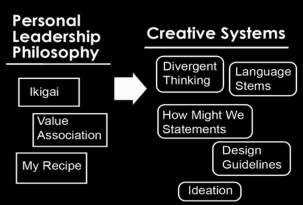
In both creative systems, a creative’s personal values and purpose are not necessarily involved, nor are personal values and purpose necessarily a part of any solutions. So how might we fuse creative systems with a creative’s per- sonal values and purpose? The IIPL Approach creative methodology drives creative systems with personal values and purpose using Personal Leadership Philosophy structures. It leverages equity, inclusion, and diversity through mindsets and as criteria for success. Developed in the form of a design char- rette as a module in the Voices of Design (VOD) events at California State University, Long Beach, it takes participants through Personal Leadership Philosophy related activities as anchors for the outcomes of merged activities using Creative Problem Solving (CPS) and Design Thinking creative systems.
Figure 1: Personal leadership philosophy driving creative systems.
METHODOLOGY
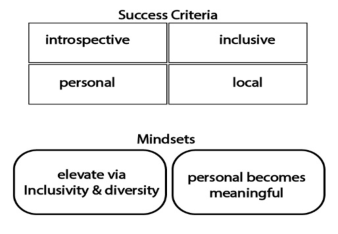
The IIPL Approach outlines four criteria for success: 1) introspective – what is your formula and what is important to you today and tomorrow, 2) inclu- sive – honor identities and stories of others, 3) personal – channel what is important, 4) local – utilize local space as a living lab. These four pillars serve as building blocks for emphasizing Personal Leadership Philosophy within the IIPL Approach framework. This foundation is then applied to Design Thinking and Creative Problem Solving (CPS) systems with the following IIPL Approach mindsets: A) elevate ideas through inclusivity and diversity, B) make it meaningful by making it personal.
Figure 2: IIPL approach success criteria and mindsets.
IMPLEMENTATION The IIPL Approach creative methodology was implemented as a design char- rette activity module within the Voices of Design (VOD) event at California State University, Long Beach. The design charrette physical space needed to be local, familiar, and friendly to serve as a living lab for the activity and to connect with this IIPL Approach criteria for success. By utilizing a space as a living lab, it can be used to encourage continued learning activities and events (Barker et al., 2014). The gallery within the Department of Design at Cali- fornia State University, Long Beach was selected as the space for the event because it was a familiar setting that was open enough to promote a captive yet collaborative audience. To promote an inclusive and group-based envi- ronment, the gallery was setup via 8 tables, each with 4–5 seats. Each table eventually became a team during the event that hinged on how participants selected seats as they arrived. The charrette utilized the walls of the gallery space for the share-out and display of the event’s outcomes. In addition, a pair of main whiteboards served to welcome opinions from the group during initial discussion, and a screen within the space clarified each activity, and shepherded the event along.
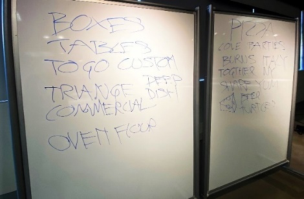
When utilizing Creative Problem Solving (CPS) for idea generation, one must prepare a relaxed, playful, brave, and positive atmosphere (Osborn, 1979). To achieve this, the charrette provided lunch, name tags, and adven- turous music as participants arrived and sat down at the strategically spaced tables. To encourage a sense of play, each table held sharpies, sticky notes, a flip chart, and a “top secret” sealed envelope. The event began with an energetic group discussion about “the experiences related to pizza.” As expe- riences involving sharing, parties, delivery, and pizza boxes were spit-balled throughout the room, they were also captured using a pair of whiteboards. Based as a divergent thinking exercise, this activity was intended to warm up the group and expanded what they were holding and eating into broader types of related experiences.
Figure 3: Expanding experiences activity warm up.
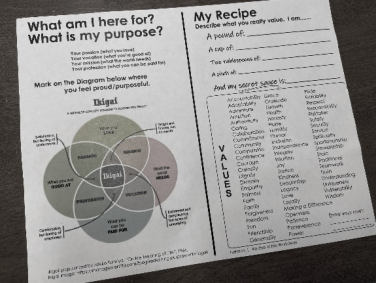
Introspective Personal Leadership Strategy One of the main pillars of the IIPL Approach is to encourage space for intro- spective reflection related to purpose and values (introspective – what is your formula and what is important to you today and tomorrow). Each charrette participant was introduced to and prompted to begin an ikigai exercise. Ikigai
238 Woelfel
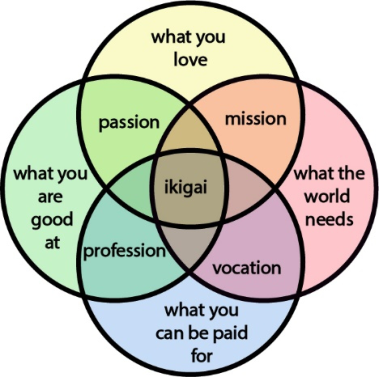
is a concept popularized by Mieko Kamiya in the mid 1960’s and relates to an individual’s reason for being (Kamiya, 1966). An ikigai map is composed of four intersecting circles, each with different anchors relating to purpose. The circles include “what you love,” “what the world needs,” “what you can be paid for,” and “what you are good at.” In defining purpose, it is popular for an individual to adjust one’s priorities to seek a space at the bullseye of the ikigai map. In this charrette, the activity introduces the concept of ikigai as an introspective glimpse into purpose as it relates to Personal Leadership Philosophy. This allows participants to identify what main anchors they iden- tify with. Using an introspective leadership worksheet, each participant was provided time and space to reflect and find where they identify purpose using an ikigai diagram. During this introspective time, relaxed and calming music played as the environment evolved to a slow and purposeful space.
Figure 4: Ikigai diagram, an individual’s reason for being.
Next, participants were introduced to an introspective personal value exer- cise named “My Recipe.” It is an adaptation of the game “Recipe for Me” credited to the Albany Park Theatre Project in Chicago and developed into a “Recipe of Me” presentation and leadership exercise by Dr. Latise Hairston (Hairston, 2021). Each participant was asked to identify five values that speak to them. These values were then written in a recipe format on their introspective leadership worksheets. “A pound of” is the most influential, while “a pinch of” is the least. The “secret sauce” is the wildcard and is up to the individual to define how this ingredient adds to their own Personal Leadership Philosophy. Time was provided along with contemplative music for participants to build their value-based recipes. These recipes serve as an informal visualization of values that motivate and values that make things personal to the individual.
Figure 5: Introspective leadership worksheet and value recipe.
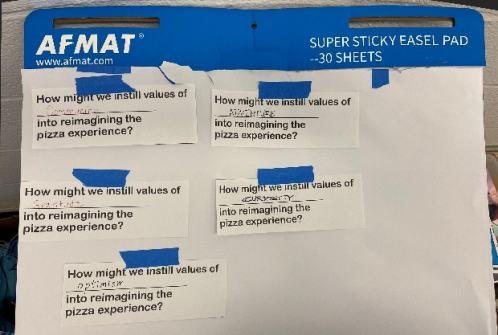
Fusing Personal Purpose and Value With Creative Systems With acknowledgement of individual purpose, values, and identity taking shape, participants were given a challenge to collaborate on and apply their discoveries. One of the IIPL Approach mindsets is to “make it meaningful by making it personal” and one of its success criteria is “personal - channel what is important.” To emphasize these elements, a creative language stem was utilized to connect the individual purpose and value-based exercises with team-based Design Thinking and Creative Problem Solving (CPS) creative systems. Slips of paper with the creative language stem “how might we instill values of _____ into reimaging the pizza experience” were placed on each table. Participants each selected one of their ingredient values to add to a slip of paper and attach to a flip chart on their table. This resulted in each table having about four personal value-imbued statements on a flip chart. These now served as “personal design guidelines” to be used for personal purpose and value-based divergent idea generation. For this, sticky notes and sharpies were utilized along with the playing of energetic music to promote a rowdy and collaborative team environment.
Figure 6: Personal value “how might we” language stem slips.
240 Woelfel
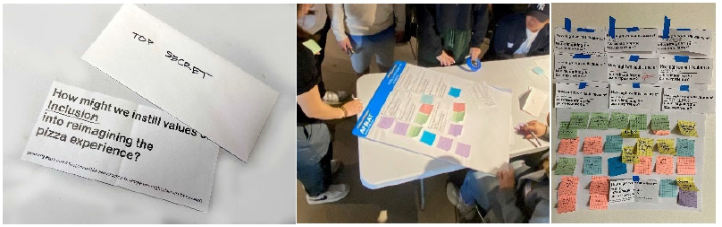
ELEVATING DIVERGENT THINKING VIA EQUITY, INCLUSION AND DIVERSITY A mindset of the IIPL Approach is to “elevate ideas through inclusivity and diversity.” After a period of divergent idea generation, each team was handed a sealed envelope labelled as “top secret.” Within the sealed envelope was an additional language stem slip that randomly included either an inclusive, equity, or diversity value to it. Teams added their new design guideline to their flip charts and continued to build upon their ideas. This, along with the previous idea generation, worked to honor the identities and stories of others which is a criteria of success in the IIPL Approach creative methodology.
Figure 7: Top secret envelope and sticky note divergent idea generation.
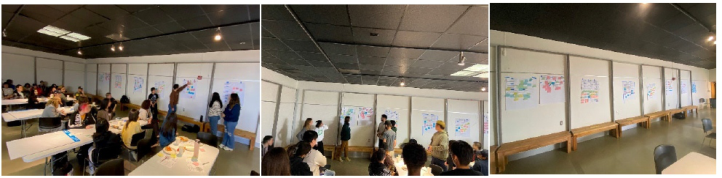
Following this session, each team mounted their flip chart page with value- based design guideline language stems and sticky note design ideas to the gallery wall. Each team shared their work by presenting their purpose and value-driven design guidelines followed by their sticky note ideas. After the share session, information on further readings related to Personal Leadership Philosophy, Design Thinking, and Creative Problem Solving (CPS) systems was shared along with information on other ways to apply their purpose and value-based lens to design.
Figure 8: Team values to design ideas share out.
DISCUSSION
The total time of the charrette event was one hour, and the designed mood of the space appeared to be a key ingredient to keeping the attention to and
the effectiveness of the exercises in the event going to the end. The Design Thinking and Creative Problem Solving (CPS) components were energetic, collaborative, fast, and tangible. The Personal Leadership Philosophy com- ponents were patient, introspective, and full of thinking and writing. These repeated transitions between lively discussion and slow introspective space elevated the exercises in divergent thinking and introspective convergent thinking accordingly (Creative Education Foundation, 2015). Another ele- ment that made a difference was the topic of pizza. It was imbued from the start as the lunch provided but also its associations of togetherness, infor- mality, and general popularity appeared to serve the exercises well. By basing the design challenge during the second half of the event on pizza, the charette integrated the experiences the participants were already having into the topic. For a longer event, there are opportunities to expand the exercises to include swapping stories related to values and/or pizza. This could build empathy and assist in fostering thinking about experiences as stories instead of a sequence of things that happen. This may also further emphasize the IIPL Approach success criteria of “honor identities and stories of others.” In this charrette format, it is recommended to have participants write their sticky note ideas as newspaper headlines. This encourages the ideas to get straight to the point and will make them easier to read from afar during the team share outs (Cre- ative Education Foundation, 2015). The sharpies used in this session were the thin type. A standard sharpie would be easier to read from distance. Another idea that came from this session would be to have participants write their favorite pizzas onto their name tags to serve as informal icebreakers upon arrival. This may work to reinforce the divergent thinking environment needed for the initial group whiteboard discussions related to experiences.
CONCLUSION
This charrette based upon the IIPL Approach creative methodology produced over 40 value-based language stems driving over 150 ideas. The combina- tion of the four criteria for success along with the two mindsets from this creative methodology provides a sandbox for curating different charrettes and modalities for experiences that create bridges between Personal Leader- ship Philosophy and applied creative systems. Its strength revolves around the ability to apply the transition between personal purpose-based values and creative systems while also honoring the values of others. Using per- sonal design guidelines developed within this approach can be layered onto a design project’s guidelines or needs to ensure the alignment between creativ- ity and values. The IIPL Approach creative methodology has the potential to be utilized in a wide range of contexts to build teams, appreciation for team members, brands, portfolios, and of course, to solve problems.
REFERENCES
Barker, H., Martin, I., Martin, W., Toossi, R., Whitcraft, C., Woelfel, W. (2014).
Sustainability: Our Community as a Living Lab. (Sustainability White Paper) Brown, T. (2019). Change by Design, Revised and Updated: How Design Thinking Transforms Organizations and Inspires Innovation. New York: Harper Business.
242 Woelfel
Cashman, K. (2017). Leadership from the Inside Out: Becoming a Leader for Life.
Massachusetts: Creative Education Foundation. Dawson, K., Cawthon, S. (n.d.). Recipe for Me. Drama-Based Instruction Activating Learning Through the Arts! Website: https://dbp.theatredance.utexas.edu/teachi ng-strategies/recipe-me. Hairston, L. (January 22, 2021). The Recipe of Me: Developing Your Personal
Mission Statement. (Presentation). IDEO.org. (2015). The Field Guide to Human-Centered Design. California: IDEO.org/Design Kit. Kamiya, M. (1966). Ikigai ni Tsuite (On the Meaning of Life). Tokyo: Misuzu Shobo. Kelley, D., Kelley T. (2013). Creative Confidence: Unleashing the Creative Potential Within Us All. New York: Crown Business. Masgo, E. (July 14, 2020). Ikigai Diagram. Management 3.0 Website: https://mana
gement30.com/blog/redefining-purpose-with-ikigai/. Osborn, A. (1953). Applied Imagination: Principles and Procedures of Creative Thinking. New York: Charles Scribner’s Sons. Osborn, A. (1979). Applied Imagination: Principles and Procedures of Creative
Problem-Solving 3rd Revised Edition. New York: Charles Scribner’s Sons. Satterfield, D., Rivera-Chang, J., Teubner, D., Tredway, T., Woelfel, W. (2021).
“Evaluating Innovation Strategies in Online Education in Higher Education.” In: Advances in the Human Side of Service Engineering, pp. 219–225. Sezer, O., Nault, K., Klein, N. (May 7, 2021). Don’t underestimate the power of kindness at work. Harvard Business Review Website: https://hbr.org/2021/05/do nt-underestimate-the-power-of-kindness-at-work.
LISTED IN THE AHFE DIGITAL BOOKSTORE CATALOGUE
Explore the complete digital volume
The Human Side of Service Engineering
Read this individual research paper free through the original publisher, or explore the full digital proceedings book.
ISBN 978-1-964867-19-9
Explore this ISBN in the AHFE Bookstore ↗Listed in the July 2026 bookstore catalogue; search by ISBN to confirm current availability · Digital book purchase optional