Shimeng Xiao, Xiaohan Tu, Long Liu (2024). Self-service Health Screening Devices Based on Community Health Management Services. In: Human Factors in Aging and Special Needs. AHFE Open Access, vol. 133, pp. 61–69. https://doi.org/10.54941/ahfe1004894
The development of primary public health services in China is facing great challenges. A shortage of family doctor resources, inadequate health awareness of residents, and low health screening coverage of residents are still the current dilemmas that primary health services face. Gradually, community health services that include a type of self-service health screening device are starting to emerge. In this context, a community is defined as a collection of individuals living in a particular geographical area with public facilities for their daily life use.In light of today's aging trends, self-service devices may be adopted by senior residents, who are the primary users of community services. Enabling seniors to manage their health more proactively can effectively prevent primary health care services from stagnating.This study aimed to explore how design can help older adults better adopt self-help sign detection devices in the community in the context of technological development. A value sensitivity research approach was used in this thesis. First, through a desktop survey and conceptual literature review, the current health care dilemma and development trends were understood, and values appreciated by each stakeholder for self-help physical sign testing in a community setting were defined. The combination of multiple interview methods was used by users to analyze information on existing self-services used to integrate the value claims of health screening devices in Shanghai to gain a more realistic view and explore potential design opportunities. Finally, the value claims were further transformed into a solution that was designed. This includes suggestions for the design of devices that can be used in the near future, for the human‒machine interaction process, for the overall service process, and for future functional expansion. The industrial design was also produced through sketches and 3D model iterations.The findings and outcomes can be used as a reference for the development and design of current or near-future self-service sign detection devices.
Community Health Management Within the Tiered Diagnosis and Treatment System Healthcare is a critical component of public welfare and directly affects the health and familial wellbeing of the populace. Amidst the balancing act of equitably distributing medical resources and safeguarding the health rights of citizens, China has enacted multiple reforms, such as the tiered diagnosis and treatment system, aimed at enhancing resource efficiency. This system is designed to allocate medical resources logically and establish a continuum of health management. Despite challenges in the grassroots medical system, in 2019, outpatient services at China’s township health clinics and com- munity health service centers accounted for merely 23.3% of the nation’s total outpatient visits, with an average of only approximately 2.22 general practitioners per 10,000 people, as stated in the Statistical Bulletin on the Development of Health and Wellness in China (Anonymous, 2020; Ma et al., 2020). Furthermore, the coverage rate for health check-ups lags behind that of developed nations, at a mere 37%, as analyzed in the China Physical Exam- ination Industry Research and Business Investment Decision Analysis Report (Anonymous, 2020). Confronted with the challenge of an aging population, which is especially pronounced in China, as of the end of 2019, the coun- try was home to approximately 254 million individuals aged 60 and above, constituting 18.1% of the total population. This figure is projected to exceed 28% by 2040 (Pang, Hu, & Yang, 2021). With chronic noncommunicable diseases emerging as a primary health concern, the health management of the elderly population has surfaced as a pivotal issue. To address these challenges, China has rolled out the “Internet + Medical Health”digital health initiative, bolstering comprehensive health services through partnerships and techno- logical innovations, such as optical sensing, to encourage the advancement of home health testing and personal health monitoring (The State Council of the People’s Republic of China, 2021). These steps highlight the need and significance of shifting from a predominantly treatment-oriented approach to a more effective health management model.
The Current State of Community Health Management China’s community health services are currently facing critical challenges: a shortage of medical staff, limited service offerings, and inadequate sup- port for preventive healthcare. This scenario has led to suboptimal preventive health check-ups, partly due to insufficient community facilities and services. Such deficiencies hinder the effectiveness of community-based family doc- tor systems, particularly in the context of China’s rapidly aging population. Addressing these issues requires leveraging advancements in internet health- care to develop user-friendly medical devices for nonprofessional settings. Prioritizing elderly people’s needs in these community health initiatives is crucial, as is enhancing vital sign monitoring and health awareness at the community level.
Self-Service Health Screening Devices Based on Community Health Management Services 63
LITERATURE REVIEW
Value-Sensitive Design Theory Value-sensitive design (VSD) serves as the principal framework for this research. A deeper comprehension of VSDs was pursued before embarking on practical research, gathering more information on value orientations and stakeholder positioning to support further studies. Introduced by Batya Fried- man in the 1990s, VSD is a design philosophy that integrates human values into the design of new technologies (Friedman & Hendry, 2019). VSD epit- omizes a human-centered design ethos that proactively incorporates human values throughout the technological design process. It has provided designers with theoretical and methodological guidance, outlining human values in a principled and systematic manner. Central to this approach is the mobiliza- tion of researchers’ ethical and technical creativity, which is deemed one of the most expansive methods for examining human value trade-offs within technology (Value Sensitive Design Lab, n.d.).
Selection and Transformation of Values The Meaning of Values In both nonacademic and academic settings, “value” generally signifies prin- ciples or standards held to be important in personal or social life, particularly in ethical and moral dimensions (Oxford English Dictionary). Friedman, the progenitor of VSD, delineates value as matters of significance to an indi- vidual’s life, focusing on ethical dimensions (Friedman et al., 2019). Values are categorized into moral, conventional, and personal domains: the moral domain encompasses normative judgments such as justice and rights; the con- ventional domain is concerned with behavioral consistency; and the personal domain involves judgments of self-governance (Turiel, 1983).
Stance on Value Selection VSD compels designers to sift through a multitude of values to construct a research panorama. The process of selecting values is inherently subjective, given that any list of values could be incomplete, a critique often leveled at VSD (Davis & Nathan, 2015). VSD adopts an interactive posture, recogniz- ing that humans shape technology and that technology reciprocally shapes human experiences and society (Miller, Friedman, & Jancke, 2007). Further- more, design processes need to address value conflicts and disagreements, and VSDs provide a framework for managing such conflicts (Friedman, Kahn, & Borning, 2013).
Critiques of Value Selection Critics point out the subjective nature of VSDs, where different stakeholders may harbor diverse expectations for the same value, resulting in solution conflicts. VSD conventionally assumes a positive valuation of technology; however, practical applications should take into account the real effects of technology on stakeholders.
Transformation of Values Employing VSDs to probe the latent effects of novel technologies can aid in discerning how technological characteristics can either support or impede value. Translating values into design stipulations implies fusing values with tangible settings, evolving into measurable design criteria. Van de Poel sug- gested a methodology for transforming values into assessment standards and then into specific attributes (Kroes & Van de Poel, 2015). This necessitates mediating value conflicts without engendering new ones, ensuring that the defined attributes are efficient, reusable, and accurate.
METHODOLOGY
Concept-Experience-Technology Ternary Research Initially, conceptual research laid the groundwork. This stage entailed two principal tasks: first, identifying stakeholders who are influenced by the implementation of technology, which included both direct and indirect participants. Second, insights into the potential values held by these stake- holders might hold in relation to their interactions with nascent technological advancements, guided by the perspectives of value-sensitive design (Ding & Du, 2020) (Jin & Shang, 2020). A thorough literature review highlighted the dichotomy faced by community health services: a scarcity of resources versus the challenges of an aging population and the urgency to foster per- sonal health management skills in anticipation of sufficient medical resource availability (Li, 2019) (Yang, Xie, & Shao, 2020).
Transitioning into the empirical research phase, built upon the conceptual foundation, we immersed ourselves in understanding stakeholders’ behav- iors, values, and demands through methodical observations and structured interviews. This phase focused on how stakeholders interpret personal val- ues within interactive contexts and navigate through the juxtaposition of conflicting values in the design decision-making process.
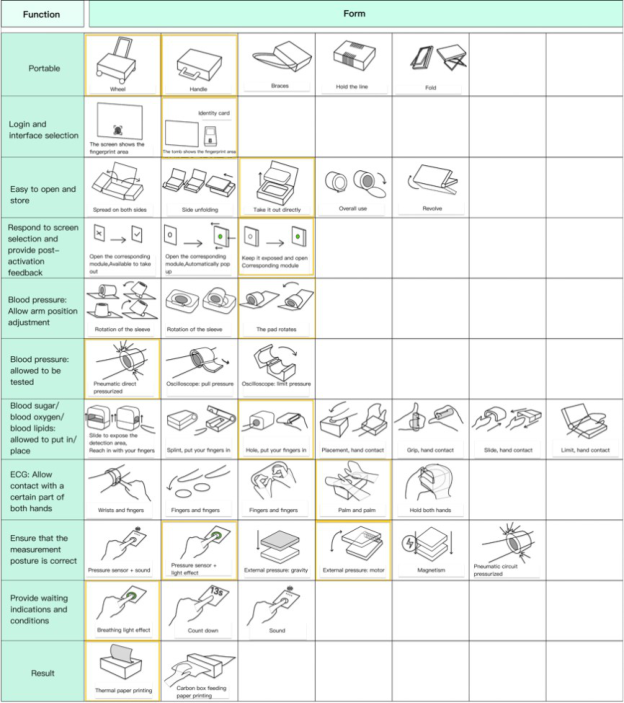
Building upon the value research previously outlined, this section explores the requisite attributes for self-service detection design. This exploration entails analyzing existing device service issues, design challenges associated with value characteristics in the usage environment, and specific features of relevant technologies. Merging findings from the technological research phase, we transformed these essential values into critical design practice ele- ments. By integrating insights across conceptual, empirical, and technological dimensions, this study scrutinized the functional forms of existing products. This thorough analysis has established a robust foundation for designing self-service health screening devices, with careful consideration given to the practical needs and ease of use for users. Our objective is to develop a product that not only fulfills the basic health management requirements of the community but is also equipped to keep pace with rapidly evolving technology.
Self-Service Health Screening Devices Based on Community Health Management Services 65
Figure 1: Product function-form diagram.
Design of Self-Service Testing Equipment Value Proposition in PSS Design In the context of product service system (PSS) design, our study identifies crit- ical user needs through observations at self-service health stations in Shanghai and interviews with key stakeholders. The findings emphasize the importance of accessibility, cost-efficiency, perceived usefulness, usability, and comfort aligned with a community-centric approach in health products.
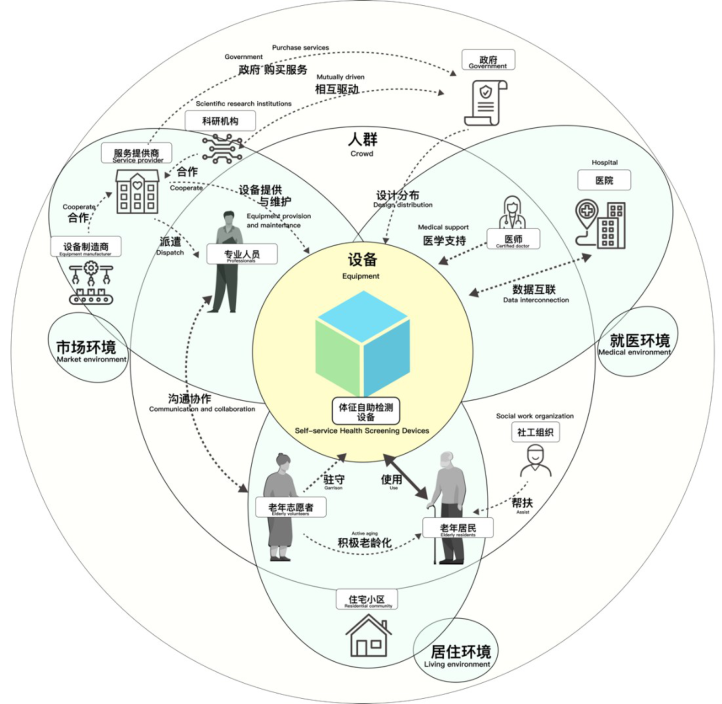
Future Multi-Level Distributed Community Sign Detection Service System The proposed model introduces a tiered system of health monitoring devices, providing a range of services from basic health checks near residences to spe- cialized screenings for chronic diseases at community centers. Basic health metrics such as blood pressure and glucose levels demand devices that are easily accessible, simple to use, and maintained by community volunteers. In contrast, screenings for complex chronic conditions are centralized at community service points with professional support.
Figure 2: Current equipment system location map
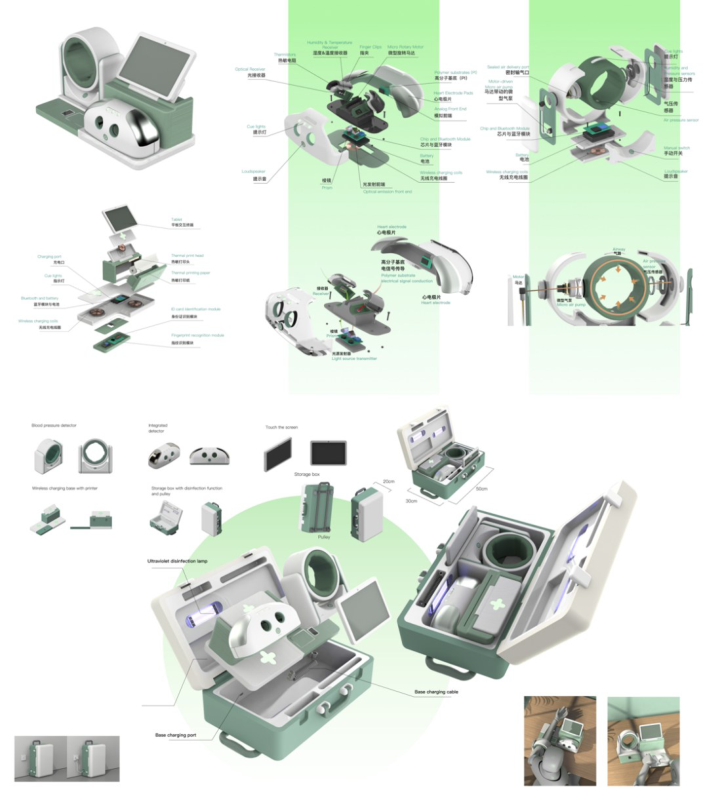
Design Practice for Self-Service Vital Signs Monitoring The design process begins with the integration of various detection technolo- gies into user-friendly devices. It aims to simplify operations and enhance usability, particularly for older users. The key design features include:
Integrated detection technologies for a simplified and efficient health monitoring process.
A shift from traditional medical product design to a more inclusive and community-friendly approach.
Enhanced accessibility and usability, catering to older adults and ensuring inclusivity for all community members.
Self-Service Health Screening Devices Based on Community Health Management Services 67
Figure 3: Concept rendering of the final scheme.
DISCUSSION
Self-service vital sign monitoring devices have emerged as crucial tools for bridging the gap in community health management, particularly given the nuanced needs of an aging population. These devices offer enhanced acces- sibility and professionalism, and the integration of gerontechnology has transformative potential, especially for elderly people. This study’s experi- mental phase has revealed stakeholders’ value demands and envisioned the future with tiered service models in line with advancements in extracor- poreal testing technology and societal aging trends. However, challenges abound in transitioning from concept to community-wide implementation, notably limited user feedback due to the pandemic’s impact on healthcare delivery and insufficient sample sizes in empirical research. These challenges underscore the need for a flexible, iterative design process responsive to the
growing needs of an aging population increasingly susceptible to chronic noncommunicable diseases.
CONCLUSION AND FUTURE WORK This study, grounded in value-sensitive design, investigated the evolving service models of self-service vital sign monitoring devices through litera- ture reviews and interviews. This study suggested a user-friendly design for basic monitoring, which is crucial for active aging and chronic disease man- agement. The research acknowledges certain limitations, including limited practical application during the pandemic and a narrow focus on elderly participants.
Future directions involve using mixed methods to understand user needs and device usage comprehensively and integrating advanced data analytics and AI for enhanced performance and personalized health recommendations. Future studies aim to incorporate these devices effortlessly into older adults’ lives, fostering active aging and improving their autonomy and quality of life. As healthcare moves toward a digital model, such devices, combined with gerontechnology, will be key to ongoing health management, aligning with the WHO’s health goals. Economic, privacy, and ethical aspects will be crucial in developing a digitally inclusive healthcare system for the aging population.
ACKNOWLEDGMENT
The authors would like to acknowledge and thank everyone involved in making these projects successful—in particular, the Residents of Hehai Com- munity and the students and staff of the product design department at the College of Design and Innovation, TongJi University.
REFERENCES
Anonymous. (2020). Statistical Bulletin on the Development of Health and Wellness in China 2019 [R]. Department of Planning and Information. Anonymous.2018–2019 China Physical Examination Industry Research And Busi-
ness Investment Decision Analysis Report[R]. IiMedia, 2020. Cheng, Z. (2018). A study on the factors influencing the continuous participation of elderly volunteers in community volunteer services and its practical path [D]. Chongqing University. Davis, J., & Nathan, L. P. (2015). Value sensitive design: Applications, adaptations,
and critiques. In Handbook of ethics, values, and technological design: Sources, theory, values and application domains (pp. 11–40). Ding, X., & Du, J. (2020). The basic principles of service design: From user-centered to stakeholder-centered. Decoration, (03), 62–65. Friedman, B., & Hendry, D. G. (2019). Value Sensitive Design: Shaping Technology
with Moral Imagination. The MIT Press. Friedman, B., Kahn, P. H., & Borning, A. (2013). Value Sensitive Design and Information Systems. In M. H. Hoven, J. Van den, & I. Van de Poel (Eds.), Dordrecht: Springer Netherlands. https://doi.org/10.1007/978-94007-7844-3_4
Self-Service Health Screening Devices Based on Community Health Management Services 69
Jin, C., & Shang, L. (2020). Research progress in the application of stakeholder theory in chronic disease nursing. Journal of Nursing, 35(23), 102–105. Kroes, P., & Van de Poel, I. (2015). Design for values and the definition, speci-
fication, and operationalization of values. In Handbook of Ethics, Values, and Technological Design. Springer. Li, X. (2019). Inclusive design: A public space renewal strategy aimed at the community goals of all ages. Urban Development Studies, 26(11), 27–31. Ma, X., Yu, X., Yu, J., et al. (2020). China Health and Healthcare Statistics Yearbook
2019 [R]. National Health Commission. Miller, J. K., Friedman, B., & Jancke, G. (2007). Value tensions in design: The value sensitive design, development, and appropriation of a corporation’s groupware system. In Proceedings of the 2007 international ACM conference on Supporting group work - GROUP ‘07 (p. 281). Sanibel Island, Florida, USA: ACM Press. http://portal.acm.org/citation.cfm?doid=1316624.1316668 Pang, G., Hu, C., & Yang, Z. (2021). China’s population aging trend and counter-
measure. Chinese Journal of Geriatric Care, 19(1), 3–5. The State Council of the People’s Republic of China. (2021, June 17). Key tasks for deepening the reform of the medical and health system in 2021 [EB/OL]. Retrieved July 6, 2021, from http://www.gov.cn/zhengce/content/202106/17/cont ent_5618799.htm Turiel, E. (1983). The Development of Social Knowledge: Morality and Convention.
Cambridge University Press. Value Sensitive Design Lab. (n.d.). Retrieved January 20, 2021, from https://vsdesi gn.org/. Yang, H., Xie, C., & Shao, W. (2020). The current situation and prospects of the
development of preventive medicine and public health management. Guide of China Medicine, 18(29), 25–26+29.
LISTED IN THE AHFE DIGITAL BOOKSTORE CATALOGUE
Explore the complete digital volume
Human Factors in Aging and Special Needs
Read this individual research paper free through the original publisher, or explore the full digital proceedings book.
ISBN 978-1-964867-09-0
Explore this ISBN in the AHFE Bookstore ↗Listed in the July 2026 bookstore catalogue; search by ISBN to confirm current availability · Digital book purchase optional