Zhen Zhao, Qian Mao, Yun Hei Chak, Trudy Cheung, Hailiang Wang (2024). Overcoming Obstacles: Examining User Resistance to Home-based Health Monitoring Systems among Older Adults. In: Human Factors in Aging and Special Needs. AHFE Open Access, vol. 133, pp. 128–135. https://doi.org/10.54941/ahfe1004901
Home-based Health Monitoring Systems (HHMSs) have rapidly emerged as a promising tool for health management among older adults. By providing real-time, easily accessible health information, HHMSs can facilitate proactive health management and potentially improve health outcomes for older adults. However, despite the potential benefits of this technology, its adoption by older adults remains a complex challenge. Older adults’ unique perceptions and attitudes toward technology often create barriers to effectively using these systems. While numerous studies have explored the factors affecting technology acceptance among older adults, there is a relative lack of research into the factors contributing to resistance towards health monitoring technologies. The present study aims to fill this gap by investigating the factors influencing older adults’ resistance to HHMSs. To this end, the study integrates two key theoretical frameworks: status quo bias theory and task-technology fit theory. We conducted an empirical study investigating factors influencing older adults’ resistance to HHMSs. Data was collected from 483 seniors aged 55 and above through an online survey. Based on this data, a structural model of user resistance was proposed and tested using the partial least squares structural equation modeling (PLS-SEM) method. The results revealed that inertia and technology anxiety accounted for 43.5% of the variance in user resistance. Among these factors, technology anxiety was found to strongly impact user resistance (p < 0.01), suggesting that fears or apprehensions about using the technology can significantly deter older adults from adopting HHMSs. The study also found that inertia, switching costs, and switching benefits significantly influenced technology anxiety (all p values < 0.01). When older adults perceive higher benefits and lower costs of switching to a new technology, they may experience lower anxiety. Furthermore, if the required task and technology are fit, they are more willing to switch to the new technology. It’s worth noting that the study found that task-technology fit did not significantly affect technology anxiety and user resistance (p > 0.05), suggesting that even if a technology perfectly aligns with an older adult’s tasks, it may not necessarily reduce their anxiety or resistance towards it. This study dedicated that the development of HHMS should consider the relationship between task characteristics and technology capabilities, identify tasks in specific contexts, and gain insight into older adults’ emotional and psychological anxieties. It also provides valuable insights into designing effective, user-friendly, and easy-to-use systems for older adults.
Overcoming Obstacles: Examining User Resistance 129
INTRODUCTION
In recent years, home-based health monitoring systems (HHMSs) have emerged as a promising approach to promoting health and well-being, espe- cially among older adults. These systems use sensing technology to create an intelligent environment that continuously monitors and evaluates users’ daily activities, sleep patterns, physiological signals, and other health parameters (Liu et al., 2016; Mshali et al., 2018). The benefits of HHMSs for older adults include improved convenience, enhanced engagement in self-care, and timely detection of health problems (Reeder et al., 2013). However, despite the potential advantages, adopting health management information systems in the health management of older adults still faces significant challenges. A crit- ical issue that needs to be addressed is user resistance to health management information systems, which refers to older adults’ reluctance or hesitancy to accept and use new technology (Kim & Kankanhalli, 2009). Older adults with limited exposure to advanced digital devices may feel overwhelmed or intimidated by the complexity of new technologies. They may question the potential benefits or drawbacks of new technologies and whether these innovations will improve their quality of life or create additional challenges (Vaportzis et al., 2017). In addition, the status quo bias is particularly preva- lent among older adults, who demonstrate a higher propensity to maintain existing situations or adhere to familiar choices instead of exploring alter- native possibilities. This bias is influenced by cognitive inertia, aversion to uncertainty, and loss aversion (Sproten et al., 2018). While most researchers have focused on improving technology functionality and efficiency, few stud- ies have delved into task and technology characteristics’ role in older adult users’ resistance to home health management systems. Hence, it is crucial to understand the factors that effectively overcome user resistance from the perspective of task-technology fit. By considering status quo bias theory and task-technology fit as theoretical foundations, this study explored the fac- tors that affect user resistance towards HHMSs. The findings will provide valuable recommendations to healthcare professionals, technology develop- ers, and policymakers to better design and implement HHMSs that align with older adults’ needs and preferences, ultimately improving their health outcomes and quality of life.
THEORETICAL BACKGROUND AND RESEARCH HYPOTHESES User Resistance
In information technology, user resistance is defined as the phenomenon where individuals show reluctance, opposition, or hesitancy to adopt or accept new technologies or systems (Kim & Kankanhalli, 2009). It can significantly impact the success of a technology implementation or change initiative. It also can hinder user adoption and effective utilization of new technologies or systems or even lead to the failure of intended outcomes. According to Kling (1980), users may resist changes due to personal beliefs, values, attitudes, and understanding of new technologies. In the case of older adults, anxiety is one of the main reasons they resist using new technology
(Mariano et al., 2022; Venkatesh & Davis, 2000). Compared with younger generations, older adults may have less access to or familiarity with technol- ogy, and the cost of learning to use new technologies is higher, which may make them feel uncertain, fearful, or frustrated when using digital devices or adapting to new technologies (Tsai et al., 2020). Based on these arguments, we proposed the following hypothesis: H1. Technology anxiety positively correlates with older adults’ resistance to the HHMS.
Status Quo Bias Theory Status quo bias (SQB) theory reflects an individual’s tendency to dispropor- tionately prefer the actual situation (Samuelson & Zeckhauser, 1988). This theory holds that individuals naturally prefer the current state of affairs or existing situation over potential changes or alternatives. Each individual’s cognitive biases can lead to resistance when adopting new behaviors or mak- ing changes, further affecting decision-making. One of the critical factors is switching costs, which are the effort, time, resources, or potential disadvan- tages required to transition from a current state to an alternative (Kim & Kankanhalli, 2009). These costs may include financial outlay, learning curve, system reconfiguration, or loss of familiarity. When switching costs are per- ceived to be high, individuals are more likely to resist change and adhere to the status quo. On the other hand, switching benefits refer to the advantages or perceived benefits an individual expects to gain by switching from the cur- rent state to an alternative (Kim & Kankanhalli, 2009). These benefits may include increased efficiency, cost savings, enhanced functionality, or better results. When the perceived benefits of switching are low or uncertain, indi- viduals may be less motivated to change and prefer to maintain the status quo. Based on these arguments, the following hypotheses are proposed:
H2. Switching benefits negatively correlate with the technology anxiety of the HHMS.
H3. Switching costs positively correlate with the inertia of the HHMS. H4. Switching costs positively correlate with older adults’ resistance to the HHMS.
Inertia is the tendency to maintain existing habits or behaviors due to a lack of motivation or resistance to change (Samuelson & Zeckhauser, 1988). Eidelman and Crandall (2012) believed that inertia can stem from previous habits, fear of the unknown, and stability preference. Inertia causes individ- uals to resist new ideas, technologies, or practices, preferring to maintain the status quo rather than explore alternatives. Based on these arguments, the following hypotheses are proposed: H5. Inertia positively correlates with the technology anxiety of the HHMS. H6. Inertia positively correlates with older adults’ resistance to the HHMS.
Task-Technology Fit Theory Task-technology fit (TTF) theory provides a way to quantify the effectiveness of technology in a system by assessing the relationship between the technol- ogy and the tasks the technology is intended to support (Spies et al., 2020).
Overcoming Obstacles: Examining User Resistance 131
Precisely, this theory mainly measures the fit between the characteristics of the technology and the tasks required by users. The dimension of task characteristics refers to specific attributes of a task, such as its complexity, interdependence, and level of routine. The dimension of technology charac- teristics focuses on the characteristics and functions of the technology used to perform the task. It includes factors such as ease of use, compatibility with existing systems, flexibility, and reliability (Goodhue & Thompson, 1995). Based on these arguments, the following hypotheses are proposed.
H7. Task characteristics positively correlate with the task-technology fit of the HHMS.
H8. Technology characteristics positively correlate with the task- technology fit of the HHMS.
H9. Task-technology fit positively correlates with the switching benefits of the HHMS.
H10. Task-technology fit negatively correlates with the technology anxiety of the HHMS.
H11. Task-technology fit negatively correlates with older adults’ resistance to the HHMS.
METHODS
Participants and Data Collection The study collected data on a professional web-based platform through con- venience sampling. Individuals above 55 were eligible to participate in the study. The participants were informed that none of their personal information would be collected. Among the 525 samples received, 483 valid responses were used for data analysis (Table 1). The construct items were rated on 5-point Likert scales, ranging from “1 = strongly disagree” to “5 = strongly agree”.
Table 1. Demographic characteristic (n = 483).
Table available in the original PDF paper.
Characteristics Items Frequency Percent (%) Gender Male 246 50.8 Female 237 48.9 Education Junior high school 32 6.6 Senior high school 179 36.9 College 131 27.0 University 126 26.0 Master/Doctor 15 3.0 Living status Alone 26 5.30 With relatives or friends 27 5.50 With partner 428 88.4 Nursing home 2 0.4 Marital status Single 8 1.6 Married 460 95.0 Divorced 4 0.8 Widowed 11 2.2
DATA ANALYSIS Partial least squares structural equation modeling (PLS-SEM) was adopted to verify the causal relationship between the variables in the measurement model (Chin, 1998). All of the analyses were conducted in SmartPLS 4.0. The rationale for using PLS-SEM instead of ordinary regression analysis is to consider formative constructs. This higher-order construct helps to under- stand the theoretical model better. The study examined the structural model by calculating the path coefficients and statistical significance. Apart from that, the R2 values were calculated to explain the amount of variance caused by the independent variables.
RESULTS AND DISCUSSION
Measurement Model As shown in Table 2, the reliability and validity of the constructs were analyzed by Cronbach’s alpha, Composite Reliability (CR), and Average Vari- ance Extracted (AVE). The Cronbach’s alpha values of most constructs were greater than 0.7, indicating acceptable reliability. Additionally, the item load- ings and CR values for all constructs were greater than 0.7, and all AVEs were above 0.5, indicating that the constructs had good convergent validity.
Table 2. Reliability and convergent validity of the constructs.
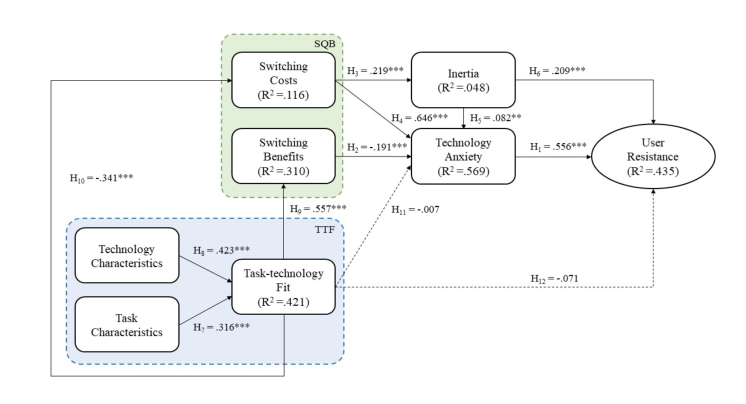
Figure 1 illustrates the results of the research model about factors influencing user resistance toward HHMSs among older adults.
The results showed that technology anxiety (path coefficient = 0.556; p < 0.001) and inertia (path coefficient = 0.209; p < 0.001) have significant relationships with user resistance. Therefore, H1 and H6 were supported. Moreover, H2, H4, and H5 were supported, which indicate that switch- ing benefits (path coefficient = −0.191; p < 0.001), switching costs (path coefficient = 0.646; p < 0.001), and inertia (path coefficient = 0.082; p < 0.01) have significant relationships with technology anxiety. In the case of TTF theory, the results showed that H7 and H8 were supported, indi- cating that task characteristics (path coefficient = 0.316; p < 0.001) and technology characteristics (path coefficient = 0.423; p < 0.001) have positive
Overcoming Obstacles: Examining User Resistance 133
significant relationships with task-technology fit in our model. Furthermore, H9 and H10 were supported, indicating a positive significant relation- ship between task-technology fit (path coefficient = 0.557; p < 0.001) and switching benefits. There is a negative significant relationship between task- technology fit (path coefficient = −0.341; p < 0.001) and switching costs. However, task-technology fit has no significant relationship with technol- ogy anxiety (path coefficient = −0.007; p > 0.05) and user resistance (path coefficient = −0.071; p > 0.05). Therefore, H11 and H12 were not supported.
Figure 1: The results of the research model (Note: R2 denotes the amount of variance explained by the associated variables. *p < 0.05, **p < 0.01, ***p < 0.001).
Based on the SQB theory, the model revealed that inertia and technology anxiety accounted for 43.5% of the variance in user resistance, indicating that older adults prefer the status quo and may experience anxiety or appre- hension towards HHMSs. This finding is consistent with previous studies (Chi et al., 2020; Tsai et al., 2019). Researchers and developers can improve older adults’ acceptance of HHMSs by reducing technology anxiety, such as by providing targeted support, education, and user-friendly designs to help alleviate their concerns and increase their confidence in using technology. In addition, task-technology fit significantly impacts switching benefits and switching costs, indicating that older people are more likely to experience greater switching benefits when health monitoring tasks are highly aligned with technology. These benefits may include increased efficiency in health monitoring, convenience in health management, or improved health out- comes. In contrast, when the fit between the health monitoring task and the technology is low, older adults are more likely to perceive switching costs as higher. These costs may include the effort, time, and resources required to transition to a different technology and learning costs.
However, although TTF can be used to predict the acceptance of many information technologies in previous research (Kang et al., 2022; Wang et al.,
2020), our findings indicate that the lack of significant impact of task- technology fit on technology anxiety and user resistance among older adults are thought-provoking. While task-technology fit is undoubtedly crucial for optimizing the performance and efficiency of the HHMS, it appears that it may not directly influence the anxiety and resistance experienced by older adults when engaging with technology. Researchers and developers may need to consider additional factors to develop effective strategies, such as per- sonal perceptions, prior experience, cognitive abilities, and attitudes toward technology.
CONCLUSION
This study contributes to human factors research by proposing and eval- uating a model that explains 43.5% of the variance in user resistance to HHMSs. The findings highlight the need for researchers and developers to understand the complex factors contributing to technology anxiety and user resistance in older adults. Although task-technology fit is critical to increasing the benefits of switching to new technologies, its direct impact on technology anxiety and user resistance in older adults may be limited. By taking an inte- grated approach, researchers and developers can develop effective strategies to address older adults’ challenges, increase their confidence in technology, and promote their acceptance and adoption of digital health interventions.
ACKNOWLEDGMENT
This work was partially supported by the grant from The Hong Kong Poly- technic University [grant no.: P0045769] and the TCL Corporate Research (HK) [grant no.: P22-0084].
REFERENCES
Chi, W.-C., Lin, P.-J., Chang, I.-C., & Chen, S.-L. (2020). The inhibiting effects of resistance to change of disability determination system: a status quo bias perspective. BMC medical informatics and decision making, 20, 1–8. Chin, W. W. (1998). The partial least squares approach to structural equation
modeling. Modern methods for business research, 295(2), 295–336. Eidelman, S., & Crandall, C. S. (2012). Bias in favor of the status quo. Social and Personality Psychology Compass, 6(3), 270–281. Goodhue, D. L., & Thompson, R. L. (1995). Task-technology fit and individual
performance. MIS quarterly, 213–236. Kang, H.-J., Han, J., & Kwon, G. H. (2022). The Acceptance Behavior of Smart Home Health Care Services in South Korea: An Integrated Model of UTAUT and TTF. International journal of environmental research and public health, 19(20), 13279. Kim, H.-W., & Kankanhalli, A. (2009). Investigating user resistance to information
systems implementation: A status quo bias perspective. MIS quarterly, 567–582. Kling, R. (1980). Social analyses of computing: Theoretical perspectives in recent empirical research. ACM Computing Surveys (CSUR), 12(1), 61–110.
Overcoming Obstacles: Examining User Resistance 135
Liu, L., Stroulia, E., Nikolaidis, I., Miguel-Cruz, A., & Rincon, A. R. (2016). Smart homes and home health monitoring technologies for older adults: A systematic review. International journal of medical informatics, 91, 44–59. Mariano, J., Marques, S., Ramos, M. R., Gerardo, F., Cunha, C. L. d., Girenko, A.,
Alexandersson, J., Stree, B., Lamanna, M., & Lorenzatto, M. (2022). Too old for technology? Stereotype threat and technology use by older adults. Behaviour & Information Technology, 41(7), 1503–1514. Mshali, H., Lemlouma, T., Moloney, M., & Magoni, D. (2018). A survey on health monitoring systems for health smart homes. International Journal of Industrial Ergonomics, 66, 26–56. Reeder, B., Meyer, E., Lazar, A., Chaudhuri, S., Thompson, H. J., & Demiris, G.
(2013). Framing the evidence for health smart homes and home-based consumer health technologies as a public health intervention for independent aging: A systematic review. International journal of medical informatics, 82(7), 565–579. Samuelson, W., & Zeckhauser, R. (1988). Status quo bias in decision making. Journal of risk and uncertainty, 1, 7–59. Spies, R., Grobbelaar, S., & Botha, A. (2020). A scoping review of the application of
the task-technology fit theory. Conference on e-Business, e-Services and e-Society, Sproten, A. N., Diener, C., Fiebach, C. J., & Schwieren, C. (2018). Decision making and age: Factors influencing decision making under uncertainty. Journal of Behavioral and Experimental Economics, 76, 43–54. Tsai, J.-M., Cheng, M.-J., Tsai, H.-H., Hung, S.-W., & Chen, Y.-L. (2019). Accep-
tance and resistance of telehealth: The perspective of dual-factor concepts in technology adoption. International Journal of Information Management, 49, 34–44. Tsai, T.-H., Lin, W.-Y., Chang, Y.-S., Chang, P.-C., & Lee, M.-Y. (2020). Technology anxiety and resistance to change behavioral study of a wearable cardiac warming system using an extended TAM for older adults. PloS one, 15(1), e0227270. Vaportzis, E., Giatsi Clausen, M., & Gow, A. J. (2017). Older adults perceptions of
technology and barriers to interacting with tablet computers: a focus group study. Frontiers in psychology, 8, 1687. Venkatesh, V., & Davis, F. D. (2000). A theoretical extension of the technology acceptance model: Four longitudinal field studies. Management science, 46(2), 186–204. Wang, H., Tao, D., Yu, N., & Qu, X. (2020). Understanding consumer accep-
tance of healthcare wearable devices: An integrated model of UTAUT and TTF. International journal of medical informatics, 139, 104156.
LISTED IN THE AHFE DIGITAL BOOKSTORE CATALOGUE
Explore the complete digital volume
Human Factors in Aging and Special Needs
Read this individual research paper free through the original publisher, or explore the full digital proceedings book.
ISBN 978-1-964867-09-0
Explore this ISBN in the AHFE Bookstore ↗Listed in the July 2026 bookstore catalogue; search by ISBN to confirm current availability · Digital book purchase optional