Jiaxin Liu, Changming Tang (2024). Chinese nursing home design studies based on changes in design formal language. In: Human Factors in Aging and Special Needs. AHFE Open Access, vol. 133, pp. 105–115. https://doi.org/10.54941/ahfe1004899
1 BackgroundBased on the current structural shortage of labor force and serious shortage of caregivers in China's elderly and medical services [1], the future demand for elderly care services for the elderly population is also increasingly strong [2]. At present, the proportion of Chinese elderly people living in elderly care institutions is 0.73%, which reflects that there are still some obstacles to the general acceptance of elderly care institutions by Chinese elderly people. Combined with the theory of environmental psychology, it can be seen that the environment can have an impact on behavior, psychology and other aspects, so the scientific shaping of space is inextricably linked to the enhancement of the user's spatial acceptance. Based on this, this study discusses the development history, development status and future development trend of nursing home design in China, and explores the innovative development path of nursing home design in the future. It aims to improve the acceptance and willingness to use nursing homes by the elderly and their families through optimization at the design level, so as to alleviate the current aging problem in China and the world.2 MethodDesign form language, is a kind of abstract language that can cover the design concept, design strategy, is a logical combination of structure, color, material and other figurative language in design. The change of design form language is often closely related to the change of user needs, the development of the industry now, etc. Citespace can present the structure of knowledge, the situation of information in the form of graphical distribution [3], and combined with the resulting graphs to analyze the disciplinary structure of the field of study related to the discipline structure, the hot frontier and other laws [4]. In view of the fact that the keyword maps that can be directly generated by importing literature data in Citespace cannot accurately represent the design form language explored in this study, this study organizes the design form language of each piece of literature in the valid title data for the titles, keywords, and abstracts of the 253 pieces of literature in the CNKI database, respectively.3 ResultThis study combines the data processing results of the design form language to produce three results related to the development of nursing home design in China. First, the development history of nursing home design in China is divided into three stages: the "starting period", the "high speed development period" and the "innovation enlightenment period", and there is still much room for development. Secondly, from the current development status of Chinese nursing home design, the concentration of current research is high, which also proves that the innovation of Chinese nursing home design is low at this stage. In addition, the research hotspots are mainly "people-oriented" and "integration of medical and nursing care", which reflects the current Chinese nursing home design's emphasis on the physiological and psychological needs of the elderly, and conforms to the current Chinese government's guidelines for nursing homes. Thirdly, "multi-dimensional consideration of user needs", "optimization of nursing home living mode through spatial design", and "exploration of cutting-edge fields" are proposed, The four suggestions on the direction of future development of nursing home design in China are "multi-dimensional consideration of users' needs", "optimization of living mode through spatial design", "exploration of frontier fields", and "in-depth combination of theory and practice".4 ConclusionThis study applies Citespace to analyze the literature about design form language visualization mapping in the field of Chinese nursing home design in the past 15 years, and according to the changing law of design form language, we have launched a study on the development history, development status, and future development trend of China's nursing home design, and obtained four directions of the future of China's nursing home design that are worth developing and studying in depth, which provides a directional guideline for the research of China's nursing home design.References[1] Zuo Meiyun. Meaning and mode of smart aging[J]. China Social Work,2018(32):26-27.[2]Wang Min. Research on nursing home design based on geriatric psychology[D]. Southwest Jiaotong University,2016.[3]Chen Yue,Chen Chaomei,Liu Zeyuan et al. Methodological functions of CiteSpace knowledge graph[J]. Science Research,2015,33(02):242-253.DOI:10.16192/j.cnki.1003-2053.2015.02.009.[4] Du Shuxing,Peng Liping,Lian Lilin. Current status of foreign industrial design research based on CiteSpace econometric analysis[J]. Journal of Graphics,2017,38(06):876-880.
The changes in design language are often closely related to changes in user needs and the current development of the industry. Taking the design of Chi- nese nursing homes as an example, Wang (2019) explores a truly suitable rehabilitation landscape design method for elderly care institutions based on the neglect of the physiological, psychological, and behavioral needs of the elderly population in Chinese nursing homes, combined with environmen- tal psychology, plant therapy, horticultural therapy, mobile concept theory, and behavioral and psychological needs of the elderly. Li (2020) conducted research on the architectural design of elderly care institutions under the medical and elderly care integration model, based on the current situation that traditional single-function elderly care institutions are no longer able to meet the current elderly care needs in the context of Chinese increasingly aging society. Shan, Yu & Qin (2023) proposed optimization and improve- ment suggestions for elderly care institutions in the post-epidemic era based on alleviating the psychological pressure caused by the closed management of the epidemic on the elderly and promoting the construction of a healthy
environment for the elderly. Therefore, based on the analysis of the chang- ing characteristics and paths of design formal language, this study discusses the development process, current situation, and future development trends of Chinese nursing home design. Intended to provide directional guidance for subsequent nursing home design through further in-depth research on the development of nursing home design.
Based on the serious phenomenon of “getting old before getting rich” in Chinese current aging population, the structural shortage of elderly care and medical service labor force, and the serious shortage of nursing staff, the demand for elderly care services among the elderly population is becoming increasingly strong (Zuo, 2018, p. 26, Wang, 2016). Nursing homes and other elderly care institutions cannot effectively cope with the rapidly devel- oping aging situation in China, alleviate the burden of family elderly care, and improve the elderly care experience for the elderly population. Accord- ing to the research results of China Elderly Care Weekly, the proportion of elderly people living in elderly care institutions in China is 0.73%, which indirectly reflects that there are still certain obstacles to the general accep- tance of elderly care institutions among Chinese elderly people and a certain stage of development is still needed. According to the theory of environmen- tal psychology, the environment we shape has a significant impact on our behavior, psychology, and other aspects. Therefore, the scientific shaping of space is closely related to the improvement of user space acceptance. Based on this, this study starts with formal language and researches the design of nursing homes, sorting out the relationship between the current development status of nursing home design and the general acceptance of nursing homes, and exploring innovative development paths for future nursing home design.
METHODS
This article is based on the design research of Chinese nursing homes with changes in formal language, using Citespace software as a visual analysis tool. Trough using Citespace, the information can be present into the form of a graph distribution (Chen et al., 2015), and it also can combine the obtained graph to analyze the discipline structure, hot topics, and frontiers in the rel- evant fields of this study (Du, Peng & Lian 2017). There have been some studies on Citespace visualization knowledge graphs in the field of design in China, which mainly involve comparisons between domestic and foreign research, research hotspots, analysis of research status, and prospects for development. Zhou & Yao (2023) utilized the functions of category anal- ysis, institutional analysis, keyword co-occurrence analysis, and keyword detection in Citespace to compare and analyze participatory design at home and abroad in terms of spatiotemporal relationships, publishing institutions, publishing fields, and journals, research hotspots, and development trends. Lou & Zheng (2022) utilized Citespace to analyze the research hotspots and frontiers of community renewal in China and provided prospects for the future. Zhou et al. (2022) used keyword co-occurrence analysis in Cites- pace to investigate the current research status and development prospects of elderly-friendly smart homes in China. All have produced excellent research results, enriching the research achievements in the field of design. However,
Chinese Nursing Home Design Studies Based on Changes in Design Formal Language 107
there is currently no research on visual knowledge graphs related to nurs- ing homes and other elderly care institutions. Based on this, this article uses Citespace software to visually analyze the formal language of nursing home design, aiming to conduct research on the development history, current sta- tus, cutting-edge hotspots, and prospects of nursing home design by analyzing the network graph, timeline clustering graph, and clustering time zone graph of the formal language of nursing home design. It aims to explore the design laws of nursing homes more systematically and deeply, And based on existing research, find breakthroughs in optimizing the design of nursing homes.
Search Strategy The data for this study was obtained from an advanced search in the CNKI database using the keywords “Theme=Nursing Home*Space Design” or “Title=Nursing Home*Space Design”. The time slot is from January 2008 to November 2023. The search was conducted on November 2, 2023, with all literature selected as the source category, resulting in a total of 303 initial citation data.
Data Processing Strategy Based on the fact that the knowledge graph directly generated by import- ing literature data in Citespace cannot accurately represent the design formal language discussed in this study, and contains many vocabulary that can- not reflect the design form. This study combined the title, keywords, and abstract of each piece of literature to organize the design formal language of 253 valid entries. Given the previous definition of formal language, this study focuses on extracting “design methods and strategies”, “design concepts”, and “design theories” from the design formal language involved in each lit- erature. During the process of refining the design formal language of 253 valid literature, many design formal languages with different expressions but similar meanings were found. Therefore, based on representative literature in this field, this study unifies and integrates the design formal language with the same meaning mentioned in 253 valid literature on terms such as “design methods and strategies”, “design concepts”, “design theory”, etc. Finally, this study extracted a total of 55 design formal languages (Appendix 1).
RESULTS AND ANALYSIS Analysis of Research and Development History
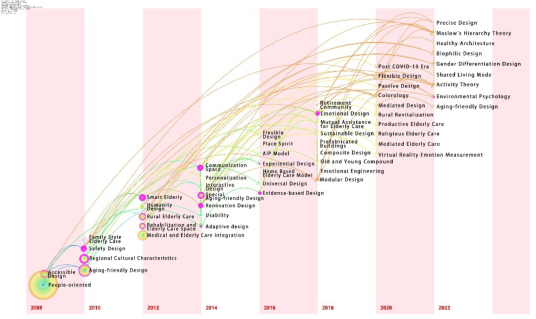
The time zone graph of language clustering for the design of Chinese nursing homes (Figure 1) shows the time period when the design formal language first appeared in related research, which can indirectly reflect the development process of research in the relevant field. According to the time zone graph of language clustering for the design of Chinese nursing homes (Figure 1), it can be seen that the development of nursing home design in China has
108 Liu and Tang
gone through three stages of development. The first stage is the initial stage of development (2008–2011), with an average of 1.5 new design formal lan- guages emerging each year. During this stage, the formal language involved in the research of nursing home design in China is mostly related to the spatial design methods themselves, such as “Accessible Design”, “Aging- friendly Design”, “Safety Design”, etc., which are mostly the basis of nursing home design research and have a lot of correlation and integration with subsequent research content, with less involvement in the interdisciplinary or theoretical introduction. The second stage is a period of rapid develop- ment (2012–2019), with an average of 3.5 new design formal languages emerging each year. During this stage, the number of new design formal lan- guages has shown a stable growth trend. Among them, formal languages such as “Smart Elderly Care”, “Medical and Elderly Care Integration”, and “Virtual Reality Emotion Measurement” involve a wide range of interdisci- plinary fields. In addition, a large number of specific design strategies have emerged in the formal language of this stage, with a focus on the physiolog- ical needs of the elderly population, proving that research in this field has begun to pay more attention to the special physiological needs of the elderly population and provide guidance for design practice. The third stage is the innovation enlightenment stage (2020-2023), with an average of 4.75 new design formal languages emerging each year. The number of new design for- mal languages in this stage is still relatively high. Different from the second stage of development, the design language of the third stage incorporates many psychological theories and cultural design strategies such as “Colorol- ogy”, “Religious Elderly Care”, “Virtual Reality Emotion Measurement”, and “Maslow’s Hierarchy Theory”, with a focus on the psychological and spiritual cultural needs of the elderly population. In addition, compared to the second stage, there is less correlation between this stage and the basic design of formal language in this field, which indirectly proves that research on the basic design of formal language in this field has been relatively sufficient, reflecting that research in this field has begun to enter the stage of innovation enlightenment, and there is still great room for innovative development.
Figure 1: Language clustering time zone graph of chinese nursing home design forms.
Chinese Nursing Home Design Studies Based on Changes in Design Formal Language 109
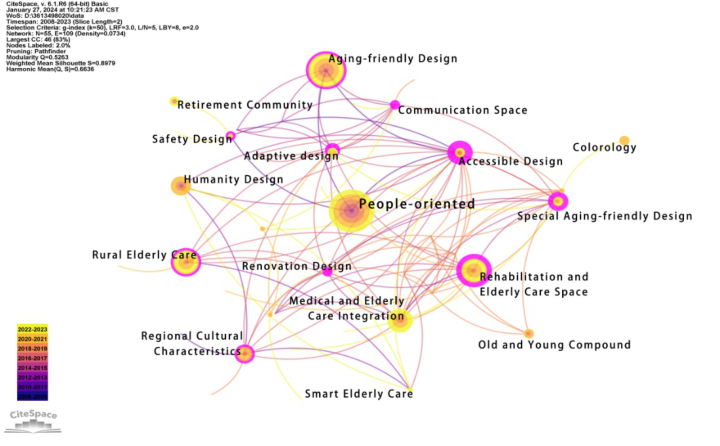
Analysis of Current Research and Development Status Set the time slot from January 2008 to November 2023 to generate a visual network graph of Chinese nursing home design formal languages (Figure 2) and a frequency list of Chinese nursing home design formal languages (Appendix 2). Among them, the module value (Q value) is 0.5263, within the interval of [0,1], and >0.3, which proves that the community structure identified in this study is significant.
According to the visual network graph of Chinese nursing home design form language (Figure 2), it can be seen that there are 55 nodes, 109 con- nections between nodes, and a network density of 0.0734, indicating that research in the field of nursing home design is relatively concentrated. How- ever, a higher degree of research concentration represents my lower level of innovation in this field.
Figure 2: Visual network graph of chinese nursing home design form language.
The following are analyses of current research hotspots and limitations: Analysis of Research Hotspots Through the analysis of the visual network graph of design language for Chinese nursing homes (Figure 2) and the frequency list of design language (Appendix 2), it can be seen that research on nursing home design in China mainly focuses on design language forms such as “People-oriented”, “Aging-friendly Design”, “Medical and Elderly Care Integration”, “Rural Elderly Care”, and “Rehabilitation and Elderly Care Space”. Among them, “People-oriented” has the highest frequency of occurrence, with a total of 57 occurrences. The high attention paid by domestic scholars to “People- oriented” and “Aging-friendly Design” indicates that current research on nursing home design in China places great emphasis on meeting the physio- logical and psychological needs of the elderly population. Through the study
110 Liu and Tang
of theories such as geriatric behavior and geriatric psychology, design strate- gies are proposed to improve the auditory, visual, and thermal comfort of the elderly population, with a focus on endowing nursing homes with human- istic care, Centered on the elderly population, user oriented, and tailored to the actual needs of the elderly population. At the same time, the high frequency of “Humanity Design”, “Accessible Design”, and “Special Aging- friendly Design” also reflects the attention paid by Chinese nursing home design to the special needs of the elderly population. In addition, the high frequency of “Medical and Elderly Care Integration” and “Rehabilitation and Elderly Care Space” conforms to Chinese guidance on further promot- ing the development of medical and elderly care integration; “Rural Elderly Care” is in line with Chinese opinions on the key work of comprehensively promoting rural revitalization. At present, there is a structural shortage of the labor force and a serious shortage of nursing staff in Chinese elderly care and medical services (Zuo, 2018, p. 26). Therefore, the widespread integra- tion of information technology in the design of nursing homes can effectively improve the efficiency of elderly care services while ensuring service qual- ity. Compared to the current research status abroad, in recent years, China has paid less attention to emerging fields such as “Smart Elderly Care” and “Interactive Design”.
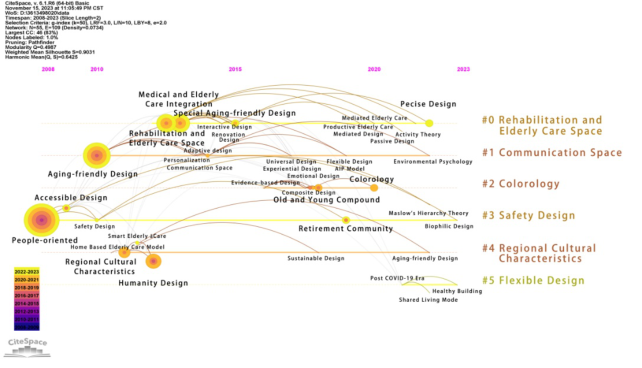
In addition, the timeline clustering view (Figure 3) conducted by Chinese nursing home design formal language shows that “Post COVID-19 Era”, “Shared Living Mode”, “Biophilic Design”, and “Gender Differentiated Design” are the formal languages that have emerged in the field of nursing home design in China in recent years.
Figure 3: Timeline clustering view of chinese nursing home design form language.
Analysis of Research Limitations The design research of nursing homes in our country has hardly taken into account the needs of nursing home service personnel and the families of user groups. The node centrality in Appendix 2 illustrates the importance of this
Chinese Nursing Home Design Studies Based on Changes in Design Formal Language 111
design formal language in the domain and its correlation with other design formal languages in the domain. A design formal language with a node cen- trality value exceeding 0.1 is the central node in that domain. Through the analysis of the frequency list of design formal languages (Appendix 2), it can be seen that there are 10 central nodes, accounting for less than 20% of the total number of nodes. The number of nodes with a centrality value of 0 is 30, indicating a weak correlation between design formal languages and fewer intersections in multiple directions and fields.
Above all, it can be seen that since 2008, the design of nursing homes in China has mainly focused on meeting the needs of the elderly population and responding to major national policies, and has produced a large number of excellent research results. However, this research field lacks innovation and is less focused on the current cutting-edge fields, with less interdisciplinary research.
Future Research Directions and Prospects Through the analysis of the research development process and current sit- uation, this article summarizes the following four directions worth further development in the future:
Multidimensional Consideration of User Needs The current research in this field is mainly based on the needs of the elderly population itself, involving both the physiological and psychological needs of the elderly population to consider users. There have been certain research results so far. As an important component of the nursing home user group, the needs of nursing home service personnel should also be taken into con- sideration accordingly. In addition, meeting some of the needs of elderly family members should also be incorporated into the design of nursing homes. Therefore, when considering user needs, in addition to maintaining the cur- rent emphasis on the physiological and psychological needs of the elderly population, the needs of nursing home service personnel and elderly family members should also be taken into consideration.
Optimizing the Living Mode of Nursing Homes Through Spatial Design The introduction of lifestyle-related strategies such as “Shared Living Mode” in the design of nursing homes in China has become one of the current research hotspots. With the development of the economy and the growing spiritual and cultural needs of the people, nursing homes are no longer lim- ited to “food” and “housing”, but are developing towards a multifunctional and composite form. Therefore, how to optimize the living mode of nursing homes through space design, enrich the late life of the elderly, and help them improve their sense of self-identity may become a research hotpot in the field of nursing home design.
Exploring the Combination of Cutting-Edge Technology and Aging-Friendly Design In recent years, the interdisciplinary intersection with artificial intelligence, human-computer interaction, and other fields has been one of the current research hotspots in the field of design, which can effectively improve the efficiency of space use. Many scholars at home and abroad have conducted
112 Liu and Tang
varying degrees of research on the field of smart elderly care. However, com- pared to foreign countries, domestic research in related fields has certain limitations in terms of both the quantity of publications and the breadth and depth of research. Therefore, research on the design of nursing homes in China should strengthen the exploration of cutting-edge fields.
The Deep Integration of Theory and Practice Based on the current trend of language changes in the design of nursing homes in China, the research method mainly adopts a combination of interdisci- plinary theory and practice. The innovation in this field in our country is mostly through the introduction of cross-disciplinary strategies or theories into research for macroscopic guidance, and there is a lack of specific meth- ods for introducing theories into design practice targeting the physiological and psychological characteristics of the elderly population, which generally lacks a certain depth. Given this, future research directions in this field can be based on the current combination of theory and practice, develop exist- ing viewpoints, and creatively expand them. Through sufficient research and analysis of the specific needs of the elderly population, conduct in-depth research on specific design strategies, and propose specific methods or means that can directly introduce theory into practice, For example, under the the- ory of smart elderly care, research on the planning of the location of smart devices in nursing homes, and the impact of the setting of smart devices in different functional spaces on the acceptance of the elderly population.
CONCLUSION
This study applied Citespace to conduct a visual graph analysis of 253 lit- erature in the field of nursing home design in China in the past 15 years, focusing on the design formal language. Based on the changing patterns of design formal language, the development process, current situation, and future development trends of nursing home design in China were studied, and four directions worth further development and research in the field of nursing home design in China were summarized, This provides directional guidance for the design and research of nursing homes in China.
APPENDIX
Appendix 1. Design formal language vocabulary of this study.
No. Formal Language No. Formal Language No. Formal Language 1 Shared Living Mode 19 Rural Elderly Care 37 Composite Design 2 Accessible Design 20 Active Design 38 Flexible Design 3 Medical and Elderly Care Integration
39 Mutual Assistance for Elderly Care
21 Virtual Reality Emotion Measurement
40 Sustainable Design
4 Retirement Community
22 Special Aging-friendly Design
(Continued)
Chinese Nursing Home Design Studies Based on Changes in Design Formal Language 113 Appendix 1. Continued
No. Formal Language No. Formal Language No. Formal Language
23 Passive Design 41 Renovation Design
5 Aging-friendly Design
6 Functional Boundaries
24 Adaptive design 42 Emotional Engineering 7 People-oriented 25 Old and Young Compound
12 Biophilic Design 30 Precise Design 48 Efficiency 13 Rehabilitation and Elderly Care Space
31 Home-based Elderly Care Model
50 Personalization
49 Gender Differentiation Design 14 Family Style Elderly Care
32 Productive Elderly Care
51 AIP Model
15 Communication Space
33 Mediated Elderly Care
54 Rural Revitalization
16 Activity Theory 34 Safety Design 52 Evidence-based Design 17 Emotional Design 35 Colorology 53 Mediated Design 18 Modular Design 36 Religious Elderly Care
55 Regional Cultural Characteristics
Appendix 2. Frequency list of chinese nursing home design formal languages.
F Centrality Formal Language F Centrality Formal Language 57 0.07 People-oriented 3 0 Mediated Elderly Care 34 0.12 Aging-friendly Design 2 0 Personalization 24 0.05 Medical and Elderly Care Integration
1 0 Functional Boundaries
1 0.03 Mutual Assistance for Elderly Care 21 0.11 Rural Elderly Care 1 0.03 Prefabricated Architecture 18 0.23 Rehabilitation and Elderly Care Space
1 0 Flexible Design
18 0.01 Humanity Design 1 0 Religious Elderly Care 16 0.18 Regional Cultural Characteristics
1 0 Active Design
13 0.42 Accessible Design 1 0 Maslow’s Hierarchy Theory 12 0.21 Special Aging-friendly Design 9 0.24 Renovation Design 1 0 Place Spirit 7 0.08 Smart Elderly Care 1 0 Family Style Elderly Care 6 0.21 Communication Space 1 0 Gender Differentiation Design 6 0.21 Adaptive design 1 0 Productive Elderly Care 6 0 Retirement Community 1 0 Activity Theory 6 0 Old and Young Compound 1 0 Universal Design 5 0.12 Safety Design 1 0 Home-based Elderly Care Model
(Continued)
114 Liu and Tang
Appendix 2. Continued F Centrality Formal Language F Centrality Formal Language
Chen, Y 陈悦et al. (2015). The Methodological Function of Citespace Knowledge Graph Citespace知识图谱的方法论功能. Studies in Science of Science 科学学研 究. doi: 10.16192/j.cnki.1003–2053.2015.02.00. (2), 242–253. Du, S 杜淑幸, Peng, L 彭丽萍& Lian, L 连立麟. (2017). Research Status of Foreign
Industrial Design Based on CiteSpace Metric Analysis 基于Citespace计量分析的 国外工业设计研究现状. Journal of Graphics 图学学报. doi: 10.11996/JG.j.2095– 302X.2017060876. (6), 876–880. Li, J 李晶磊. (2020). Exploration of Architectural Design Practice for Elderly Care Institutions under the Mode of Medical and Elderly Care Integration 医养结合模 式下养老机构建筑设计实践探讨——以上海某新建公办养老院为例. Construc- tion Materials & Decoration 建材与装饰. doi: 1673-0038 (2020) 17-0057-02. (17), 57–58. Lou, S 楼森宇& Zheng, J 郑剑艺. (2022). Research Hotspots, Frontiers and
Prospects of Community Renewal in China——Visualization research based on CiteSpace 中国社区更新的研究热点、前沿与展望——基于Citespace的可视 化研究. Furniture & Interior Design 家具与室内装饰. doi: 10.16771/j.cn43- 1247/ts.2022.10.019. (10), 120–125. Shan, C 单忱, Yu, G 于戈& Qin, G 秦淦. (2023). Research on the Psychological Health Needs and Spatial Optimization Design of Elderly People in Nursing Homes in the Post Epidemic Era 后疫情时代养老院老年人心理健 康需求和空间优化设计研究. Collected Papers of the Chinese Architecture Society from 2022 to 2023 中国建筑学会2022-2023中国建筑学会论文集. doi: 10.26914/c.cnkihy.2023.019905. (7), 176–182. Wang, J 王娟. (2019). Design And Research Of Rehabilitation Landscape Based On
Behavioral Psychological Needs Of The Elderly 基于老年人行为心理需求的康复 景观设计与研究. Shaanxi University of Science and Technology 陕西科技大学. Wang, M 王敏. (2016). Study on Nursing Homes Space Design Based on Gerontological Psychologyn 基于老年心理学的养老院空间设计研究. Southwest Jiaotong University 西南交通大学. Zuo, M 左美云. (2018). The Meaning and Model of Smart Elderly Care 智慧养老的
含义与模式. China Social Work 中国社会工作. (32), 26–27, p. 26.
Chinese Nursing Home Design Studies Based on Changes in Design Formal Language 115
Zhou, C 周橙et al. (2022). Status and Direction of Smart Home for the Elderly in China Based on the CiteSpace 基于Citespace的中国适老智能家居研究现 状与发展前景. Packaging Engineering 包装工程. DOI:10.19554/j.cnki.1001– 3563.2022.02.005. (02), 35–41. Zhou, Q 周沁& Yao, Z 姚. (2023). A Comparative Study of Participatory
Design Research at Home and Abroad Based on CiteSpace 基于Citespace的 国内外参与式设计研究现状比较分析. Packaging Engineering包装工程. DOI:10.19554/j.cnki.1001–3563.2023.10.024. (10), 241–250+268.
LISTED IN THE AHFE DIGITAL BOOKSTORE CATALOGUE
Explore the complete digital volume
Human Factors in Aging and Special Needs
Read this individual research paper free through the original publisher, or explore the full digital proceedings book.
ISBN 978-1-964867-09-0
Explore this ISBN in the AHFE Bookstore ↗Listed in the July 2026 bookstore catalogue; search by ISBN to confirm current availability · Digital book purchase optional