Hsuan-yu Lu, Zhongping Ye, Chun Hang Ti, Cathy Lau, Chengpeng Hu, Xiangqian Shi, Kai-yu Tong (2024). Design a Rehabilitation Platform to Improve Mild Cognitive Impairment by Integrating Cognitive Training Games with Moderate-intensity Cycling Exercise. In: Human Factors in Aging and Special Needs. AHFE Open Access, vol. 133, pp. 136–147. https://doi.org/10.54941/ahfe1004902
Most studies recognized motor-cognitive dual-task training as an effective treatment to enhance neurological disorders in patients with improved motor and cognitive performance. However, the practical treatment strategy of motor-cognitive dual-task training still need to be confirmed with the clinical evidence-based support. The purpose of this study aimed to propose the optimal strategy of dual-task training using moderate-intensity stationary cycling and multidomain cognitive training for patients with MCI, and compare the post-training performance between motor, cognitive and motor-cognitive dual-task training.Materials and MethodsNineteen patients were recruited from the local rehabilitation centers in Hong Kong and were diagnosed with mild cognitive impairment (MCI). The following inclusion criteria were used: (a) total scores of Montreal Cognitive Assessment, Hong Kong version (HK-MoCA) ranging from 7th to 16th percentile stratified by age and education, (b) be able to follow the instructions and perform cycling independently, (c) free of any other neuromuscular that affect the motor performance, (d) free of any cardiovascular diseases that may have a potential risk of life during cycling. All participants were randomly allocated to the treatments of motor (N=7), cognitive (N=7) and motor-cognitive dual-task training (N=5). In this study, we proposed the rehabilitation platform integrating the stationary cycling (Monark 928E, Monark Sport & Medical, Sweden) with cognitive training games (RehaCom, HASOMED GmbH, Germany). The rehabilitation platform was equipped with optical encoder (HN3806-AB -400N, Electronic Katrangi Trading, Syria), power meter sensors (Vector™, Garmin Ltd, Taiwan) and heart rate sensor (Polar H10, Polar Electro, Finland) for real-time cycling parameters display (i.e., elapsed time, heart rate, RPM, power output, and power ratio between left and right pedals) and cardiovascular intensity monitoring. Last, performing stationary cycling concurrent with multidomain cognitive training operated by the touchscreen is the way of the treatment of motor-cognitive dual-task training. Before training, all subjects were asked to perform the Graded Exercise Test modified from YMCA Sub-Maximal Cycle Ergometer Test to determine the upper and lower boundary of workloads for maintaining the moderate-intensity cycling at pedaling rate of 50 RPM during motor and dual-task training. In this study, the definition of HRmax was calculated: 208-(0.7*age), and the moderate-intensity cycling was defined as the range from 55% to 75% HRmax. After finishing the Graded Exercise Test, all patients received 30 training sessions in the frequency of four sessions weekly. The assessments of MoCA, Trail Making Tests (TMTs), 5-Times Sit to Stand Test (5TSTS), 10-Meter Walk Test (10MWT) and 6-Minute Walk Test (6MWT) were used for evaluation. In addition, the record of grading level of the cognitive training using RehaCom software were also used to quantify the multidomain cognitive performance. Paired t-test and Kruskal-Wallis test were used to examine the outcome differences in cognitive function and functional motor performance within groups between baseline and post-assessments, and the comparisons between groups, respectively. After the Kruskal-Wallis test, the Bonferroni correction was used for post-hoc pairwise comparisons. All comparisons were performed using SPSS 22.0 software (SPSS, IBM, Armonk, New York, U.S.A.), and the statistical significance was set at α = 0.05.ResultsFor cognitive function, significant improvements in MoCA were found in cognitive and dual-task groups, and the significant differences in TMTs – part A and part B were found in cognitive group. For functional motor performance, both motor and dual-task groups showed significant improvements in 5TSTS, 10MWT and 6MWT. The greater improvement of grading level in sustain attention and logical reasoning were found in the typical subjects after receiving dual-task training than cognitive treatment. The greater slopes of grading level in sustain attention and logical reasoning were found in the typical subjects after receiving dual-task training than cognitive treatment.ConclusionsThe treatment strategy of simultaneous dual-task using moderate-intensity stationary cycling and computer-based multidomain cognitive training was proposed. The current results encouraged this treatment to be applied as the routine training in a population of MCI for restriction of cognitive decline or delayed progression to related dementia.
Design a Rehabilitation Platform to Improve Mild Cognitive Impairment 137
INTRODUCTION
Motor-cognitive dual-task training has been a suggested treatment for patients diagnosed with mild cognitive impairment (MCI) to prevent motor and cognitive decline from the incidence of Alzheimer’s dementia (AD) or related dementia. Most studies recognized dual-task training as an effec- tive treatment to enhance neurological disorders in patients with improved motor and cognitive performance (Porosi´nska et al., 2010; Negahban et al., 2011; Rábago and Wilken, 2011; Fritz and Basso, 2013; de Andrade et al., 2013; Coelho et al., 2013; Xiao et al., 2023; Johansson et al., 2023; Spanò et al., 2022). However, the practical treatment strategy of motor-cognitive dual-task training still need to be confirmed with the clinical evidence-based support. The purpose of this study aimed to propose the opti- mal strategy of dual-task training using moderate-intensity stationary cycling and multidomain cognitive training for patients with MCI, and compare the post-training performance between motor, cognitive and motor-cognitive dual-task training.
Cycling, continuous repetition movement, and user-friendly and low-cost rehabilitative training presented the ideal motor recovery approach from motor impairment with a low risk of falls and limited supervision from ther- apists (Mazzocchio et al., 2008; Barbosa et al., 2015; Kwok et al., 2021). Based on research evidence with clinical results, improved lower extrem- ity (L/E) motor performance for patients with impaired motor function was shown after receiving a single motor task of conventional rehabili- tation with additional cycling training (Yang et al., 2014; Pereira-Pedro et al., 2022; Zhou et al., 2022). In addition, research found that moderate- intensity cycling with greater than 20 mins would help improve cognitive function on rapid decision-making tasks, working memory and selec- tive attention (Quelhas Martins et al., 2013; Kimura and Hozumi, 2012; Lambourne and Tomporowski, 2010; Kunzler and Carpes, 2022). On the other hand, cognitive training was recommended to be matched with different domains of cognitive performance, such as processing speed, attention, memory, language, visuospatial abilities, and executive func- tioning/reasoning (Harada et al., 2013; Nousia et al., 2021). The previ- ous studies found better cognitive performance in the groups with MCI using computer-based cognitive training programs (Nousia et al., 2021; Herrera et al., 2012; Cipriani et al., 2006), and multidomain cognitive training showed more domains with improved cognitive performance than a domain-focused approach (Bahar-Fuchs et al., 2017; Barban et al., 2016; Delbroek et al., 2017; Ge et al., 2018; Gooding et al., 2016). A previous study reported that patients with cognitive dysfunction showed increased scores on clinical assessments of Mini-Mental State Examina- tion (MMSE) and Montreal Cognitive Assessment (MoCA) after receiving 60 training sessions with 30 min/day and 5 day/week duration by using the multidomain training of RehaCom software (Jiang et al., 2016). Over- all, moderate-intensity cycling combined with concurrent computer-based multidomain cognitive training may be an optimal approach to improve the motor and cognitive performance of patients with MCI. So far, no
study investigated the effects on cognitive and physical impact of motor- cognitive dual-task, following the strategy of moderate-intensity cycling and computer-based multidomain cognitive training, for patients with MCI. The purpose of this study aimed to propose the optimal strategy of dual- task training using moderate-intensity stationary cycling and multidomain cognitive training for patients with MCI, and compare the post-training performance between motor, cognitive and motor-cognitive dual-task training.
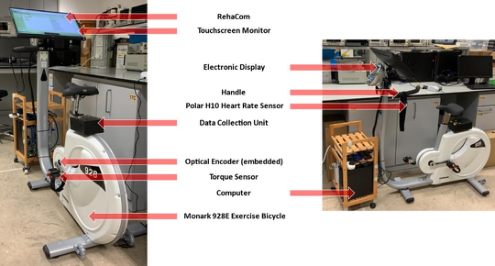
DEVELOPING CYCLING-COGNITIVE DUAL-TASK REHABILITATION SYSTEM We proposed the rehabilitation platform integrating the stationary cycling (Monark 928E, Monark Sport & Medical, Sweden) with cognitive training games (RehaCom, HASOMED GmbH, Germany) (Fig. 1). The rehabili- tation platform was equipped with optical encoder (HN3806-AB-400N, Electronic Katrangi Trading, Syria), power meter sensors (Vector™, Garmin Ltd, Taiwan) and heart rate sensor (Polar H10, Polar Electro, Finland) for real-time cycling parameters display (i.e., elapsed time, heart rate, RPM, power output, and power ratio between left and right pedals) and cardio- vascular intensity monitoring. In addition, video-based scenery of 59 major cities was provided for outdoor sensory experiences, and the frame rate of the video would be changed according to the RPM. In this study, the six cognitive therapy modules of (I) Sustain Attention, (II) Visuo-Constructional Ability, (III) Physiognomic Memory, (IV) Figural Memory, (V) Logical Reasoning and (VI) Exploration, corresponding with the multidomain of attention, memory, executive functions, and visual field in the computer-based cognitive training program of RehaCom software.
Figure 1: Illustration of rehabilitation platform combining stationary cycling and multidomain cognitive training games for dual-task training. The multiple function of real-time display of heart rate, RPM, power output could be provided.
Moderate Intensity Cycling Measured by Graded Exercise Test All subjects were asked to perform the Graded Exercise Test modified from YMCA Sub-Maximal Cycle Ergometer Test to determine the upper and lower boundary of workloads for moderate-intensity cycling at a pedalling rate of 50 RPM (Yu et al., 2011). The heart rate sensor of Polar H10 was placed on the participant’s chest. For injury prevention and performance, the subject sit
Design a Rehabilitation Platform to Improve Mild Cognitive Impairment 139 on the saddle of the exercise bike with a knee flexion angle between 25
and 35
while the crank angle is 180
(Holmes et al., 1994). Before the Graded Exercise Test, resting heart rate (HRresting), HRmax and seat height were recorded, and the elapsed time of each phase in the Graded Exercise Test was 3 minutes. In phase 1, the subject performed cycling with a pedalling rate of 50 RPM at workloads of 90 kpm/min at the beginning of 3 minutes, and cycling cadences were monitored by a metronome. At the elapsed time of 2:40, the subject’s HR and scale of perceived exertion (RPE) were recorded. In phase 2, the workload was determined as 120 kpm/min if the HR in phase 1 was greater than 50% maximum heart rate (HRmax), and the workloads would be set at 150 kpm/min while HR less than 50% HRmax. At the elapsed time of 5:40, the subject’s HR and scale of RPE were also recorded. In the following phase, the workloads (i.e., phase 3) were calculated by accumulat- ing 120 kpm/min with the previous setting (i.e., phase 2). The participants’ information on HR and RPE was recorded again at the last 20 seconds. The graded exercise test was completed when the participant’s HR was up to 85% HRmax, or the scale of RPE was 10 (Imperial et al., 1990). Finally, the workloads for moderate intensity cycling at a pedalling rate of 50 RPM, cor- responding to the range from 55% to 75% HRmax, were obtained. In this study, the definition of HRmax depended on the participant’s age, calculated by 208-(0.7*age) (Tanaka et al., 2001), and moderate-intensity cycling was defined in the range from 55% to 75% HRmax (Inbar et al., 1994).
EXPERIMENTAL PROCEDURE Participants
Nineteen participants were recruited from the local rehabilitation centers in Hong Kong and were diagnosed with mild cognitive impairment (MCI). The following inclusion criteria were used: (a) total scores of Montreal Cognitive Assessment, Hong Kong version (HK-MoCA) ranging from 7th to 16th per- centile stratified by age and education (Yeung et al., 2020; Wong et al., 2015), (b) be able to follow the instructions and perform cycling independently, (c) free of any other neuromuscular that affect the motor performance, (d) free of any cardiovascular diseases that may have a potential risk of life during cycling. The subjects were excluded if matching the conditions of a) BMI greater than 27 kg/m2, b) any additional medical or psychological diagnosis, c) trauma of hip, knee or ankle joints, and d) cardiovascular problem that would affect their ability to follow the instructions and conduct the experi- mental protocol. All subjects were randomly allocated to Cognitive (N = 7, age: 68.4±2.5 y/o, BMI: 23.4±3.3 kg/m2, gender: 4 females/3 males), Cycling (N = 7, age: 72.0±6.7 y/o, BMI: 22.2±2.1 kg/m2, gender: 6 females/1 male) and Dual-Task groups (N = 5, age: 69.4±3.4 y/o, BMI: 22.0±3.8 kg/m2, gender: 3 females/2 males) following the single-subject randomization design. All subjects provided informed consent approved by the Joint Chinese Uni- versity of Hong Kong – New Territories East Cluster Clinical Research Ethics Committee (identifier: NCT05384639).
Intervention After finishing the Graded Exercise Test, all subjects received 30 sessions using the cycling-cognitive dual-task training system at the frequency of four
sessions a week, according to recommendations from the World Health Orga- nization Physical Activity Guide. For the Cognitive group (N = 7), subjects were asked to perform 40-mins training sessions, including six sets of cog- nitive training with 5 mins and five sets resting with 2 mins (Jiang et al., 2016) (Fig. 1). The grading level of cognitive training was determined based on the therapist’s recommendation following occupational therapy interven- tion guidance (Hinojosa, 1993). For Cycling (N = 7) and Dual-Task groups (N = 5), six sets of moderate-intensity cycling at a pedalling rate of 50 RPM with 5 mins (55%–75% HRmax), five sets of active recovery with 2 mins (45%–50% HRmax), 1 set warm-up with 2 mins (45%–50% HRmax) and 1 set cool-down with 2 mins (HRresting) were arranged (Coswig et al., 2020; Ramirez-Velez et al., 2016). In addition, Dual-Task group simultaneously performed the cognitive and motor training, which separately following the procedure of Cognitive and Cycling groups, by using the cycling-cognitive dual-task training system. With real-time heart rate monitoring, the cycling workloads would be manually updated by the therapists based on the results of the Graded Exercise Test to maintain moderate intensity cycling.
Evaluation For evaluation, the baseline and post training of cognitive function and func- tional motor performance were assessed by using MoCA, Trail Making Tests (TMTs), 5-Times Sit to Stand Test (5TSTS), 10-Meter Walk Test (10MWT) and 6-Minute Walk Test (6MWT).
STATISTICAL METHOD Descriptive data were compared between Cognitive, Cycling and Dual-Task groups using the Kruskal-Wallis test of the nonparametric method. Paired t- test and Kruskal-Wallis test were used to examine the outcome differences in cognitive function and functional motor performance within groups between baseline and post-assessments, and the comparisons between groups, respec- tively. After the Kruskal-Wallis test, the Bonferroni correction was used for post-hoc pairwise comparisons. All comparisons were performed using SPSS 22.0 software (SPSS, IBM, Armonk, New York, U.S.A.), and the statistical significance was set at α = 0.05.
RESULTS
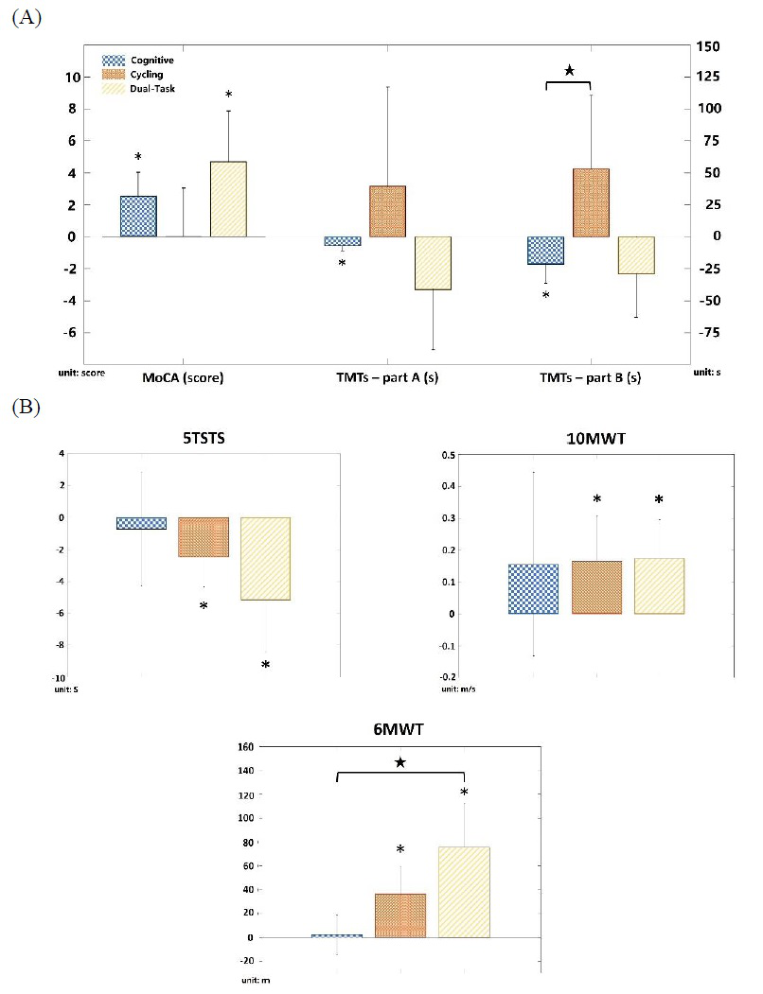
The descriptive characteristics (i.e., age, BMI, education) in groups of MCI participants were presented in Table 1. No differences in demographics, baseline and post-assessments of cognitive function and functional motor per- formance were found between the Cognitive, Cycling and Dual-Task groups (Table 1 & 2). For cognitive function, significant improvements in MoCA were found in cognitive and dual-task groups, and the significant differences in TMTs – part A and part B were found in cognitive group (Fig. 2A). For functional motor performance, both motor and dual-task groups showed significant improvements in 5TSTS, 10MWT and 6MWT (Fig. 2B).
For the evaluation of cognitive function and functional motor perfor- mance, the mean (SD) of outcomes in MoCA, TMTs-part A, TMTs-part B, 5TSTS, 10MWT and 6MWT between baseline and post-assessments for Cognitive, Cycling and Dual-Task groups were listed in Table 1.
Design a Rehabilitation Platform to Improve Mild Cognitive Impairment 141
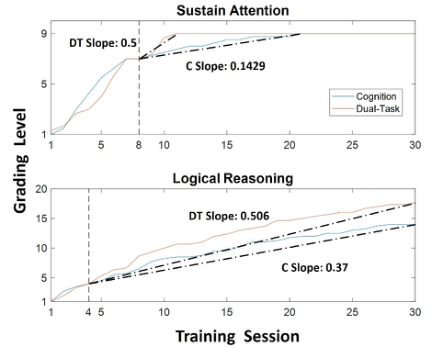
Moreover, the grading level of the cognitive training using RehaCom soft- ware were also recorded to quantify the multidomain cognitive performance. The greater slopes of grading level in sustain attention and logical reason- ing were found in the typical subjects after receiving dual-task training than cognitive treatment (Fig. 3).
Table 1. Descriptive participant characteristics (mean ± SD) including demographics, baseline of cognitive function and functional motor performance.
Table available in the original PDF paper.
Cognitive (N = 7) Cycling (N = 7) Dual-Task (N = 5) Age (years) 68.4 ± 2.6 72.0 ± 6.7 69.4 ± 3.4 BMI (kg/m2) 23.4 ± 3.3 22.2 ± 2.1 22.0 ± 3.8 Educations (years) 9.7 ± 4.5 10.0 ± 5.1 8.8 ± 3.6 Montreal Cognitive Assessment (score) 18.71± 7.84 18.57± 6.97 18.60 ± 7.19 Trail Making Tests - part A (s) 68.62 ± 27.88 100.58 ± 90.04 86.09 ± 60.17 Trail Making Tests - part B (s) 118.99 ± 55.27 254.44 ± 284.77 143.11 ± 76.80 5-Times Sit to Stand Test (s) 11.75 ± 5.54 15.50 ± 6.98 23.95 ± 20.35 10-Meter Walk Test (m/s) 1.53 ± 0.26 1.36 ± 0.49 1.64 ± 0.24 6-Minute Walk Test (m) 419.50 ± 158.58 368.08 ± 163.26 379.26 ± 163.63
10-Meter Walk Test: test with maximum walking speed
Table 2. Mean (SD) of outcomes in cognitive function and functional motor performance for mild cognitive impairment (MCI) receiving the intervention of cognitive (N = 7), cycling (N = 7) and daul-task (N = 5) after 30 sessions (post) using the dual-task cycling training system.
Table available in the original PDF paper.
Baseline Post p
I. Cognitive Function Montreal Cognitive Assessment (score) Cognitive 18.71 (7.84) 21.43 (7.98) 0.006* Cycling 18.57 (6.97) 18.57 (8.67) 1 Dual-Task 18.60 (7.19) 23.60 (9.27) 0.043* Trail Making Test - part A (s)
Cognitive 68.62 (27.88) 61.56 (26.17) 0.005* Cycling 100.58 (90.04) 140.21 (142.26) 0.256 Dual-Task 86.09 (60.17) 44.76 (18.45) 0.153 Trail Making Test - part B (s) Cognitive 118.99 (55.27) 97.45 (41.02) 0.012* Cycling 254.44 (284.77) 307.68 (301.40) 0.063 Dual-Task 143.11 (76.80) 113.78 (60.02) 0.158 II. Functional Motor Performance 5-Times Sit to Stand Test (s) Cognitive 11.75 (5.54) 11.03 (3.63) 0.637 Cycling 15.50 (6.98) 13.02 (6.12) 0.017* Dual-Task 23.95 (20.35) 13.18 (7.12) 0.035* 10-Meter Walk Test (m/s) Cognitive 1.53 (0.26) 1.69 (0.27) 0.233 Cycling 1.36 (0.49) 1.53 (0.38) 0.029* Dual-Task 1.64 (0.24) 1.81 (0.24) 0.046* 6-Minute Walk Test (m) Cognitive 419.50 (158.58) 422.02 (164.74) 0.722 Cycling 368.08 (163.26) 404.70 (173.31) 0.008* Dual-Task 379.26 (163.63) 454.63 (192.34) 0.015*
Figure 2: The changes between baseline and post assessments in cognitive function (Fig. 2A) and functional motor performance (Fig. 2B) for patients with mild cognitive impairment (MCI) assigned to the intervention of cognitive (blue), cycling (orange) and dual-task (yellow) groups using the dual-task cycling training system. Asterisk indi- cated the significant difference of outcomes between baseline and post assessments within groups, and black pentagram indicated the significant difference in change of outcomes normalized by baseline performance between groups.
Design a Rehabilitation Platform to Improve Mild Cognitive Impairment 143
Figure 3: The typical subjects receiving the treatments of cognitive (blue) and dual- task (red) showed the grading level in sustain attention and logical reasoning of the multidomain cognitive training games.
DISCUSSION
In this study, cycling and dual-task training followed the motor feedback, which was similar to the previous studies (Yang et al., 2014; Ferrante et al., 2011), and the post-assessment results of Cycling and Dual-Task groups showed the significant improvement in 10MWT and 6MWT than base- line (Fig. 2B). Nevertheless, no significant differences in post assessments between Cycling and Dual-Task groups, the mean score of outcomes in Dual- Task exhibited increased functional motor performance in sit-to-stand and level walking (Fig. 2B). These results confirmed that dual-task strategy of moderate-intensity cycling and multidomain cognitive training have a posi- tive influence on functional motor performance after 30 training sessions of 40 mins session duration. Although the single-task cognitive training showed a significant improvement in MoCA and TMTs, cycling-cognitive dual-task training only exhibited a significant improvement in MoCA after 30 training sessions (Fig. 2A). These results may attribute to the less sensitivity of TMT assessment for distinguishing MCI from a population of normal cognition (Wei et al., 2018). Based on the current outcomes of clinical assessments in cognitive function, single-task cognitive training using a multidomain computer-based program may be recommended for MCI rehabilitation. Nev- ertheless, there are exciting findings in the post-training cognitive function for the typical MCI patients through cycling-cognitive training with 30 ses- sions compared to the single-task cognitive training approach. Compared to single-task cognitive training, more efficient treatment of cycling-cognitive dual-task training with the increased slope of grading level was found in the attention (i.e., sustain attention) and execution function (i.e., logical reason- ing) domains of cognitive tasks (Fig. 3), which corresponds to the results of the previous studies investigating the effects on cognitive function between dual-task and single-task training (Herold et al., 2018; Zhu et al., 2016;
Radder et al., 2020; Hvingelby et al., 2022; Li et al., 2020; Fritz et al., 2015; Gallou-Guyot et al., 2020; Mancioppi et al., 2021). From the current results, the cycling-cognitive dual-task approach facilitated both cognitive function and functional motor performance, and this approach especially showed more effective improvements in the grading level of the attention, memory, and execution domains than the single-task cognitive training approach.
This study helped to examine the effects of cycling-cognitive dual-task training following the strategy of moderate-intensity and computer-based multidomain cognitive training for patients with MCI on functional motor and cognitive performance. The strategy of moderate-intensity cycling and multidomain computer-based cognitive in dual-task training could be rec- ommended for optimal rehabilitation guidance for MCI intervention. The further study was recommended to involve more types of neurodegenerative disorder, such as Alzheimer’s or Parkinson’s disease to facilitate the impacts on clinical applications. Moreover, the limited number of participants of this study could be improved by recruiting more than 12 patients of each group, and the results could be recognized with more powerful support by using statistical analysis. With further development in dual-task training studies, effective restriction of cognitive decline in patients with neurodegenerative disorder or delayed progression of the MCI to mild AD/dementia would be possible.
CONCLUSION
The treatment strategy of simultaneous dual-task rehabilitation system using moderate-intensity stationary cycling and computer-based multidomain cog- nitive training was proposed. The current results encouraged this treatment to be applied as the routine training in a population of MCI for restriction of cognitive decline or delayed progression to related dementia.
ACKNOWLEDGMENT
This study is supported by the Knowledge Transfer Project Fund (project ID: KPF22GWP34). The authors are grateful for the cooperation with JC Centre for Osteoporosis Care and Control, Faculty of Medicine, The Chinese Uni- versity of Hong Kong and Department of Medicine and Therapeutics, The Chinese University of Hong Kong. We also thank for the support from par- ticipants and therapists in The Chinese University of Hong Kong Jockey Club Centre for Osteoporosis Care and Control (JCCOCC) at the Prince of Wales Hospital, Jockey Club Centre for Positive Ageing (JCCPA) at the Shatin Hos- pital, and Sports Medicine and Rehabilitation Centre at the CUHK Medical Centre (CUHKMC).
REFERENCES
Bahar-Fuchs, A., et al., Tailored and adaptive computerized cognitive training in older adults at risk for dementia: a randomized controlled trial. Journal of Alzheimer’s Disease, 2017. 60(3): pp. 889–911.
Design a Rehabilitation Platform to Improve Mild Cognitive Impairment 145
Barban, F., et al., Protecting cognition from aging and Alzheimer’s disease: a computerized cognitive training combined with reminiscence therapy. International Journal of Geriatric Psychiatry, 2016. 31(4): pp. 340–348. Barbosa, D., C. P. Santos, and M. Martins, The application of cycling and cycling
combined with feedback in the rehabilitation of stroke patients: a review. Journal of Stroke and Cerebrovascular Diseases, 2015. 24(2): pp. 253–273. Cipriani, G., A. Bianchetti, and M. Trabucchi, Outcomes of a computer-based cognitive rehabilitation program on Alzheimer’s disease patients compared with those on patients affected by mild cognitive impairment. Archives of gerontology and geriatrics, 2006. 43(3): pp. 327–335. Coelho, F. G.d. M., et al., Multimodal exercise intervention improves frontal cog-
nitive functions and gait in Alzheimer’s disease: a controlled trial. Geriatrics & gerontology international, 2013. 13(1): pp. 198–203. Coswig, V. S., et al., Effects of high vs moderate-intensity intermittent training on functionality, resting heart rate and blood pressure of elderly women. Journal of translational medicine, 2020. 18: p. 1–11. de Andrade, L. P., et al., Benefits of multimodal exercise intervention for postural
control and frontal cognitive functions in individuals with Alzheimer’s disease: a controlled trial. Journal of the American Geriatrics Society, 2013. 61(11): pp. 1919–1926. Delbroek, T., W. Vermeylen, and J. Spildooren, The effect of cognitive-motor dual task training with the biorescue force platform on cognition, balance and dual task performance in institutionalized older adults: a randomized controlled trial. Journal of physical therapy science, 2017. 29(7): pp. 1137–1143. Ferrante, S., et al., A biofeedback cycling training to improve locomotion: a case
series study based on gait pattern classification of 153 chronic stroke patients. Journal of neuroengineering and rehabilitation, 2011. 8: pp. 1–13. Fritz, N. E. and D. M. Basso, Dual-task training for balance and mobility in a person with severe traumatic brain injury: a case study. Journal of Neurologic Physical Therapy, 2013. 37(1): pp. 37–43. Fritz, N. E., F. M. Cheek, and D. S. Nichols-Larsen, Motor-cognitive dual-task train-
ing in neurologic disorders: a systematic review. Journal of neurologic physical therapy: JNPT, 2015. 39(3): p. 142. Gallou-Guyot, M., et al., Cognitive and physical impact of cognitive-motor dualtask training in cognitively impaired older adults: An overview. Neurophysiologie Clinique, 2020. 50(6): pp. 441–453. Ge, S., et al., Technology-based cognitive training and rehabilitation interventions for
individuals with mild cognitive impairment: a systematic review. BMC geriatrics, 2018. 18(1): pp. 1–19. Gooding, A. L., et al., Comparing three methods of computerised cognitive training for older adults with subclinical cognitive decline. Neuropsychological Rehabili- tation, 2016. 26(5-6): pp. 810–821. Harada, C. N., M. C. N. Love, and K. L. Triebel, Normal cognitive aging. Clinics in
geriatric medicine, 2013. 29(4): pp. 737–752. Herold, F., et al., Thinking while moving or moving while thinking–concepts of motor-cognitive training for cognitive performance enhancement. Frontiers in aging neuroscience, 2018. 10: p. 228. Herrera, C., et al., Positive effects of computer-based cognitive training in adults with
mild cognitive impairment. Neuropsychologia, 2012. 50(8): pp. 1871–1881. Hinojosa, J., Position paper: Purposeful activity. Amer J Occup Ther, 1993. 47: pp. 1081–1082.
Holmes, J. C., A. L. Pruitt, and N. J. Whalen, Lower extremity overuse in bicycling.
Clinics in sports medicine, 1994. 13(1): pp. 187–205. Hvingelby, V. S., et al., Interventions to improve gait in Parkinson’s disease: A systematic review of randomized controlled trials and network meta-analysis. Journal of Neurology, 2022. 269(8): pp. 4068–4079. Imperial, E. S., et al., Graded exercise testing protocol for the elderly. Journal of
Cardiopulmonary Rehabilitation and Prevention, 1990. 10(12): pp. 465–470. Inbar, O., et al., Normal cardiopulmonary responses during incremental exercise in 20-to 70-yr-old men. Medicine and science in sports and exercise, 1994. 26: pp. 538–538. Jiang, C., et al., Clinical efficacy of acupuncture treatment in combination with reha-
com cognitive training for improving cognitive function in stroke: a 2× 2 factorial design randomized controlled trial. Journal of the American Medical Directors Association, 2016. 17(12): pp. 1114–1122. Johansson, H., et al., Effects of motor–cognitive training on dual-task performance in people with Parkinson’s disease: a systematic review and meta-analysis. Journal of Neurology, 2023. 270(6): pp. 2890–2907. Kimura, K. and N. Hozumi, Investigating the acute effect of an aerobic dance exer-
cise program on neuro-cognitive function in the elderly. Psychology of Sport and Exercise, 2012. 13(5): pp. 623–629. Kunzler, M. R. and F. P. Carpes, Moderate intensity cycling combined with cognitive dual-task improves selective attention. International Journal of Sports Medicine, 2022. Kwok, B. C., J. X. L. Lim, and P. W. Kong, The theoretical framework of the clin-
ical pilates exercise method in managing non-specific chronic low back pain: a narrative review. Biology, 2021. 10(11): p. 1096. Lambourne, K. and P. Tomporowski, The effect of exercise-induced arousal on cognitive task performance: a meta-regression analysis. Brain research, 2010. 1341: pp. 12–24. Li, Z., et al., Dual-task training on gait, motor symptoms, and balance in patients
with Parkinson’s disease: A systematic review and meta-analysis. Clinical Reha- bilitation, 2020. 34(11): pp. 1355–1367. Mancioppi, G., et al., The use of Motor and Cognitive Dual-Task quantitative assessment on subjects with mild cognitive impairment: A systematic review. Mechanisms of Ageing and Development, 2021. 193: p. 111393. Mazzocchio, R., et al., Cycling, a tool for locomotor recovery after. NeuroRehabili-
tation, 2008. 23: pp. 67–80. Negahban, H., et al., The effects of cognitive loading on balance control in patients with multiple sclerosis. Gait & posture, 2011. 34(4): pp. 479–484. Nousia, A., et al., Beneficial effect of computer-based multidomain cognitive train-
ing in patients with mild cognitive impairment. Applied Neuropsychology: Adult, 2021. 28(6): pp. 717–726. Pereira-Pedro, K. P., et al., Effects of cycling dual-task on cognitive and physical function in Parkinson’s disease: a randomized double-blind pilot study. International Journal of Environmental Research and Public Health, 2022. 19(13): p. 7847. Porosi´nska, A., et al., Evaluation of postural balance control in patients with multiple
sclerosis–effect of different sensory conditions and arithmetic task execution. A pilot study. Neurologia i Neurochirurgia Polska, 2010. 44(1): pp. 35–42. Quelhas Martins, A., et al., Moderate intensity exercise facilitates working memory.
Psychology of Sport and Exercise, 2013. 14(3): pp. 323–328.
Design a Rehabilitation Platform to Improve Mild Cognitive Impairment 147
Rábago, C. A. and J. M. Wilken, Application of a mild traumatic brain injury rehabilitation program in a virtual realty environment: a case study. Journal of Neurologic Physical Therapy, 2011. 35(4): pp. 185–193. Radder, D. L., et al., Physiotherapy in Parkinson’s disease: a meta-analysis of present
treatment modalities. Neurorehabilitation and Neural Repair, 2020. 34(10): pp. 871–880. Ramirez-Velez, R., et al., High intensity interval-vs resistance or combined-training for improving cardiometabolic health in overweight adults (cardiometabolic hiit- rt study): study protocol for a randomised controlled trial. Trials, 2016. 17(1): pp. 1–13. Spanò, B., et al., The effect of Dual-task motor-cognitive training in adults with
neurological diseases who are at risk of falling. Brain sciences, 2022. 12(9): p. 1207. Tanaka, H., K. D. Monahan, and D. R. Seals, Age-predicted maximal heart rate revisited. Journal of the american college of cardiology, 2001. 37(1): pp. 153–156. Wei, M., et al., Diagnostic Accuracy of the Chinese Version of the Trail-Making Test
for Screening Cognitive Impairment. J Am Geriatr Soc, 2018. 66(1): pp. 92–99. Wong, A., et al., Montreal cognitive assessment: one cutoff never fits all. Stroke,
2015. 46(12): pp. 3547–3550. Xiao, Y., T. Yang, and H. Shang, The impact of motor-cognitive dual-task training on physical and cognitive functions in Parkinson’s disease. Brain Sciences, 2023. 13(3): p. 437. Yang, H.-C., et al., Effect of biofeedback cycling training on functional recovery and
walking ability of lower extremity in patients with stroke. The Kaohsiung Journal of Medical Sciences, 2014. 30(1): pp. 35–42. Yeung, P. Y., et al., Montreal cognitive assessment—single cutoff achieves screening purpose. Neuropsychiatric Disease and Treatment, 2020: pp. 2681–2687. Yu, F., et al., Maintaining physical fitness and function in Alzheimer’s disease: a
pilot study. American Journal of Alzheimer’s Disease & Other Dementias®, 2011. 26(5): pp. 406–412. Zhou, X., et al., Effectiveness of aerobic and resistance training on the motor symptoms in Parkinson’s disease: Systematic review and network meta-analysis. Frontiers in Aging Neuroscience, 2022. 14: p. 935176. Zhu, X., et al., The more the better? A meta-analysis on effects of combined cognitive
and physical intervention on cognition in healthy older adults. Ageing Research Reviews, 2016. 31: pp. 67–79.
LISTED IN THE AHFE DIGITAL BOOKSTORE CATALOGUE
Explore the complete digital volume
Human Factors in Aging and Special Needs
Read this individual research paper free through the original publisher, or explore the full digital proceedings book.
ISBN 978-1-964867-09-0
Explore this ISBN in the AHFE Bookstore ↗Listed in the July 2026 bookstore catalogue; search by ISBN to confirm current availability · Digital book purchase optional